AI Communications






Cisco Webex is a capable meeting platform, but many teams run into its limits, starting with the free plan’s meeting cap. The free plan cuts meetings off at 40 minutes, which is enough for a quick standup but not a full client call.
Paid plans charge per host, and licensing costs climb once an entire department needs access. Cisco has also retired several Webex products over the years, including Support Center and Training Center, leading some organizations to question a long-term commitment.
Cost is pushing some of those organizations out entirely. The University of Connecticut announced that it will retire Webex by the end of the 2026-27 school year after Cisco imposed substantially higher licensing fees, a decision that reflects a broader pattern of budget-driven migration away from the platform.
The need for video collaboration software isn’t going away, though. Owl Labs surveyed 2,000 US knowledge workers in 2025 and found that 28% work hybrid and 9% work fully remote. That’s more than a third of the workforce that depends on video meetings as a regular part of their work. The right platform should fit that way of working without surprise limits, complicated pricing, or friction for guests joining from outside your organization.
This guide breaks down eight Webex alternatives worth evaluating in 2026, covering what each platform does well, where it falls short, and what it costs.
Key takeaways
- Cisco Webex’s free plan caps meetings at 40 minutes, which can be limiting for teams with longer recurring calls
- Most credible Webex alternatives include AI features, though many reserve them for paid tiers
- Pricing structures differ significantly across tools; some offer genuinely capable free tiers while others require a paid subscription for basic business use
- The best fit depends on your team size, existing tech stack, and whether you need standalone video or a unified communications platform
- RingCentral Video is included in RingEX plans, supporting up to 300 participants and meetings running up to 24 hours.
What is Cisco Webex?
Cisco Webex is video conferencing software that combines meetings, messaging, calling, webinars, and whiteboards in one platform.
On the feature side, Webex supports HD video, screen sharing, AI-generated meeting summaries, real-time noise removal, and breakout rooms. It integrates with Microsoft 365, Google Workspace, Salesforce, and Slack, and it supports HIPAA compliance and holds FedRAMP authorization and SOC 2 attestation.
The free plan includes unlimited meetings of up to 40 minutes with 100 attendees, screen sharing with annotation, whiteboards, local recording, and unlimited messaging. Paid plans include more capabilities:
- Webex Meet costs start at $12 per user per month, and it raises capacity to 200 participants and allows meetings of up to 24 hours.
- Webex Suite adds calling for a starting price of $22.50.
- Enterprise pricing is custom, supports up to 1,000 attendees, and includes FedRAMP authorized security.
Top Webex alternatives
Webex is a capable platform, but it isn’t the right fit for everyone. Teams that need longer meetings on a budget, easier guest onboarding, or tighter non-Cisco integrations often start looking elsewhere. Below are eight platforms worth evaluating.
| Tool | Pros | Cons | Pricing |
| RingCentral Video | Included in RingEX with meetings up to 300 participants and 24-hour sessions; built-in personal AI assistant; guests join with no download | Some admin tools need higher-tier licensing | Included in RingEX plans, starting from $20/user/month |
| Microsoft Teams | Deep Microsoft 365 integration; single sign-on, Outlook, and SharePoint sync work right away | Thinner integration outside the Microsoft ecosystem; Copilot AI features cost extra | Limited free version; Teams Essential from $4/user/month, Microsoft Business plans start from $7/user/month |
| Google Meet | One-click join from Calendar and Gmail; no separate license needed for Workspace users | Gemini AI features need Business Standard or higher; phone dial-in requires Enterprise or Google Voice | Free for individuals; Workspace plans from $7/user/month |
| Zoom | Works on nearly any device; large third-party app marketplace; easy for outside guests to join | Free plan capped at 40 minutes; advanced security and telephony features cost extra | Free plan available; paid plans from $14.16/user/month |
| Dialpad Meetings | Free plan with no credit card or trial period; unlimited meetings and audio recording; real-time AI transcription | Free plan limited to 10 participants; AI features and recording need the Business plan | Free plan available; Business plan from $15/user/month |
| Zoho Meeting | Free plan runs 60 minutes; paid plans price by participant count | Best features tied to the Zoho ecosystem; cost rises with participant count | Free plan available; Standard plan from $1/host/month, scaling to $13/host/month for 100 participants |
| Go To Meeting | Strong audio and connection stability; 24/7 support; a personal room per organizer | No permanent free plan; tops out at 250 participants | Professional $12/organizer/month; Business $16/organizer/month |
| ClickMeeting | Built-in lead generation and monetization tools; full features during the trial | No free plan; limited recording storage on entry plans | Live plan from about $37/month; Automated plan scales with attendee count |
Top 8 alternatives to Webex for small businesses
RingCentral Video
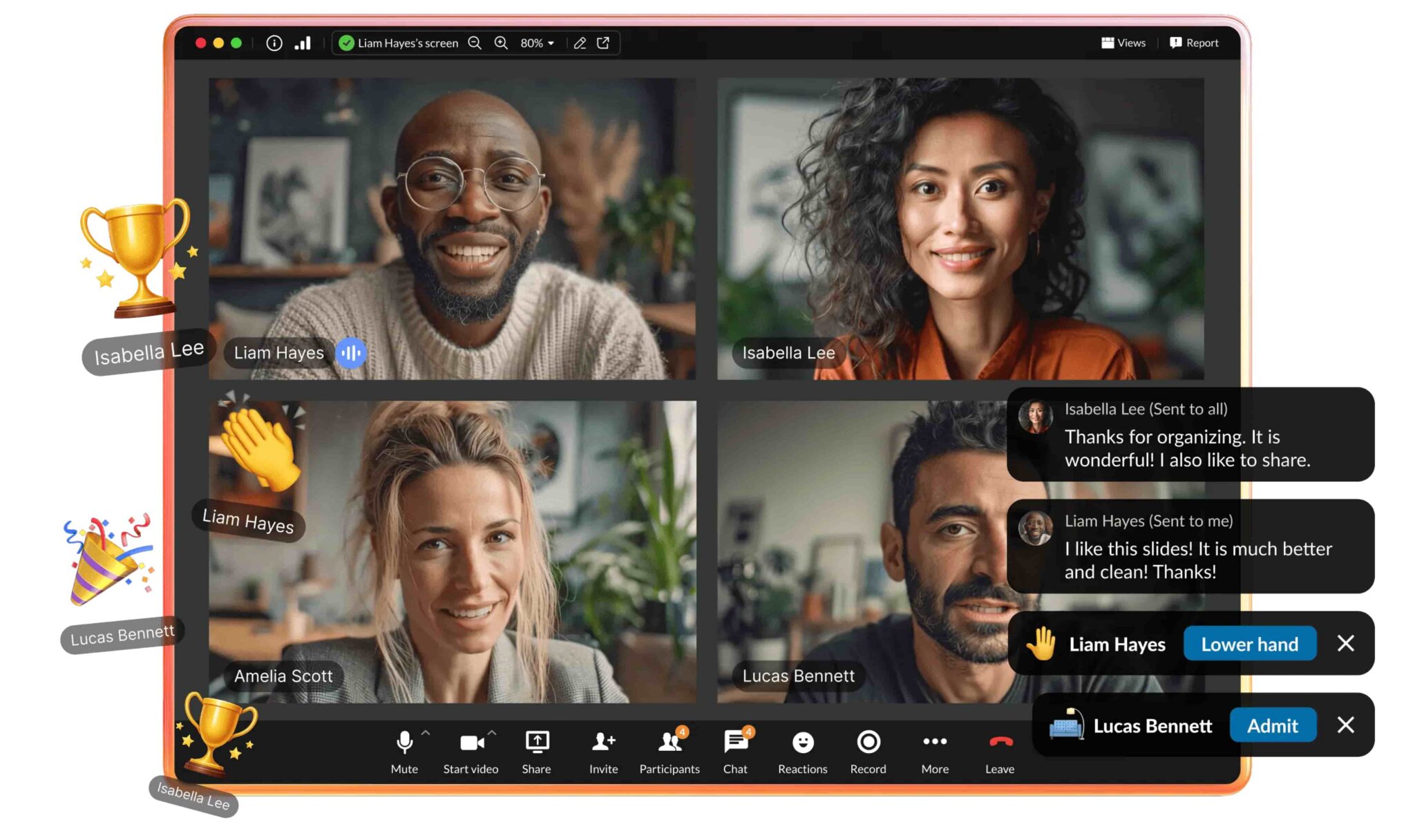
RingCentral Video is the video conferencing product built into RingEX, RingCentral’s unified communications platform. Every meeting comes with a built-in AI meeting recorder that captures transcripts, summaries, and action items automatically, without a separate tool or bot invite.
What separates it from other video conferencing platforms is that it doesn’t require guests to download anything. External attendees join directly from a browser link on any device, which removes a common friction point in client-facing meetings.
Best for: Teams that want AI-powered meetings, organizations consolidating video with calling and messaging, and businesses in regulated industries that need HIPAA compliance built in.
Features
- HD video and audio with up to 300 participants
- Personal AI Assistant for live transcriptions, post-meeting summaries, action item capture, and translated transcripts in 15+ languages
- Whiteboards, breakout rooms, screen sharing, and real-time annotations
- Seamless switching between desktop and mobile mid-meeting
- Smart Invites that automatically reach guests via the most effective channel
- 500+ pre-built integrations including Salesforce, Microsoft 365, Google Workspace, HubSpot, and Slack
- HIPAA, GDPR, SOC 2 Type II, and HITRUST compliance
- Town Halls, Rooms, and Webinars & Events available as add-ons for all-hands, hybrid spaces, and branded external events
Advantage
RingEX users get meetings of up to 24 hours with up to 300 participants. Because RingCentral Video is built natively into RingEX alongside calling and messaging, phone calls with outside guests can become screen-share sessions in a few clicks, with no switching between apps or platforms.
Limitation
Some advanced admin capabilities require higher-tier RingEX licensing.
Pricing: RingCentral Video is included with RingEX plans, starting at $20/user/month. See plans and pricing for current details.
Microsoft Teams
Microsoft Teams combines video meetings, persistent chat, file collaboration, and telephony into a single workspace. It’s tightly connected to the Microsoft 365 ecosystem, meaning meetings can be launched directly from Outlook Calendar, files shared in meetings pull from SharePoint, and Copilot can generate summaries from meeting transcripts.
Best for: Organizations already using Microsoft 365.
Features
- Video meetings for up to 100 participants(with free plan) or 1,000 participants (with Teams Enterprise)
- AI-generated meeting notes, transcription, and intelligent recap via Copilot (on eligible plans)
- Native integration with Outlook, SharePoint, OneDrive, and Copilot
- Teams Phone for enterprise cloud telephony within the same app
- Available on Mac, PC, iOS, Android, and browser
Advantage
Full integration with Microsoft 365 means single sign-on, SharePoint storage, and Outlook calendar sync work right away, with no extra setup for a third-party tool.
Limitations
Teams works best in a Microsoft-first environment. Organizations using Google Workspace or non-Microsoft productivity tools may find the integration depth thinner. The interface can feel heavy for users who primarily need a straightforward video call. AI features like Copilot-generated meeting summaries require Microsoft 365 Copilot licensing, which is an additional cost on top of the base subscription.
Pricing: A limited free version is available but lacks many business features. Microsoft Teams Essentials is priced at $4/user/month. Teams is also included with Microsoft 365 Business Basic from $7/user/month and Business Standard at $23.50/user/month.
Google Meet
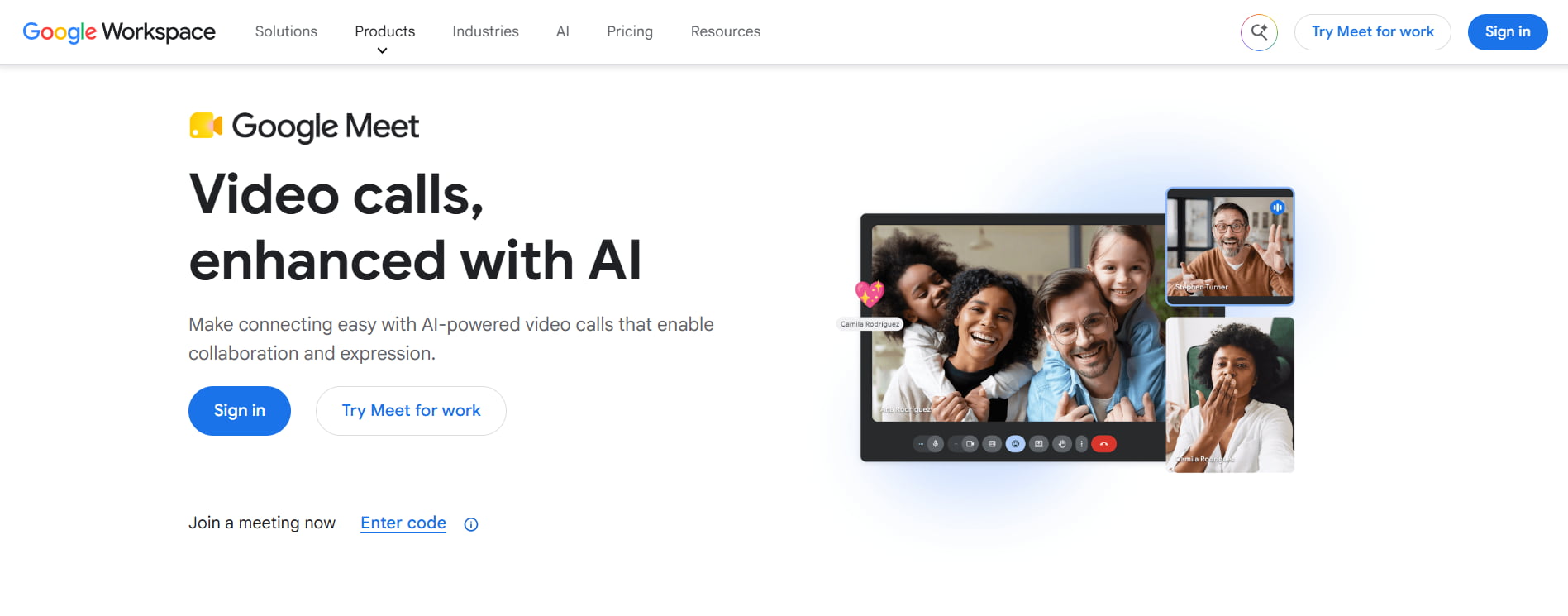
Google Meet is Google’s video conferencing product, built directly into Google Workspace. Meeting links appear in Google Calendar invites, recordings save automatically to Google Drive, and anyone with a Google account can join a meeting from a browser with no software installation required.
Best for: Teams that run on Google Workspace.
Features
- Gemini in Meet for AI-generated meeting notes, summaries, and translated captions (on Standard and higher plans)
- Screen sharing, polls, breakout rooms, Q and A, and noise cancellation (premium tiers)
- Direct integration with Google Calendar, Gmail, and Drive
- Noise cancellation, low-light mode, and adjustable layouts
- Live captions available on the free tier
Advantage
Because meeting links live in Calendar and Gmail, people can start and join without extra steps. Teams that already pay for Workspace get Meet with no separate license to manage.
Limitation
Google Meet’s value is largely conditional on Workspace adoption. Teams using Outlook for email and calendar may find the scheduling integration awkward. AI features like Gemini in Meet require at least the Business Standard plan; the Starter plan only includes Gemini in Gmail. Phone dial-in requires a Google Workspace Enterprise subscription or a separate Google Voice plan.
Pricing: Google Meet is free for individuals with a Google account. Google Workspace paid plans start at $6/user/month.
Zoom
Zoom remains one of the most recognized video platforms, known for its simple one-click join and a large third-party app marketplace. What started as a pure meetings tool has grown into a fuller workplace suite that now includes phone, whiteboarding, and AI features.
Best for: Teams that want a familiar interface and broad third-party integrations.
Features
- Zoom AI Companion for real-time summaries, action items, and chat drafting, included on paid plans at no extra cost
- Screen sharing with simultaneous multi-participant sharing and annotation
- Whiteboard, breakout rooms, virtual backgrounds, and polls
- Integrations with Salesforce, HubSpot, Slack, Google Calendar, and hundreds of others via the Zoom App Marketplace
- Zoom Phone available as a cloud calling add-on
Advantage
Zoom works on nearly every device and operating system, and its app marketplace is large. That makes it easy for outside guests, like clients or candidates, to join without setup problems.
Limitation
The free plan’s 40-minute group meeting limit is a practical constraint for teams with regular calls that run longer. Advanced security, compliance, and telephony features are gated behind higher tiers or require separate add-ons. Teams with stricter compliance requirements may want to review other Webex or Zoom alternatives before committing to a paid plan.
Pricing: Zoom’s free plan is available with a 40-minute group meeting cap. Paid plans start at $14.16/user/month.
Dialpad Meetings
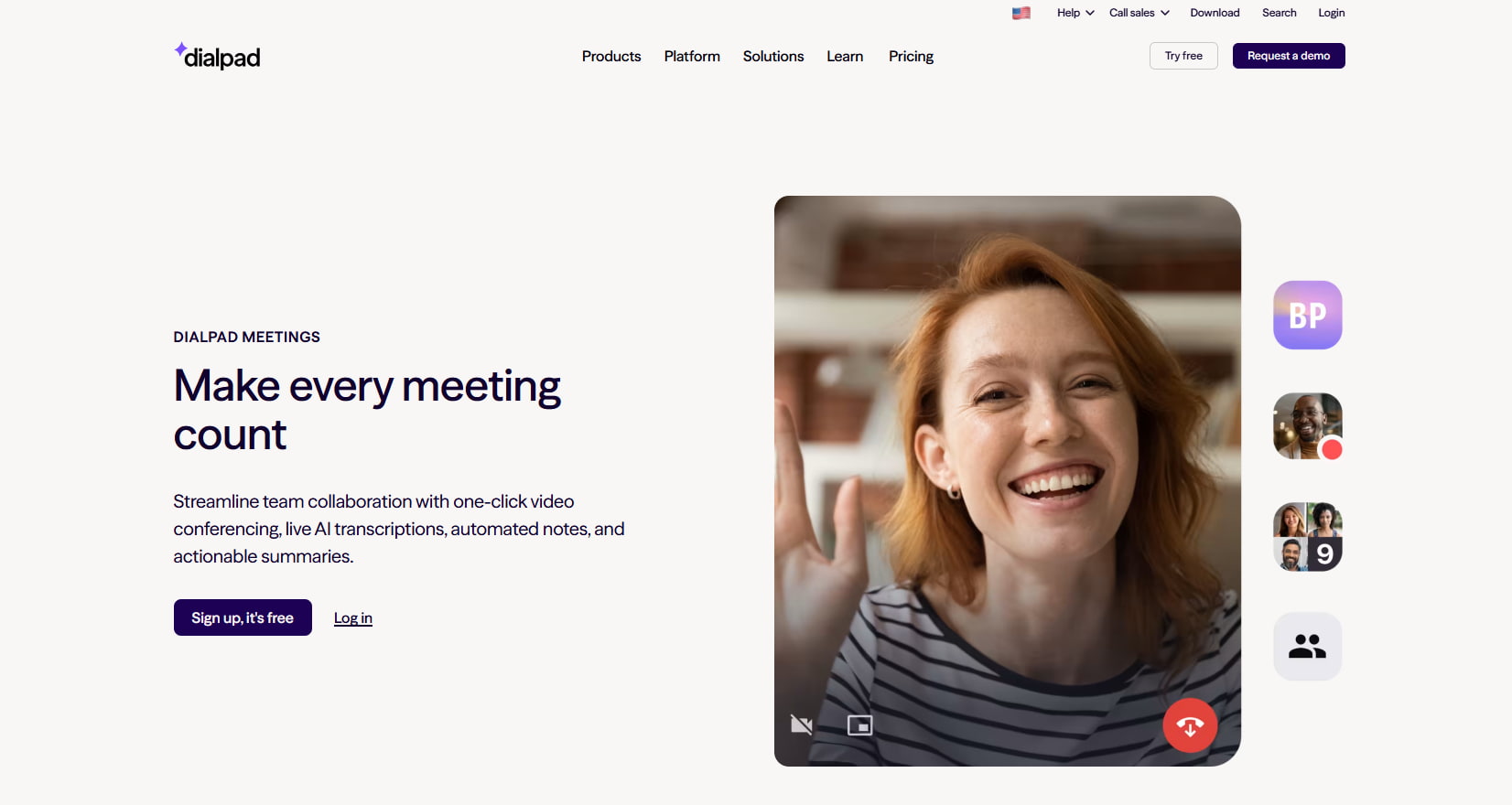
Dialpad Meetings is the video conferencing component of Dialpad’s broader AI-powered communications platform. Its standout capability is real-time AI transcription that runs throughout the meeting and generates automated summaries and action items after the call ends.
Best for: Teams that want AI meeting notes and may add phone service later.
Features
- Real-time AI transcription with speaker identification throughout the meeting
- Automated post-meeting summaries and action item extraction
- Screen sharing, whiteboard, and file sharing
- International dial-in access for 50+ countries
- Integrations with Salesforce, HubSpot, Google Workspace, and Microsoft 365
Advantage
Teams can access Dialpad Meetings free plan without credit card or trial period, so they can test it for as long as they like. It includes unlimited meetings, HD video, and unlimited audio recording.
Limitation
The free plan only allows a maximum of 10 participants, and AI features and video recording sit behind the Business plan.
Pricing: Free plan available. Paid plans start at $15/user/month for Dialpad Connect.
ZoHo Meetings
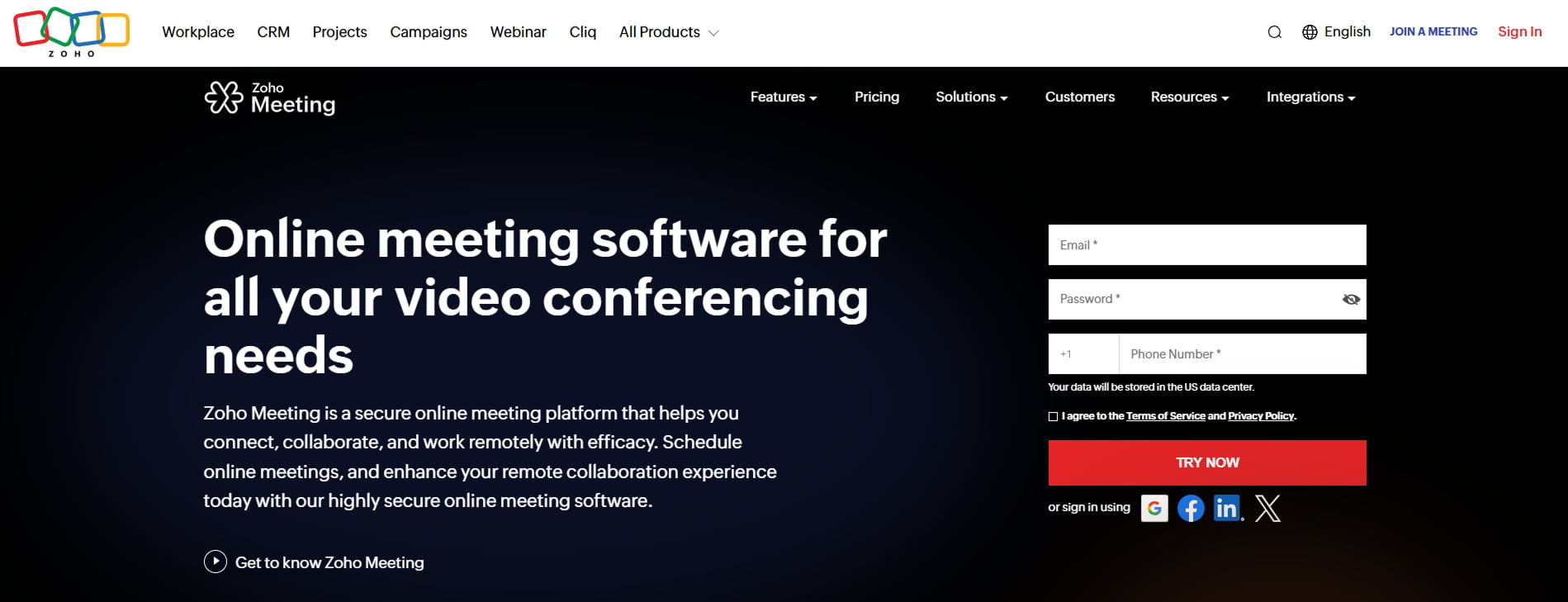
Zoho Meeting is the video conferencing product within the Zoho One suite, which covers CRM, helpdesk, project management, and marketing tools. If your organization already uses Zoho CRM or Zoho Desk, meeting records, attendee lists, and follow-up tasks can connect directly to those tools without custom development.
Best for: Budget-conscious teams and existing Zoho customers.
Features
- Free plan: up to 100 participants for up to 60 minutes per meeting
- Paid plans: up to 250 participants (Standard and Professional)
- AI-generated meeting transcripts and keynote summaries (Professional plan)
- Screen sharing, whiteboard, annotation, and file sharing
- Breakout rooms, polls, and meeting lock (paid plans)
- Personal meeting room and custom domain (Professional plan)
- Native integration with Zoho CRM, Zoho Desk, and Zoho Projects
Advantage
The free plan supports 100 participants for up to 60 minutes. Paid plans price by participant count, so a small team pays only for the room size it needs. And a 14-day trial requires no credit card.
Limitation
Zoho Meeting’s primary strength is within the Zoho ecosystem. Outside of it, the integration options are narrower than other video conferencing platforms. Costs also rise with participant count, so compare tiers against your usual meeting size.
Pricing: Free plan available. Standard plan starts at approximately $1/host/month for up to 10 participants, scaling up to $13/host/month for 100 participants.
GoTo Meeting
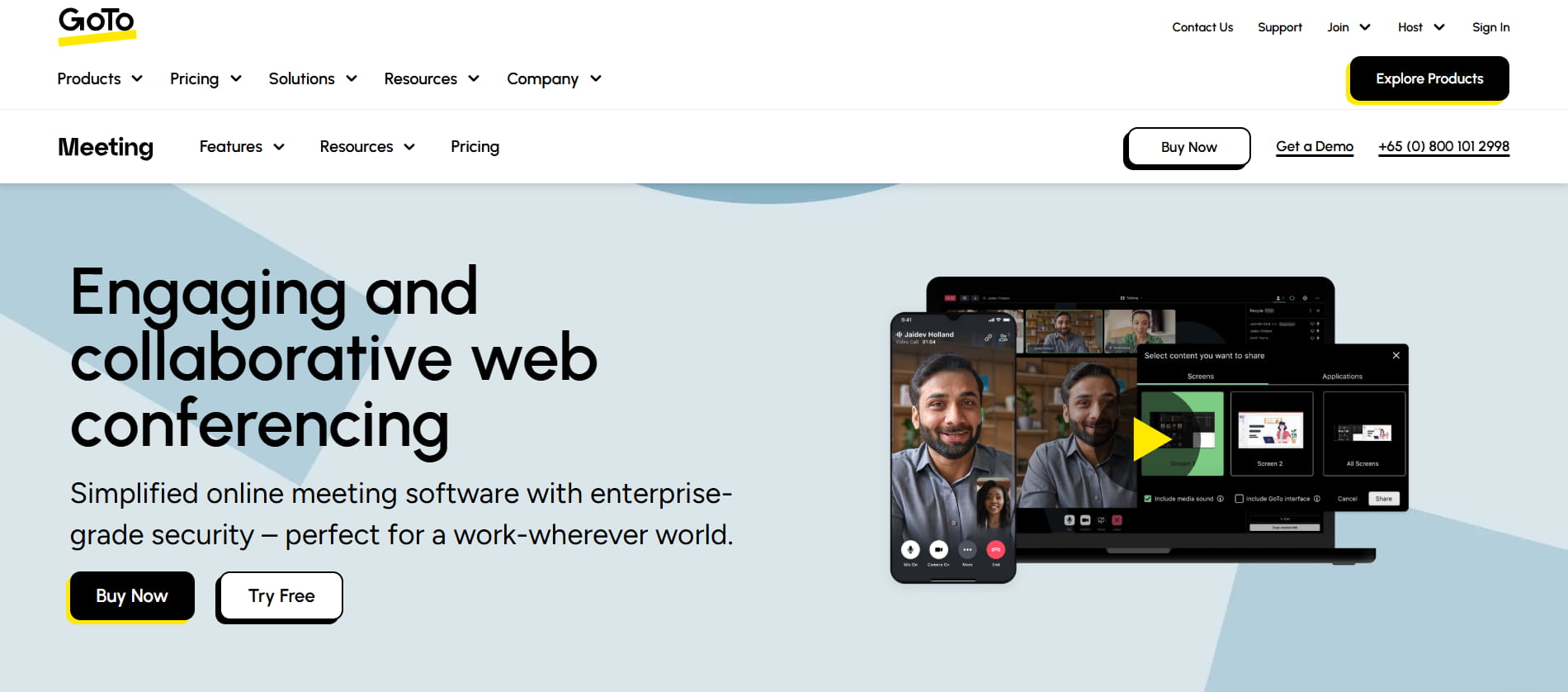
GoTo Meeting is a long-running conferencing tool from the GoTo family, which also includes GoTo Webinar and GoTo Connect. It focuses on straightforward meetings with a dial-in line and no cap on the number of meetings.
Best for: Small teams that want predictable per-organizer pricing and phone dial-in.
Features
- Up to 150 participants (Professional plan), 250 participants (Business plan)
- Unlimited meeting duration across all paid plans
- AI meeting summaries and transcription on Business and above
- Drawing and screen annotation tools well-suited to training and walkthroughs
- Cloud recording with storage on paid plans
- PIN-based attendee entry, meeting lock, and co-organizer options
- Polling, raise-a-hand, and breakout rooms (Business and above)
- Integrations with Microsoft 365, Google Calendar, Slack, and Salesforce
Advantage
GoTo Meeting’s audio quality and connection stability are frequently cited strengths. It also lists 24/7 customer care on its meeting plans, plus a personal meeting room for each organizer.
Limitation
GoTo has no permanent free plan, though a 14-day free trial is available. Listed plans top out at 250 participants, and larger events call for GoTo Webinar.
Pricing: Professional plan starts at $12/organizer/month, business plan starts at $16/organizer/month, and enterprise pricing available on request.
ClickMeeting
ClickMeeting is a webinar-first platform that also handles online meetings. Trainers, educators, and marketers use it for registration pages, branded rooms, and audience tools.
Best for: Marketing teams, educators, and event organizers who run live or automated webinars and need lead generation tools baked into the platform.
Features
- Live webinars, automated webinars, and on-demand video events
- Attendee capacity up to 10,000 on Enterprise plans
- Custom branded registration and landing pages
- Polls, Q and A, CTA buttons, and real-time chat translation
- AI transcription (Automated plan and above)
- Automated follow-up emails and attendance certificates
- Multistreaming to YouTube, Facebook, and LinkedIn simultaneously (add-on)
- Integrations with HubSpot, Salesforce, Mailchimp, Dropbox, PayPal, Zapier, and Google Analytics
Advantage
ClickMeeting includes a full set of lead generation and monetization tools that most video platforms don’t offer natively. You can sell tickets to paid webinars, issue attendance certificates, and set up fully automated event sequences, which makes it useful for teams that run online training programs or recurring educational content. The 14-day free trial covers the full feature set.
Limitation
ClickMeeting has no free plan, and recording storage is limited on entry plans. The interface leans toward webinars, so everyday team meetings may feel heavier than they need to. Extra recording storage is available as an add-on.
Pricing: Live plan starts at approximately $37/month, automated plan starts higher and scales with attendee count, and enterprise pricing is available on request.
How to choose the right Webex alternative?
If you’re starting from scratch, it helps to first get clear on what a modern online meeting platform should include before comparing options. Key criteria include ease of use, strong security, integrations, and HD video.
Choosing the right Webex alternative takes more than reading a feature list. You also need to evaluate how a platform holds up in real conditions, with real people, on the kinds of calls your team runs every week. Work through the four steps below.
1. Match your specific use case
Start with meeting size and length. A five-person team that meets for 30 minutes can run on any free tier. A sales team that hosts hour-long demos needs a plan without a 40-minute cap. Company size shapes the choice too:
- Under 25 employees: Free plans from Zoho Meeting, Zoom, or Google Meet cover most needs, and MS Teams Essentials adds longer meetings for $4. For teams that want AI-powered meetings, calling, and messaging in one place from the start, RingCentral Video—included in RingEX—is a stronger foundation.
- 25 to 300 employees: As teams grow, the case for a unified platform strengthens. RingEX with RingCentral Video handles reliable video, AI note-taking, and business calling without the overhead of managing separate tools. Paid plans such as Zoom Pro, Google Meet Standard, or GoTo Business also fit regular client and team calls.
- Large audiences or strict compliance needs: Look at enterprise tiers, webinar products, and Webex Enterprise itself. RingCentral also scales to cover both large audiences and strict compliance requirements without switching platforms. Webinars handle large external audiences, Town Halls support company-wide all-hands, and Events manages hybrid and virtual conferences at scale. Compliance certifications across HIPAA, GDPR, SOC 2 Type II, and HITRUST make it one of the few options that addresses scale and compliance together.
Your existing software environment matters just as much as meeting size. Teams deeply embedded in Microsoft 365 will get the most from Microsoft Teams, because Outlook calendar sync, SharePoint file sharing, and Copilot AI work natively, though Copilot requires a separate license. Teams running on Google Workspace get the same native lift from Google Meet.
If your organization uses neither, or wants a tool that works across both, RingCentral Video integrates with both ecosystems and adds a unified calling and messaging layer on top. Choosing a tool that fits your existing stack reduces setup time, lowers the learning curve, and avoids maintaining a separate set of credentials for a standalone app.
2. Pilot test your top choice
Before committing to any platform, run at least one real meeting with your team and treat it as a genuine evaluation rather than a quick demo. Most platforms make this easy, with Zoom, Microsoft Teams, Google Meet, Dialpad Meetings, and Zoho Meeting offering free plans, while GoTo Meeting and ClickMeeting offer 14-day trials. RingCentral Video is available through a RingEX trial, giving you access to video, calling, and messaging together so you can evaluate how they work as a unified system rather than testing video in isolation.
When you pilot, mirror your actual use case as closely as possible. Use your typical number of participants, a realistic meeting duration, and the same mix of internal staff and external guests you’d normally have on a call. Pay attention to how easily guests join without an account, how audio and video hold up on different network connections, and whether AI notes or transcripts are accurate enough to act on.
A tool that looks clean in a controlled setting can behave differently when a client joins from hotel Wi-Fi or a team member switches to mobile mid-call.
See what fits before you commit
Compare every RingCentral Video plan side by side, from Meetings to Webinars & Events to full RingEX bundles with phone and messaging built in. Sign up in a few minutes and test it with your own team before you decide.
3. Gather user feedback
The people who join meetings every day will notice problems first. After the pilot, ask them about:
- Audio and video quality on home and office networks
- How easily guests joined without an account
- Accuracy of AI notes and transcripts
- The mobile app experience
- Scheduling from Outlook or Google Calendar
- Missing tools, such as breakout rooms or whiteboards
Collect this feedback in writing, even if it’s just a short form or a message thread, so you can compare responses across team members and identify patterns. One person’s frustration with the mobile app matters less if everyone else found it fine. But if half the team struggled to join as a guest, that’s a signal worth taking seriously before you roll the tool out to clients or partners. Your team’s answers reflect how your team actually works, which is more reliable than any feature comparison table.
4. Assess customer support and reliability
Support quality and platform reliability are easy to overlook when evaluating a tool, because they only become visible when something goes wrong. Before you finalize your shortlist, spend a few minutes checking each vendor’s public status page for incidents over the past several months. Repeated outages, even brief ones, can disrupt back-to-back meetings or derail a client call at the worst moment.
During the pilot, submit a real support question and note how quickly you get a useful response, and whether the channel available at your plan tier is actually helpful. Some vendors limit live chat or phone support to higher-cost plans, leaving basic subscribers with only email or a help center article.
Before you sign anything, confirm the full annual price and cancellation terms. Some plans advertise a low monthly rate that only applies when billed annually, and others include auto-renewal clauses that require advance notice to cancel. Understanding those terms upfront prevents surprises later.
Choosing the right Webex alternative
With so many similar-looking options, research pays off. Don’t choose on price alone. As tempting as that may be, ensure your choice has all the features you need before you invest.
If you want one platform for video, team messaging, and business phone, at a competitive price, without a 40-minute cap, RingCentral Video is worth checking out. It works for a small team meeting today and up to 300 participants, with webinar options for larger events.
To see how meetings, chat, and calling work together, start with RingCentral Video.
Webex Alternatives Frequently Asked Questions
What are some reliable alternatives to Webex?
RingCentral Video, Microsoft Teams, Google Meet, and Zoom are all reliable Webex alternatives with strong uptime records and broad enterprise support. The best fit depends on your team size, existing tech stack, and whether you need standalone video or a broader communications platform.
Is Webex being discontinued?
No, the Webex platform is not being discontinued, but Cisco has retired specific products, including Webex Support Center and Webex Training Center, and stopped selling standalone Webex Events.
Does anyone still use Webex?
Yes, Webex remains widely used in enterprise environments, particularly in regulated industries and government settings where its FedRAMP and DISA certifications are requirements.
What is the best free meeting platform?
For most business use cases, Google Meet’s free plan is also capable for teams already using Google accounts. Zoom’s free plan is widely used but limits group meetings to 40 minutes, which can be restrictive for longer calls. Zoho Meeting’s free plan supports up to 100 participants for 60 minutes.
For teams that need AI-powered meetings, calling, and messaging in one platform, RingCentral Video is included in RingEX plans starting at $20/user/month.
Updated Oct 09, 2026