AI Communications






Voice interactions represent the highest-stakes moments in the customer journey. When customers call, it signals escalation or a decision that cannot wait. Voice is the channel where urgency demands resolution.
For businesses, that urgency exposes a growing problem. Call volumes are rising, expectations are higher, and legacy phone systems fail to keep up. They route calls, but they do not understand why someone is calling or what needs to happen next.
As a result, customers wait, repeat themselves, or hang up. Meanwhile, employees spend time answering the same questions instead of doing the work that actually moves the business forward. This gap between customer expectations and operational reality explains why voice AI agents are gaining traction across industries.
However, our upcoming RingCentral 2026 Report on Agentic AI Trends reveals that while 86 percent of organizations say they have an AI strategy, only 16 percent have deployed AI at scale. The issue isn’t interest or investment. It’s fragmentation: AI tools that exist in isolation instead of operating across workflows.
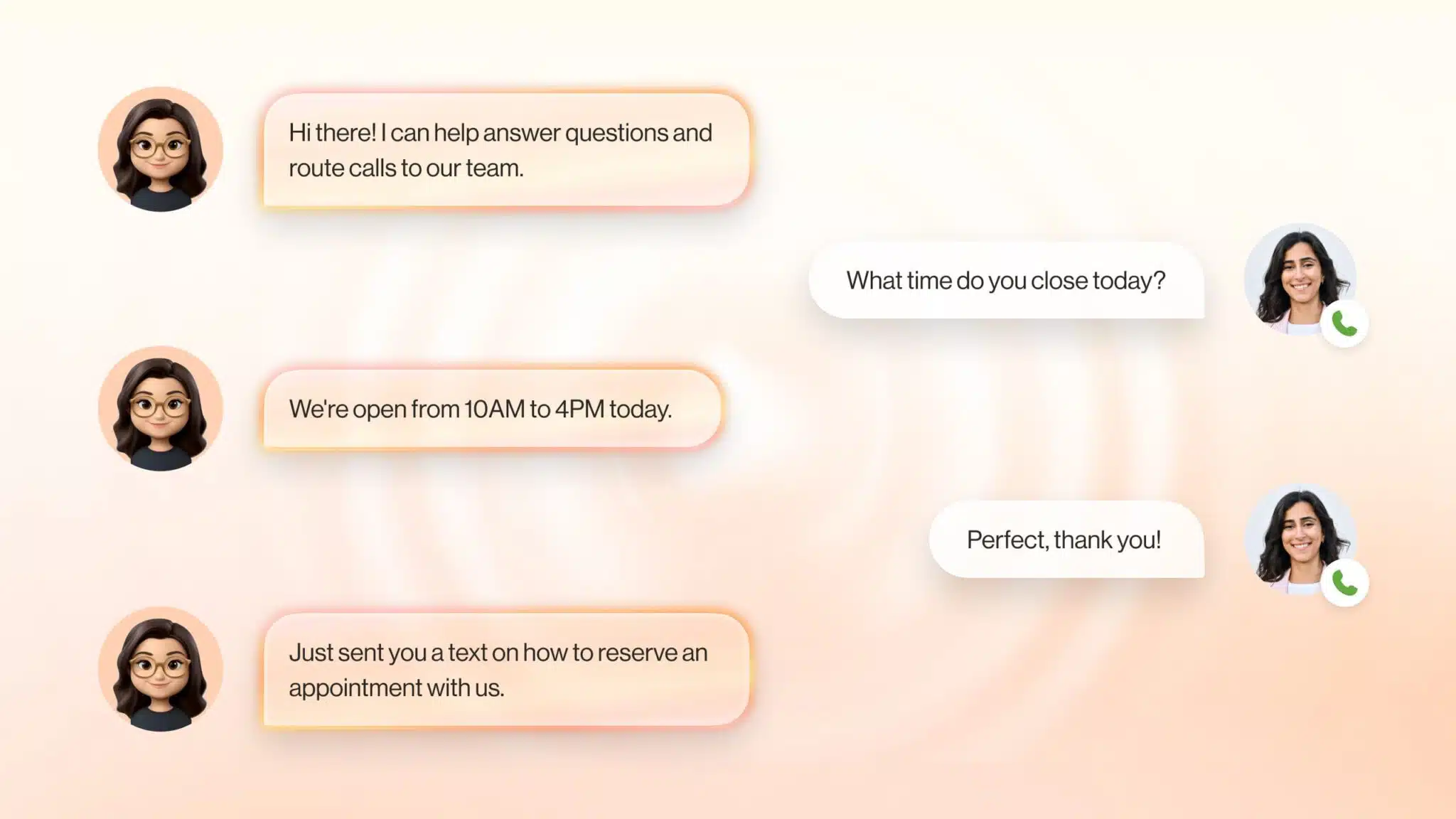
Voice AI agents eliminate these silos by serving as a single entry point that understands customer intent and initiates action across systems. From healthcare, real estate, recruiting, insurance, contact centers, and other sectors, deploying voice AI agents is how businesses can ensure urgent customer calls lead directly to action rather than queues or callbacks.
How to use voice AI agents for healthcare
In healthcare, access challenges appear well before care delivery begins. Patients call to book or change appointments, confirm insurance coverage, ask preparation questions, or raise concerns they perceive as urgent. These calls funnel through small front-desk teams that are also managing in-person patient flow.
Administrative burden is a structural issue in the US healthcare system. Research estimates that administrative spending accounts for 15 to 30 percent of total healthcare spending, and that at least half of this spending is wasteful.
To reduce this burden, voice AI agents are deployed as access coordinators rather than clinical decision-makers. They handle predictable, high-volume interactions while ensuring escalation paths remain intact.
- Healthcare organizations can use voice AI agents to:
- Manage appointment scheduling, rescheduling, and cancellations in real time
- Answer standardized questions about insurance, hours, and intake steps
- Capture patient identifiers and visit context before staff involvement
- Detect urgency in language and route time-sensitive calls appropriately
Voice AI agents reshaping real estate engagement
In real estate, responsiveness is a core determinant of conversion outcomes. Prospective buyers and renters who call asking about property details, availability, pricing, or showings expect immediate engagement.
An MIT survey shows that responding within five minutes can increase the odds of converting a lead by up to 100 times compared with waiting 30 minutes or more.
In practice, this exposes a structural constraint in real estate operations. Buyer inquiry volume fluctuates sharply, while agent capacity is constrained by showings, negotiations, and time in the field.
Voice AI agents increase operational resilience by providing 24/7 coverage for inbound calls, qualifying and routing inquiries at any hour, so prospects move directly to scheduled showings or defined next steps rather than voicemail.
Real estate teams can use voice AI agents to:
- Answer listing questions using live pricing and availability data
- Qualify buyers based on budget, timing, and preferences
- Schedule showings using connected agent calendars
- Send follow-up assets such as listings or virtual tours automatically
Improving candidate communications with voice AI agents
Recruiting pipelines often break down during coordination. Candidates call to confirm interviews, clarify timelines, or assess whether a role is worth pursuing. Delayed responses increase uncertainty and lead to candidate drop-off.
Voice AI agents streamline early-stage communication and remove coordination bottlenecks.
Recruiting teams can use voice AI agents to:
- Capture candidate availability, preferences, and basic qualifications such as desired role, travel or relocation willingness, and compensation expectations
- Explain hiring stages and timelines consistently to every candidate
- Schedule interviews directly into recruiter calendars and applicant tracking systems (ATS) by checking availability and confirming time slots
- Route sensitive, high-priority, or executive-level inquiries with full context to the appropriate recruiter or hiring manager so that complex conversations are connected to the right decision-maker without loss of information.
According to Gartner, AI is reshaping talent acquisition by assuming low-complexity, high-volume work, which enables recruiters to shift their focus toward more strategic responsibilities.
As automation takes on routine coordination and screening activities, recruiters are increasingly expected to advise on talent strategy and role design, cultivate relationships with hard-to-access candidates, and assess fit against an organization’s future workforce needs rather than focusing solely on immediate vacancies.
Why insurance teams are adopting voice AI agents
Insurance phone calls usually happen at critical moments. A policyholder may be reporting a loss, checking the status of a claim, or trying to understand coverage before making a decision. These calls require speed, accuracy, and clear handoffs, yet many insurance contact centers still rely on basic call routing.
Voice AI agents act as intelligent intake layers for insurance operations.
Insurance teams can use voice AI agents to:
- Determine call intent at the start of the conversation, such as whether the caller is filing a new claim, asking about a premium payment, or requesting policy changes
- Collect structured first notice of loss information, meaning key incident details like date, location, and type of damage, so adjusters start with complete context
- Provide real-time claim or policy status updates by securely accessing internal insurance systems instead of placing callers on hold
- Route complex or regulated cases correctly, ensuring underwriting questions or disputed claims reach the appropriate specialist without repeated transfers
Findings from McKinsey’s report, The Future of AI in the Insurance Industry, reveal that insurers unlock the most value when AI supports entire operating domains such as customer service or claims. Insurers applying AI at this level report:
- 10 to 20 percent improvement in sales conversion and new agent productivity
- 10 to 15 percent increase in premium growth
- 20 to 40 percent reduction in customer onboarding costs
- 3 to 5 percent improvement in claims accuracy
The role of voice AI agents in contact centers
Contact centers operate under constant pressure, where every unanswered call, repeated question, or delayed response directly impacts customer trust and agent morale.
Billing questions, technical issues, and account requests arrive back-to-back, while customers expect speed, accuracy, and personalization every time they call. Over time, this strain leads to longer wait times, frustrated customers, and burned-out agents.
This is why automation in contact centers has become an operational necessity rather than an efficiency upgrade. Voice AI agents absorb the volume and variability that overwhelm human agents.
Industry data confirms that voice remains the backbone of customer resolution. According to Metrigy’s report, 19.3% of organizations rate voice as their most effective channel for resolving customer needs, outperforming email, chat, AI text agents, and social media. It also reveals that voice is involved in 82% of all customer interactions.
Contact centers can use voice AI agents to:
- Resolve high-volume, repetitive inquiries automatically, such as billing status, password resets, order updates, or basic troubleshooting
- Route calls intelligently based on intent and sentiment, ensuring complex or emotional issues reach the right agent without unnecessary transfers
- Preserve and pass context across interactions, so customers do not repeat information and agents start conversations informed
- Generate structured call summaries and dispositions, reducing after-call work and improving reporting consistency
- Maintain uniform service quality across shifts and channels, even during peak periods or after hours
RingCentral customer success stories with AI Receptionist
Across industries, RingCentral customers are using AI Receptionist, our voice AI solution, to solve a common, costly problem: missed calls that stall business growth, frustrate customers, and overwhelm teams.
Axis Integrated Mental Health: turning answered calls into access to care
For Axis Integrated Mental Health, every missed call represented more than lost revenue. It represented a missed opportunity to help someone in crisis.
Before adopting RingCentral AI Receptionist, Axis relied on a patchwork of IVR systems, external call centers, and virtual assistants. The complexity led to up to 50% of inbound calls going unanswered, even as demand for mental health services surged. Staff spent valuable time answering routine scheduling and insurance questions, while patients in urgent need struggled to reach a human.
After deploying AI Receptionist, Axis saw immediate results:
- 60% increase in new patient intakes, from 20 to 32 per week
- 25% revenue increase, translating to $1.7M in projected additional revenue
Integral Recruiting Services: eliminating interruptions and accelerating placements
Integral Recruiting Services faced a different challenge. As a fast-growing, fully remote recruiting firm, constant inbound calls disrupted productivity. Nearly 90% of calls were spam or low-value, pulling recruiters away from candidate and client work.
By making RingCentral AI Receptionist the first point of contact, the firm fundamentally changed how calls were handled:
- 93% of inbound calls answered automatically by AI Receptionist
- 12 hours saved per month, translating to measurable cost savings
- 50% faster call transfer times, improving client and candidate experience
- 67% reduction in time spent writing candidate summaries
| Inspired by these outcomes? RingCentral simplifies how voice AI agents are set up.
Our redesigned AI Receptionist onboarding is guided and far less hands-on. Instead of building from scratch, simply add your business website, and a ready-to-use AI receptionist is automatically created with a pre-filled setup including business hours, an initial greeting, common customer questions, and a summary of your services. From there, you can review, refine, and personalize responses before going live. |
Why voice is the frontline of agentic AI
The primary barrier to turning AI into real business outcomes is coordination. When systems do not share context, even advanced AI increases friction by creating extra steps, handoffs, and delays.
At RingCentral, we see agentic AI emerging as the new operating model for work. Agentic AI replaces disconnected tools with coordinated, end-to-end execution. Voice sits at the center of this shift because live conversations surface intent and urgency before momentum is lost.
Unlike other channels, calls capture tone and emotional context in real time.
As the future of voice AI agents unfolds, organizations that modernize voice engagement address one of the most costly operational gaps: unresolved calls. Voice AI agents cut through delays so customers get help immediately, not eventually.
Originally published Jan 30, 2026