AI Communications









Seven contact center platforms compared on channels, AI, integrations, and the kind of team each one fits.
If your team uses or is evaluating NICE CXone, the decision in front of you is rarely about whether it works. It’s whether another platform fits your size, your tolerance for setup effort, and your budget better than the one you are looking at.
A few things tend to send buyers looking elsewhere: a consolidation push toward fewer vendors, an upcoming renewal that reopens the question, a migration already underway, or a need for native internal calling that a dedicated contact center platform doesn’t cover. None of these is a knock on any one tool. They are signals that your requirements have moved, and the platform that fit two years ago may not be the one that fits the next three.
The platforms below were evaluated on the capabilities that separate them in practice rather than on brand. Before the comparison, here’s how each one was assessed and what to weigh as you narrow the field.
Key takeaways
- Several contact center platforms match NICE CXone on core capabilities
- Evaluate on channels, AI, integrations, setup effort, and support
- Team size and needs matter more than any vendor’s market position
- Mid-market teams often want faster setup than enterprise suites demand
- Native internal calling can remove a separate communication tool
How we evaluated these NICE CXone alternatives
These platforms were assessed as of October 2026 on six criteria that tend to decide the shortlist. Each one maps to a question a buyer has to answer about their own operation rather than a feature to check off.
- Channel coverage: The voice and digital channels the platform handles in one place, matched to how your customers reach you. An omnichannel contact center is only useful if it covers the channels you run.
- AI and automation: What the platform resolves, summarizes, or routes on its own. Strong contact center automation is now core to the evaluation.
- Integration ecosystem: How well the platform connects to your CRM and the rest of your stack, through prebuilt connectors or APIs.
- Setup and administration effort: How much configuration it takes to go live and to keep running, which often separates mid-market fit from enterprise fit.
- Scalability: Whether the platform holds up as volume, channels, and team size grow.
- Support and reliability: The uptime and support model behind the platform, since a contact center outage is a revenue event.
NICE CXone alternatives at a glance
The seven platforms below each solve the contact center problem for a different kind of team, from mid-market operations to large, complex enterprises. There’s no single winner on this list, only the one that matches your channels, your tolerance for configuration effort, and how fast you need to be live.
AI is a real axis of comparison now. Gartner estimates that around 3% of contact center interactions were handled by AI in 2023, and projected to rise to 14% by 2027, so the depth and maturity of a platform’s automation is worth weighing as carefully as its channel list. A cloud contact center platform that builds AI into the core workflow may age differently from one that adds it as a separate layer.
| Platform | Primary use case | Key feature | Best for |
| RingCX | Omnichannel contact center with native AI | Voice and 20+ digital channels in one workspace | Growing teams that want omnichannel and native AI |
| Talkdesk | AI-first CCaaS with industry solution | Industry-specific workflows | Support teams that value prebuilt configuration |
| Genesys Cloud CX | Highly configurable enterprise CX | Experience orchestration across channels | Large, complex enterprises with the resources to manage it |
| Five9 | Voice and outbound-heavy contact centers | Blended inbound and outbound voice | Teams with voice and outbound calling at scale |
| Nextiva | Unified business communications and CX | Phone system plus customer experience | Smaller teams wanting one vendor |
| Dialpad | AI-native, fast to deploy | Built-in real-time AI across calls | Teams that want quick setup |
| 8×8 | Combined UCaaS and CCaaS in one suite | Phone system and contact center together | Teams consolidating comms and contact center |
1. RingCX
Teams weighing NICE CXone often want the same omnichannel coverage and native AI without the setup and administration a full enterprise suite typically demands.
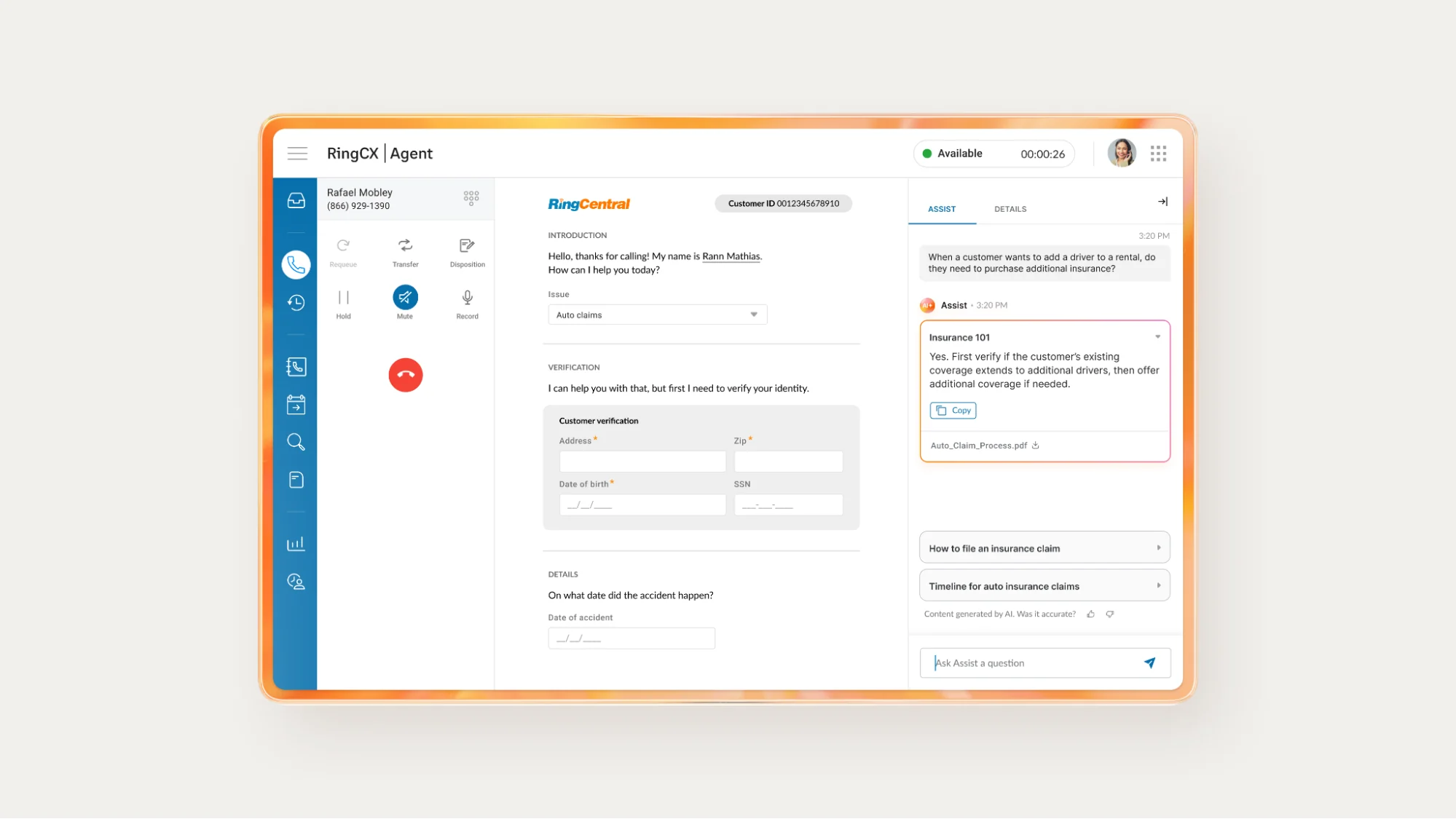
RingCX is an AI-first contact center platform that brings voice and digital channels into a single agent workspace, and suits teams of many sizes, especially those that want to go live quickly. It offers omnichannel coverage, built-in AI for automation, assistance, and analytics, and agent and supervisor assist.
Where it differs is setup, since RingCX is built for faster time to value and self-service setup.
- Resolve routine inquiries without an agent: AI Receptionist (AIR) and AI Representative (AIR Pro) help reduce wait times and provide self-service to customers, including after hours.
- Meet customers on their channel: Voice and 20+ digital channels, including SMS, chat, email, and social, sit in one agent workspace.
- Valuable customer data from every interaction: AI Interaction Analytics analyzes 100% of conversations to predict customer satisfaction, rather than relying on surveys alone.
- Support agents in real-time: AVA Agent Assist gives agents real-time answers, suggested responses, and checklists, and coaching tips. AVA Supervisor Assist flags calls that need help, so supervisors can coach, barge in, or take over, using live summaries and transcripts for context.

RingCX offers 120+ prebuilt integrations compared to NiCE’s 170+ app marketplace, so a team that depends on a long tail of niche integrations should confirm coverage before switching. For mid-market and growing teams that want omnichannel coverage and native AI without enterprise-suite setup, that’s a fair trade.
2. Talkdesk

Talkdesk is an AI-first contact center platform known for ready-made workflows built around specific industries, which can shorten the path from purchase to a configured, working setup. Its automation reaches across voice and digital channels, and it scales from mid-market operations up to the enterprise.
Because it’s a dedicated contact center platform, it doesn’t bundle native internal team calling, so an organization that wants both customer contact and internal communication in one place will run a separate tool alongside it. Teams that want industry-shaped workflows out of the box will find that framing useful.
It fits mid-market to enterprise support teams that value prebuilt, vertical-specific configuration.
3. Genesys Cloud CX

Genesys Cloud CX is a highly configurable enterprise platform that orchestrates customer experience across channels, with deep routing, workforce, and analytics tools. Large operations can shape it closely to their own processes.
That configurability is also the trade-off. The setup and administration effort runs heavier than a smaller or phone-first team may want to take on, and getting full value assumes the resources to configure and maintain it.
It fits large, complex enterprises that need control and have the team to manage it.
4. Five9
Five9 is a cloud contact center with a heritage in outbound and blended voice, pairing inbound and outbound calling with digital channels on one platform. Teams that run high call volumes, including outbound campaigns, are its core audience.
Its digital channel breadth and configuration options can mean more setup effort, and as a dedicated contact center it doesn’t unify internal employee communications the way a combined suite does. For a voice-heavy operation, that specialization is the point.
It fits teams whose work centers on voice and outbound calling at scale.
5. Nextiva
Nextiva brings business communications and customer experience together, which appeals to smaller teams that would rather buy phone and contact center capability from one vendor than assemble separate systems. Voice and digital channels sit in a single platform.
Its strength is breadth across communication and CX for a smaller footprint, so the most specialized, high-end contact center depth sits further down its priority list than it does on an enterprise-first platform. For a lean team, one vendor across both jobs is the draw.
It fits smaller teams that want unified communications and customer experience from a single provider.
6. Dialpad
Dialpad is an AI-native platform that is fast to deploy, with real-time AI built into calls rather than layered on later. Teams that want to be live quickly and lean on built-in automation tend to favor it.
Its contact center depth is strongest for AI-assisted support and mid-market use, and the most advanced workforce and contact center capabilities are more established at the enterprise end among platforms with longer contact center heritage. For a team that values speed and built-in AI, the quick path to value is the appeal.
It fits teams that want quick setup and AI working from day one.
7. 8×8
8×8 combines unified communications and contact center capability in a single suite, so internal calling and customer contact run on one platform from one vendor. Teams consolidating scattered communication and contact center tools are its natural fit.
As a broad integrated suite, its specialist contact center depth can trade off against the breadth it covers, relative to a platform built contact-center-first. For an organization that values one vendor across comms and contact center, that breadth is the reason to look.
It fits teams consolidating communications and their contact center into one suite.
How to choose the right NICE CXone alternative for your team
Start from your own operation rather than the feature list: the channels you run, the AI you’ll put to work, the integrations you depend on, and how fast you need to be live. The platform that wins on paper isn’t always the one that fits the way your team works.
Evaluate by team size and need. If you’re scaling into large, multi-channel support with your own processes, an enterprise contact center platform you can configure deeply can be worthwhile, provided you have the team to run it. If you’re mid-market and want to be live fast, weight setup effort and native AI more heavily than raw configurability. If your work is voice-heavy, prioritize outbound and call handling capabilities. And if agent productivity is the pressure point, favor platforms where AI assists agents during the interaction rather than only after it.
Match the platform to the work rather than the longest feature list. The shortest list that covers your real channels, your integrations, and your growth is the right one.
Match the platform to the way your team works
The reason to evaluate alternatives is rarely that a platform is failing. It’s that your channels, your volume, and your appetite for configuration have moved, and the shortlist that fits today looks different from the one that fit at your last renewal.
Pick two or three platforms that cover your real requirements, then run each one through your busiest-day scenario before you commit. If you want omnichannel coverage and native AI without an enterprise-suite implementation, RingCX is built for exactly that kind of mid-market team.
FAQs about NICE CXone alternatives
Which NICE CXone alternative is best for small businesses?
Smaller teams are usually best served by a platform that pairs fast setup with native AI and, often, built-in business calling, so they don’t run a separate phone system. Options positioned around unified communications and customer experience, or around quick deployment, tend to fit a small footprint better than a highly configurable enterprise suite. Weigh setup effort and the number of vendors you want to manage.
Is it difficult to switch from NICE CXone to another platform?
Switching difficulty depends largely on how deeply your current routing, integrations, and reporting are customized. A migration is more straightforward when the new platform offers prebuilt connectors to your CRM and the channels you run, and when its setup effort matches your team’s capacity. Narrowing to two or three and testing each against your real workflows surfaces the switching cost early.
Are NICE CXone alternatives scalable for growing businesses?
Most of the platforms on this list are built to scale across volume, channels, and team size, though they scale in different ways. Enterprise suites scale through deep configuration, while mid-market platforms scale by adding channels and AI with less administrative overhead. Match the scaling model to how you expect to grow, since the right path for a large enterprise differs from the right path for a growing mid-market team.
What should you look for in a NICE CXone alternative?
Look at channel coverage, AI and automation depth, integration ecosystem, setup and administration effort, scalability, and support and reliability. These six criteria separate platforms that fit your operation from ones that only look comparable on a spec sheet. Start from the channels and integrations you depend on, then weigh how fast you need to be live.
Originally published Nov 23, 2026