AI Communications








As we move towards the future of work, remember these two words: hybrid work. A hybrid work model includes a mixture of remote, semi-remote, and in-office employees. You might be familiar with remote or in-office work environments, but what about the ones that offer a mixture of both? This is where hybrid work comes into the picture. Some even say hybrid work is the new remote work.
👀 Are businesses actually fully remote right now? How many are already back in the office? Find out in our State of Hybrid Work report.
What is a hybrid work model?
As the name implies, the hybrid workplace combines both office working and home working (and, indeed, working from anywhere). It allows employees to work remotely part of the time and on site the rest of the time. Employees may choose, for example, to work from home three days a week and in the office two days a week.
According to market research firm Gartner, 67% of employees surveyed said their expectations for flexible working had increased since early 2020, while 55% said that the ability to work flexibly would play a role in determining whether or not they stayed with their existing employer or sought out new career opportunities.
There are also indications that a hybrid workforce might well be a more productive one. The same Gartner survey found that 55% of respondents performed better when given some choice over how and where they worked, compared to just 36% of those who were full-time office workers. This suggests that both employers and employees could stand to benefit from a hybrid model.
Types of hybrid work model
While there are already some all-remote companies, there are various types of hybrid work arrangements that may work better for many. The exact form of remote working chosen will depend on the needs of individual organizations.
Here are three of the most common hybrid work models:
- Remote-first: Operations are geared primarily towards remote working, but with some office space. Such as a satellite office, retained for employees who need or prefer to work there, as well as for client meetings.
- Office-occasional: Employees split their time between working from home (or wherever else they happen to be) and in physical offices. In theory, this allows employees to get the best of both options.
- Office-first, remote allowed: Here, the office is established as the primary venue for working, while allowing employees the option of working from home on occasion.
Why should you care about hybrid work?
A major reason is because businesses are shifting more to a hybrid work model. In fact, a Gartner survey revealed 82% of company leaders plan to allow employees to work remotely some of the time. Business leaders and owners are now reassessing their operations in order to effectively manage a more complex, hybrid workforce.
“The COVID-19 pandemic brought about a huge experiment in widespread remote working. As business leaders plan and execute reopening of their workplaces, they’re evaluating more permanent remote working arrangements as a way to meet employee expectations and to build more resilient business operations.” — Elisabeth Joyce, Vice President of Advisory at Gartner
There’s no denying businesses are entering a new era of hybrid work. This begs the question: How are businesses (especially small businesses) currently navigating hybrid work? To find out, we surveyed 1,000 individuals at US companies with 1–100 employees and compiled the key findings in our State of Hybrid Work report. Below, we share the top five takeaways from our research and offer tips on how you can apply these insights to your business strategy.
1. Hybrid work is the future of work
Most businesses were either completely or mostly in the office pre-COVID-19, but now 3 in 5 are at least partially remote.
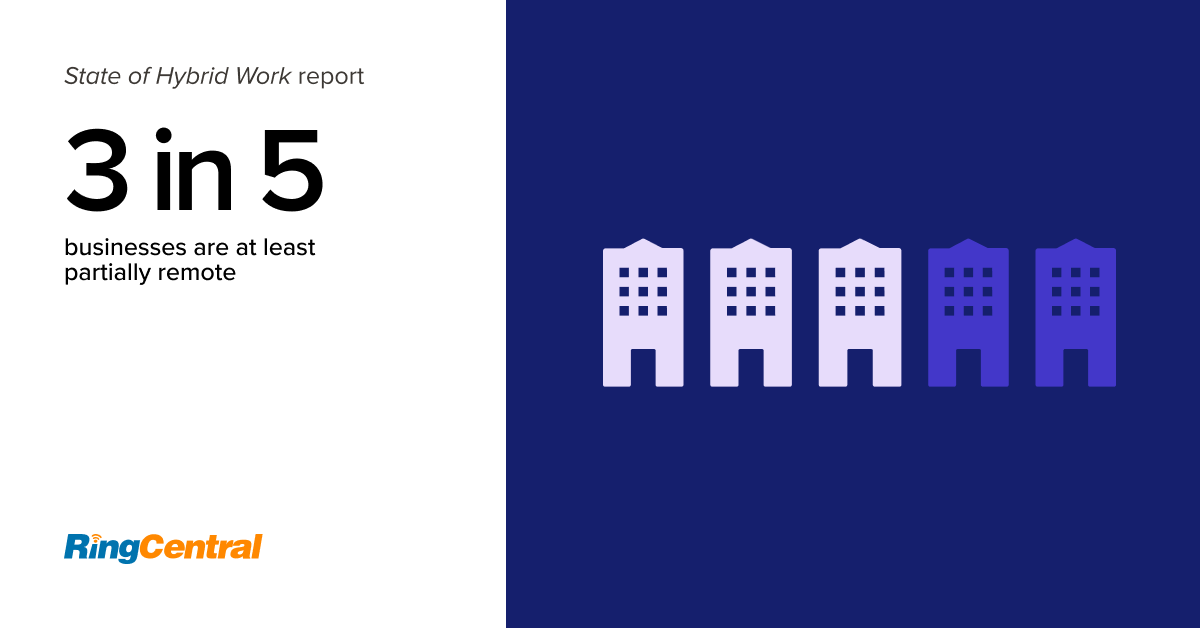
With the majority of businesses now partially remote, it’s clear that hybrid work isn’t just a buzzword. Start assessing your current operations to support both in-office and remote work setups. Give yourself the ability to manage your business from anywhere by selecting the right tools. Not sure where to get started? Check out our list of the best free business software for small and medium-size businesses.
2. A growing love for remote work
Attitudes towards remote work have improved, with 66% of businesses viewing remote work positively.
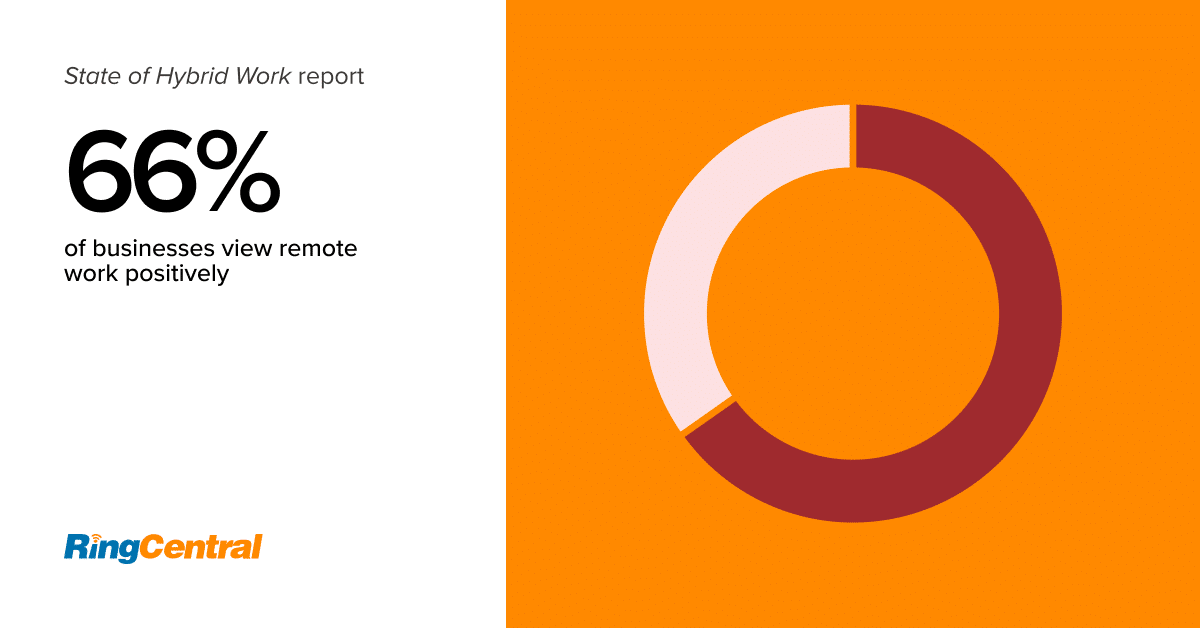
Business owners and employees alike are seeing the benefits that come with remote work, including more cost savings and flexibility. In our study, more than a quarter of employees have enjoyed an increase in time spent with family or friends. The option to work remotely has become an expectation for many people, which is not surprising given remote work offers more flexibility, a better work-life balance, less commute stress, and increased performance.
3. The need to connect
More than 1/4 of employees say they have less frequent work interactions.
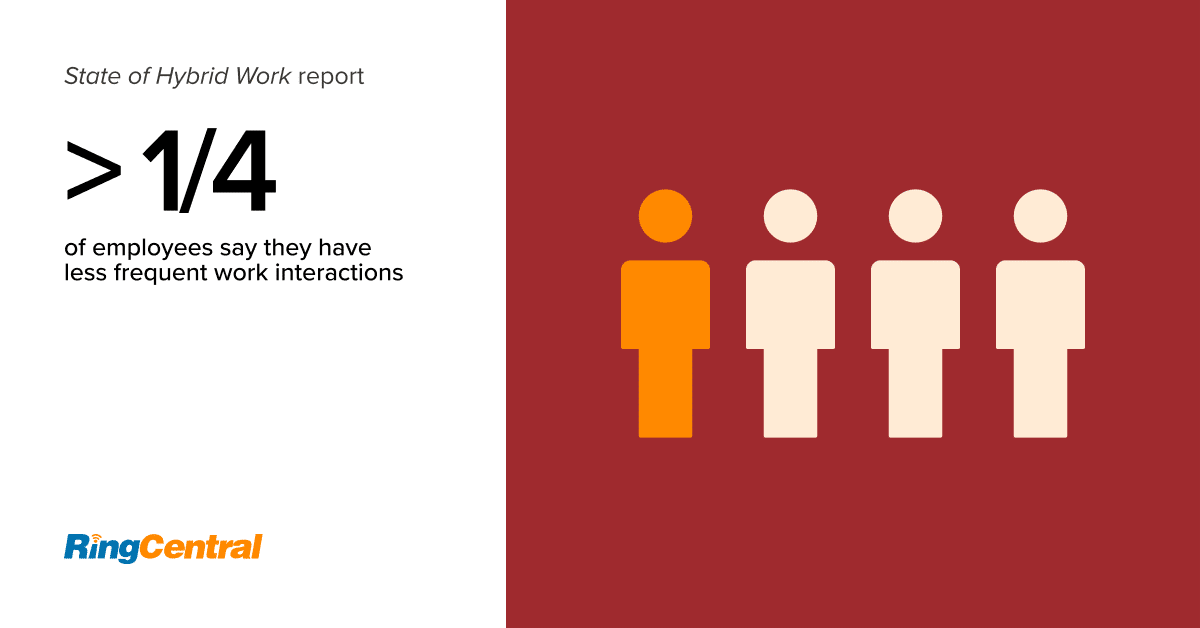
Connection is a core human need, but there are now fewer social interactions between coworkers due to COVID-19. Employees require a sense of connection and belonging, especially in a remote or hybrid work environment. Even half of employees agree that being in the same location as coworkers is important. Given employees ranked email as the #1 choice for communicating socially with coworkers, followed by phone calls and text messaging, make it your priority to pick a reliable email and phone system that is easy to use, and even easier to set up.
4. Productivity needs more attention
1 in 4 businesses are experiencing a decrease in productivity over the last few months.
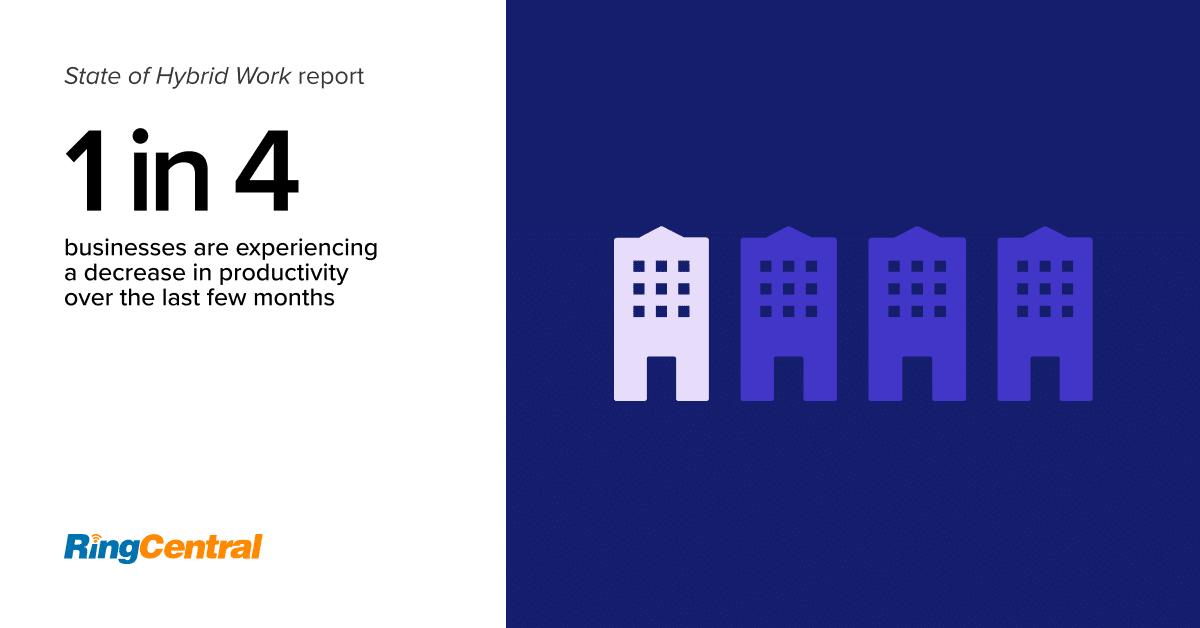
Productivity is a top focus for all business owners. If employee productivity drops, your business takes a hit. Start boosting productivity and maximizing collaboration between employees, vendors, and stakeholders by letting your employees collaborate seamlessly across team messages, video meetings, and phone calls. According to our report, employees are using phone calls, texts, team messaging, and video conferencing more frequently. And don’t stop there—take productivity to the next level by trying out these four ways to increase productivity and give your team a boost.
5. Video conferencing grows in popularity
When it comes to communication tools, video conferencing has seen the greatest increase in usage, with 2 in 5 businesses using it more frequently.
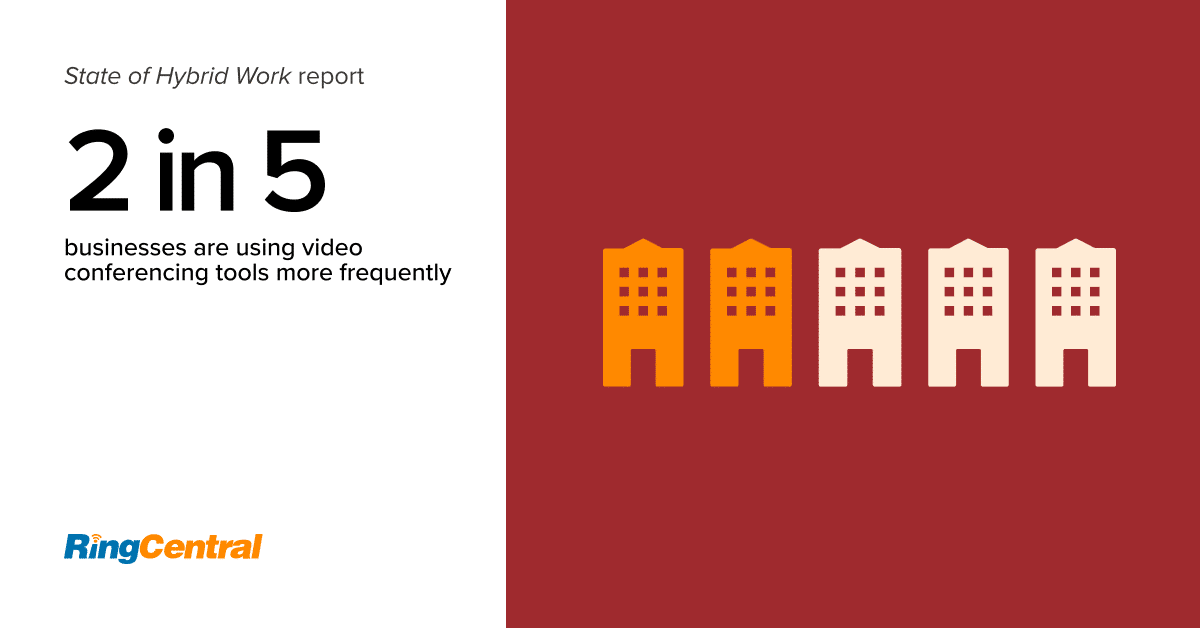
Did you know almost 1/3 of businesses have a more positive view of video conferencing now than they did six months ago? If you’re not already using video conferencing, it’s time to reconsider. Video conferencing supports tomorrow’s hybrid workplace, where meetings will require more than just a physical room. Traditional in-person meetings won’t cut it anymore because they’re unable to accomodate remote employees. Connect both your in-office and remote employees with video conferencing and built-in team messaging. Take it one step further and upgrade to an advanced online meeting tool, such as RingCentral Rooms™, to better support employees so they can meet together anytime, anywhere with new conferencing features.
Benefits of hybrid work
Of course, introducing hybrid working arrangements, and ensuring they work for all parties, is a lot easier said than done.
Many businesses have been forced to accelerate the introduction of such arrangements of late, and there will inevitably have been some teething problems for some newly hybrid companies.
Nevertheless, there are potentially significant benefits to letting employees work part of their time from home and part of their time in the office:
1. Higher employee morale
Team members who have the option to choose where they work are likely to have higher morale and feel more committed to their existing employer. A hybrid working model can therefore help to foster long-term loyalties among staff. Employees feel that their employer trusts them and is attentive to their needs—and their work-life balance.
By contrast, employers which hesitate to offer such coworking options are, as we’ve noted, likely to lose out on skilled, experienced, and hardworking employees to those businesses which do allow them to spend at least some workdays out of the office.
2. Lower staff turnover
Hybrid working can also help to increase employee retention. High levels of staff turnover can be expensive for employers, forcing them to spend money on recruiting and training replacement staff (there is also a loss of productivity involved, as it takes new recruits time to work up to their full capacity).
Employees who have the option of either working from home or from the office, depending on their circumstances and needs, are likely to stick around for longer. This is because they have more freedom to determine their own work-life balance, transforming the whole employee experience, and giving staff one less reason to commence a new job search.
3. Reduced costs
An important benefit of hybrid working is that it could potentially allow businesses to scale back their real estate costs.
Rents are expensive, especially in major cities where office workspaces are highly sought after. When the entire workforce is office-based seven days a week, you need plenty of space to accommodate them.
If part of the workforce is working elsewhere some days, you can arrange things so that the business as a whole needs less office space. Including meeting rooms and conference rooms, as well as desk space. This is because not all team members will be in office spaces at the same time, allowing for greater flexibility.
4. A wider pool of talent to recruit from
With hybrid work, employers can recruit from a wider pool of talent, from HR professionals to web developers. As we’ve mentioned, many employees find remote working convenient and will look for it in the job description when applying. Also, recruiting pools are no longer as restricted by the need to commute physically.
Commuting can be draining, sometimes taking hours out of the day and leaving workers tired by the time they get in. One or two days a week, however, is much more feasible.
5. Healthier company culture
With greater flexibility and autonomy granted to the workforce, businesses often find that their overall company’s culture is far healthier. This is because employees feel that their employer trusts them to get on with the job without hovering over their shoulder all day long. This can improve the whole workplace atmosphere, and not just for remote workers.
Potential downsides of hybrid work
Many businesses have already embraced remote and hybrid working, with tech companies in particular leading the way. But it’s important for business owners to recognize both the potential pros and cons of hybrid workplace models, as the latter will need to be addressed in order to make such arrangements work.
1. Remote workers might feel excluded
It’s particularly important to remember that remote team members could come to feel that they’re being left out of goings-on in the workplace. This isn’t just a matter of things like in-person meetings and everyday office conversation, but also other little perks of the job, like team outings and birthday parties.
This might sound like a relatively minor problem, and it is, but it can contribute to a sense of demoralization among employees who spend most of their time out of the office. When an employee feels alienated from their colleagues, this can cause problems. Employers need to be aware of this, and take steps to counteract it.
2. Less social activity
Remote workforces are also likely to find that they have less of a shared social life. This can be a big thing for employees, and its importance shouldn’t be overlooked. This kind of social interaction really does matter in helping to build team spirit and morale.
Obviously, when some members of the team are working from home, it’s not as simple as making an off-the-cuff decision to zoom out to a bar or restaurant together after work. Teams should therefore make the effort to plan outings in advance when everyone is available.
3. Collaboration can be challenging
When team members are working across different locations, it takes a special effort to maintain close collaboration between them.
Coworkers who are together in the same office can just grab a meeting room and brainstorm, for example. This isn’t so easy when people are scattered about between their respective homes and the office.
4. Communication takes work
Likewise, communication as a whole can be tricky when hybrid working arrangements are in place. There are numerous software tools and video conferencing apps to help you along, but it does require commitment to ensure that everyone is kept in the loop.
5. Office workers may receive favorable treatment
There’s also a risk that hybrid workers aren’t cut the same slack as their office-based colleagues. They may come to feel that they’re missing out on opportunities for career advancement, and that they don’t get enough face time with their managers so that they can make an impression. Hybrid workplaces must maintain a level playing field.
How to make hybrid working work for you
We should note here that for most businesses, the potential benefits of hybrid work environments—in terms of talent acquisition, employee experiences, increasing productivity, and business strategy in general—outweigh the downsides. Unless you’re aware of the latter, however, you could end up with the worst of both worlds.
Here are some steps you should take in order to make hybrid working work for your business.
1. Adopt asynchronous communication
Asynchronous communication can help companies adopt hybrid working. In short, asynchronous communication means that people aren’t expected to respond to messages instantly. Instead, coworkers are allowed to respond in their own time, giving them greater freedom to concentrate on their work rather than being bombarded continually.
2. Make sure everyone has the right tools
As well as having good internet connections, employers must also make sure that all members of the team have the tools they need in order to do the job. This includes communication apps and tools, in addition to other software and resources. What’s more, they must also be properly trained in how to use these tools.
3. Make time to socialize
Hybrid working can make maintaining team spirit and camaraderie a challenge.
Business leaders should therefore encourage remote employees to take the time to get to know one another, and talk to each other outside of work-related duties (whether on a video call or via team messaging). This requires attentive people managers to provide careful nurturing.
Moving forward
Whether you see hybrid work as a challenge, an opportunity, or both, we hope you walk away feeling confident about how to approach this new way of working. As you build and refine your business strategy to fit a hybrid work model, keep these key insights and tips in your back pocket.
🕹️ Get a hands-on look at how RingCentral works by booking a product tour:
💰 You can also use this calculator to see roughly how much your business could save by using RingCentral to support your team’s communication with each other, clients, freelancers, and more.
Updated Oct 14, 2025