AI Communications






Voice continues to outperform every other service channel. Current customer experience data confirms that when issues are urgent, complex, or critical, people pick up the phone.
Customers want immediate, direct answers so their problem can be resolved without delay. And they want to speak in a channel that feels human.
This is not just an industry trend. At RingCentral, we see more calls per user, more minutes per account, and rising dependency on voice across every major vertical.
Healthcare, financial services, retail, transportation, and service-based businesses all still rely on the phone as their primary point of customer engagement.
Legacy phone systems, however, have not kept pace with how customers engage today. Hold queues frustrate callers, rigid menus slow them down, and staff quickly become overwhelmed.
Every unanswered call becomes a missed opportunity and, in many cases, lost revenue. This widening gap between what customers expect and what businesses can deliver is exactly why organizations are adopting voice AI agents at a record pace.
What a voice AI agent is and why it matters now
A voice AI agent is an intelligent, speech-driven system that can understand natural language, determine intent with context, and complete tasks in real time. It functions like a skilled human receptionist that never misses a call, responds instantly, and maintains full awareness of the conversation.
A voice AI agent can:
- Interpret caller requests expressed in natural language, identifying whether the person is trying to reschedule an appointment, ask a question, cancel a service, file a concern, or escalate an issue to a specialist.
- Access the business systems required to complete the task, including provider calendars, CRM platforms such as Salesforce or HubSpot, electronic health or care records, billing tools, or internal service databases.
- Carry out operational tasks from start to finish, such as booking or updating an appointment, completing intake steps, qualifying a new lead, checking policy details, or updating customer information.
- Provide accurate answers to specific, real-world operational questions, including hours of operation, preparation instructions, accepted insurance plans, service availability, or pricing details.
- Route callers based on true conversational intent, sending them directly to the right team member or department instead of forcing them through outdated, menu-based navigation.
- Document every interaction as structured data, capturing intent, sentiment, outcomes, next steps, and follow-up requirements so businesses have complete visibility into customer needs and operational performance.
This leap in capability reflects a broader shift in customer engagement, and we see it firsthand.
At our recent Investor Day, RingCentral’s Founder, Chairman, and CEO Vlad Shmunis challenged the assumption that voice is fading in the age of AI.
“Sometimes we hear that business voice is dead. It’s all going to be messaging and other channels,” he said. “But voice is what makes us human. It’s far from dead.”
He backed this up with hard numbers. Our own network data shows a clear rise in voice activity—a growing share of business-critical interactions happening over the phone.
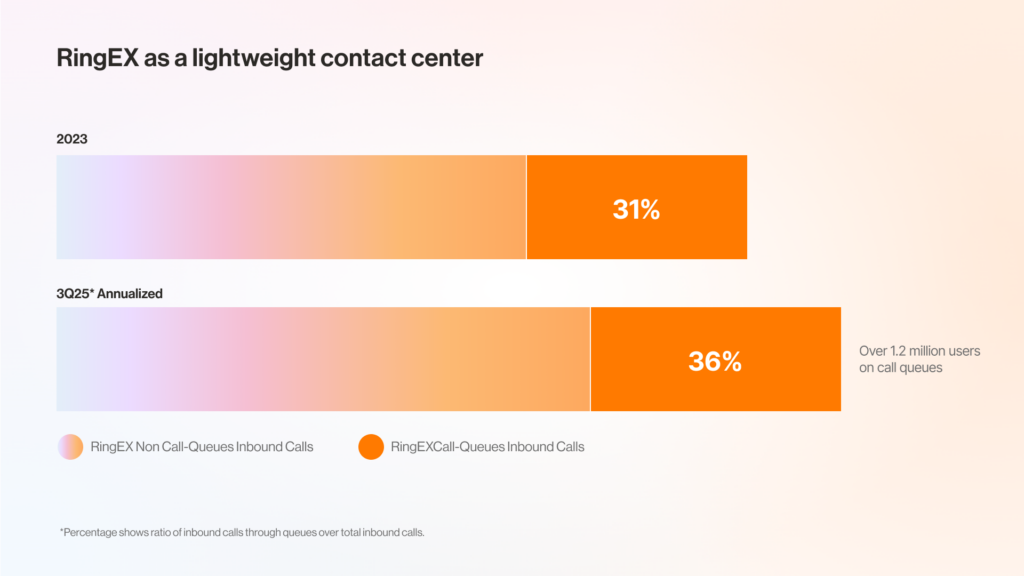
“Voice is actually going through a renaissance right now, and, believe it or not, it’s being fueled by AI,” he said.
Voice is the new AI frontier. And clearly, with RingCentral as a global leader in business voice communications, we’re extremely well-positioned to leverage and expand this technology.
“Many people still think of us as a phone company. And yes, we do have what we believe is the world’s best phone platform. But we’re not in the phone business. We’re in the business of customer engagement.”
At RingCentral, we don’t just connect people with each other; we connect consumers directly to the businesses they trust. Voice AI agents are not just an add-on, they are the next evolution of the platform we’ve built.
These AI agents bring intelligence, automation, and continuity to voice interactions that were previously manual, disconnected, or delayed.
By embedding voice AI across various verticals, we’re seeing how this technology drives measurable gains in speed, accuracy, and customer satisfaction. This is what customer engagement now demands, and that’s exactly how our voice AI agents are designed to provide.
How voice AI agents work
From the caller’s perspective, it’s simple: they speak, and the voice AI agent responds instantly. Behind that simplicity is a layered process that blends multiple technologies:
- Speech recognition converts the caller’s audio into text with high accuracy, even with accents or background noise.
- Natural language understanding determines the caller’s intent, extracts specific details, and identifies relevant entities such as dates, names, or service types.
- A context engine preserves information shared earlier in the call so the caller does not need to repeat details.
- Integrations connect the agent to the business’s operational tools such as scheduling systems, Salesforce or HubSpot, billing platforms, EHRs, or service databases.
- A response engine determines the correct next action, whether booking a calendar slot, checking eligibility, updating records, or escalating to a live agent.
- Text-to-speech technology delivers a natural-sounding, easy-to-understand reply.
- A monitoring layer evaluates accuracy, detects frustration cues, and triggers handoffs to human agents when necessary.
Every interaction is logged as structured data, feeding analytics dashboards and machine learning models. This data can be used for continuous improvement, helping businesses refine workflows, predict trends, and enhance future interactions.
Why companies are adopting voice AI agents
Businesses don’t adopt new systems just for novelty. They do it because their current processes are inefficient, costly, or damaging to customer experience. The shift toward voice AI agents is driven by real operational pain points:
- Missed calls and lost revenue: Many small businesses—like clinics, salons, and legal offices—lose valuable leads simply because no one answers the phone. Even a few missed calls per day can cost thousands in potential revenue.
- Staff burnout and turnover: Repetitive calls about hours, cancellations, or FAQs drain staff productivity. Voice AI agents take on these routine tasks, allowing employees to focus on higher-value interactions.
- Inefficient call routing: Manual routing often leads to misdirected calls and long wait times. Voice AI agents use intent-based routing to connect customers to the right person or department faster.
- Unlogged interactions: When humans forget to document calls, valuable insights disappear. Voice AI agents automatically record and categorize each conversation, closing that data gap.
- Inconsistent service quality: Unlike human agents who vary in tone or attentiveness, voice AI agents maintain a consistent, professional, and brand-aligned communication style.
According to Metrigy’s Customer Experience Optimization 2025–26 report, 19.3% of companies identify voice as their most effective channel for resolving customer needs, ranking higher than email, chat, AI text agents, or social media.
The report also highlights that voice is used in 82% of all customer interactions—either as the first touchpoint or an escalation, rising from 77% in 2024.
This data reinforces what many businesses are already realizing: voice isn’t going away. In fact, it’s becoming more essential.
RingCentral AI Receptionist (AIR): Our voice AI agent for real business outcomes
AI Receptionist, or AIR, is our purpose-built voice AI agent. It is designed to answer every call, understand the customer’s intent, complete tasks, and preserve context throughout the interaction. This makes AIR more than a replacement for traditional phone trees. It is a fundamental upgrade to how voice-driven engagement works.
Whether it’s handling peak call volumes or supporting 24/7 service without additional staffing, AIR ensures every caller is greeted, heard, and supported.
Here’s what AIR can do for your business:
- Captures every lead automatically by collecting caller details and interaction context, then logging them directly into Salesforce, HubSpot, or a built-in CRM with no manual entry.
- Books and manages appointments seamlessly by handling scheduling and rescheduling across multi-provider calendars, locations, and service types without staff involvement.
- Answers detailed, real-world customer questions using natural language to deliver accurate responses to inquiries like rescheduling needs or policy questions.
- Routes calls based on true intent by understanding context instead of relying on keypad inputs, reducing misdirected calls and cutting down on wait times.
- Integrates with your existing phone system and delivers 24/7 multilingual support in English, Spanish, French, and more, with the ability to switch languages mid-conversation.
Easy setup, powerful customization
Getting started with AI Receptionist is fast and intuitive. You don’t need an IT team or complex onboarding process. From your RingCentral portal, you can set up AIR in minutes using a simple dashboard. It learns directly from your website, FAQs, or uploaded documents—so it starts answering calls based on your actual business knowledge from day one.
You can also define how AIR interacts with callers by:
- Setting custom greetings
- Uploading business-specific documents or policies
- Creating intake forms and lead capture questions
- Teaching it to recognize keywords or service-specific requests
- Configuring call routing based on team, location, or service type
If you need help, our dedicated RingCentral support team is always available to guide you through setup, help fine-tune configurations, or troubleshoot any issues along the way.
AIR is already delivering results
Businesses using AIR aren’t just experimenting with AI; they’re seeing measurable improvements that directly impact their operations, revenue, and team productivity.
- Integral Recruiting Services reports that AIR now handles over 90% of their calls, reducing manual workload while capturing every lead.
- Owen Security tripled their outbound call volume and saves 20 hours per agent per week by automating inbound call handling with AIR.
Part of a complete agentic voice AI suite
AIR is the first line of engagement in RingCentral’s agentic voice AI suite. Our comprehensive platform brings AI into every phase of the customer conversation:
- Before the conversation — AI Receptionist (AIR)
Captures every call, qualifies leads, schedules appointments, and provides contextual handovers for seamless experiences. - During the conversation — AI Virtual Assistant (AVA)
Our AI Virtual Assistant listens in and provides real-time assistance and automation to agents during live calls. - After the conversation — AI Conversation Expert (ACE)
Analyzes transcripts, surfaces actionable insights, and recommends follow-ups across voice, video, and messaging interactions.
Together, these AI agents form an intelligent loop that continuously improves how your business connects with customers—before, during, and after the call.
Unlock the future of customer engagement with voice AI agent
It’s time to stop thinking of the phone as a legacy channel. See what’s possible when a voice AI agent becomes your front line of engagement. Sign up for a demo today.
FAQ
What is a voice AI agent, and how is it different from a traditional IVR or bot?
A voice AI agent is a conversational system that understands natural speech, responds in real time, and connects to your business tools (CRM, booking, billing, EHR, etc.). Unlike legacy IVR, it can understand intent, handle complex workflows, personalize responses, and complete tasks end-to-end instead of just routing calls.
Is this suitable for small and local businesses, or only for enterprises?
Both. Small businesses use voice AI agents to handle FAQs, bookings, and basic support without hiring extra staff. Enterprises use it for high-volume call centers, advanced routing, compliance, and analytics across multiple regions and teams.
Which industries get the most value from voice AI agents right now?
High-intent, high-volume, or appointment-driven businesses such as healthcare and dental clinics, real estate and property management, restaurants and hospitality, salons and wellness, insurance and finance, home services, retail, education, SaaS, and call centers.
Will it understand accents, noisy environments, and fast speakers?
Yes. Modern voice AI is trained on diverse speech and real-world noise conditions. Prompts can be fine-tuned for clarity in busy environments.
Can voice AI agents handle both inbound and outbound calls, plus SMS/email?
Yes. You can configure inbound support and routing, outbound callbacks and reminders, and follow-ups via SMS or email using the same conversation context.
Updated Dec 14, 2025