AI Communications







Traditionally, customers needing to contact a company would only have one option—the phone. Today, 65% of younger customers (Millennials and Gen Z) and even 42% of Boomers prefer to engage through digital channels. What’s more, 78% of customers have used multiple channels to start and complete a transaction.
A multichannel contact center model is what they want, but let’s begin by defining multichannel contact center and its advantages.
Read on to find out all about multichannel contact centers—and discover why an omnichannel contact center is even better.
Multichannel contact center: Key takeaways
Multichannel contact centers allow you to engage with customers via their preferred methods, improving satisfaction and spreading the volume of inquiries across multiple channels. Benefits include faster resolutions and improved satisfaction, especially if you use smart software to streamline operations and analyze results. The drawback, however, is that the channels are siloed, whereas omnichannel contact centers unify all channels and data for more consistent CX.
What is a multichannel contact center?
A multichannel contact center is a hub that handles customer communications across multiple channels. It’s the next stage of evolution from a traditional call center, which only handles phone interactions.
Multichannel contact centers may be inbound, outbound, or hybrid. They offer a range of communication options so that customers can get in touch with the business, and agents or reps can reach out. Channels can include all or some of the following:
- Phone: Many customers still favor this option, and contact centers have moved beyond traditional telephony to embrace internet-based VoIP calling.
- Email: Useful for discussing complex issues in detail—with no need to wait in a call queue.
- Video: Makes interactions feel more personal and allows tech support agents to walk customers through troubleshooting.
- Live chat: Customers can access near-instant answers and support from human agents.
- SMS: Good for quick queries and responses, and for bulk outreach messaging. It also works on almost any device.
- Instant messaging: Again, this gives customers a fast and asynchronous way to get in touch.
- Social media: Allows businesses to meet customers where they already spend their time.
- Self-service: AI chatbots and IVR (interactive voice response) tools allow customers to resolve basic issues themselves.
Benefits of multichannel contact centers
Now that we understand the multichannel contact center definition, let’s check out the main advantages of a multichannel contact center over a traditional call center:
Expand your reach
By offering multiple channels, you’re automatically increasing your reach to a wider customer base. Not everyone wants to communicate via phone, so traditional call centers could be missing an opportunity to connect with people who prefer other methods. Meeting them where they are leads to higher engagement in the long run.
Deliver faster support
A multichannel contact center also enables you to accelerate the support and service you deliver, making your center more efficient. Because customers have several channels to choose from, they’re not all using the phone and clogging up your lines. The volume of interactions is spread, especially if you add self-service options.
Be more flexible
Having more channels in the mix gives you more flexibility when interacting with customers, since certain channels work better for certain queries. For example, a quick question can be resolved via SMS or live chat, while a complex issue or complaint would be better handled via phone or email. Plus, you can add or remove communication channels whenever you need to.
Improve customer satisfaction
Multichannel contact centers are more convenient for customers, who can choose their preferred method of contact.
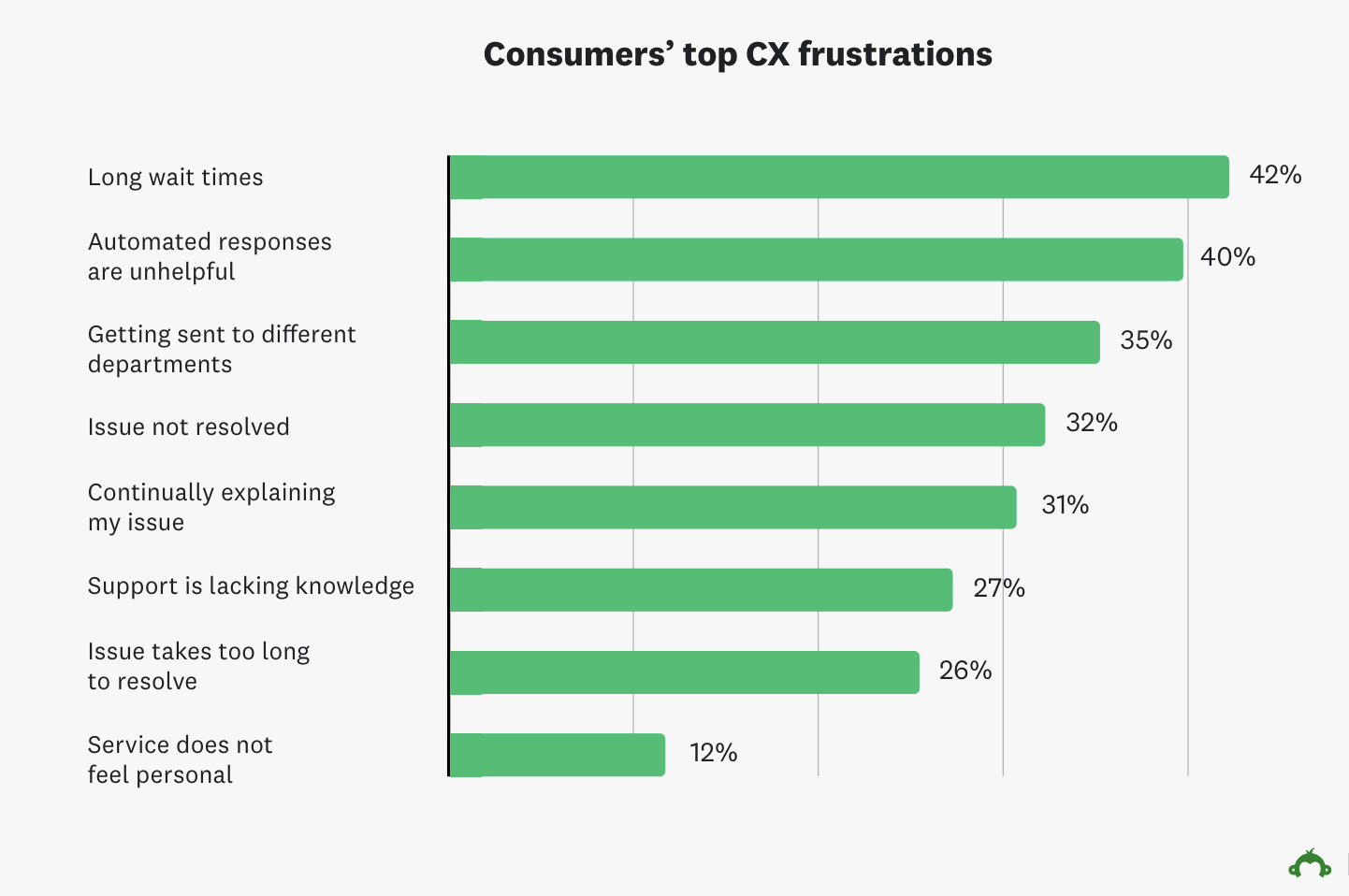
This is important for digital customer engagement, as it shows customers that you’re committed to meeting their needs. And they’re less likely to be frustrated by call queues when they have other options to choose from. 42% of customers listed long wait times as a major CX frustration in a 2024 SurveyMonkey poll:
Boost agent engagement
The call center industry is known for its high agent turnover, but a multichannel contact center makes their jobs less stressful by empowering them to resolve issues quickly. With shorter wait times and self-service shouldering some of the burden, they’re less likely to get overwhelmed by inquiries.
Gain extra insights
With interactions taking place on multiple channels, your business has more opportunities to gather data and valuable insights into customer behavior. You can use this to forecast demand and to personalize future communications.
Reduce costs
A multichannel customer contact center can trim your costs through improved efficiency, and through the use of automation and self-service options. These centers are typically hosted in the cloud, which also brings cost reductions because there’s no on-premises infrastructure to maintain.
Multichannel contact center use cases
With those multichannel contact center benefits in mind, here are a few ways in which businesses can deploy this type of center.
Technical support
Providing tech support is one of the most common use cases of a multichannel contact center. When a customer is experiencing technical issues with a product or with using the company website, a video call can work better than a phone call. This allows the customer to show the problem and the agent to go through troubleshooting steps. For simple issues, customers can get help via live chat or a knowledge base.
Retail and ecommerce
Multichannel contact centers are often used in an online retail setting, where customers are all about convenience and any delay in supporting them could lead to a lost sale.
Quick questions (order updates, store opening hours, return policies), are resolved easily via instant messaging or virtual agents. Phone or email are available to discuss issues with billing or store credit. If someone’s browsing your products on social media, they can access support without leaving the platform.
Sales & marketing
Outbound contact centers use the multichannel model to deliver promotional messaging on customers’ preferred channels. If you’re sending out information on a new product, you can reach traditional consumers via email and younger demographics via instant messaging or social media. It’s much more likely to yield results than cold calling—and it’s faster, too.
Key features of multichannel contact center software
If you’re setting up a multichannel contact center (either from scratch or upgrading from a call center), you’ll need software to help it run smoothly. Here are some of the key features you’ll find in the best multichannel contact center solutions:
AI and automation
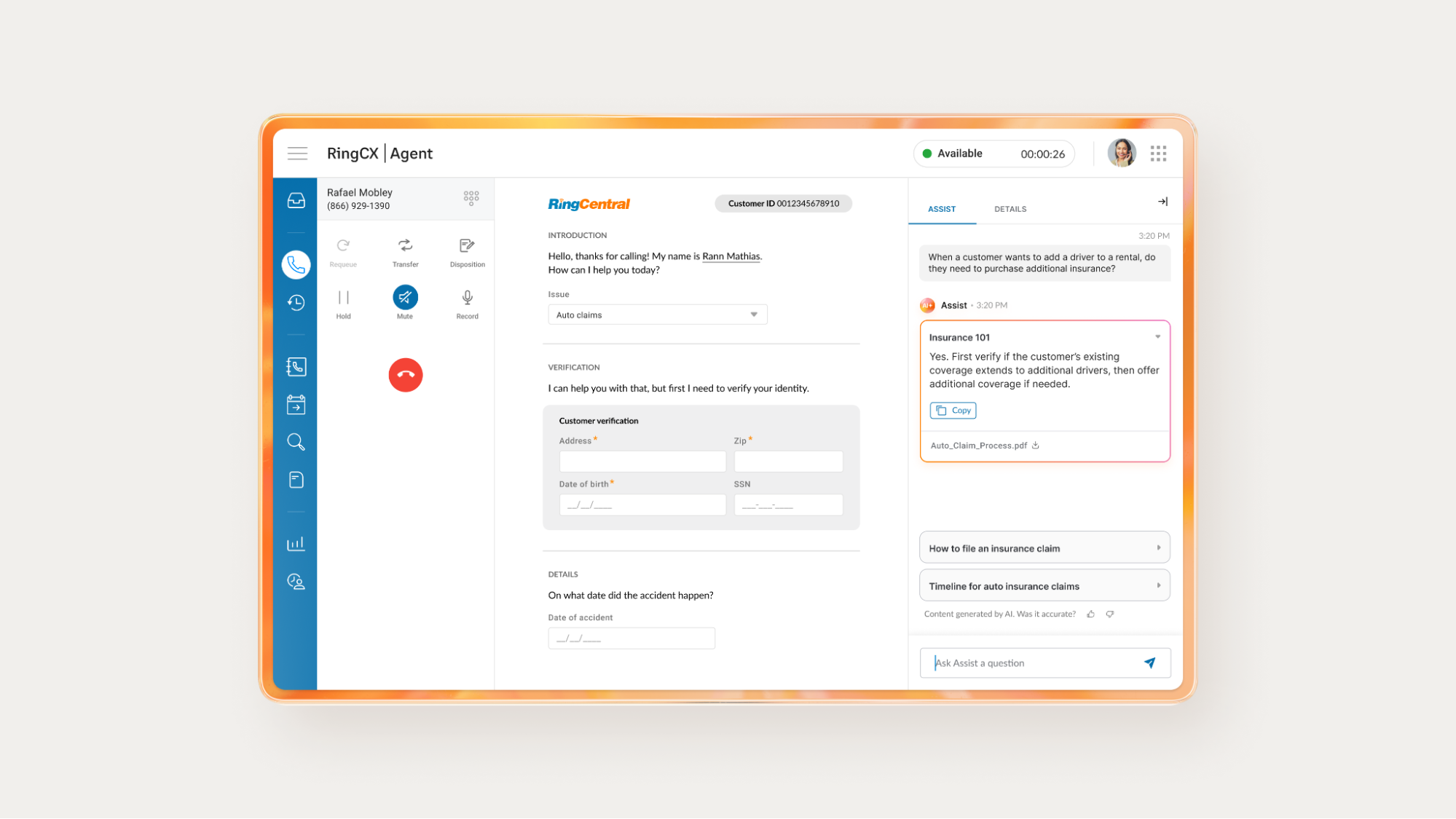
AI-powered contact center software maximizes efficiency by automating repetitive tasks and delivering valuable insights. Intelligent virtual agents (IVAs) can interact with customers to find quick resolutions, handing over to human agents when necessary. AI tools can also provide live coaching for agents, summarize calls, and analyze the sentiment of interactions.
Smart routing and IVR
Intelligent routing directs callers to the most appropriate agent based on skills and availability—and increases the rate of first-contact resolution. IVR menus kick-start the process, offering prerecorded options for callers to choose via speech or their phone keypad. They can also offer automatic callback or direct customers to self-service support.
Auto-dialers
For outbound or hybrid contact centers, auto-dialers are essential. They save time, boost productivity, and reduce human error. They automatically dial customer numbers from a list, only starting a new call when the agent is ready.
Analytics and reporting
Multichannel contact center software should have historical and real-time analytics to keep track of your KPIs (key performance indicators) and enable you to adjust routing rules and agent schedules according to demand. Dashboards and custom reporting help you to visualize performance.
Third-party integrations
It’s vital that your software includes integrations with the other tools and apps you use, especially your CRM (customer relationship management) system. This means agents can store and access customer details from all channels in one place. Some solutions allow you to build your own integrations via APIs.
Multichannel contact center best practices
Here are some top tips on how to manage a multichannel contact center successfully:
Assess your customers’ needs
There’s no point adding a channel if your customers aren’t going to use it. Think about the ages, demographics, and known preferences of your audience—if you mainly handle queries from seniors, you probably don’t need to offer Instagram or TikTok as contact options.
You’ll also need to assess your capabilities. If you don’t have enough agents (or agents with the right skills) to manage multiple channels, you won’t be able to provide a high level of service on any of them.
Choose the right software
It’s important to pick software that aligns with your business model and processes. You can use the previous section on key features to understand what you should be looking for, but you’ll also need to pay attention to elements like pricing, support, and security.
It’s a good idea to ensure the software can scale as your business grows, allowing you to add (or remove) channels, features, and users as required. Take advantage of free trials and demos offered by vendors, and do your research by reading reviews on third-party sites.
Provide self-service options
It’s essential that your chosen software lets you provide self-service options. More than 80% of companies plan to invest in this area by the end of 2025.
Alongside IVR menus and AI virtual agents, set up FAQs and knowledge bases on your website to give customers the best chance of resolving issues by themselves. You’ll also free up your human agents for handling more complex inquiries and building rapport with customers.
Make sure customers know that they can always choose a human interaction if they’re not keen on self-service.
Train agents thoroughly
Training agents is a huge part of managing a multichannel contact center effectively, as you need different skillsets for different channels. Set up teams for each channel based on existing experience, and train existing or new agents to fill any gaps. They’ll also need training on how to use your software (and any new tools you may introduce in the future).
Set clear guidelines for contact center staff, as this will help you to provide a consistent customer experience. Everyone should know how and when to escalate issues, and understand the principles of data privacy and security.
Use real-time analytics
Analyzing historical data is super-important for multichannel contact centers, because it enables you to evaluate performance and customer preferences over time. You can look for patterns and trends, such as seasonal spikes in contact volume.
But real-time analytics show you what’s happening right now and allow you to make adjustments—mid-interaction, if necessary. For example, conversation intelligence tells you if a customer’s sentiment is negative, giving you the chance to turn things around.
Track and improve
Tracking and monitoring has to be a continuous process, so that you can assess progress against your contact center metrics and make improvements. This includes keeping a close eye on performance (both overall and by individual agents) and getting feedback from customers, before using the data to make decisions about training and scheduling, and which channels to use.
Multichannel contact center metrics to track performance
To evaluate your successes and identify failings, measure against multichannel contact center performance metrics. Here are the main KPIs to track:
- Volume of inquiries: By measuring the volume per day, week, month, or quarter, you can see if the figure fluctuates over time and look into the reasons behind the change.
- Average time in queue: Measure the length of time customers have to wait for a response on each channel—this helps you to judge which channels are most responsive and why.
- Average speed of answer (ASA): This reveals how long it took for the agent to pick up the phone after it started ringing (not including the time the customer spent in the queue)
- Average handle time (AHT): This is the average time it takes for an agent to handle a single customer interaction from start to finish.
- First-contact resolution (FCR): Here, you’re measuring the percentage of interactions resolved at the first attempt, without the customer having to try again or the agent having to call them back.
- Abandonment rate: This shows you how many customers hang up or otherwise abandon an inquiry before reaching an agent, expressed as a percentage.
- Customer satisfaction (CSAT):Know how many customers stick with your company over a given period. There may be other factors at play apart from contact center service (such as product pricing) but a negative CRR shows you need to up your game.
- Net Promoter Score (NPS): Ask customers how likely they are to recommend you, on a scale of 1-10. Take the percentage of those who gave 9 or 10 (“promoters”) and subtract the percentage of those who gave 6 or lower (“detractors”) to find the NPS score.
- Service Level Agreement (SLA) compliance ratio: Also known as SLA success rate, this shows the percentage of interactions resolved within the agreed service level parameters.
- Customer retention rate (CRR): Know how many customers stick with your company over a given period.? There may be other factors at play apart from contact center service (such as product pricing) but a negative CRR shows you need to up your game.
Omnichannel vs multichannel contact center: What’s the difference?
In the context of contact centers, you may have heard the words “omnichannel” and multichannel” used interchangeably, but they definitely aren’t the same thing. Both models use multiple channels where agents support and engage with customers. The distinction lies in the integrations between channels. In a multichannel model, the channels are separate. Different teams manage different channels, and the data they generate is typically siloed.
This means that agents and reps don’t see the full picture of customer interactions. For example, let’s say a customer uses live chat to get troubleshooting instructions for a tech issue. A few days later, the problem pops up again. This time, the customer calls the helpline and speaks to an agent.
Because the agent has no way of viewing the original live chat conversation, the customer ends up explaining the whole thing over again. This is frustrating and time-consuming, putting a dent in both your average handle time metric and your CSAT score.
In an omnichannel contact center, all channels are connected in a unified platform. The agent would be able to see the live chat transcript (plus records of any other previous interactions with that customer.) When you manage all channels in a single place, it’s easy to move between them without losing the thread.
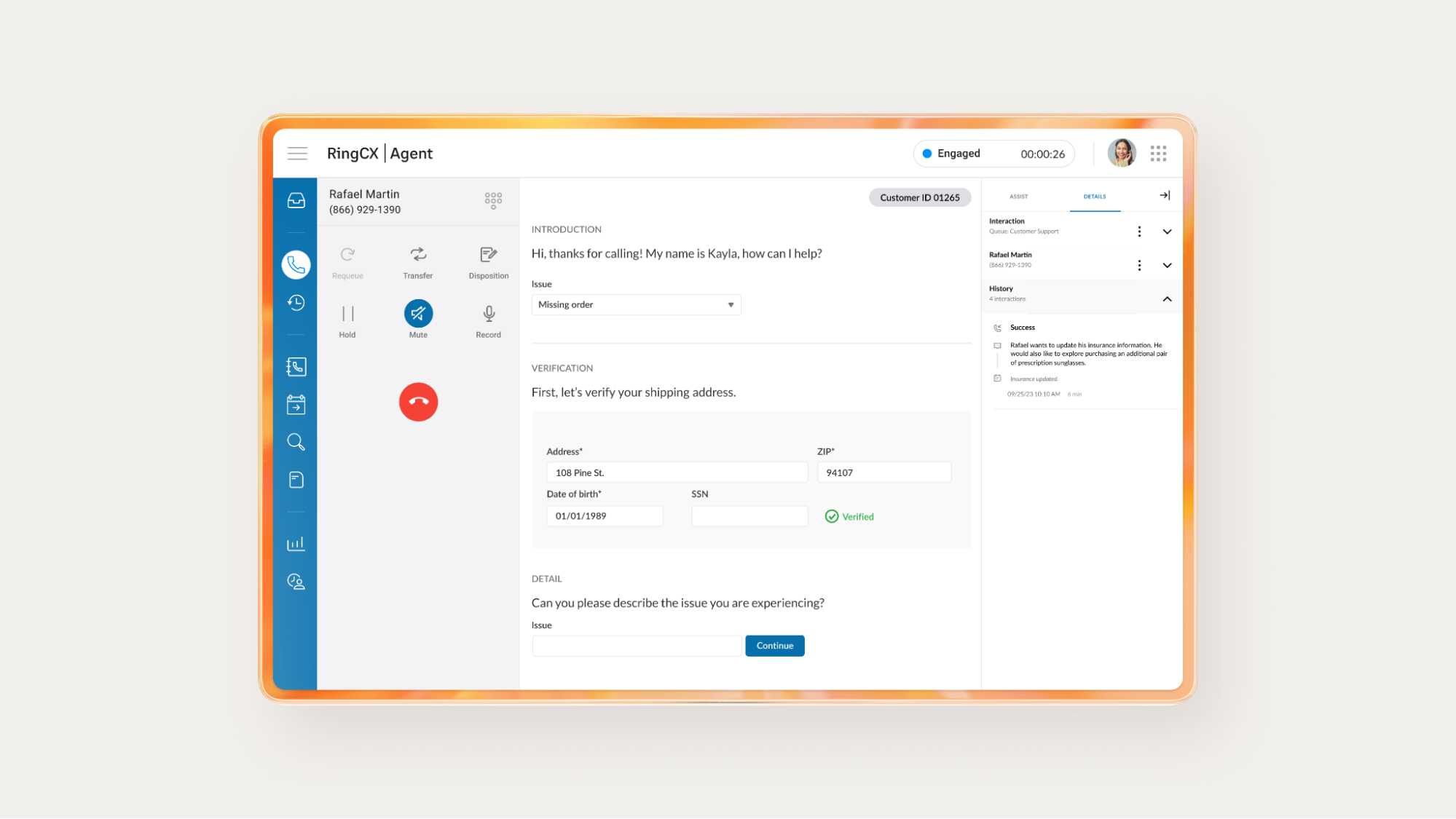
By bringing all your communication channels and customer data together, an omnichannel contact center enables you to provide a consistent experience for every customer, as well as a more personalized service.
Go beyond multichannel contact center management with RingCX
Multichannel contact centers are a step up from traditional call centers, allowing you to connect with customers via their preferred methods. With each channel operating separately, though, you risk siloed data and an inconsistent customer experience.
With an omnichannel contact center solution like RingCentral RingCX, you can go beyond the benefits of the multichannel model. RingCX unifies more than 20 channels in one platform, giving your customers maximum support and eliminating app-switching for agents.
Fully unified channels and built-in CRM integrations enable agents and reps to access information from previous interactions, and get instant context when a conversation transitions from self-service to a live agent. They can also escalate a chat to a video call in one click.
The platform is powered by AI, including intelligent virtual agents for simple inquiries and a real-time Agent Assist feature that helps reps answer customer questions. AI also handles note-taking, call summaries, live transcription, and sentiment analysis. Outbound reps can use various auto-dialers.
RingCX also lets you monitor performance with historical and real-time analytics, visualized on custom and pre-built business intelligence dashboards. Automated scorecards and live coaching help you empower agents to do their best work and deliver great experiences on every channel.
Multichannel contact center FAQs
How does a multichannel contact center work?
Multichannel contact centers handle customer communications on various channels, not just the phone. Customers can choose to get in touch by their favored method, such as live chat, email, SMS, or social media. Typically, a contact center will deploy specialist teams to handle each channel.
What’s the difference between multichannel and omnichannel contact centers?
In a multichannel setup, each channel is treated separately and the data from interactions is siloed. Agents handling queries on one channel can’t access previous conversations from a different channel. Omnichannel contact centers link all the channels together in a single platform, making it easy to access all the data and switch channels without losing context.
What is an example of multichannel customer service?
A customer has a query about a product. She calls the company helpline, but there’s a long wait time. Luckily, there are other channels to choose from. She opts to use the AI chatbot, which is much faster. It resolves her query without a human agent getting involved.
Originally published Aug 11, 2025