AI Communications








“How do you scale AI without losing the human touch that customers actually care about?”
Too often, human oversight is treated as a temporary control to phase out once AI proves itself. Our CX experts argued the opposite: human oversight is the operating model that lets AI keep earning customer trust as adoption scales.
This question framed the latest episode of AI Real Talk featuring RingCentral executives: Andy Watson (Director of Product Marketing), Ryan Mulholland (SVP & General Manager of Contact Center), Todd Cotharin (General Manager of AI Workforce Management), and Jeff Canter (Chief Customer Officer).
Key takeaways
- Voice gives AI the context to route, escalate, and automate in real time.
- AI moves workforce managers from data entry to planning and analysis.
- Shared context separates connected AI platforms from isolated tools.
- Human oversight protects trust by catching issues before they escalate.
- AI shifts agents from routine work to more complex interactions.
- Support organizations will evolve as AI absorbs repetitive work.
- Successful AI adoption starts small and scales with proven results.
1. Voice is the breakthrough channel for AI
| “Voice lets us capture distress or emotion. AI gives us the ability to look across the board in a voice conversation, whereas text is much more linear.” |
The same words can signal very different levels of urgency depending on how they’re spoken. “This isn’t working” could mean a simple question, a frustrated customer, or a churn risk. Text captures the statement. Voice turns intent into something AI can detect through tone, pace, hesitation, urgency, and emotion.
That context changes the value of AI. In voice, AI can help determine whether to automate, route, escalate, or alert a supervisor in real time.
Many organizations started with chat-based AI because it was easier to deploy. But the highest-value customer moments often happen in voice, where issues are more urgent, emotional, or complex.
For leaders weighing where to prioritize sentiment-driven routing, the data points to voice. It carries context that text can’t replicate. Voice gives AI the context it needs to automate workflows, not just conversations.
2. AI is changing the work, not replacing the worker
| “We’ve always strived to take as much of the data entry and heavy lifting out of the process as possible, and with some of the new AI tools we have, we’re being really effective at that — we’re making a big difference for workforce managers. What we believe is that it’s going to help them move from being data-entry people to really being the analysts and planners we need them to be.” |
Building a staffing schedule manually means pulling historical volume data, mapping it against shift patterns, and adjusting for absences hour by hour. None of that consumes the workforce engagement manager’s actual expertise; it consumes their time.
AI-powered forecasting now generates that schedule directly from demand data, freeing the WEM manager to make the decision that actually requires judgment: whether the schedule accounts for a product launch, a seasonal spike, or a staffing risk the model hasn’t seen before.
This shift also creates new responsibilities: deciding how AI-handled volume should change staffing plans, hiring needs, and recruiting priorities. Those decisions require business context, operational judgment, and an understanding of customer expectations that no forecasting model can provide on its own.
3. Context is the real competitive advantage
| “We’re [RingCentral] the only vendor in the market who can carry that context all the way through the contact center experience–all orchestrated on the same AI layer.” |
A customer who calls about a billing issue and then follows up by chat an hour later expects the business to remember the conversation. They don’t care which channel they used or which system handled the first interaction. They expect continuity.
That’s where many AI deployments break down. A voice assistant may capture one part of the interaction. A chatbot may handle another. But if those tools don’t share context, the customer has to repeat the issue, and the agent starts without the full picture.
This often happens when companies buy AI tools one at a time to solve narrow problems. Each tool may improve its own workflow, but the experience can still fall apart at the handoff.
For leaders evaluating AI, the question is simple: Does context move with the customer, or does every interaction start from zero?
The answer determines whether you’re building a connected customer experience or a collection of tools that can’t work together when it matters.
4. Oversight protects trust in the age of AI
| “In the world we live in today, with social media, one bad interaction could be online in minutes. So the important thing to remember, as it relates to why humans should be in the loop, is: if something’s going wrong, you need a human there to monitor it, catch it, triage it, and fix it as soon as possible.” |
Even strong AI systems can produce the wrong response in certain situations. The risk isn’t only the mistake itself. It’s how quickly that mistake can become visible, shared, and damaging.
A single poor response can turn into a screenshot, a social post, or an escalation before a team even knows there’s a problem. That changes the standard for responsible AI. Accuracy still matters, but it’s not enough on its own.
Leaders also need to measure the time to intervention: how quickly a human agent can detect, review, and correct a flawed AI interaction. That number should be clear, tracked, and owned by the business.
If an organization can’t define its time to intervention, the issue isn’t only the model. It’s the monitoring system around it.
Human oversight gives AI a necessary control layer. It ensures that when automation gets something wrong, the business can respond before the interaction becomes a trust problem.
5. The conversation has shifted from replacement to augmentation
“A few years ago, we were seeing businesses promise, ‘You’re going to replace all your human agents with AI, it’s going to be great, but reality has kind of set in. What we’re actually seeing is humans getting the more complex work.”
Early customer service AI was often positioned as a way to reduce agent headcount while maintaining the same service volume. In practice, the bigger shift is in the type of work agents handle.
AI is well-suited for high-volume, repeatable tasks: answering common questions, collecting information, routing customers, summarizing conversations, and resolving simple requests. Once those interactions are automated, what remains for human agents tends to be more complex.
Think billing disputes, account exceptions, escalations, frustrated customers, or issues that require judgment across multiple systems and policies.
For contact center leaders, that changes how AI should be measured. Headcount reduction is only one lens. A more useful measure is workload mix: which interactions AI resolves, which ones move to agents, and how the complexity of human-handled conversations changes over time.
6. AI is reshaping the support organization
| “We’re actually seeing it play out in front of us: the repetitive, mundane work gets handled by AI, and then we can up-level and coach our teams to deliver more Tier 2 and Tier 3-type answers.” |
Tier 1 support handles routine, high-volume questions, while Tier 2 addresses issues that Tier 1 can’t resolve. As AI absorbs Tier 1 volume, agents advance to Tier 2 responsibilities sooner than before.
But there’s an important operational risk leaders need to plan for. Tier 1 work hasn’t only been a queue. It’s also been a training ground.
Repetitive tickets help agents build pattern recognition: what customers usually mean, where issues commonly break down, which questions to ask, and when something needs escalation.
If AI removes much of that routine volume, it also removes part of the learning path agents used to rely on before taking on more complex cases.
Support leaders should address that gap directly. If agents are moving into Tier 2 work sooner, they’ll need more structured onboarding, better knowledge tools, stronger coaching, and clearer decision frameworks. They can’t be expected to develop judgment the same way if the work that once built that judgment is now automated.
AI can move people up the value chain. But organizations need to build the training model that helps them succeed there.
7. Start with one use case. Scale with proof.
At RingCentral, we see the most successful AI programs start with focus. Not a broad rollout. Not AI applied to every interaction at once. One use case that’s specific, measurable, and tied to a real business outcome.
Jeff Canter, RingCentral’s Chief Customer Officer, put it simply:
“Pick one use case and get started. Don’t let AI just run wild on its own.”
That might mean automating after-hours call handling, improving call routing, summarizing customer conversations, or resolving a defined set of routine requests. The goal is to prove value in a controlled environment before expanding AI into more complex workflows.
Todd Cotharin, RingCentral’s General Manager of AI Workforce Management, emphasized on operational control:
“Know what your contingency plans are. Make sure somebody’s continuously monitoring it.”
AI shouldn’t be deployed without clear ownership. Teams need to know what’s being monitored, who’s responsible for reviewing performance, how issues get escalated, and how quickly the business can adjust if outcomes drift.
Ryan Mulholland, RingCentral’s SVP & General Manager of Contact Center, brought the discussion back to data:
“Don’t make it a science experiment. Let the data tell you.”
Responsible AI adoption depends on measurable results, not early excitement. Leaders should evaluate resolution rates, escalation patterns, customer sentiment, agent impact, and time to intervention before deciding where to expand next.
How AI builds customer trust
Our latest AI Real Talk session surfaced the real AI mandate for customer-facing organizations: don’t make customers carry the risk of your automation strategy.
That’s the standard leaders should be designing around. Customers don’t evaluate AI by model sophistication. They evaluate it by consequence. Did the business understand the issue? Did the interaction move forward? Was there a path to a person when judgment was required? Did automation reduce friction or create a new one?
Human oversight is the control layer that makes AI fit for live customer environments. It gives teams a way to monitor outcomes, correct failures, escalate edge cases, and improve the system without turning customer interactions into unprotected experiments.
Winning companies will scale AI innovation through continuous human oversight, keeping the trust that makes automation valuable in the first place.
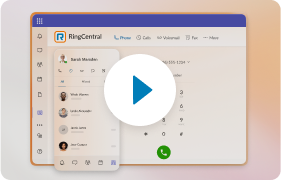
Watch the full episode of AI Real Talk to explore the insights, strategies, and practical guidance for scaling AI while keeping humans at the center of better customer experiences.
FAQ
Does human oversight slow down AI adoption?
No. Oversight speeds up adoption because it catches problems early, before they turn into a trust issue. Businesses that skip oversight tend to slow down later, when a mistake forces them to pull AI back and rebuild confidence from scratch.
What is time to intervention, and why does it matter?
Time to intervention is how fast a human agent can spot, review, and fix a flawed AI response. It’s a core metric for responsible AI programs, alongside resolution rate and customer sentiment, because it measures how quickly a business can act when something goes wrong.
Should a business roll out AI across every channel at once?
No. RingCentral’s CX leaders recommend starting with one specific, measurable use case, such as after-hours call handling or conversation summarization, and expanding only once the data shows it’s working.
Originally published Aug 17, 2026