AI Communications







A mishandled patient call can turn into a reportable compliance incident fast. Here’s how to tell a compliant answering service from one that only markets itself that way.
This article is general information and not legal advice. You should consult with legal counsel before making decisions.
It’s 9:40 p.m., and a patient calls your after-hours line with a question about her medication. The answering service picks up, records her name, date of birth, and symptoms, then relays a message to the on-call provider by text.
Nobody has checked whether that vendor is contractually bound to protect the data that was just shared, or whether the text message sits unencrypted on a server somewhere. Scenarios like this are more common than most practices realize. A routine after-hours call can just as easily become a reportable breach under the Health Insurance Portability and Accountability Act (HIPAA).
The good news is that this outcome is avoidable. A properly built answering service can take that same 9:40 p.m. call, protect every detail the patient shares, and deliver the message to your on-call provider without any of it slipping outside HIPAA’s rules. What makes the difference is whether the service was designed for healthcare and backed by the right safeguards and agreements, rather than one that simply answers the phone. That distinction is what defines a HIPAA-compliant answering service.
Key takeaways
- A HIPAA-compliant answering service must sign a business associate agreement (BAA)
- Encryption in transit and at rest are required to secure patient health information across digital channels
- Not every “medical answering service” is actually HIPAA-compliant
- After-hours patient calls carry the same compliance risk as daytime calls
- Verify BAA and encryption claims directly, never assume they’re a given
What actually makes an answering service HIPAA-compliant?
Under HIPAA, any vendor that creates, receives, maintains, or transmits protected health information (PHI) on your behalf, including an answering service that takes patient calls, qualifies as a “business associate.” That classification isn’t optional, and it doesn’t depend on what the vendor calls itself or whether a contract has been signed. It depends on the function the vendor performs.
A business associate must meet the same technical and administrative safeguards required under the HIPAA Security Rule—there is no reduced standard.
That standard breaks down into three concrete requirements. Skip any one of them, and the vendor isn’t compliant, regardless of what its marketing page says.
1. A signed BAA
A BAA is a legal contract that spells out how a vendor protects PHI, what happens after a breach, and who’s liable for what. Without a signed BAA, a practice can’t share patient information with that vendor, full stop.
Confirm this first: a compliant vendor produces this document without hesitation. If a sales rep hedges on the BAA question or points to a generic “compliance statement” instead, treat that as a red flag.
2. Encryption in transit and at rest
Vendors should encrypt PHI they capture or relay from patient calls, such as names, diagnoses, and callback numbers, both while it moves across digital channels (in transit) and while it sits in storage, such as call recordings, transcripts, or voicemail (at rest).
A vendor that encrypts one and not the other has a gap. Ask specifically about both. “We encrypt your data” could be shorthand for just one half of the requirement.
You’ll also want to know what type of encryption the vendor uses. A HIPAA-compliant answering service should follow NIST guidance on encryption standards:
- NIST-aligned encryption (e.g., AES-256) for data at rest
- NIST-aligned encryption (e.g., TLS 1.2 or TLS 1.3) for data in transit
3. Access controls and audit logging
HIPAA requires role-based access, so only staff who need to see PHI can see it, along with an audit trail of who accessed what and when.
For an answering service, that means the vendor logs every agent login, every call record pulled, and every message sent, and makes that log reviewable on request. Ask for that log directly rather than taking its existence on faith. Tools built around conversation intelligence for compliance increasingly make this kind of audit trail a standard, reviewable feature rather than an afterthought.
The real cost of a compliance gap in patient communications
A compliance gap in patient communications rarely stays contained to the vendor. In most cases, when an answering service mishandles PHI, the practice that owns the patient relationship bears the reporting obligation, the patient notifications, and the reputational fallout.
The financial exposure is well documented, though the exact figures shift year to year. IBM’s 2026 Cost of a Data Breach Report puts the average healthcare breach at $6.64 million, making healthcare the costliest industry in IBM’s annual analysis for well over a decade running. That figure covers detection, notification, legal response, and lost business, the same categories a practice would face if a mishandled after-hours call triggered a reportable incident.
Scale matters too, and the trend is not encouraging. HHS’s Office for Civil Rights logged 405 reports of large breaches (500 or more individuals) for calendar year 2025, of which 107 were attributed to business associates, exposing protected health information belonging to more than 79 million people.
For a small practice or a multi-location contact center, the calculus is straightforward. A vendor contract that saves a few dollars per call isn’t worth the risk of fines and potential lawsuits if that vendor can’t produce a BAA or explain its encryption approach. More importantly, it doesn’t cover the cost of lost patient trust, and your organization’s reputation.
Verifying compliance and HIPAA-compliant VoIP infrastructure up front costs little next to a breach notification process, a regulatory investigation, and patient trust that doesn’t come back easily.
7 questions to ask before choosing a provider
A website that says “HIPAA-compliant” isn’t proof. Before signing with any answering service, whether it’s a dedicated medical call center or a general-purpose vendor pitching healthcare capability, get direct answers to these questions in writing:
- Will you sign a business associate agreement (BAA)? Ask for the document itself, not a verbal confirmation.
- How is protected health information (PHI) encrypted at rest and in transit? Ask which encryption standard applies to both states, not just one.
- What audit logs are available on request? Confirm you can pull a record of who accessed what patient information and when.
- Who has access to call recordings and transcripts, and how is that access restricted? Role-based access should be explicit, not assumed.
- What’s the breach notification process, and what are the contractual timelines? HIPAA sets requirements here; the vendor’s contract should mirror them.
- Is compliance consistent across every agent, shift, and location, or only during business hours? After-hours and overflow staffing is where gaps often show up first.
- Can the vendor provide documentation of a recent security assessment or certification? A vendor with nothing to show hasn’t tested its own systems.
Any vendor unwilling to answer these directly, or one that redirects to generic reassurances instead of specifics, hasn’t earned the “HIPAA-compliant” label yet. Treat vague answers as a decision point, not a formality to work around.
Why consistency matters as much as compliance
A practice can have airtight compliance during business hours and still carry serious risk after 6 p.m. HIPAA doesn’t distinguish between a call that a trained front-desk staffer handles at noon and one an overflow vendor handles at midnight. The required safeguards are identical, and so is the audit exposure if either one fails.
This is where many practices underestimate their risk. Your front-desk staff are trained on your policies, but an overflow vendor’s agents handle the same PHI, and under HIPAA the vendor’s workforce needs training too. Training isn’t something you can assume, so ask the vendor how it trains agents on handling PHI, and ask for it in writing. A patient calling about lab results at 11 p.m. shares exactly the same PHI as one calling at 11 a.m.
Consistency also matters operationally, not just for compliance. A patient who reaches a confused after-hours agent, or one who can’t get routed to the right on-call provider, has a worse experience regardless of what happens to their data.
Reviewing how practices approach patient engagement software is a useful next step for teams trying to standardize both the compliance posture and the patient experience across every touchpoint, not just the ones during office hours. Avoiding a breach matters, and so does making sure every patient gets the same standard of care on the phone, whether they call at 9 a.m. or 2 a.m.
How RingCentral supports compliant patient communications
After-hours patient calls create a dual problem: they leave a coverage gap when nobody answers, and a compliance risk when the wrong vendor does. Practices need a way to make sure every call gets handled consistently without introducing a new point of failure.
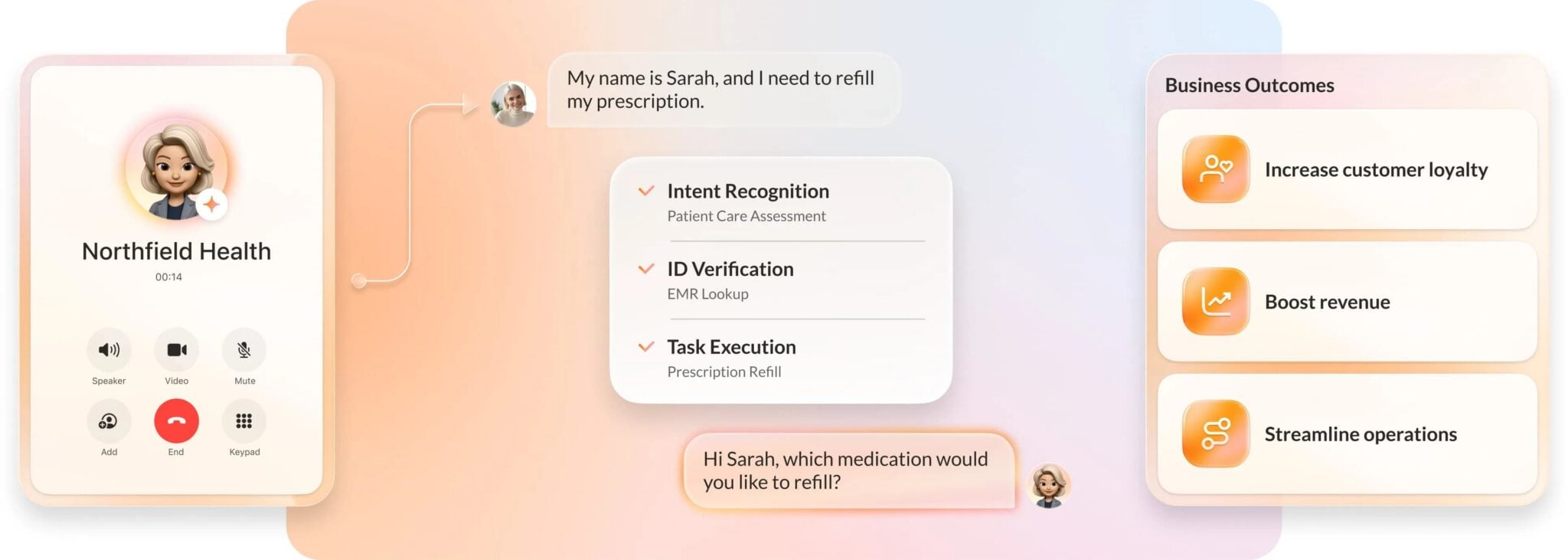
RingCentral’s AI Receptionist (AIR) helps close the coverage side of that gap. It answers incoming calls automatically, so no patient call rings out or lands with an unprepared vendor. It routes callers using context-aware logic instead of a rigid phone tree, directing patients to the right destination, whether that’s an on-call provider, a nurse line, or a scheduling queue.
It also applies the same call-handling logic across every shift and location, which addresses the consistency problem directly: the front desk and the after-hours line follow the same process instead of two different ones.
AI Representative (AIR Pro) for Healthcare handles the parts of the job that outgrow a standard AI receptionist or interactive voice response (IVR) system. It routes callers dynamically based on intent and context instead of a fixed menu, so a multi-location practice or urgent care group can route a scheduling call, a billing question, and a clinical question to three different destinations without building three separate phone trees.
It also verifies patient identities, books appointments by location and priority, manages prescription refills, and handles billing issues and post-visit follow-ups, all through the same call-handling logic across every shift and location.
AIR Pro for Healthcare connects with the systems a growing practice already runs on, including your existing records management platform, so patient-facing use cases pull from real data instead of a static script. It supports 100+ EHR integrations to speed that connection.
Custom call flow logic and access controls give practices with more complex routing needs room to configure the tool around their own workflows rather than a default setup. Behind those capabilities, AIR Pro for Healthcare is designed to support HIPAA compliance requirements and carries HITRUST CSF certification, PCI DSS compliance, SOC 2 attestation, and GDPR alignment for data protection.
AIR Pro for Healthcare is currently in early access with sign-up open, so practices ready to move forward should confirm rollout timing with RingCentral directly.
Make compliance a decision, not an assumption
HIPAA compliance in an answering service is never something to take on faith. Verify it directly: confirm a signed BAA, documented encryption at rest and in transit, and access controls you can audit on request. A vendor that can’t produce all three isn’t compliant, no matter what its marketing claims, and no single safeguard covers for a missing one.
The stakes are high, from patient trust to breach liability to the cost of cleaning up a reportable incident. Before you commit to any vendor, it’s worth walking through your compliance requirements, your current documentation, and your after-hours coverage with someone who knows the healthcare side. Talk to a RingCentral specialist about covering patient calls consistently across every shift without adding compliance risk.
FAQs about HIPAA-compliant answering services
What makes an answering service HIPAA-compliant?
A HIPAA-compliant answering service does the following:
- Signs a Business Associate Agreement
- Uses NIST-aligned encryption (e.g., AES-256) to safeguard protected health information (PHI) at rest
- Encrypts PHI in transit across digital channels (e.g., TLS 1.2 or 1.3)
- Maintains access controls with audit logging
These are baseline safeguards, not a complete list. HIPAA also requires things like a documented risk analysis, workforce training, and breach notification procedures. A vendor that can’t demonstrate any of these baseline items, or explain in writing why an equivalent safeguard is in place, hasn’t earned the “HIPAA-compliant” label, even if it markets itself as a “medical answering service.”
Does a HIPAA-compliant answering service need to sign a BAA?
Yes. A business associate agreement is a legal requirement, not an optional add-on, whenever a vendor handles protected health information on a covered entity’s behalf. If a provider can’t produce a signed BAA, a practice can’t share patient information with it.
Can an AI answering service be HIPAA-compliant?
An AI-powered answering platform can meet HIPAA requirements if the vendor builds it with the right safeguards, including a signed BAA, encryption, and audit logging, and confirms that in writing. Compliance depends on the specific product and its certifications, not on whether the technology involves AI.
Always verify a vendor’s current compliance status and BAA availability directly rather than assuming AI capability implies compliance.
What happens if an answering service has a compliance gap?
A compliance gap can trigger breach notification requirements, a regulatory investigation by the US Department of Health and Human Services Office for Civil Rights, and financial exposure for the practice, not just the vendor. It also creates reputational risk with patients, who trust that their health information stays protected regardless of which vendor answers the phone.
Originally published Nov 25, 2026