AI Communications








Compare the top customer experience software platforms for enterprise teams in 2026.
Keeping up with modern customer expectations is an ongoing challenge. You need to provide fast service while keeping your operations organized, yet using separate tools for different channels slows things down. Disconnected systems force customers to repeat themselves and make it difficult for your team to stay on the same page.
Customer experience software solves this by bringing every channel into a single platform. Your team can manage conversations across channels, view relevant context before they connect, and track performance without jumping between tools. That means quicker responses, fewer handoff mistakes, and more consistent customer service.
The following comparison of five leading customer experience software options highlights where each one excels and the trade-offs to consider. Weighing these platforms can help you select the right one to unify your communications and simplify your daily operations.
Key takeaways
- Unified customer experience software eliminates the friction and slow response times caused by fragmented toolsets
- Centralized customer context allows agents to view the entire journey in one place for a more consistent experience
- Voice-centric workflows prioritize high-stakes conversations to improve routing and first-contact resolution
- Integrated AI agents automate tasks across the full customer lifecycle to reduce manual work for teams
- Built-in security and AI governance provide the necessary controls to manage risk and maintain compliance at scale
What is customer experience software and why does it matter for enterprises?
Customer experience software unifies customer interactions across voice and digital channels. It brings routing, agent workflows, conversation history, and analytics into one place, shifting support from reactive to proactive regardless of where a conversation starts.
This is critical because modern service standards are higher than ever. In fact, customer service (61%) is the third-most important quality driving customer loyalty, after product quality and fair pricing.
To meet rising expectations, you must overcome three common issues:
- Fragmented customer data: Splitting context between sales and support means agents miss history, ignore customer needs, and leave callers feeling overlooked.
- Complex compliance: Managing multiple regions and channels increases the risk of errors and inconsistent service.
- Difficult scaling: Forcing agents to switch between tools or handle follow-ups manually wastes time they could spend creating personalized experiences.
Modern CX platforms eliminate this friction by keeping every interaction and workflow in one view. That means faster help, fewer repeated explanations, and less avoidable rework for your team.
The 5 best customer experience software platforms
The right platform does more than organize your messages—it provides a foundation for your team to scale. To find a system that supports your growth, look past the marketing and consider how the following tools handle high-stakes moments like complex call routing, agent-to-customer handoffs, and large-scale sentiment analysis.
1. RingCentral RingCX
RingCentral unifies customer conversations across phone, chat, SMS, and digital channels. With RingCX, you manage voice calls and 20+ digital channels in a single environment. This helps agents stop switching tools and focus on resolving issues faster.
Instead of stitching together separate systems for telephony, messaging, quality management, and analytics, RingCX centralizes everything agents and supervisors need to deliver consistent, high-quality support.
Key features:
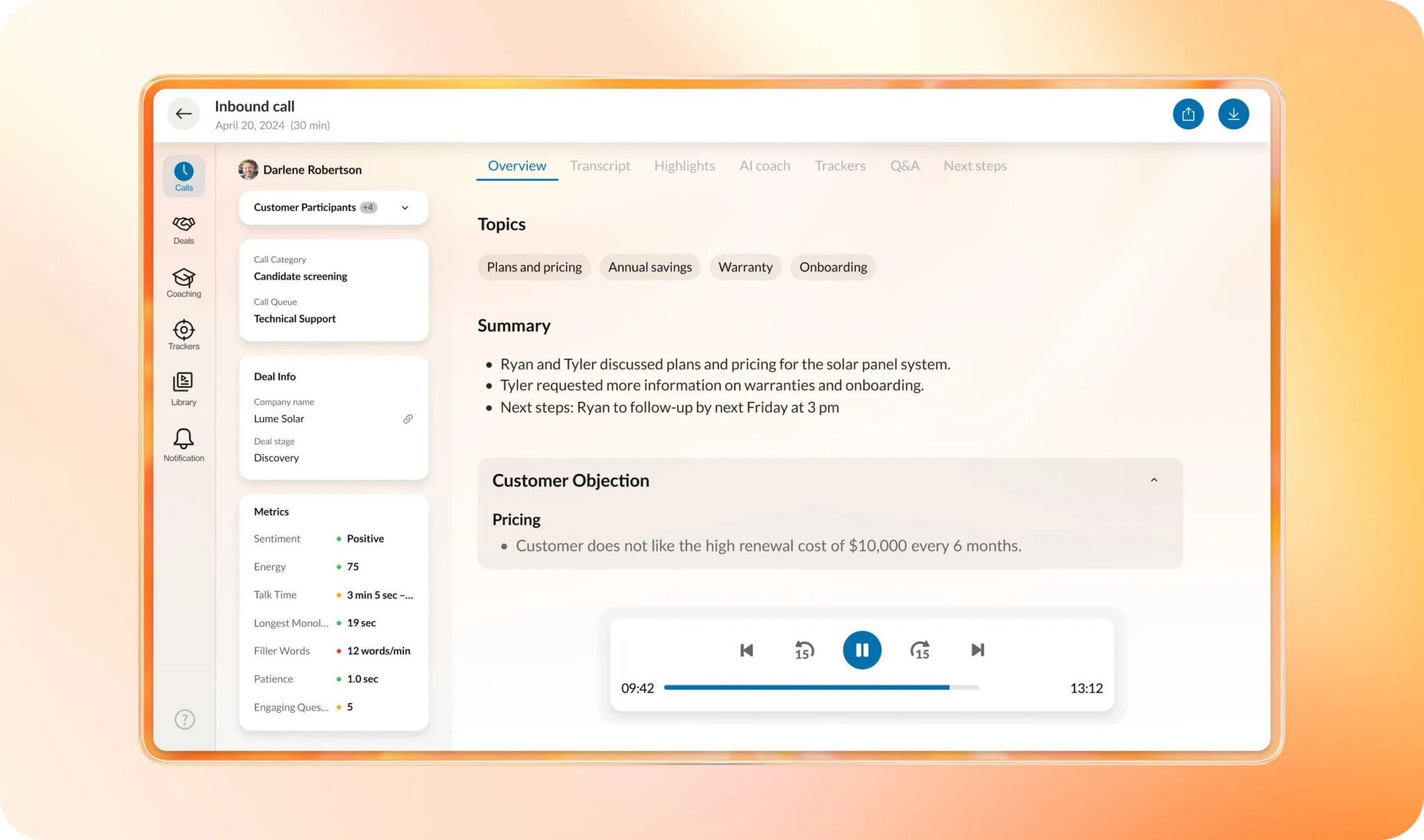
- Omnichannel routing and unified workspace: RingCX unifies voice, chat, SMS, email, and social channels into one interface. Agents see full conversation history and customer context in a single view, reducing handle time and improving first-contact resolution. Supervisors gain real-time visibility into queues, workloads, and performance across every channel.

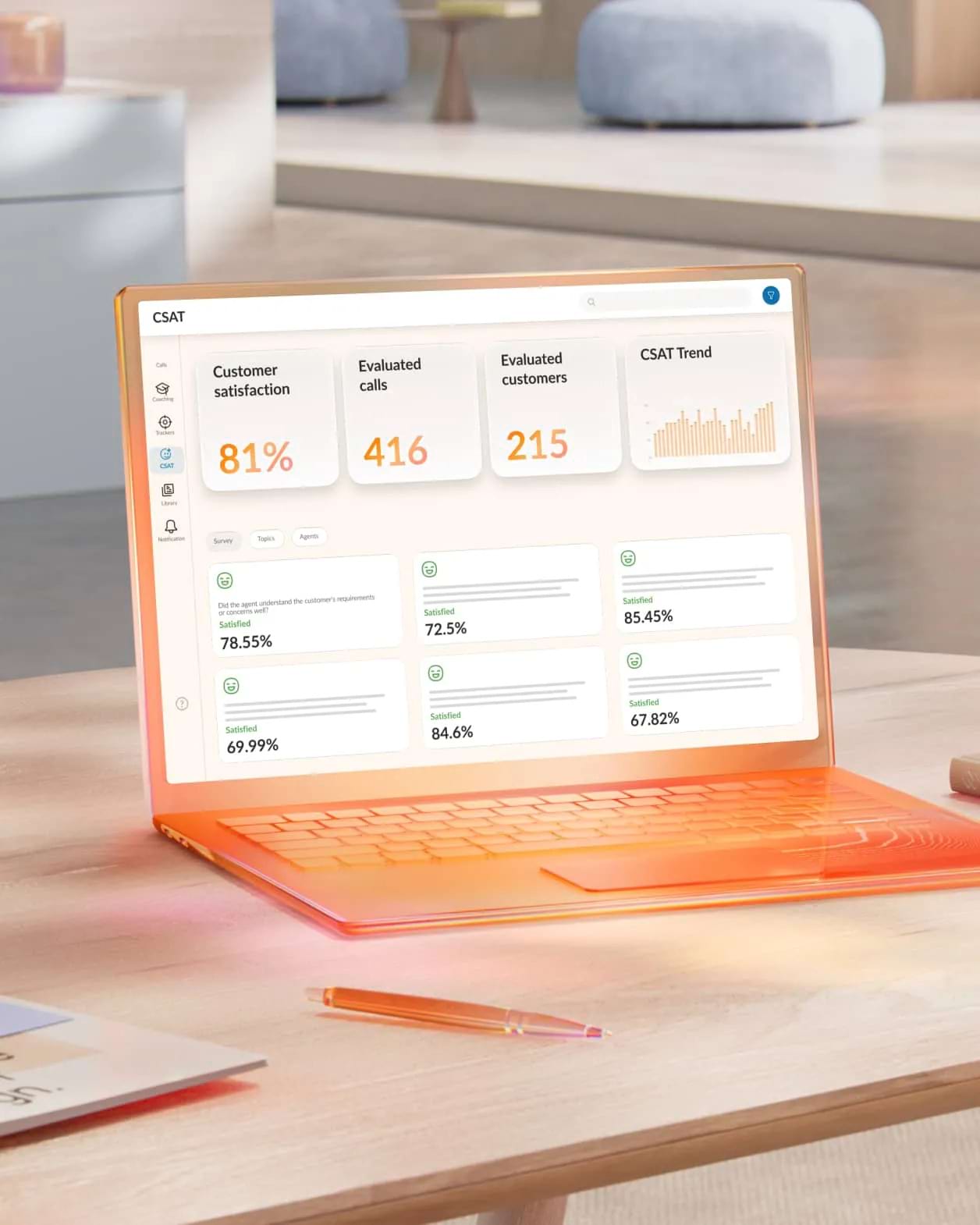
- AI quality management: Instead of sampling 1%–2% of calls, RingCX analyzes 100% of interactions across voice and digital channels. Automated scoring, customizable scorecards, and AI-driven coaching insights help supervisors identify trends, close knowledge gaps, and improve consistency across teams.

- AI Interaction Analytics: RingCX extracts sentiment, intent, customer satisfaction signals, and root causes from every interaction. Leaders can pinpoint recurring issues, identify friction in the customer journey, and proactively improve service operations. Rather than relying solely on post-call surveys, you gain insight from the conversations themselves.
- Virtual agents across the conversation lifecycle: RingCX includes intelligent virtual agents that automate customer interactions across voice and digital channels without sacrificing personalization. RingCX virtual agents use conversational AI to understand intent, resolve common requests, guide customers through workflows, and escalate to live agents with full context so customers never have to repeat themselves.

Real-world impact: AllThingsCX realized a 25% reduction in average handle time using RingCX AI Quality Management, allowing them to identify and resolve frustrations before they lead to churn.
2. Salesforce Service Cloud
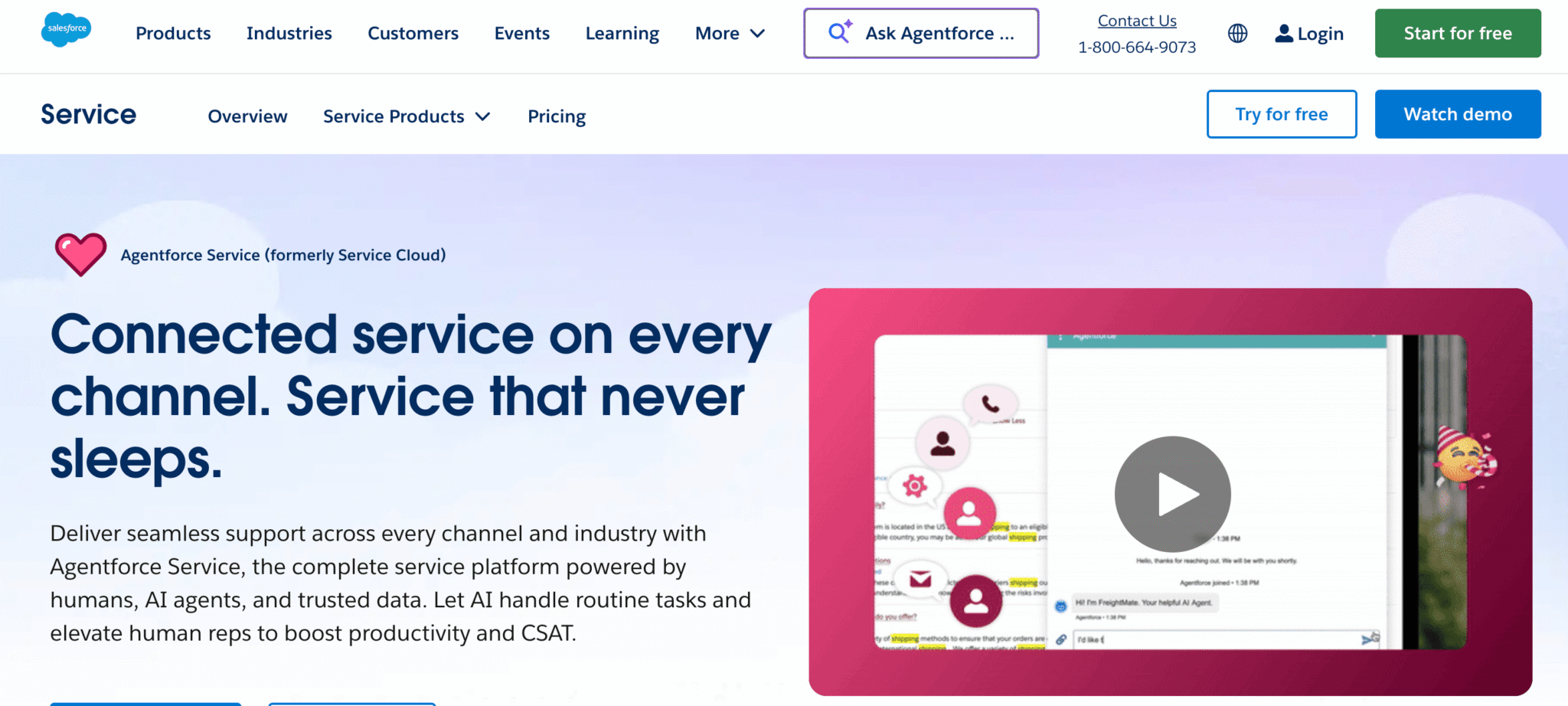
Salesforce Service Cloud (now Agentforce Service) builds customer experience directly onto the Salesforce CRM. It unifies customer history, case management, and real-time interactions into a single screen, making it standard for enterprises already using the Salesforce ecosystem.
Key features:
- Omnichannel routing: Matches cases and conversations to agents based on skills, language, and capacity to improve response speed
- Unified service workspace: Brings phone, chat, and email into one workspace so agents can resolve issues with complete context
- CRM-native workflows: Connects service interactions with account data to eliminate repetitive questioning
- Agentforce AI: Automates routine resolutions and provides “next-best-action” guidance during live interactions
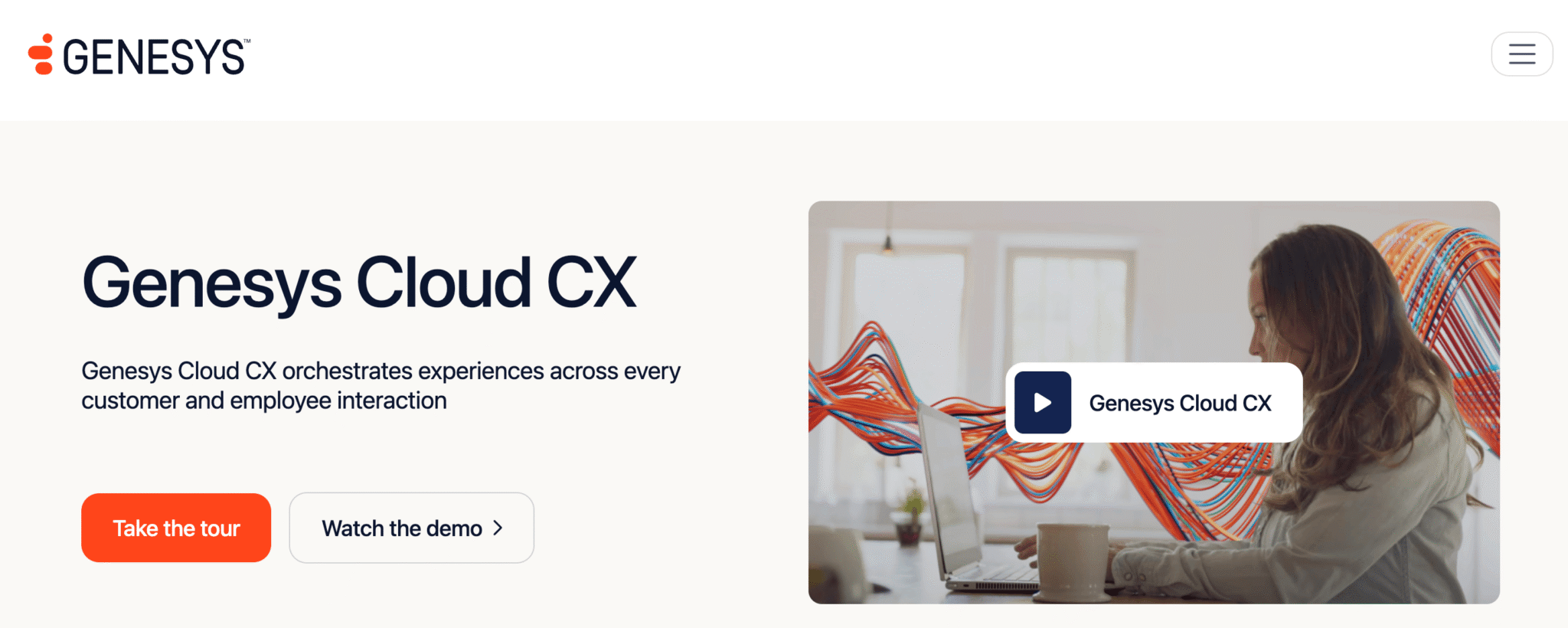
3. Genesys Cloud CX
Genesys Cloud CX handles high volumes of customer conversations across voice and digital channels. It manages complex queues and agent staffing to ensure consistent service levels during peak periods.
Key features:
- Journey orchestration: Unifies voice, digital, and social channels into a single timeline so agents maintain full context during transfers
- Predictive routing: Matches incoming interactions with the best-suited agent available based on skills and historical performance
- Workforce engagement management: Provides native tools for forecasting, scheduling, and monitoring within the same interface
- Agentic virtual agents: Executes end-to-end actions across back-office systems to resolve customer requests autonomously
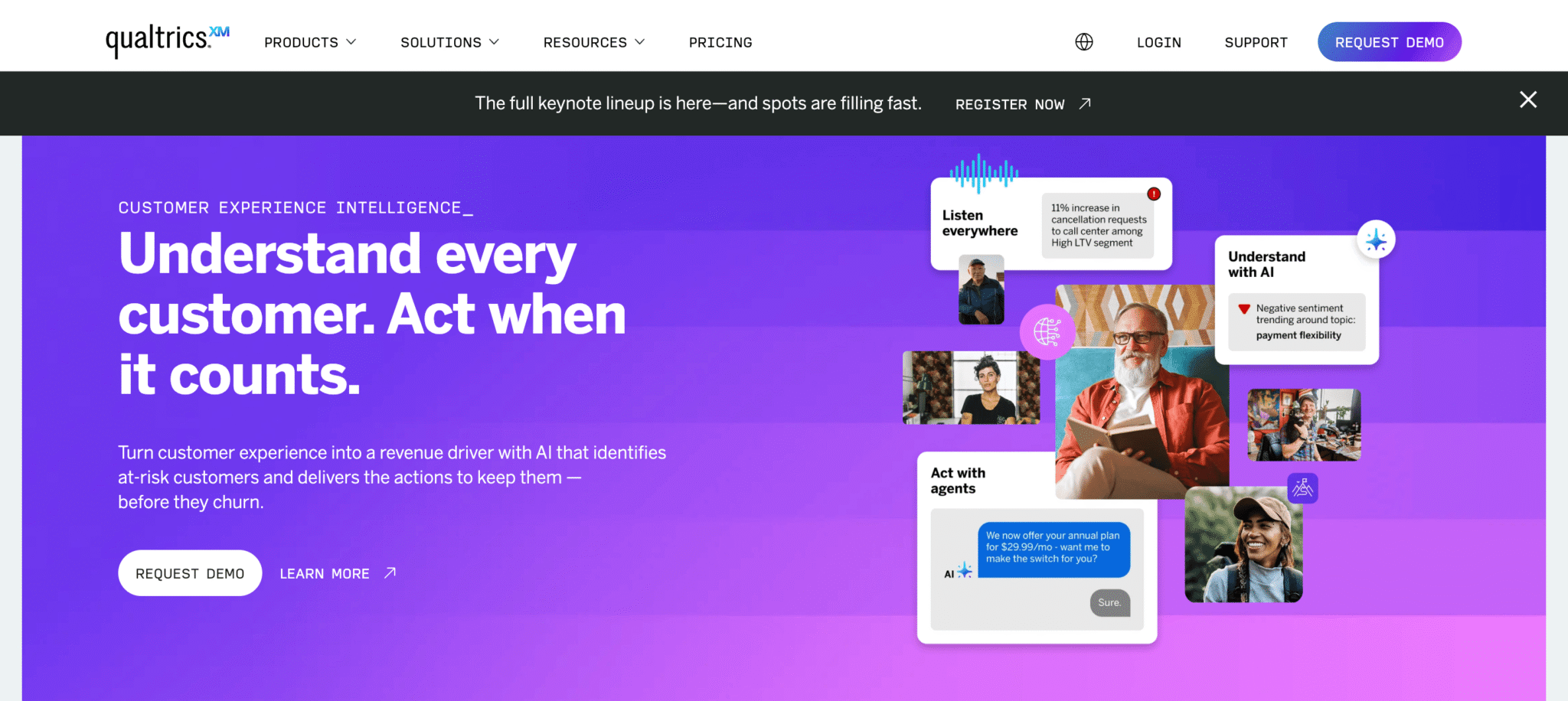
4. Qualtrics XM
Qualtrics XM identifies root causes of customer friction by analyzing millions of interactions across surveys, social media, and call transcripts. It transforms raw sentiment into structured intelligence and automates the recovery process when customer satisfaction drops.
Key features:
- AI-assisted actioning: Suggests replies and next-best actions like service recovery offers based on context and urgency
- Profile-level context: Pulls in customer status, location, lifetime value, and recent visits so frontline teams respond with more relevance
- Sentiment and theme analysis: Groups customer feedback into sentiment trends so teams can quickly see what drives positive or negative experiences
- Cross-experience coverage: Supports customer and employee experience programs to help connect internal issues with customer outcomes
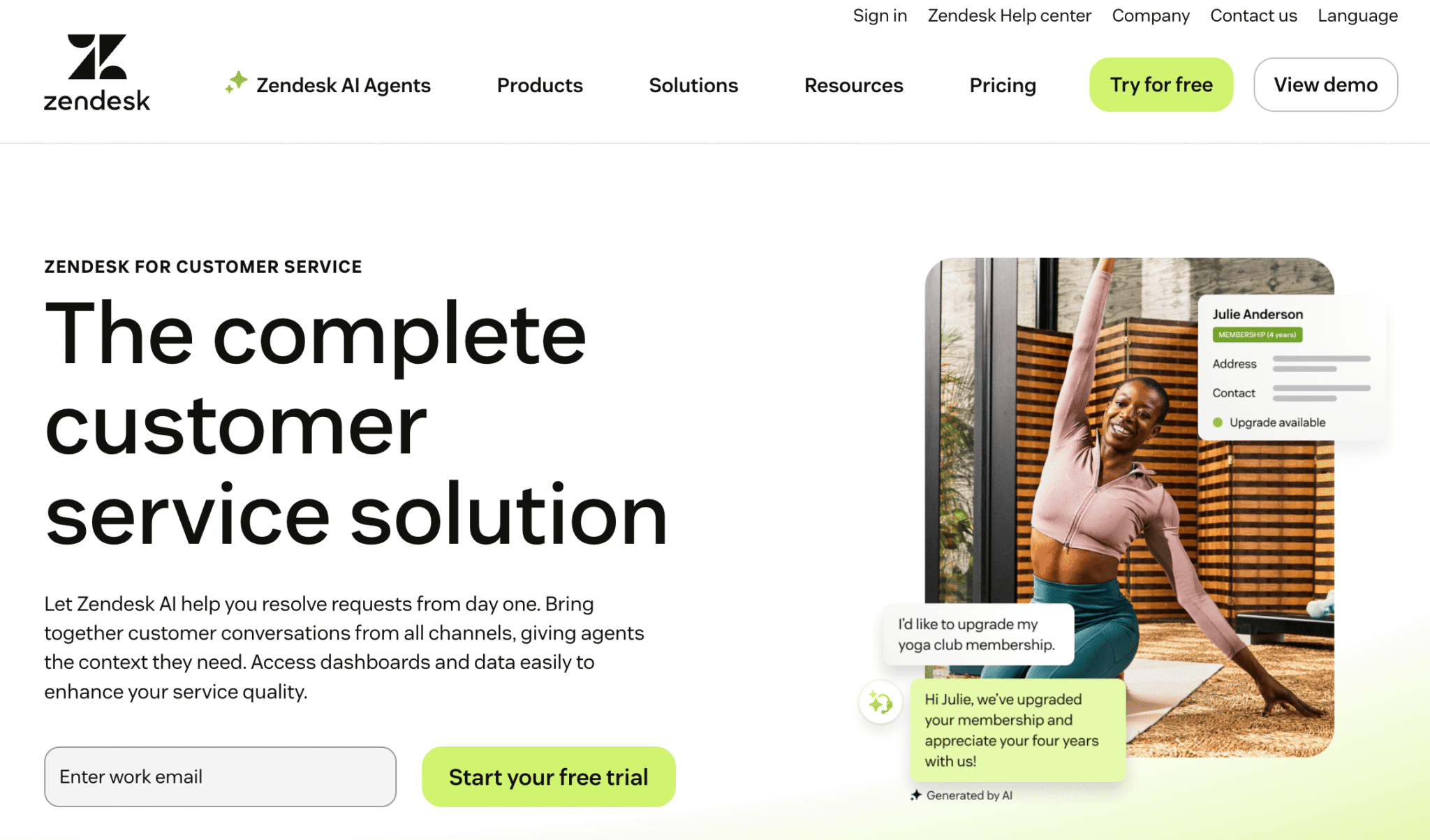
5. Zendesk for Customer Service
Zendesk for Customer Service manages customer requests through a ticketing-first architecture. It centralizes conversations from email, chat, messaging, and social channels, allowing teams to organize incoming work and automate repetitive steps at scale.
Key features:
- Unified agent workspace: Consolidates tickets and conversations from multiple channels so agents can respond without switching apps
- Ticketing and routing automation: Assigns requests automatically based on intent and agent skills to reduce manual triage
- Help center and self-service: Powers branded knowledge bases and AI-driven bots to resolve common issues automatically
- AI and agent assist tools: Generates suggested responses and ticket summaries to reduce manual drafting time
Top features to look for in customer experience software
As you compare platforms, look for features that close the gaps leading to slow service, inconsistent quality, compliance risks, and avoidable costs. The four capabilities below usually have the biggest impact on enterprise outcomes.
Unified communications and contact center convergence
Many enterprise teams still use separate systems for internal calls, contact center queues, and customer data. That fragmentation buries critical customer context, forces agents to spend time switching screens, and leaves managers with disjointed reporting.
A converged model addresses this friction by integrating internal communications and customer support into one workflow. This keeps customer history visible across departments, making routing more consistent and escalation paths more obvious. It also improves resolution speed and allows you to optimize operations to increase customer loyalty.
Voice-first AI and conversation intelligence
Most high-stakes service moments still happen over the phone. While many platforms treat voice as just another channel, a voice-first architecture takes a different approach. It builds the entire service workflow around live conversations while keeping digital channels connected to the same context.
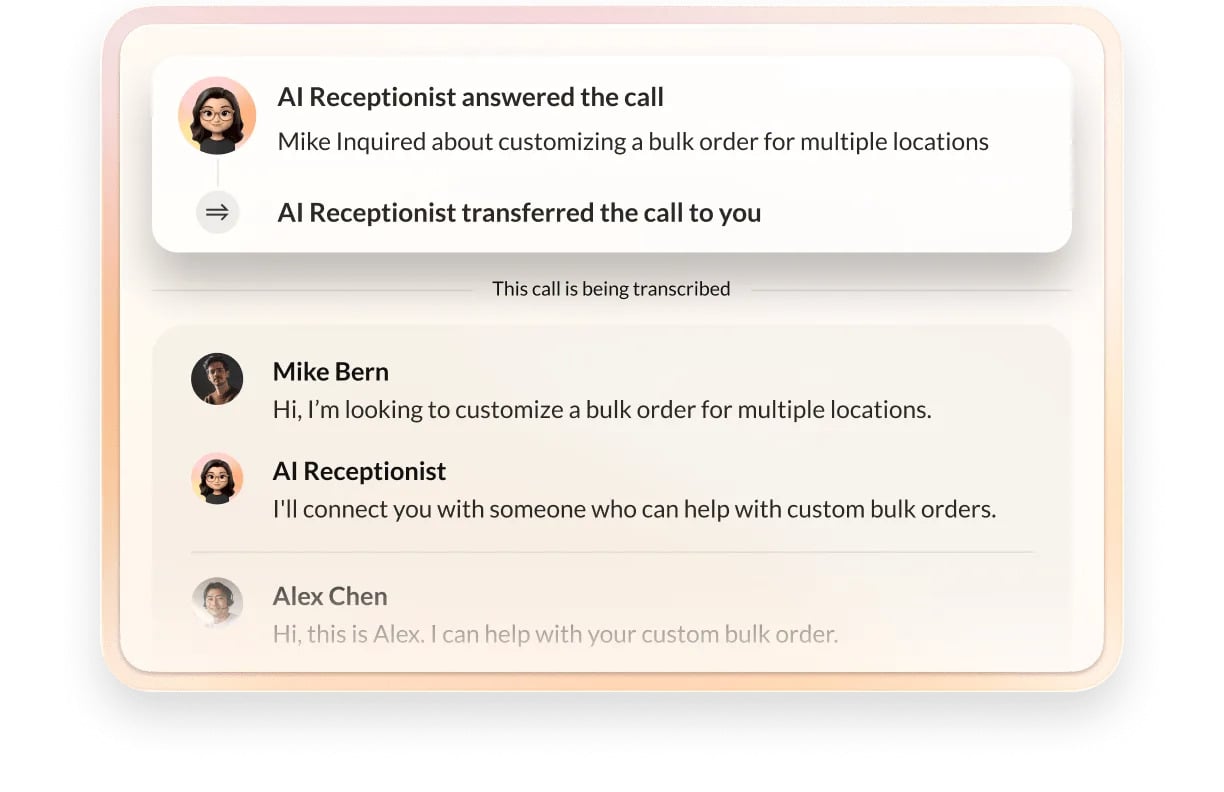
RingCentral demonstrates how this works in practice by deploying agentic AI across three distinct stages:
- AI Receptionist (AIR) handles intake and routing before a human joins.
- AI Virtual Assistant (AVA) supports agents with real-time context and prompts.
- AI Conversation Expert (ACE) analyzes completed calls to identify coaching needs.
Real-world impact: Keller Interiors used RingCentral’s AI Receptionist to manage more than 2,000 calls a week and cut average wait time from 12 minutes to 90 seconds.
Enterprise-grade security and compliance
As CX operations expand across channels and regions, risk exposure grows. Modern customer conversations contain personal data, payment information, and service records that require strict, consistent control. Weak permissions and limited audit trails can allow compliance issues to go undetected until remediation costs peak.
In fact, IBM’s Cost of a Data Breach report lists the average global cost of a data breach as $4.44 million USD. To mitigate this risk, enterprise data platforms must provide role-based access controls, strong auditability, and governance that scales across business units and geographies. Strong governance also protects customer relationships and gives teams the confidence to expand service quality globally.
Real-time analytics and actionable insights
Most teams already have dashboards—but many only show what happened, not what to fix next. Modern CX software should connect live performance signals to immediate action. This allows you to measure customer experience quality by pinpointing where routing fails, where coaching is needed, and where service bottlenecks form.
How to implement customer experience software at scale
Rolling out enterprise CX software is a staged operational change, not a “buy tool, flip switch” project. To succeed, you must first determine how the platform connects to your existing systems and whether it can meet enterprise-grade security and scale requirements from day one.
Assess organizational needs and integration requirements
Friction stemming from broken connections between CRM, telephony, ticketing systems, and analytics tools is a common hurdle at scale. According to MuleSoft’s 2025 benchmark summary, the average enterprise manages 897 applications, with only 29% integrated. That gap is exactly where customer context gets lost and service slows down.
Start by analyzing your current customer journey and the systems supporting it:
- Map high-impact journeys first: Pick two or three journeys with the biggest influence on customer success, such as billing resolutions or renewals.
- Define required integrations before vendor scoring: List “must-connect” systems and required data fields before scheduling demos.
- Run a controlled pilot: Launch in one region or business unit with fixed metrics like first response time, transfer rate, and customer satisfaction score (CSAT).
- Measure operational lift and rework: Track whether teams actually spend less time switching tools and handling manual follow-ups.
- Scale in phases: Expand only after the pilot proves operational improvement and governance readiness.
Centralizing internal collaboration and external customer engagement preserves context during escalations and cross-team transfers. This reduces repeat handling and speeds resolution for a more seamless experience.
Ensure data security, compliance, and scalability
CX platforms process sensitive conversation data across channels, regions, and teams, making governance failures costly. Enterprise evaluation must include concrete control checks before procurement.
Verify these governance pillars to mitigate risk:
- Access governance: Role-based permissions, least-privilege controls, and audit logs
- Data controls: Retention policies, regional data handling, and encryption coverage
- Compliance operations: Clear evidence trails for QA, policy enforcement, and incident response
- Scalability readiness: Capacity to handle higher interaction volume, more teams, and multi-region governance without redesigning workflows
Beyond traditional security, evaluate AI oversight, as weak AI management increases breach risk and cost. If your platform includes AI assistance, require clear controls for model use, data access, and human review paths.
Future-proof your customer experience strategy
Customer experience directly affects revenue, cost, and risk across entire organizations. When systems remain fragmented, customers suffer through long hold times, redundant transfers, and the frustration of repeating their issue to multiple agents.
Customer experience software addresses these pain points by unifying internal communication, contact center operations, and customer insights. Centering this system on voice—where high-stakes interactions still happen—maintains context across every channel. For large enterprises, this convergence provides the visibility necessary to maintain accountability and make informed decisions at scale.
Explore RingCX and see how you can elevate customer interactions with a solution designed to streamline engagement across every touchpoint.
Originally published Mar 03, 2026