AI Communications







Learn how to design, operationalize, and measure a unified customer engagement strategy that delivers retention, revenue, and competitive advantage.
A recent survey found that only 50% of customers think brands are doing a good or excellent job at personalization. Even after years of investment in customer experience (CX) programs and tools, half of your customers still feel like your interactions with them are generic.
That gap isn’t just a marketing strategy problem. It signals deeper challenges in how you connect data across systems, align functions, and scale meaningful conversations across regions, business units, and channels.
Personalized experiences are just one of several ways to kindle the engagement fire. We’ll cover seven strategies for building a successful customer engagement strategy and strengthening connections with your audience.
Key takeaways
- Customer engagement strategies that unify people, platforms, and data across the full lifecycle turn every customer interaction into measurable retention, revenue growth, and competitive advantage.
- Voice-first AI orchestration preserves context across channels and surfaces real-time insights. Agents can manage high-value conversations while automation handles routine requests.
- Enterprises that define clear KPIs, experiment in 90-day cycles, and govern engagement as an ongoing capability can scale and prove ROI faster than teams treating rollout as a finish line.
What is a customer engagement strategy?
A customer engagement strategy is a blueprint for building and maintaining meaningful customer relationships across every interaction. It’s a connected system of communications, content, and support that continually reinforces value throughout the customer journey, not just one-off touchpoints.
At enterprise scale, this demands tight team alignment across IT, CX, marketing, sales, and customer success: shared data, coordinated outreach, and a single face to the customer, backed by technology that unifies every channel with your customer data.
According to Twilio’s 2025 State of Customer Engagement, 88% of consumers are more likely to make a purchase with more personalized, real-time experience. This shows that clear governance, unified data, AI-assisted personalization, and continuous measurement are what sets these programs apart.
7 customer engagement strategies you may want to try
While no single perfect customer engagement tactic works for everyone, here are seven strategies proven to work across multiple businesses. These examples of customer engagement illustrate what a customer-centric approach looks like in practice:
1. Meet your customers where they are
You can’t engage with your target audience if you don’t know where to find them. Whether it’s your website, social media channels, or phone support, you need to meet your customers where and when they expect to find you.
Meeting new and existing customers where they are reduces friction, facilitates personalization, and strengthens brand loyalty.
- Identify priority channels: Analyze first-party data, customer relationship management (CRM) insights, and interaction history to determine where customers initiate conversations. Invest where demand already exists.
- Align to peak engagement windows: Use interaction analytics and queue data to match staffing, routing, and automation to real-time volume patterns.
- Unify cross-channel visibility: Consolidate reporting across voice and digital channels to track wait times, response rates, and abandonment in one view.
- Optimize response cadence: Adjust campaigns, notifications, and support coverage based on channel behavior. Prioritize SMS for urgent updates and route complex issues to live agents with full context.
2. Personalize interactions at scale
Today, 76% of customers expect personalization. However, manually customizing every customer interaction isn’t realistic for most businesses.
Instead, unify customer data and apply AI to automate relevance across every interaction.
When you connect purchase history, browsing behavior, sentiment, and prior conversations, you enable teams to respond with precision. The result: faster resolutions, higher conversion rates, and stronger customer retention without adding headcount.
- Activate AI-driven personalization: Use AI to analyze behavioral and transactional data, then automate next-best actions, messaging, and follow-ups across voice and digital channels.
- Deliver dynamic digital experiences: Adapt website and app content based on lifecycle stage, account status, or engagement history to reduce friction and accelerate decisions.
- Embed contextual recommendations: Integrate CRM and interaction data to power relevant product, service, or content suggestions across web, mobile, email, and support channels.
- Equip agents with real-time context: Surface customer history, open cases, and sentiment insights directly in the agent workspace. Reduce tool switching and improve first contact resolution.
3. Offer omnichannel support and engagement
Email, phone, and chat remain core channels, but 71% of customers prefer different channels depending on the situation. They might discover your brand on social, complete a purchase in your app, and escalate an issue over voice. If your systems don’t connect those moments, customers repeat themselves and service levels decline.
Understanding customer expectations around channel flexibility is fundamental to omnichannel execution. It means unifying every interaction so teams respond with full context, not fragments.
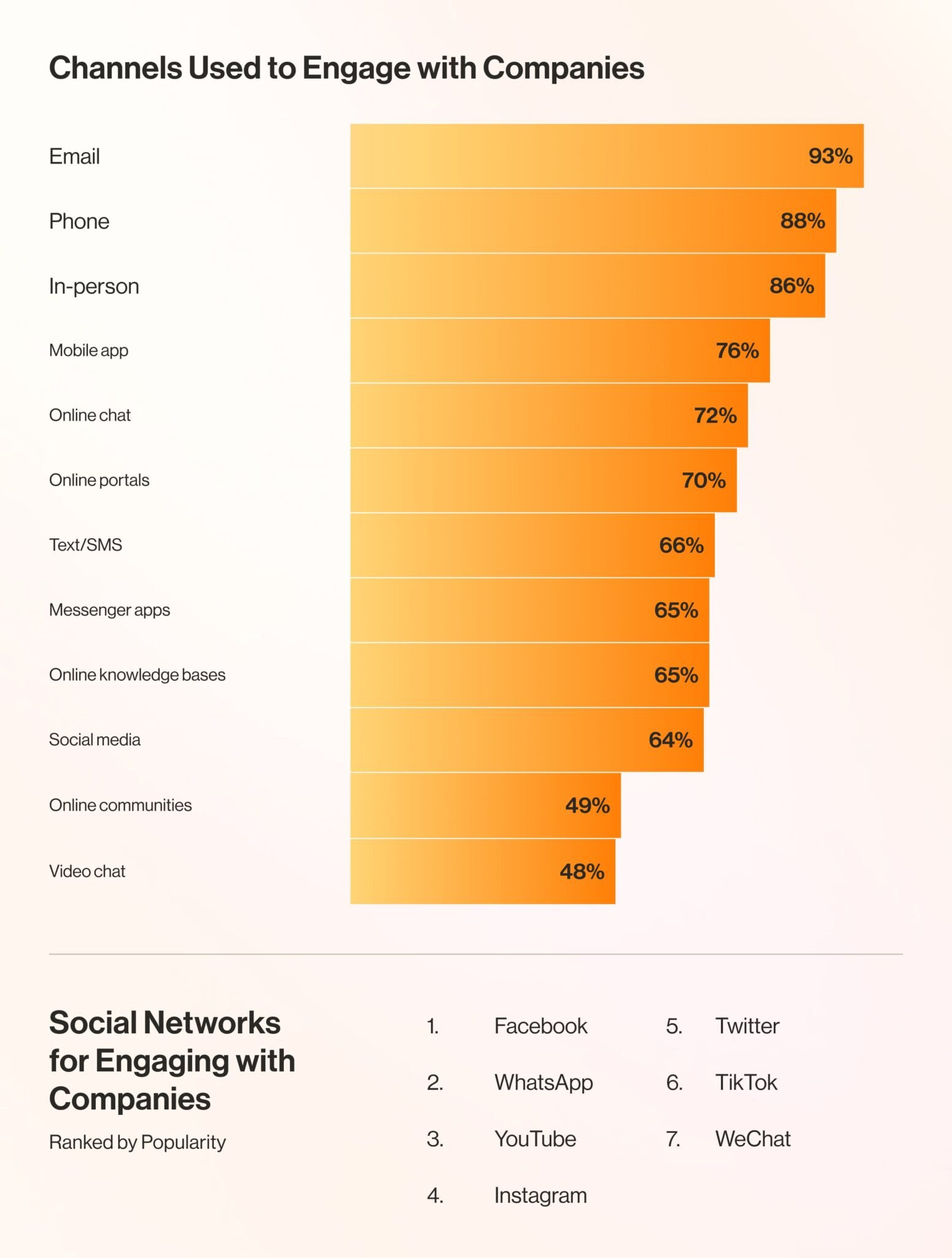
- Deploy a unified cloud contact center: Implement a contact center as a service (CCaaS) platform to connect voice, chat, SMS, and social in one workspace. Give agents shared visibility to improve first contact resolution and reduce handle time.
- Document channel preferences: Capture preferred engagement channels through surveys, account settings, and behavioral data. Route interactions based on real customer behavior, not assumptions.
- Integrate commerce and service systems: Sync ecommerce, mobile, and support platforms so order history, browsing data, and case details flow into every conversation.
- Centralize performance reporting: Track service levels, abandonment rates, and response times across channels in a single dashboard. Replace siloed metrics with unified operational insights.
4. Listen to your customers
Every effective customer engagement strategy depends on one capability: listening at scale and acting on what you hear.
Customers expect you to capture customer feedback across every interaction, not just annual surveys. If you ignore sentiment signals, support data, or social commentary, you miss early indicators of churn, product gaps, and service breakdowns. The pain points that surface through listening often reveal the quickest path to improvement.
- Trigger post-interaction survey: Send targeted surveys immediately after purchases or support cases to capture high-fidelity feedback.
- Monitor sentiment across channels: Track social mentions, support tickets, chat logs, and voice transcripts to identify trends and emerging risks.
- Offer frictionless feedback paths: Let customers share input through web forms, in-app prompts, SMS, or email on their terms.
- Run structured customer panels: Engage high-value segments in focused discussions to validate roadmap decisions. Webinars and virtual roundtables can also serve as structured listening formats that double as educational touchpoints.
- Close the loop publicly: Communicate the changes you’ve implemented based on feedback. Visibility builds trust.
5. Engage on social media
Your strategy should extend beyond owned channels. Social media now functions as a real-time service, feedback, and brand experience channel. Customers don’t just consume content, they ask questions, raise concerns, and expect responses.
Forums and branded community spaces extend this further, giving loyal customers a place to connect with each other and share experiences. Word-of-mouth and referrals often originate in these spaces, making them worth investing in even when direct conversion is hard to measure.
Social engagement requires governance, monitoring, and integration. When you treat social as a connected engagement channel, you gain earlier sentiment signals, reduce escalation risk, and strengthen brand trust.
- Respond consistently and quickly: Acknowledge comments, questions, and complaints. Even brief replies signal accountability and attentiveness.
- Use social management and monitoring tools: Set alerts, route issues to the right teams, and automate responses when appropriate to maintain coverage at scale.
- Encourage interactive engagement: Use polls, Q&A sessions, and user-generated content campaigns to invite participation and surface customer insight.
- Share human-centered content: Highlight customer stories, behind-the-scenes moments, and real use cases to deepen the emotional connection customers feel with your brand.
6. Leverage predictive analytics for proactive engagement
When customers contact you with problems, churn risk is often already on the rise. Instead, use behavioral data and predictive analytics to identify friction early and, ideally, before service levels drop or renewal dates pass.
Proactive engagement protects revenue, improves customer retention, and strengthens trust. It also creates natural openings to build relationships with existing customers that go beyond transactional support.
- Monitor usage patterns: Identify underutilization, feature gaps, or sudden behavior changes that signal risk or upsell opportunity.
- Trigger renewal and lifecycle reminders: Reach out on preferred channels before contracts expire with relevant renewal details or upgrade options.
- Deliver timely recommendations: Use purchase history and engagement trends to suggest next-best products, services, or resources.
- Send service and maintenance alerts: Notify customers about updates, outages, or potential disruptions before they impact performance.
7. Deliver excellent post-purchase support
The relationship with your customers doesn’t end after a sale. It extends into onboarding, support, and long-term success.
After purchase, your service and success teams shape retention, expansion, and advocacy. If onboarding stalls or support feels fragmented, customers question your value. If you deliver fast, contextual support, you increase adoption and lifetime value, which is especially critical for loyal customers who have the potential to become advocates and drive referrals.
Post-purchase engagement requires unified workflows and the right technology to support them.
- Design structured onboarding: Guide customers through setup and early milestones with customer success teams, knowledge bases, and proactive check-ins.
- Provide true omnichannel support: Offer phone, chat, email, and social support through a unified contact center platform like RingCentral RingCX to preserve context across interactions.
- Use AI to accelerate resolution: Deploy chatbots for 24/7 assistance on routine requests, and equip live agents with real-time summaries and conversation insights for complex cases.
- Automate follow-ups: Trigger satisfaction checks, usage tips, and renewal touchpoints based on lifecycle stage and behavior.
How to measure customer engagement strategy success
Build a measurement framework that connects engagement activity to business outcomes. Track experience, efficiency, and revenue signals consistently across channels and regions to justify investment and drive continuous improvement.
Customer experience and satisfaction metrics
- Customer Satisfaction Score (CSAT): Deploy short surveys after key interactions like support cases or onboarding sessions. Compare CSAT by channel, product, or region to target improvements.
- Net Promoter Score (NPS): Measure how likely customers are to recommend you. Organizations with higher NPS see greater customer interest: CustomerGauge found that a 10-point increase in NPS can lead to 3.1% higher revenue.
- Customer Effort Score (CES): Track how easily customers complete tasks like resolving issues or changing orders.
Operational efficiency and cost reduction indicators
- First Contact Resolution (FCR): Track the percentage of issues you resolve in a single interaction. Higher FCR drives both satisfaction and lower handling costs.
- Average Handle Time (AHT): Measure how long agents take to resolve inquiries across channels. Aim for fewer transfers and less repetition, not rushed conversations.
- Channel mix and containment: Monitor the share of interactions you handle through self-service, virtual agents, and lower-cost digital channels versus phone.
- Agent productivity: Count work items handled per hour or day, especially when you use tools like AI Agent Assist to automate after-call work and note-taking.
Unified platforms like RingCentral RingCX let you track these indicators across all channels in one reporting environment, so you can see how engagement efforts affect both customer outcomes and costs.
Revenue impact and customer lifetime value tracking
- Customer Lifetime Value (CLV): Calculate the total revenue you expect from a customer over the relationship, factoring in renewal rates and expansion.
- Retention and churn: Measure the percentage of customers or revenue that renews versus what you lose.
- Repeat purchase frequency: Track how often customers buy again within a defined window to gauge how deeply they rely on your offerings.
- Engagement scoring: Build composite scores that combine logins, feature usage, event attendance, and support interactions to predict growth or risk.
Integrate contact center analytics, CRM data, and marketing systems to see how specific engagement motions influence renewals, expansions, and advocacy. Then, refine your strategy based on what drives the strongest financial results.
Turn customer engagement into measurable competitive advantage
Building a customer engagement strategy that drives retention and revenue takes more than good intentions. It takes diagnosed gaps, prioritized use cases, orchestration that preserves context, and metrics tied to efficiency, customer health, and outcomes.
Connect your people, platforms, and data on unified architecture so every interaction carries context and every metric ties back to business goals.
With RingCentral RingCX, your teams get communications, contact center, and conversation intelligence in one place: no fragmented tools, full context across every channel, and a faster path to proven ROI.
Customer engagement strategy FAQs
What are customer engagement strategies?
Customer engagement strategies are plans that businesses use to build meaningful, ongoing relationships with their customers across all touchpoints.
These strategies focus on creating value beyond transactions through personalized interactions, proactive support, and consistent communication.
Why have a customer engagement strategy?
Customer engagement strategies help improve customer loyalty and satisfaction. Better engagement also improves the overall CX by delivering value and showing customers you care about their needs.
How do I create and develop a customer engagement strategy?
To develop a customer engagement strategy, start by researching where your customers spend time and which channels they prefer.
Then implement personalization tools, create valuable content, and establish omnichannel support systems. Finally, use data analytics to track customer behavior and preferences, then continuously test and refine your approach based on feedback and performance metrics.
Updated Mar 19, 2026