AI Communications








AI IVR uses conversational, intent-driven routing to improve efficiency, reduce costs, and scale with your contact center.
Contact center leaders are under pressure from every direction. Customer expectations keep rising, operational costs are hard to control, and aging interactive voice response (IVR) systems are making both problems worse.
Legacy IVR wasn’t built for today’s call volumes or customer standards. Rigid menus slow down resolution, increase transfers, and leave agents recovering from poor routing before a conversation even starts.
AI IVR changes this. Instead of navigating phone trees, customers speak naturally, and the system understands intent, routes with context, and resolves requests faster. Lower handle time, fewer transfers, and stronger customer satisfaction follow.
Key takeaways
- AI IVR replaces menus with intent-driven routing
- Reduces transfers, handle time, and costs
- Improves first-call resolution and customer experience (CX)
- Connects call intake, interaction, and insights
- Works best as part of a unified platform
What is AI IVR?
AI IVR replaces static menu trees with natural language processing and intelligent routing.
Instead of forcing customer calls through “press 1, press 2” menus, AI-powered IVR lets callers speak naturally. When a customer says, “I need to update my billing information,” the system identifies caller intent, captures context, and routes the call or resolves the request directly.
Modern AI IVR connects call intake, live interactions, and post-call insights into a single continuous workflow, so every part of the interaction runs on shared context.
For call centers, the operational impact is direct:
- Lower call abandonment as customers avoid frustrating menus
- Faster resolution through accurate first-time routing
- Reduced wait times through smarter call handling
- Improved customer satisfaction through natural interactions
For mid-market and enterprise teams handling high call volumes, the impact compounds quickly across thousands of interactions.
Core components of AI-powered interactive voice response systems
AI IVR combines several technologies that work together to handle calls more intelligently than traditional systems.
- Natural language understanding (NLU) converts spoken requests into identified intent, even when phrasing varies. A caller saying “track my order,” “where’s my package,” or “check delivery status” all map to the same intent. Accurate intent capture at the first touchpoint reduces misroutes and lowers transfer rates across every call.
- Conversational interaction supports multi-turn exchanges, asking clarifying questions, and retaining context throughout. Callers don’t need to repeat information or restart call flows, which reduces abandonment and improves containment.
- Intelligent routing and resolution uses intent, context, and real-time data to resolve common requests through self-service options, route calls to the right live agent with full context, or prioritize urgent and high-value interactions.
- Continuous learning via machine learning refines intent recognition and optimizes workflows based on real interaction data, improving routing accuracy and containment rates over time without manual updates.
AI IVR vs traditional IVR: What actually changes
The difference between AI IVR and traditional IVR is structural. Traditional IVR tries to reduce agent workload. AI IVR improves how every interaction is handled, whether automated or agent-assisted.
Traditional IVR:
- Fixed decision trees
- Keypad-based navigation
- Manual updates and maintenance
- Limited self-service options
- Minimal integration with business systems via APIs
AI IVR:
- Conversational, intent-based interaction
- Context-aware routing decisions
- Continuous learning and adaptation
- Expanded self-service across complex scenarios
- Deep integration with CRM platforms, knowledge bases, and contact center platforms
The result is a shift from call deflection to conversation optimization.

Why contact centers are adopting AI IVR now
Contact center leaders face pressure on multiple fronts: rising customer expectations, tighter operational budgets, and the need to scale without adding headcount. Legacy phone system infrastructure makes all three harder to manage.
AI IVR addresses these challenges directly. Organizations that effectively deploy AI tools can boost productivity and growth, reduce operational costs, improve customer satisfaction, and build a measurable advantage over competitors still running traditional IVR systems.
For enterprise contact centers, where reliability and integration complexity are critical, RingCentral’s voice-first AI approach is built specifically for these demands.
Operational efficiency and cost control
Traditional IVR was built to deflect calls. In practice, it often does the opposite, creating friction that leads to transfers, escalations, and longer wait times.
AI IVR resolves routine customer support requests conversationally and routes complex interactions with greater accuracy from the start.
The operational impact is measurable:
- Improved containment of routine inquiries
- Reduction in average handle time
- Fewer call transfers and less rework
- Lower cost per contact without adding headcount
- Less time spent on repetitive, low-value agent tasks
Implementing artificial intelligence in customer-facing workflows can generate revenue increases of up to 8% and reduce service costs by up to 30%, according to McKinsey. These gains shift contact center operations from reactive to scalable, handling higher volumes without proportional staffing increases.
Customer experience improvements
Customers don’t think in menu options. They expect to explain what they need and get a clear path to resolution. AI IVR meets that expectation. Customers use natural speech, and the system responds with context from the start.
Instead of navigating menus, customers:
- Speak freely and are understood immediately
- Avoid repeating information across steps or channels
- Reach resolution faster, with fewer handoffs
The result is consistent improvement in:
- First-call resolution
- Repeat contact rates
- Overall customer satisfaction
It also creates a more accessible service experience for customers who struggle with traditional keypad navigation.
For organizations still running legacy IVR, this gap is becoming a competitive liability. Customers who reach faster, more natural resolution stay longer and require less follow-up. Those who hit friction go elsewhere.
Conversational IVR is increasingly becoming the baseline expectation in high-volume service environments, and contact centers that haven’t modernized are feeling it in their satisfaction scores.
Agent experience and performance gains
AI IVR improves customer experience by improving how agents work. By handling routine inquiries and qualifying calls upfront, it ensures agents start each interaction with the right context.
The result for agents is direct:
- Less time spent on repetitive, low-value tasks
- More productive conversations from the first touchpoint
- Greater focus on complex, high-impact interactions
Forrester predicts that AI-driven automation will reduce daily agent workloads by an average of an hour through automating admin and repetitive tasks. Agents handle more complex work, resolve calls faster, and spend less time on repetitive tasks.
Essential AI IVR capabilities for enterprise deployment
Not all IVR solutions are designed for enterprise environments. At scale, you need capabilities that improve accuracy, integrate across systems, and operate reliably under real-world conditions.
The right AI platform also eliminates the complexity of managing separate UCaaS and CCaaS tools, delivering the convergence that modern contact centers need to operate efficiently at scale.
Advanced natural language understanding
Enterprise-grade AI IVR must accurately interpret intent in real-world scenarios, not controlled environments.
This includes understanding accents and varied speech patterns, industry-specific terminology, and conversations with background noise and imperfect audio.
Effective systems combine:
- Intent recognition to identify what the caller needs
- Entity extraction to capture key details (account numbers, dates)
- Sentiment detection to identify urgency or frustration
- Context retention across multi-turn conversations
The combination gives the system enough context to act on what the customer actually needs, not just their literal words.
RingCentral’s AI Receptionist (AIR) is built specifically for voice environments, where a misunderstood intent means a misrouted call.
This includes low-latency speech recognition and interruption handling so callers can speak naturally without waiting for prompts. AI virtual agents like AIR can also process context-aware responses in multi-turn conversations, and accurately detect intent even with background noise or varied speech patterns.
Intelligent routing with real-time context
Effective routing requires more than the caller’s stated request. AI IVR should evaluate:
- Customer history and value
- Agent skills and availability
- Real-time operational conditions
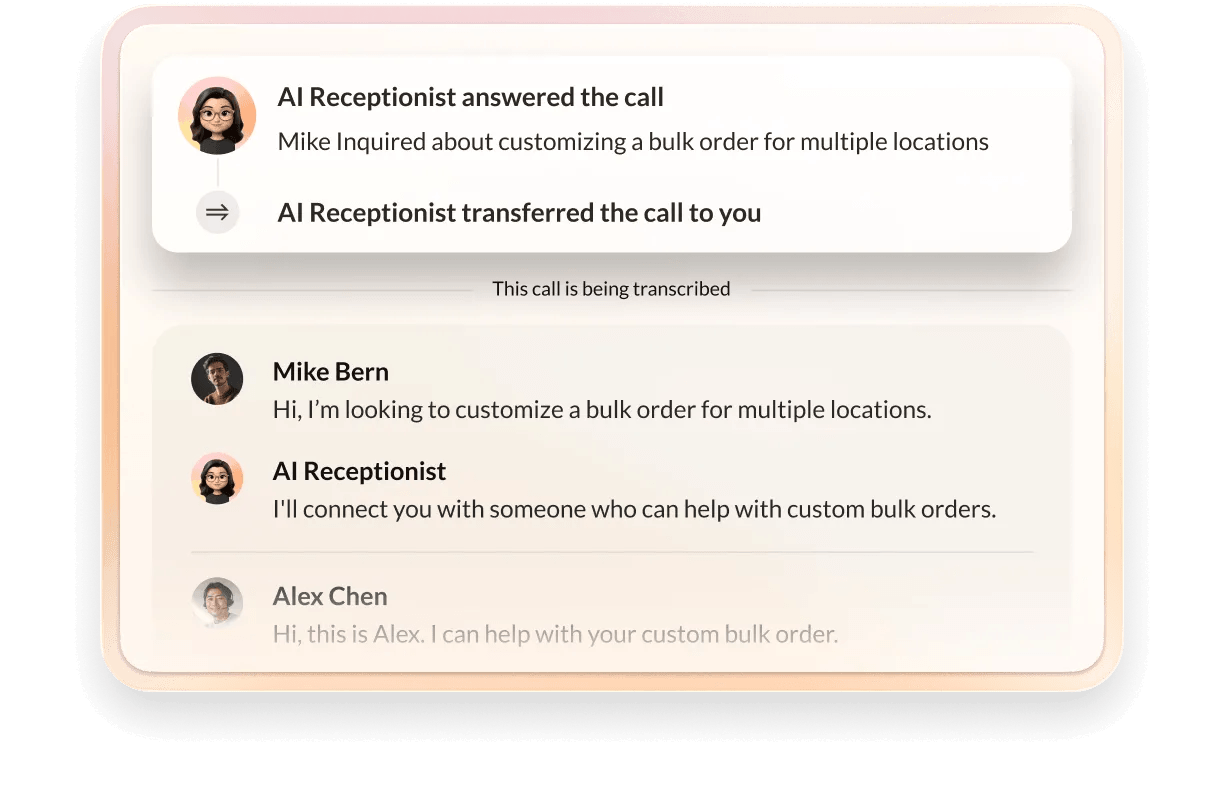
This ensures each caller reaches the right resource on the first attempt, reducing transfers, shortening handle time, and improving resolution rates.
Deep integration across your tech stack
AI IVR only delivers value when it connects to the systems your teams already use. At a minimum, it should integrate with customer relationship management (CRM) platforms, ticketing systems, knowledge bases, and workforce management tools.
These integrations enable:
- Personalized interactions from the first touchpoint
- Automated data capture and updates
- Clean transfers between AI and human agents with full context passed through
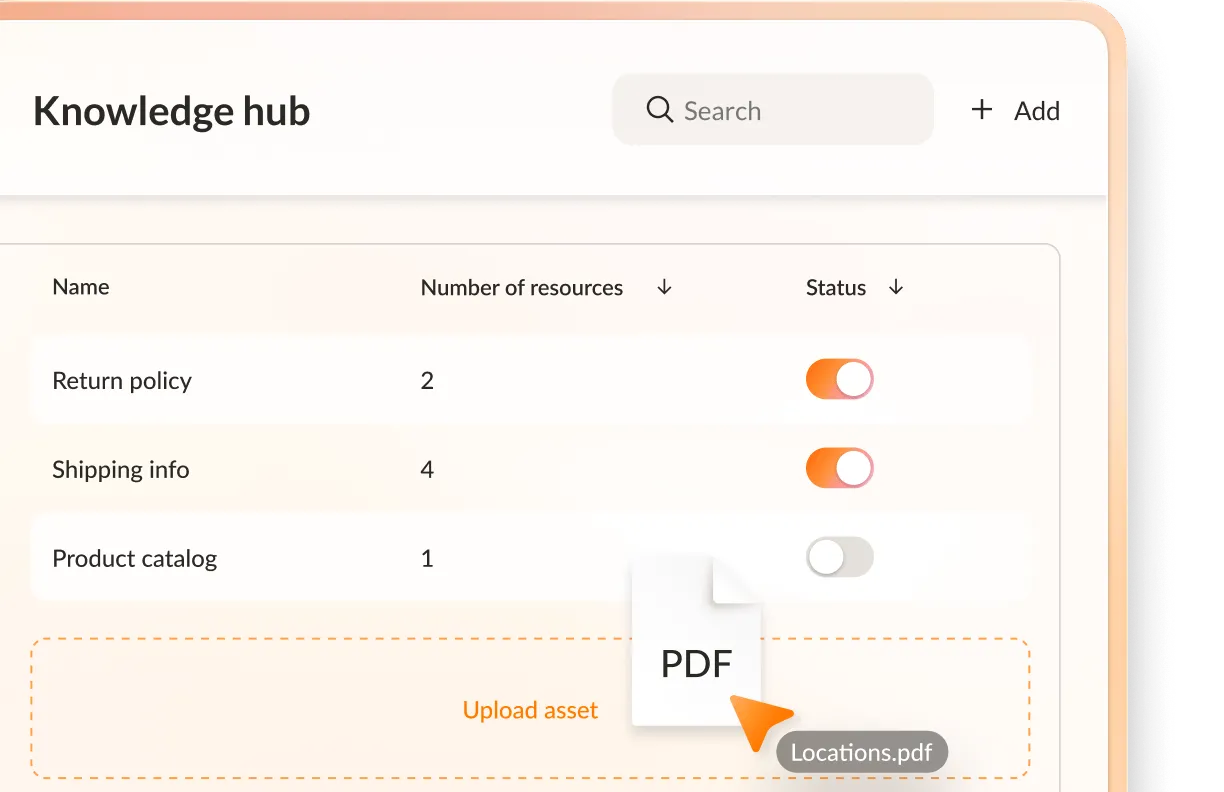
With AIR, intent and context are captured at the start of the call and passed through the interaction, so agents receive qualified calls instead of starting from scratch. Agents receive the full picture before they say hello.
Omnichannel continuity
Customer conversations don’t stay in one channel, and your AI IVR shouldn’t either. Effective communication demands omnichannel orchestration. When a conversation shifts from a voice call to an SMS or a digital chat, your communication system must maintain the underlying context to prevent the friction of repetitive explanations.
True continuity ensures that customer intent and history follow the user regardless of the medium. This serves as a core pillar of agentic voice AI, which treats different interaction points as part of a single, unified lifecycle.
For example, RingCentral AI Representative (AIR) Pro acts as an intelligent orchestration layer. It doesn’t just answer and route voice calls, but deploys across SMS, web chat, messaging, and social media channels. This ensures that both AI and human agents have a complete, real-time view of the customer’s needs.
The effectiveness of these transitions depends on the depth of your platform’s integration. Rather than layering a standalone IVR on top of existing tools, a unified communications and contact center platform allows data to flow through a shared infrastructure. This architectural approach provides several key advantages for your business:
- Reduces integration overhead: Operating on a single stack eliminates the need to manage disparate bolt-on solutions.
- Improves routing accuracy: Shared data enables more intelligent, context-aware routing, so customers reach the right resource faster.
- Strengthens operational intelligence: By unifying interaction data from all channels, leadership gains total visibility into demand and performance trends.
By centering your strategy on agentic AI that executes tasks and maintains context, you provide a professional, consistent experience that scales with your growth.
Enterprise-grade security and scalability
At enterprise scale, trustworthy AI principles, reliability, and compliance are non-negotiable.
Look for:
- Support for standards like the Health Insurance Portability and Accountability Act (HIPAA) for healthcare environments, Payment Card Industry Data Security Standard (PCI DSS), and General Data Protection Regulation (GDPR) where applicable
- High availability and consistent uptime
- Infrastructure that scales with peak demand
- Clear governance and data control
Enterprise-ready platforms like RingCentral are built with these requirements in mind, combining AI capabilities with the reliability and governance needed for high-volume, mission-critical environments.
AI IVR implementation: What to consider before deployment
Successful AI IVR implementation depends on more than the technology itself. It requires the right infrastructure, clear integration planning, and strong organizational alignment. It also starts with a foundational technology decision: choosing a platform built for voice-first AI, not a text-based solution adapted for voice after the fact.
Infrastructure and integration planning
AI IVR relies on real-time voice processing, which places higher demands on your environment than traditional systems.
You need at least:
- Low-latency, high-quality voice processing
- Reliable cloud infrastructure
- Secure, stable integration across systems
Map dependencies early across CRM platforms, data sources, and workflows. This helps prevent bottlenecks, reduces deployment risk, and ensures the system can access the data it needs from day one.
This also means evaluating the underlying architecture, not just the feature set. Platforms purpose-built for voice handle real-time speech processing, latency, and audio quality at a level that text-based AI systems adapted for voice typically can’t match.
Change management and adoption
Even well-designed AI IVR falls short without the organizational alignment to support it.
Start by defining how workflows will change across teams. Agents, supervisors, and IT leaders all interact with the system differently, and each group needs clear guidance.
Successful teams:
- Align on new workflows and responsibilities
- Train agents to handle AI-assisted interactions
- Equip supervisors with analytics and performance insights
- Roll out in phases to test, learn, and refine
Make clear to your team that AI IVR is there to take the repetitive work off their plate, not to take their jobs. When agents see how it reduces the repetitive parts of their day, they get on board faster.
AI IVR is evolving; your approach should too
AI IVR shapes how your contact center performs from the first interaction. Connecting call intake, live conversations, and post-call insights into one continuous workflow produces fewer transfers, more accurate routing, and more consistent outcomes across every interaction.
Treating AI IVR as a standalone upgrade means leaving most of the value behind. The contact centers seeing the strongest results treat it as infrastructure, not a point solution.
RingCentral is built for contact centers that need more than a basic IVR upgrade. Proven enterprise-grade reliability, a platform that unifies voice, contact center, and conversation intelligence, and hands-on experience supporting complex deployments at scale make RingCentral a partner IT leaders and CX executives can count on from day one.
For standard deployments, AI Receptionist handles customer-facing call intake with accuracy and speed. For enterprise teams managing more complex workflows, AIR Pro extends those capabilities with agentic AI that executes multi-step tasks and integrates deeper into your systems.
Explore how RingCentral’s AI Receptionist can help you modernize call routing and improve how your contact center performs every day.
Originally published Apr 09, 2026