AI Communications




You’re probably using some form of artificial intelligence in your daily life. Maybe your organization has already adopted it in some departments. But if you haven’t yet embraced AI sales technology, it’s time to find out exactly what it can do.
So, what is AI in sales, and how does it help your team to close more deals? In this post, we’ll answer those questions and more.
What is artificial intelligence?
Everyone’s talking about AI, but let’s have a quick recap of what the term actually means.
Artificial intelligence is a branch of computer science in which machines are taught to simulate human intelligence and to perform tasks that usually require it. AI covers various technologies, including machine learning, deep learning, and natural language processing (NLP).
Although machines cannot actually think in the way that humans do, scientists can train them to reason, extract meaning, and learn new things over time. AI tools can automate tasks without human intervention, analyze large volumes of data, and make accurate predictions.
What is sales AI?
Sales AI refers to artificial intelligence technology you use to simplify and optimize your sales processes. Various types of AI-driven software are now in use across sales-based operations—often to improve the experience for customers and coach sales personnel more effectively.
AI supports both agent-based sales activities and self-supported interactions via chatbots. Sales reps benefit from the insights gleaned to improve strategies for converting prospects into customers. AI analysis of large volumes of customer interactions can improve sales and support activities by identifying areas for chatbot optimization.
AI in sales examples
Artificial intelligence is a broad and diverse technological field. There are a range of interrelated types and subsets of AI that you can apply to sales. Here are just a few examples:
- Conversational AI: This is artificial intelligence which mimics human interactions. Using natural language processing (NLP) and related tech, this area of AI is particularly useful in sales for providing cross- or up-sell opportunities via AI sales bots.
- Conversation intelligence: Similarly named and related to the above, conversation intelligence is when AI helps sales organizations to analyze interactions and derive actionable insights.
- Predictive analytics: Applying AI to analyze large amounts of data, spot trends, and make predictions for the future. In sales, this may involve forecasting future areas of sales growth or resources needed to meet sales objectives.
- Generative AI: Artificial intelligence that’s able to be “creative” and produce new content (which can be written or visual). In sales, this may be useful for more cost-effective production of sales collateral like emails or for generating sales call scripts.
AI in sales: What’s the full potential of AI sales tools?
There are myriad use cases for artificial intelligence in sales, especially as the technology becomes simpler and more affordable to implement. Let’s take a look at the potential of AI in sales.
Productivity is one of the key areas where AI is having an impact. In a recent HubSpot report, 73% of salespeople with AI-powered CRMs said that these tools had significantly boosted their team’s productivity. 74%, meanwhile, say that AI helped them increase responses for warm and cold calls.
McKinsey estimates that gen AI could open up an incremental $0.8 trillion to $1.2 trillion in productivity across sales and marketing. That’s not surprising, given AI’s ability to shorten the sales cycle and to take care of time-consuming sales tasks.
For example, reps can save a huge amount of time when AI tools automate data collection and entry, deliver post-call summaries, and send scheduled messages and follow-ups. They can also pull in data from a CRM, such as purchase history, to help reps personalize interactions.
Sales AI tools can analyze customer behaviors and characteristics for lead generation and prospecting, matching potential customers with your buyer personas and scoring leads. This means that reps can create tailored nurture campaigns.
Using AI tools for such activities not only saves time but has the potential to increase conversions and therefore revenue. Salesforce reports that 83% of sales teams who use AI grew their revenue in the past year, compared to 66% of teams without it.
According to McKinsey, 66% of respondents using AI in marketing and sales reported a revenue increase of 5% or higher in the second half of 2024. The research also found that advanced sales technology is among the strategies of “winning” companies—those increasing their market share by at least 10 percent annually.
We can expect to see further growth in the volume of data companies collect and store, and an increase in computational power to handle it. AI helps sales teams to maximize the potential of this information, identifying patterns and trends and continually learning from new data.
As they derive deep insights from this data, AI tools help reps to build and maintain strong customer relationships. Conversational intelligence identifies customer preferences and needs, while AI can also monitor customer reactions such as online reviews and social media.
Sales teams can employ AI for mapping the customer journey to identify critical touchpoints and areas of the sales funnel that need improvement. Predictive analytics tools can predict future sales trends, and you can use AI to track customer accounts and identify opportunities for relationship building and buyer intent signals for upselling.
Generative AI continues its rise, with its full potential yet to be unlocked. Sales teams can use it to create hyper-personalized messages and call scripts, and sales presentations. With natural language generation (NLG) tools, the output sounds increasingly human. AI chatbots can handle FAQs and even ask qualifying questions.
The role of AI in sales also extends to performance monitoring, tracking sales attribution, and carrying out A/B testing. Accurate forecasts and competitive analysis helps your business to make more informed business decisions and stay ahead in an evolving marketplace.
To sum up, AI carries an incredible amount of potential for sales teams—as long as it’s combined with a human touch.
AI sales automation and more: The bottom-line benefits of AI in sales
There are a few key benefits to using AI for sales. These benefits impact the customer or prospect experience as well as the ability of your agents to manage the selling process. They include:
- Sales process automation
- Boosted productivity
- Improved conversion rates
Sales process automation
The first key benefit of sales AI is its ability to automate otherwise time-consuming processes. Things like call disposition, updating customer relationship management (CRM) platforms, and other previously manually after call work (ACW) is taken off your reps’ shoulders. AI automation for sales then leads seamlessly into our second advantage.
Boosted productivity
With fewer time-consuming tasks on their plates, reps can spend more time actually selling. And that’s just one way that sales AI can boost productivity. Their sales activities can also be supported by AI-generated tips on live calls, better tailored coaching, the use of generative AI in sales collateral creation, and more. All of which results in…
Improved conversion rates
With automated sales processes and boosted sales rep productivity, conversion rates improve. You can more effectively home in on the right types of prospects with ideal communication strategies, and your reps have the time and support needed to close those deals.
How can I use AI in sales? Areas of the sales process where AI sales software can help

When it comes to how to use AI in sales, the potential applications are ever-growing and evolving. The best AI tools for sales can help your sales reps in a range of ways across a great many areas of the sales process.
Here are just a few ways that AI sales software, like RingSense, could help you close more deals:
- AI sales prospecting and lead qualification
- AI sales calls scripting
- AI sales assistant on live calls
- AI sales coaching post-call
- AI sales bots
- AI to automate sales representatives’ after call work (ACW)
- AI sales forecasting and analytics
AI sales prospecting and lead qualification
AI analysis of prospect interactions gives your business more visibility for improving lead-based qualification. It helps you improve lead-scoring models based on analysis of interactions, prospect traits, and other factors. Improved lead scoring by AI sales prospecting tools reduces time spent on less-promising prospects.
AI sales calls scripting
Using AI for sales scripts on sales calls can help agents keep calls moving in the right direction, handle objections, and more. The ideal AI sales call scripts help agents say the right things at the right time based on real-time prospect interactions.
AI sales assistant on live calls
With the right AI sales tool, your reps can also have a sales AI assistant on hand while they’re on calls talking with prospects. RingSense, for example, delivers automated coaching tips so the team can give consistent, successful pitches.
AI sales coaching post-call
Using AI in sales isn’t only about live, real-time assistance. Sales artificial intelligence can also help with coaching post-call and at scale.
RingSense delivers automated post-call feedback via an AI coach so sellers can improve over time. What’s more, AI is great at analyzing large volumes of sales data to extract actionable insights which can apply to coaching across your organization.
AI sales bots
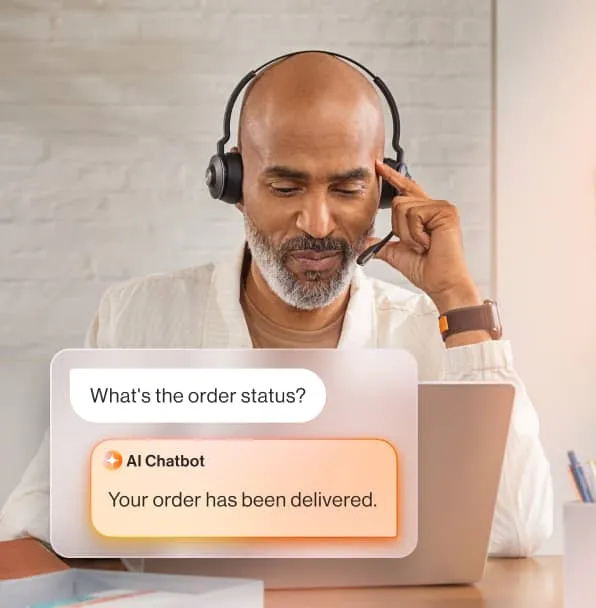
AI sales chatbots are yet another example of useful AI sales automation. They provide fast, convenient access to prospects who have questions. Responding quickly to prospect inquiries is important to winning customers. AI-powered chatbots can accurately identify answers to common questions and make resource recommendations.
AI to automate sales representatives’ after call work (ACW)
Artificial intelligence tools in sales are also great for handling the repetitive, time-consuming, and yet vital tasks that reps otherwise have to handle themselves.
RingSense, for instance, seamlessly records and transcribes phone calls and video meetings and stores them for easy retrieval afterwards. Automated note taking during sales calls also helps reps to focus on active listening.
When the call’s done, RingSense then automatically updates sales CRMs like Salesforce. That automated data entry of summaries and next steps into CRMs, powered by AI-powered conversation analytics with CRM integration, aids hygiene and helps reps move on to the next call more quickly.
AI sales forecasting and analytics
Finally, AI sales solutions can also help you make the most of all that lovely sales data. Data analytics is a known strength of artificial intelligence, with tools able to process and understand a large volume of data near-instantaneously.
RingSense can delve into your data and provides insights into what topics, competitors, and products customers are interested in. As well as insights across all your customers on your competition and their most common objections. All that actionable stuff you can use to close more deals.
That covers how to use AI in sales, in terms of the ways it can help you. How, though, can you ensure that your teams use artificial intelligence to its fullest? We’re glad you asked.
How to implement AI in sales: Some best practices
There are multiple benefits to using AI for sales, but how can you make sure the implementation is successful? Here are some top tips on how to implement AI sales solutions in your business:
Be clear on goals and expectations
Our first tip is to set out clearly defined goals to serve as the foundation for your AI sales strategy.
What do you want to achieve with this technology? Your vision will inform the data you capture, the type of AI technology you adopt, and any predictive models you build.
Align specific sales objectives with wider business goals and make sure they are realistic and measurable.
You should also be clear about expectations. Bear in mind that you may not see instant results, and that you’ll need to set achievable targets as you begin to explore the technology.
Seek broad input and buy-in
For sales AI to work successfully, you’ll need to get buy-in across the organization. In fact, AI adoption requires a transformation in the way you operate, and it works best with a top-down model where leadership comes from the C-suite and all parts of the business work together.
This means proving the worth of AI in a sales setting, so look at results from any tools you’ve started using. If you haven’t combined sales and AI before, start with a low-risk project that’s likely to have an impact in a short time period such as six months or one year.
Of course, buy-in from those who’ll be using the tech—reps and supervisors—is also crucial. Seek their input when setting goals and ask them which parts of the sales process would benefit most from AI. Show them the potential of AI to increase conversions and make their jobs more rewarding.
Don’t forget your customers, who may have misgivings about AI usage—especially when their personal data is being analyzed. Explain how it benefits them, and be transparent about how you’ll collect data and what you’ll do with it. Allow them to opt out or access and delete their data.
Track performance and iterate
As with any new project, you’ll need to keep track of progress to make sure that AI is having the desired effect on your sales operations. Consider the sales metrics that will accurately assess the impact of AI tools and processes.
Metrics such as the number of calls made and the length of the sales cycle will demonstrate the efficiency gains from AI. Measure the number of appointments booked and the eventual conversion rate and win rate, and compare them with results from before you implemented AI.
The customer churn or retention rate— particularly important in B2B sales—can also be impacted by AI. Check forecast accuracy by comparing predictions with actual results, and measure any changes in total or recurring revenue.
If performance isn’t where you want it to be, tweak your processes and the way you implement AI. Provide extra training if necessary until you have the perfect combination of AI and sales.
Use the right AI sales tools
There’s no sense in using AI tools just because you can—it’s important to think carefully about the value they’ll bring to your business and choose solutions that meet your unique needs.
You’ll need to align your AI strategy and tools with overall goals or specific sales targets.
Be aware that “AI” is sometimes used to describe automated tools where the user has to set up rule-based actions. These are highly useful, but ideally you want a solution that features true artificial intelligence that runs by itself and uses machine learning to become smarter over time.
Look for sales AI software that includes predictive analytics and conversational intelligence, plus robust security to keep business info and customer details safe. It should integrate smoothly with the rest of your tech stack, especially your CRM. Just like RingSense does, in fact.
RingSense: An AI sales platform that will help you close more deals
AI is making a huge impact on sales and business in general. By leveraging AI, you can improve sales coaching, optimize conversion rates, and give customers access to more effective self-supported chatbot interactions.
RingSense is designed specifically to support sales leaders through accurate and efficient data extraction powered by artificial intelligence.
Grow your sales team through custom and tailored onboarding for new hires. Improve coaching through sales enablement features like data-driven sales playbooks and greater individual and team insights. Empower your agents with AI-driven action suggestions during customer interactions.
Continually improve the digital customer experience with automated buyer journey summaries that offer insight into past interactions while creating upsell opportunities. Track customer behaviors and messaging sentiment more effectively.
All of these advantages boost your sales productivity and conversion rates. AI has become the great differentiator between companies that thrive and those that lose out to more tech-savvy and innovative leaders.
Contact sales or get a demo today to learn more about how RingSense can help you make the most of AI in sales.
AI sales FAQs
What is AI sales?
AI sales is the name given to a sales process that utilizes artificial intelligence technology. Subsets of AI such as conversation intelligence, predictive analytics, and generative AI can all help sales teams to improve conversions and close more deals.
How can AI help sales teams?
AI makes life easier for sales teams by automating repetitive tasks and freeing them up for higher-value sales activities. It also helps them to understand the needs of their prospects and customers by analyzing conversations and behaviors.
How can AI help me prospect in sales?
Using AI tools for sales, you can identify the prospects most likely to convert and also improve your lead-scoring models through AI analysis. You can use automation to generate and send the right messages at the right times, while AI-powered sales coaching helps you become better at prospecting.
What is AI sales assistant software?
It’s any AI software that’s designed to assist sales reps as they nurture leads toward conversion. This type of software can include automation for sales processes, conversational intelligence tools, generative AI, and predictive analytics.
What are the key benefits of using AI for lead qualification?
By using AI for lead qualification, the tools will quickly analyze interactions with prospects and accelerate your qualification and scoring process. It will also be more accurate, meaning you’re not wasting any time on prospects who are never going to convert.
How should I use AI in sales?
Precisely how AI and sales can best mesh for your reps depends on your organization and its sales goals. If you find that reps aren’t able to make as many sales calls each day as you’d like, automation of ACW may be your most useful application of AI. If it’s not the number of calls but their success rate that’s the issue, live AI assistance and coaching on those calls may work better for you.
Will AI replace sales reps?
That’s a resounding no. Any sales professional will tell you that human connection and trust-building will always be crucial to selling. AI is advancing apace, but it won’t ever be able to build rapport or connect on an emotional level like a human. Sales AI is best thought of as a support and a complement to your sales reps. When artificial intelligence and highly skilled reps work in perfect harmony is when you close most deals.
Updated Sep 15, 2025