AI Communications








Align staffing, AI forecasting, and real-time performance management to reduce costs, protect service levels, and improve agent experience.
Contact centers face mounting pressure from every angle. Flat budgets collide with rising service expectations. Volume spikes, channel proliferation, hybrid teams, and agent burnout threaten to erase months of training investment.
A modern workforce management (WFM) strategy transforms those challenges into an advantage. It aligns staffing, schedules, and performance with actual demand, protecting both your cost structure and the experience you deliver to customers and agents.
This guide covers what call center workforce management means today, how to implement it without disruption, and how AI-powered tools move you from reactive scheduling to proactive, intelligent operations.
Key takeaways
- Modern WFM strategies align staffing with real-time demand across all channels to reduce labor costs while protecting customer experience
- AI-powered forecasting and automated scheduling eliminate manual planning work and provide continuous visibility
- Unified platforms that connect WFM with your contact center, analytics, and CRM deliver a single source of truth
What is workforce management in a call center?
Workforce management in a call center is the process of matching the right number of agents and their specific skill sets to customer demand across all channels, including voice, chat, email, and digital. It uses historical and real-time data to predict when and how customers will contact you, allowing you to meet service-level targets without overspending on labor.
At its core, call center workforce management combines four critical functions:
- Forecasting contact volume and handle times
- Creating optimized agent schedules
- Managing real-time adherence and adjustments
- Analyzing performance to improve accuracy
In an enterprise environment, effective workforce management acts as a control system for your entire customer contact operation, giving you the ability to:
- Predict omnichannel volume with confidence
- Align staffing levels with service-level objectives and operating budgets
- Balance efficiency metrics like cost per contact with quality metrics like first-contact resolution
- Design schedules that respect agent preferences and work-life balance to reduce burnout and attrition
- Respond quickly to unplanned events, such as outages, weather disruptions, or news cycles
Modern WFM software delivers real-time analytics, AI-enabled forecasting, and automated scheduling recommendations to identify exactly where you’re overstaffed, understaffed, or at risk of missing KPIs. Shifting from manual, reactive planning to intelligent optimization improves both your operating margin and the customer experience.
What are the key components of effective call center workforce management?
When you evaluate workforce management platforms for your call center, you’re not just choosing a scheduling tool. You’re building a system that connects demand forecasting, capacity planning, intraday management, and performance improvement into one continuous feedback loop.
Here’s how these components work together and why each one matters:
Forecasting and capacity planning
Forecasting and capacity planning form the foundation of your workforce management strategy. If they’re inaccurate, every downstream metric suffers.
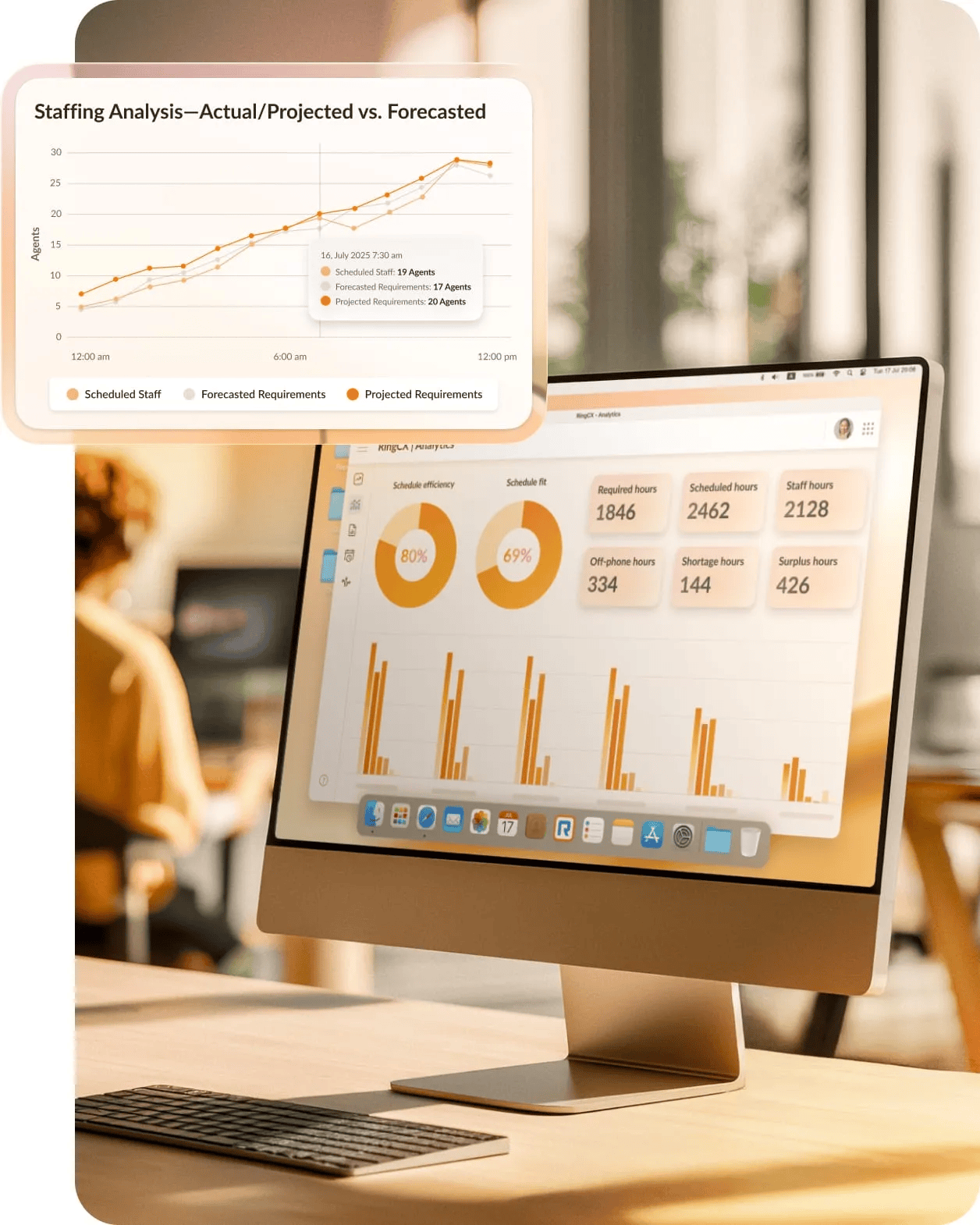
Effective forecasting requires models that account for:
- Seasonal patterns: Daily, weekly, and annual demand cycles, including holidays and peak seasons
- Business events: Product launches, billing cycles, promotions, outages, and marketing campaigns
- Channel mix shifts: The impact of self-service, chatbots, and digital channels on the complexity of calls reaching agents
- Handle time variations: Fluctuations in average handle time (AHT) driven by new products, policies, or customer issues
AI-enabled workforce management tools automatically detect these patterns and recommend updated forecasts as demand changes. This allows your team to shift from manually building forecasts to validating assumptions, incorporating business intelligence, and challenging outliers.
With a reliable forecast in place, you can translate those numbers into capacity plans that balance service levels with cost constraints. These plans determine how many agents you need by interval, skill, and channel to avoid understaffing while accounting for shrinkage factors like training, meetings, breaks, and time off.
Scheduling and shift optimization
Scheduling turns your capacity plan into work assignments that ensure the right people are in place at the right time. Modern strategies blend service level requirements with agent preferences to prevent coverage gaps and increase employee satisfaction.

Modern scheduling strategies include:
- Flexible shift types: Blend fixed shifts with part-time, split shifts, and flex hours to prevent under- or overstaffing.
- Agent preference management: Let agents specify preferred hours, days, and channels, then use automated optimization to respect those preferences within your staffing envelope.
- Automated optimization: Use AI-powered engines to generate schedules that balance service levels, labor cost, and fairness.
- Continuous refinement: Compare forecast vs. actual volume and handle time, then use those insights to improve future schedules.
AI-enhanced scheduling improves predictability for agents, providing more control over work-life balance and reducing turnover risk. Research from Invoca shows that improving agent satisfaction can increase customer satisfaction (CSAT) by 62%, boost efficiency by 56%, and improve retention by 39%.
Real-time adherence and intraday management
Even the best forecast won’t deliver results without strong execution. Real-time adherence and intraday management close the gap between plans and reality.
Adherence tracking tells you:
- Who’s out of adherence and for how long
- Which queues or skills require immediate support
- Where there’s idle capacity you could redirect to another channel or queue
Modern contact center workforce management platforms deliver these insights through real-time dashboards that allow you to act in the moment—reassigning skills, opening overtime, or encouraging digital deflection for routine inquiries.
Performance analytics and continuous improvement
Performance analytics connect WFM data with broader agent performance and customer support outcomes, such as handle time, transfers, hold time, and customer satisfaction, to drive continuous improvement.

Integrating these metrics can reveal patterns like:
- Agents who meet adherence targets but struggle with complex interactions
- Teams that fall behind schedule when specific interaction types spike
- Supervisors who maintain superior adherence and performance
Applying these insights to forecasting models, scheduling policies, and training programs creates a feedback loop that transforms WFM from a static planning exercise into a dynamic system that adapts to changing business conditions and customer needs.
How to implement a workforce management solution in your call center
Moving from spreadsheets or legacy tools to a modern solution feels risky when you run a large, distributed operation. A clear roadmap reduces disruption, accelerates adoption, and delivers value early.
To design an effective implementation strategy, you must balance system integration requirements, agent and supervisor buy-in, and executive demand for measurable impact. Most successful WFM rollouts follow the same general path:
- Define objectives and constraints. Clarify what you want to achieve—lower cost per contact, improved service level consistency, reduced overtime, higher agent satisfaction, or a combination. Document constraints like union rules, regulatory requirements, or strict service level agreements (SLAs) that will impact implementation.
- Audit current processes and data. Map how you currently forecast, schedule, and manage adherence, identifying data sources, gaps, and manual workarounds. This baseline informs both configuration and ROI measurement.
- Select the right platform. Evaluate whether a unified contact center and WFM solution like RingCentral RingCX or a standalone tool fits your architecture. Prioritize integration options, real-time data access, AI capabilities, and the vendor’s track record with similar organizations.
- Design integrations and data flows. Work with IT and the vendor to map how data moves between your contact center, customer relationship management (CRM) platform, HR, and payroll systems. Prioritize historical data imports, as they power your first forecasts.
- Configure policies and workflows. Set up service goals, queues, skills, scheduling rules, time-off workflows, and adherence thresholds. Involve supervisors so policies align with how they actually manage teams.
- Run a pilot. Start with one or two teams with different interaction types or channels to validate forecast accuracy, scheduling logic, reporting, and agent experience. Capture feedback and refine before expanding.
- Train and communicate. Show WFM analysts, supervisors, and agents what’s changing, how the tools work, and how you’ll measure success. Explain how you’ll use adherence to support fairness and performance, not penalize reasonable behavior.
- Roll out in phases. Add teams, locations, or channels in planned waves. Monitor service levels and agent sentiment at each step, then adjust.
- Optimize continuously. Review forecast accuracy, schedule efficiency, and adherence regularly. Use insights to refine models, update staffing strategies, and improve policies.
Treating WFM deployment as an ongoing program allows you to experiment, learn, and iterate while protecting day-to-day performance.
How to measure ROI for workforce management in call centers
To make the case for WFM investment, your CFO needs a clear story of how it pays off. Using the right metrics helps translate incremental improvements into financial impact.
KPIs to monitor include:
- Efficiency and cost metrics: Cost per contact, labor cost as a percentage of total spend, overtime hours, occupancy, and channel utilization
- Service and quality metrics: Service level, average speed of answer, abandonment rate, handle time, first-contact resolution (FCR), and customer satisfaction
- People metrics: Schedule adherence, shrinkage, agent satisfaction, and turnover
Workforce management improves all three. Better forecasting cuts overtime and idle time, lowering cost per contact. Predictable schedules aligned with agent preferences boost engagement and reduce attrition. Consistent staffing reduces wait times and abandonment, improving first contact resolution (FCR) and customer satisfaction (CSAT).
These operational wins drive bottom-line results. In Peopleware’s 2025 WFM benchmark report, 65% of surveyed companies said WFM reduced operating costs and improved efficiency, while 51% reported lower planning loads.
To calculate ROI, follow this four-step framework:
- Establish your baseline: Capture three to six months of pre-WFM data across key performance indicators, headcount, and interaction volumes.
- Attribute improvements: After WFM stabilizes, compare metrics over an equivalent period. Use supervisor and agent feedback to validate which changes link directly to WFM.
- Monetize: Translate improvements into dollars, accounting for overtime and turnover reduction relative to recruitment and training costs.
- Compare to total cost: Sum annualized benefits against your WFM subscription, implementation, and support costs.
Don’t stop at hard-dollar savings. Executives also value reduced risk, increased customer loyalty, and enhanced employee experience.
6 future trends for workforce management in call centers
Artificial intelligence maturity, evolving employee expectations, and increasingly complex customer interactions are reshaping workforce management. Modern WFM must support both immediate needs and long-term strategy.
Six trends are defining how leading organizations approach call center WFM:
- AI-powered predictive analytics. Machine learning detects volume and handle-time patterns humans miss, letting you update forecasts continuously and adapt staffing plans the moment behavior shifts.
- Automated scheduling optimization. AI engines generate schedules that balance service levels, labor cost, and agent preferences—they then learn from your decisions to propose better options with less manual work.
- Unified CX platform integration. The ability to tightly integrate WFM with your contact center, unified communications as a service (UCaaS), CRM, and analytics enables you to manage staffing, routing, and quality from a single data source.
- Voice-first AI and virtual assistants. AI tools handle routine inquiries, triage interactions, and support agents during live calls. Automating simpler work allows you to shift your WFM strategy toward the complex, high-value interactions that require human expertise.
- Hybrid and distributed teams. WFM must now account for multiple time zones, flexible policies, and remote coaching while maintaining fairness and transparency in schedules and adherence.
- Employee experience as strategy. Agent well-being, career growth, and flexibility now drive WFM design as much as service levels and operational cost. Preference-based scheduling, self-service shift bidding, and transparent adherence policies have become essential.
Transform your call center with modern workforce management
Modern workforce management gives you control over the chaos. It lets you match staffing to demand using AI-powered forecasting, build schedules that respect agent preferences while meeting service levels, and respond to real-time changes before they impact customers.
To transform your call center:
- Use AI to enhance—not replace—human judgment. Let machine learning detect patterns and automate routine decisions, so your team can focus on strategy, exceptions, and continuous improvement.
- Integrate WFM with your CX and collaboration platforms. Use unified systems to eliminate data silos, reduce manual reconciliation, and create a single source of truth for every staffing decision.
- Design policies that support agents as much as KPIs. Build predictable schedules, transparent adherence tracking, and preference-based shift options to reduce burnout and turnover while protecting performance.
When you align these elements, WFM evolves from a scheduling tool into a strategic lever for customer experience, employee engagement, and operational resilience.
RingCentral’s workforce management capabilities can help you refine your scheduling and forecasting for a smoother day-to-day. Request a personalized demo to see how a unified, AI-ready approach transforms efficiency and experience across your call center.
Originally published Mar 23, 2026