AI Communications




Video has become the backbone of how organizations communicate. Teams depend on it for daily collaboration, leaders use it to align employees, and marketers rely on it to reach customers.
Yet many of these interactions underperform because the format does not match the audience or the objective. The problem is not a shortage of tools but the way they are applied.
Too often, companies stitch together different vendors for different formats—one for meetings, another for webinars, another for messaging.
This patchwork makes collaboration harder, increases costs, and leads to poor engagement.
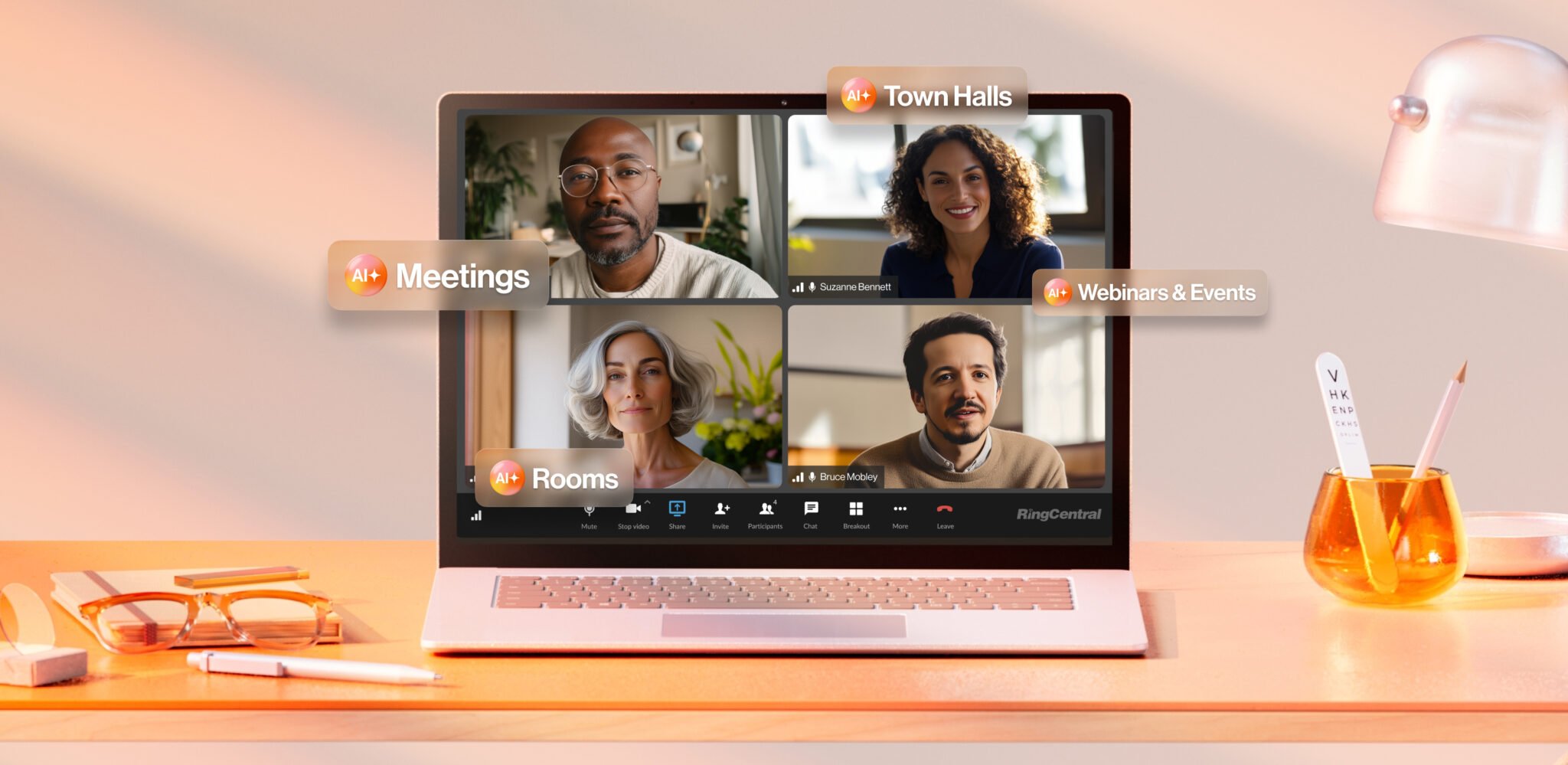
With RingVideo, the AI-powered video suite from RingCentral that unifies meetings, rooms, town halls, webinars, and events, companies no longer need to rely on multiple vendors to host different video formats.
In this blog, we’ll share how to use the engagement spectrum to maximize the RingVideo portfolio by matching each format to the right audience, level of interactivity, and purpose.
Why so many organizations get video formats wrong
Video anchors the way work gets done today, but many organizations use it in ways that hurt productivity instead of supporting it.
70% of meetings prevent employees from completing their tasks, and employees now attend more meetings overall—up more than 13% compared to before.
The most common mistakes come from stretching formats beyond what they were designed for:
- Oversized team meetings: Team meetings are effective when a small group can exchange ideas, make decisions, and move work forward. Once attendance grows beyond 50–75 people, the chance for meaningful dialogue disappears. These meetings turn into long updates that would have been more effective as a recorded briefing.
- Town halls with no interactivity: Town halls are meant to connect leadership with employees at scale. Without Q&A, polls, or multilingual captions, the format strips away employee voice. Instead of reinforcing transparency and culture, the absence of interaction leaves employees feeling disconnected and unheard.
- Unstructured webinars: Webinars are designed for external audiences who expect a clear agenda, professional delivery, and structured engagement. When webinars run like internal discussions—with too much back-and-forth or poor production—customers disengage and tune out.
When organizations fail to align format with purpose, they create a cycle of more sessions, more platforms, and less impact.
How to apply the engagement spectrum to every session
The engagement spectrum makes clear that video sessions are not one-size-fits-all. Each one sits at a different point on a scale that measures how much interaction is expected versus how much information is being delivered.
At one end are highly collaborative conversations, where small groups share ideas and everyone is expected to contribute.
At the other are structured broadcasts, where presenters deliver information to large audiences.
Between the two are balanced formats that combine scale with controlled engagement, giving participants opportunities to interact without overwhelming the flow.
By applying the engagement spectrum, organizations can prevent misusing formats and instead deliver the right experience every time.
The process starts by answering three guiding questions: Who is the audience? What is the purpose? What level of interactivity is required?
Here’s how these questions translate into the right video format across the RingVideo suite:
| Video format | Audience size | Best for | Interactivity level |
| Meetings | Small teams (up to ~25 participants) | Daily collaboration, project planning, team updates | Everyone contributes equally. Real-time dialogue, screen sharing, whiteboarding, and breakout rooms keep discussions active. AI transcription and summaries capture decisions. |
| Rooms | Small to mid-sized groups (room capacity based) | Hybrid sessions connecting remote and in-office teams | Balanced participation between in-room and remote attendees. Shared content displays, one-touch join across platforms, and AI tools (auto framing, noise control) make interaction seamless. |
| Town halls | Up to 10,000 employees | Leadership updates, company-wide announcements, employee engagement | Leader-driven with structured input. Employees engage through moderated Q&A, polls, and multilingual captions. AI-generated responses help ensure clarity and inclusivity. |
| Webinars | Up to 10,000 participants | Customer education, product demos, thought leadership, onboarding | Presenter-led with controlled audience participation. Attendees ask questions or respond to polls, while presenters keep sessions polished, focused, and brand-aligned. |
| Events | Up to 100,000+ attendees | Large-scale conferences, product launches, multi-session experiences | Multi-layered engagement. Participants connect through session chats, networking lounges, and follow-up content, while main sessions are delivered as broadcast-quality presentations. |
Strengthen every video format with AI
AI in the RingVideo suite is designed to solve the everyday friction points that make video less effective.
Teams don’t have to scramble for notes after meetings, employees no longer feel left out because of language barriers, and event moderators aren’t buried under unanswered questions.
Instead of video being a one-time interaction, AI ensures that every session is clear, accessible, and reusable.
Capture outcomes with instant meeting summaries
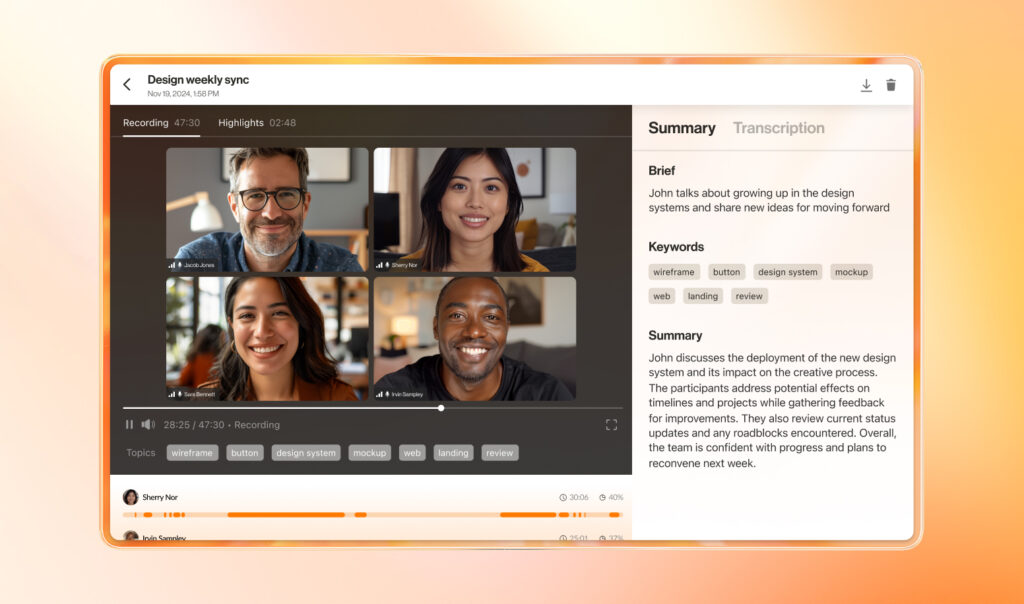
With RingCentral, teams no longer need to leave a meeting wondering what was decided or who owns the next step. AI-generated summaries provide a clear breakdown of decisions, responsibilities, and deadlines. Full transcripts and playback organized by speaker give employees a record they can trust, cutting down on repeated discussions and helping projects move faster with stronger accountability.
Improve accessibility with live transcription and translation
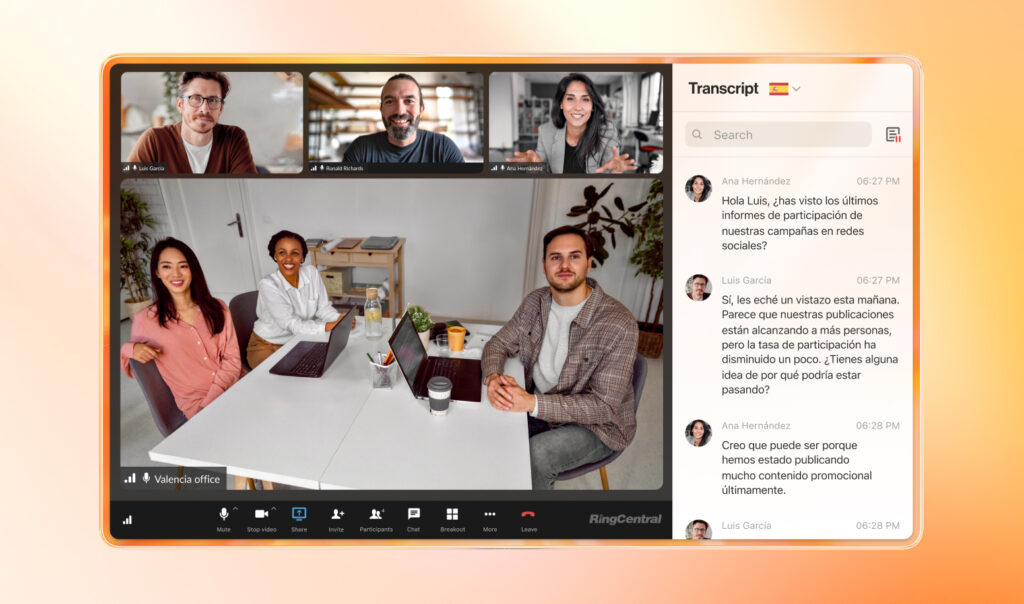
With RingCentral, language is no longer a barrier to effective communication. Live transcription and real-time translation in more than 17 languages make leadership updates, customer webinars, and global town halls accessible to every participant. Whether a strategy session involves 25 people or a company-wide briefing reaches 10,000, participants can follow along in the language that works best for them, ensuring that the message is consistent and understood.
Manage large audiences with AI-assisted Q&A
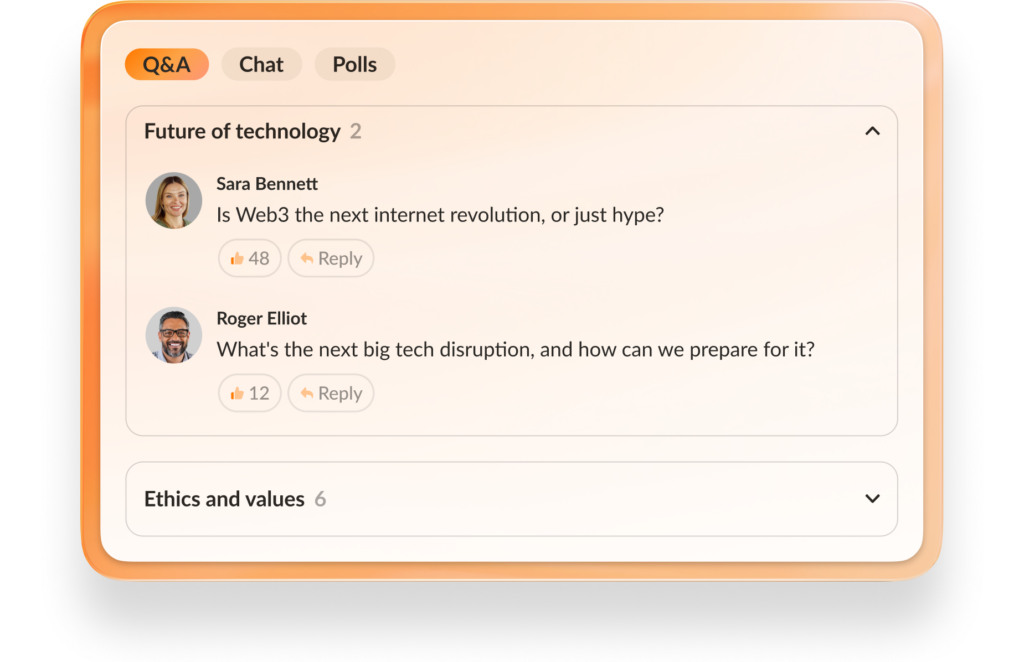
With RingCentral, moderators can keep pace with even the most active audiences. AI suggests context-aware responses that can be quickly reviewed and approved, allowing leaders to respond to more questions without breaking the flow of the event. This keeps participants engaged in webinars, town halls, and large events, while presenters stay focused on delivering their message instead of juggling the chat.
Extend value through repurposed content
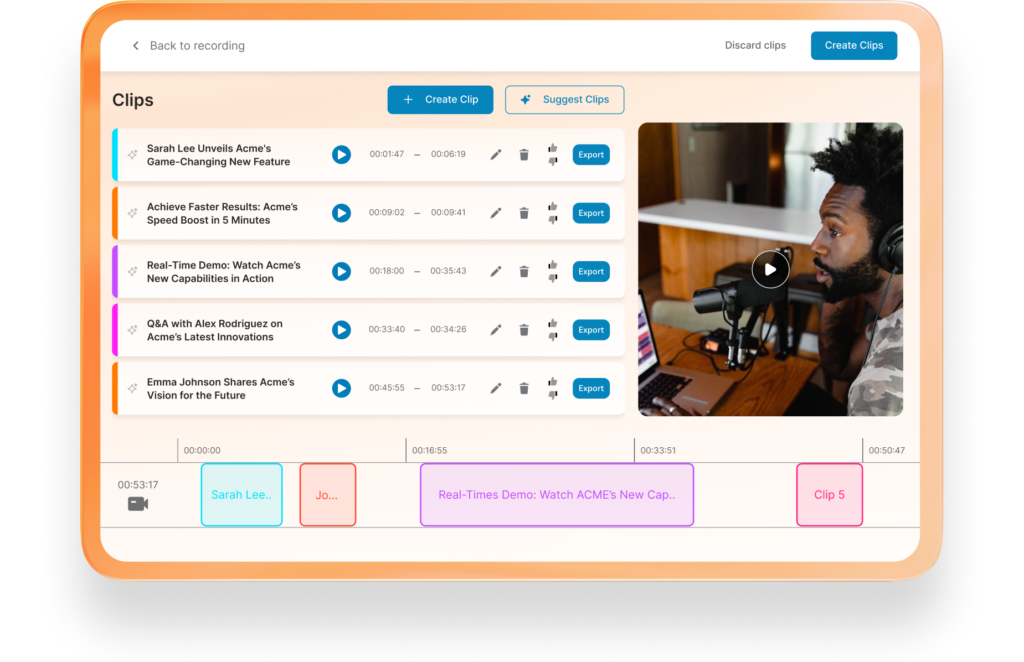
With RingCentral, long recordings don’t disappear into storage. AI automatically detects key moments—announcements, product demos, or impactful exchanges—and turns them into shareable highlight clips. These clips can be distributed internally as quick recaps or repurposed externally as customer-facing content, ensuring that every video continues to create value long after the live session ends.
Simplify decisions with a unified video collaboration suite
Organizations rely on video for collaboration, communication, and customer engagement. The problem is not the lack of video tools but the fragmentation created when each format lives on a different platform.
Employees lose time and focus moving between platforms. IT spends hours maintaining duplicate systems. And leaders end up paying for tools that do the same job.
RingVideo eliminates fragmentation by unifying meetings, rooms, town halls, webinars, and events in one suite.
Leaders can count on built-in scale for any audience size, secure reliability backed by a 99.999% SLA, and AI capabilities that make every video format more effective.
Explore the RingVideo suite today. Learn how to host video sessions that leave your audience informed, connected, and fully engaged while driving measurable results.
Updated Sep 04, 2025