AI Communications






A side-by-side look at how the two contact center platforms differ on features, reliability, security, scale, and cost.
Two contact center platforms have made your shortlist, and on paper they look interchangeable. RingCentral and Talkdesk both promise omnichannel routing, real-time agent assist, and analytics across every conversation.
The decision comes down to which differences matter most for your team’s day-to-day operation and long-term cost. Both are established cloud contact center platforms with real customer bases and strong G2 ratings, so this isn’t a case of one obvious winner.
This comparison sets the two platforms side by side on the five factors that tend to decide it: features, reliability, security, scalability, and cost.
Key takeaways
- Talkdesk CX Cloud fits global contact centers that want packaged AI automation they switch on by plan
- RingCentral RingCX fits teams unifying voice and 20+ digital channels with built-in AI agent assist in one workspace
- Both handle omnichannel routing, agent assist, and quality management well
- Your decision depends on channel mix, AI depth, and compliance needs
Talkdesk vs. RingCentral RingCX at a glance
The clearest split between RingCentral and Talkdesk is channel coverage and AI feature availability.
Where RingCentral RingCX offers omnichannel coverage across voice and 20+ digital channels in all of its plans, Talkdesk splits voice and digital channel coverage across two different plans. To get both, you’d need to subscribe to a third, more expensive plan.
If omnichannel coverage is less of a concern than AI capabilities, Talkdesk may offer a wider suite of solutions. All of its plans come with Autopilot, Copilot, and routing. RingCX also offers AI solutions, and you can choose to subscribe to a higher tier plan for additional AI tools or add them onto your plan individually.
| Talkdesk | RingCentral RingCX | |
| Best fit use case | Global enterprises running high-volume, AI-led automation | Teams unifying voice and 20+ digital channels with built-in AI assist |
| Highlighted features | Copilot, Autopilot, Navigator, interaction and quality analytics | AI agent and supervisor assist, intelligent virtual agent, AI Quality Management, ACE conversation intelligence |
| Quality of service | 99.999% | 99.999% |
| Security | SOC 2 and SOC 3, ISO 27001, ISO 42001, PCI Level 1, HIPAA, GDPR, FedRAMP | SOC 2 and SOC 3, ISO 27001, PCI DSS, HIPAA, GDPR, HITRUST, C5 |
| Scalability | Global Communications Network across multiple regions | Enterprise contact center scale across voice and 20+ digital channels |
| Pricing model | Priced per user per month, with multiple tiers | Priced per user per month, with multiple tiers |
| G2 ratings (as of August 20, 2026) | 4.4 out of 5 | 4.5 out of 5 |
Talkdesk pros and cons
Pros
- Mature, built-in automation across voice and digital channels
- Core AI automation tools included across plans
- Broad range of security certifications for regulated industries
Cons
- Voice features sit in a higher tier than the digital-only entry plan
- Higher starting price point
RingCentral RingCX pros and cons
Pros
- Unifies voice and 20+ digital channels in one agent workspace
- Offers AI Virtual Assistant (AVA) Agent Assist and Supervisor Assist for live coaching
- Adds conversation intelligence covering 100% of interactions
Cons
- Doesn’t offer a FedRAMP or ISO 42001 certification
- Deeper conversation intelligence comes as an add-on, not in the core plan

Talkdesk vs. RingCentral RingCX features
Both platforms are built around AI, and the biggest difference is how each one delivers it. Talkdesk packages its AI as named products you switch on per plan. RingCX builds the same capabilities into one agent workspace, where guidance, self-service, and quality review already live.
| AI capability | Talkdesk | RingCentral RingCX |
| Agent assist | Copilot | AVA Agent Assist |
| Self-service | Autopilot | Intelligent Virtual Agents (IVA) |
| Routing | Navigator routes on natural conversation, not rigid menus | Omnichannel routing across voice and 20+ digital channels |
| Quality and analytics | Interaction and quality analytics | AI Quality Management |
Talkdesk AI features
Talkdesk CXA encompasses its AI capabilities, which are built into Talkdesk CX Cloud, its contact center as a service (CCaaS). Talkdesk CXA includes:
- Copilot listens to live conversations and guides agents in the moment. It suggests next steps and answers, so agents resolve inquiries faster and reduce average handle time.
- Autopilot is an autonomous virtual agent that handles routine voice and digital conversations on its own, around the clock. Customers get answers without waiting in a queue.
- Interaction and quality analytics mine every conversation to surface recurring friction points. Supervisors see the patterns and fix root causes instead of chasing one-off complaints.
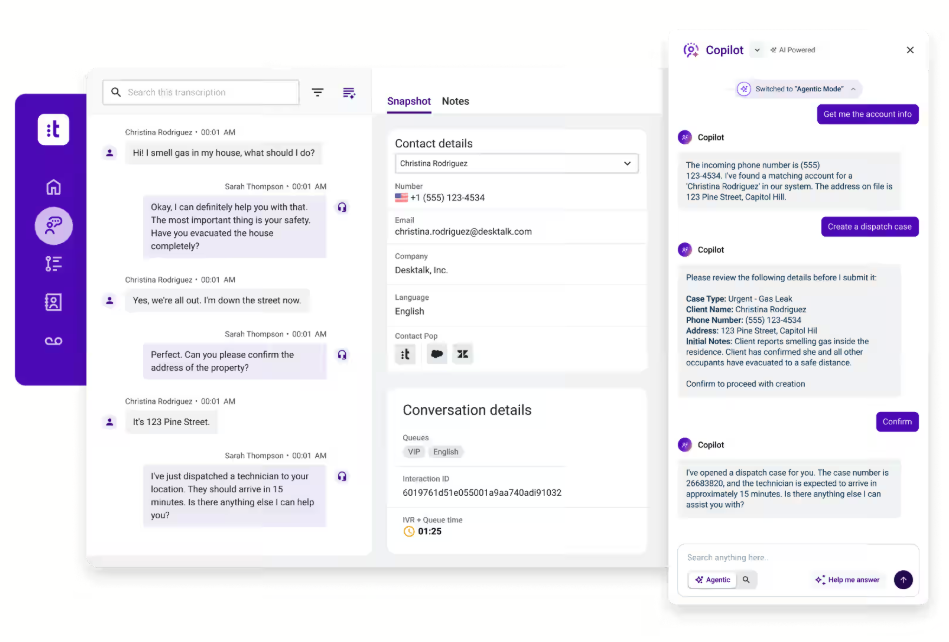
Talkdesk pairs these tools with built-in AI guardrails and enterprise security, and it keeps a human in the loop for judgment calls. That combination keeps automation inside boundaries a regulated team can defend.
In terms of industry-specific solutions, Talkdesk requires you to subscribe to its most expensive plan to access AI agents that handle various tasks for banking, insurance, retail, healthcare, travel, and hospitality. Each industry comes with about a dozen different agents designed to handle a wide range of tasks, including client identification and verification, account balance, “Where is my order?” questions, patient portal access, and travel notifications.
RingCX AI features
RingCX builds its AI into the same workspace agents already use. Guidance, self-service, and quality review run where the work happens, not in a bolted-on tool.
- AVA Agent Assist and AVA Supervisor Assist support the people handling interactions rather than interacting directly with customers. AVA Agent Assist helps agents respond faster and meet compliance requirements by providing real-time guidance, while AVA Supervisor Assist surfaces coaching opportunities and keeps supervisors in the loop.
- Intelligent Virtual Agent (IVA) handles self-service across voice, chat, and messaging. The AI agent holds natural conversations and connects to your customer records, so routine requests get resolved before they reach the queue and agents stay free for complex cases.
- AI Quality Management reviews 100% of interactions instead of a sampled subset, so coaching decisions and performance insights rest on the full record.
- AI Workforce Management forecasts interaction volume and builds agent schedules that match staffing to demand, so you plan capacity from real data instead of guesswork.
- AI Interaction Analytics reads across every conversation to surface sentiment and the trends behind your metrics, so supervisors act on patterns instead of responding reactively.
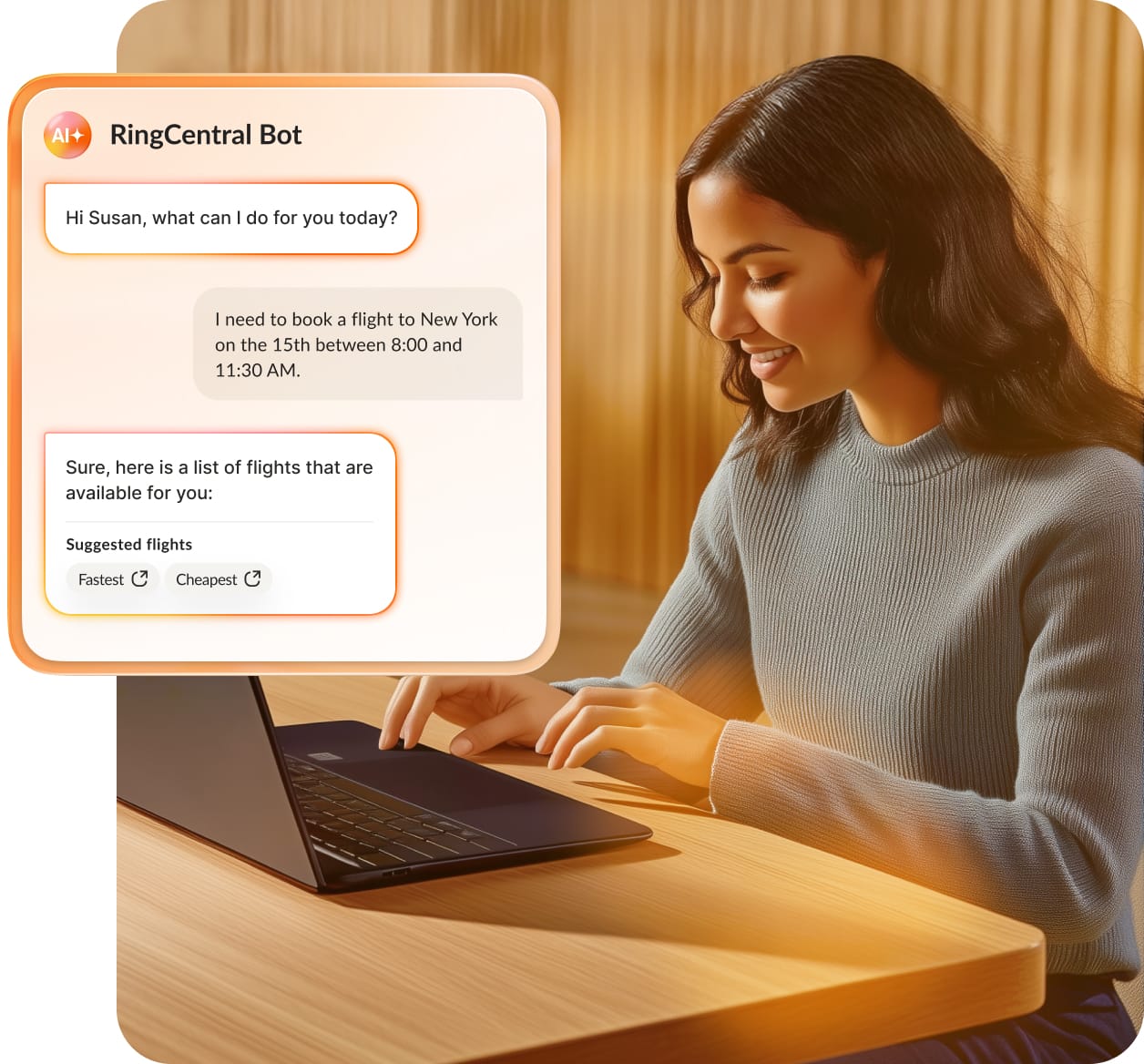
Where RingCX lines up most directly against Talkdesk is agentic AI. Talkdesk reserves its industry-specific agents for its top tier. RingCentral offers two AI agents that handle inbound calls directly, both available as add-ons to RingCX:
- AI Receptionist (AIR) is a voice-first agent that handles the front of the call. It answers inbound calls automatically, routes callers by intent and context rather than a rigid menu, captures leads, and books appointments. You can shape its responses around your knowledge base, policies, and compliance requirements, which suits teams that want consistent call intake without adding front-desk headcount.
- AI Representative (AIR Pro) is the advanced agent for complex, high-volume work. It manages multi-step inquiries across voice, SMS, chat, and social, operates autonomously inside the business rules you set, and pulls context from your existing systems so each interaction starts with the right information. When a case needs a person, it hands off with full context. Teams build and adjust these agents in natural language through Orchestration Studio, and industry accelerators, such as AIR Pro for Healthcare, preconfigure agents for specific verticals.
Verdict: The platforms are close on raw capability. Talkdesk fits teams that want packaged automation products to switch on per plan. RingCX fits teams that want channels and AI assist in one workspace, the way omnichannel routing is meant to work.
Reliability and quality of service
Reliability is close, and both platforms publish a 99.999% enterprise-grade uptime commitment that equals about 26 seconds of downtime per month, maximum.
| Reliability | Talkdesk | RingCentral RingCX |
| Published uptime SLA | 99.999% | 99.999% |
| Backing infrastructure | Global Communications Network, multi-region routing | RingCentral’s global network |
| Quality management | Scores interactions, no manual sampling | AI Quality Management scores 100% of interactions, no manual sampling |
A published service level agreement (SLA) matters most where a short outage strands hundreds of queued customers at once, so ask each vendor about failover and status reporting during an incident.
Verdict: Tie. Both give you an uptime SLA you can put in a contract. On quality, they’re comparable, since both run AI quality management that scores interactions rather than sampling a handful by hand.
RingCentral vs. Talkdesk: Security and compliance posture
Security is table stakes for both platforms, so the real question is breadth rather than a gap. Both carry the certifications a regulated buyer screens for, but they differ on a couple of specific certifications.
| Certifications | Talkdesk | RingCentral RingCX |
| Core frameworks | SOC 2 and SOC 3, ISO 27001, ISO 42001, PCI Level 1, HIPAA, GDPR, FedRAMP | SOC 2 and SOC 3, ISO 27001, PCI DSS, HIPAA, GDPR, HITRUST, C5 |
| Notable extras | ISO 42001 for AI governance | C5 for German cloud-security expectations |
How to read the list for your own buy:
- Match the certification to your obligations rather than counting logos.
- Ask each vendor to map its certifications to your specific audit scope, since a long list still has to cover the exact framework your industry answers to.
Verdict: Talkdesk’s longer published list gives it a slight edge on sheer coverage. But for mainstream regulated work in healthcare, payments, and the EU, both clear the bar, so start any contact center compliance review from your requirements.
How each platform scales
Each platform is built for large, distributed contact centers, and they scale along different axes. The one that fits depends on how your operation is growing.
| Scaling axis | Talkdesk | RingCentral RingCX |
| Geographic reach | Global Communications Network, multi-region routing | Global network across regions |
| Channel breadth | Voice-led, digital added on | Voice and 20+ digital channels in one workspace |
| Admin overhead as you grow | New regions add numbers, routing, and local planning | New channels add a queue in a familiar console |
Match it to the growth you’re planning:
- More countries and voice volume: Talkdesk’s regional backbone might be the stronger fit.
- More channels and digital volume: RingCX keeps the spread in one place, which is often what scaling an enterprise contact center actually looks like.
Verdict: Both scale well, but in different ways. You should weigh the axis you’re actually growing along, because that’s where the administrative cost shows up as headcount climbs.
RingCentral vs. Talkdesk: How pricing models differ
Both platforms use per-user, per-month pricing. The difference is how the tiers and AI are packaged, as well as starting price.
| Pricing | Talkdesk CX Cloud | RingCentral RingCX |
| Model | Per user per month, with multiple plan tiers | Per user per month, with multiple plan tiers |
| Base plan channel coverage | Email, chat, SMS, social media | Voice and 20+ digital channels |
| Base plan AI features | Copilot, Autopilot, routing | Intelligent routing included; AIR, AIR Pro, AVA Agent Assist, and AI Quality Management available as add-ons |
| Public pricing detail | Publishes per-user monthly plan tiers | Provides RingCX pricing through plan selection or sales consultation |
What shapes your final cost on either platform:
- How many agents you’re licensing
- Which channels and AI features you turn on
- Which tier or add-ons those land in
For example, for voice channel coverage, you’ll need Talkdesk’s mid-tier plan, which doesn’t include digital channel coverage. RingCentral’s base RingCX plan includes omnichannel coverage of 20+ channels, including voice.
The two platforms also differ in how they package AI. Talkdesk includes its CXA suite with every plan and reserves industry-specific AI agents for its highest tier.
RingCX takes a modular approach: the base plan covers voice and 20+ digital channels with intelligent routing, and AI capabilities are add-ons. AI Receptionist, AVA Agent Assist, and AI Quality Management can each be added for an additional cost, including on the standard plan. Teams that don’t need full AI coverage can start at a lower entry point and layer in agents and analytics as they grow.
Verdict: RingCX includes full omnichannel coverage in the base package, while Talkdesk tiers voice and digital channels across two plans. Compare like-for-like configurations rather than headline entry prices.
Match the platform to the contact center you’re running
Talkdesk might be a good fit for global, high-volume operations that want standalone automation products so they can choose specific AI features.
RingCX best fits teams unifying voice and 20+ digital channels that want AI agent assist and full-coverage conversation intelligence built into one workspace.
Both are credible contact center platforms, and the right answer is the one whose strengths line up with the way your team is growing. If your priority is running voice and digital in a single workspace with built-in AI, see how RingCX handles omnichannel volume.
FAQs about Talkdesk vs. RingCentral
What’s the difference between Talkdesk and RingCentral?
Talkdesk CX Cloud is a cloud contact center platform built around AI automation, with industry-specific agents available for banking, retail, hospitality, and more.
RingCentral RingCX is a cloud contact center platform that unifies voice and 20+ digital channels in one agent workspace with built-in AI assist.
The practical difference is channel coverage: Talkdesk offers different plans for voice-only and digital channel-only coverage, while RingCX includes coverage for voice and 20+ digital channels in every plan.
Is Talkdesk better than RingCentral for a contact center?
It depends on what you’re weighing. Talkdesk is the stronger fit for a globally distributed, voice-heavy operation that wants a published uptime commitment and standalone automation it can enable per plan.
RingCX is the stronger fit for a team that wants voice, 20+ digital channels, and AI assist in a single workspace. Both hold competitive ratings on G2.
Is RingCentral a contact center platform?
Yes. RingCentral RingCX is its cloud contact center platform. It handles voice and 20+ digital channels, with an intelligent virtual agent for self-service, AI agent and supervisor assist, and conversation intelligence across every interaction.
Originally published Oct 01, 2026