AI Communications




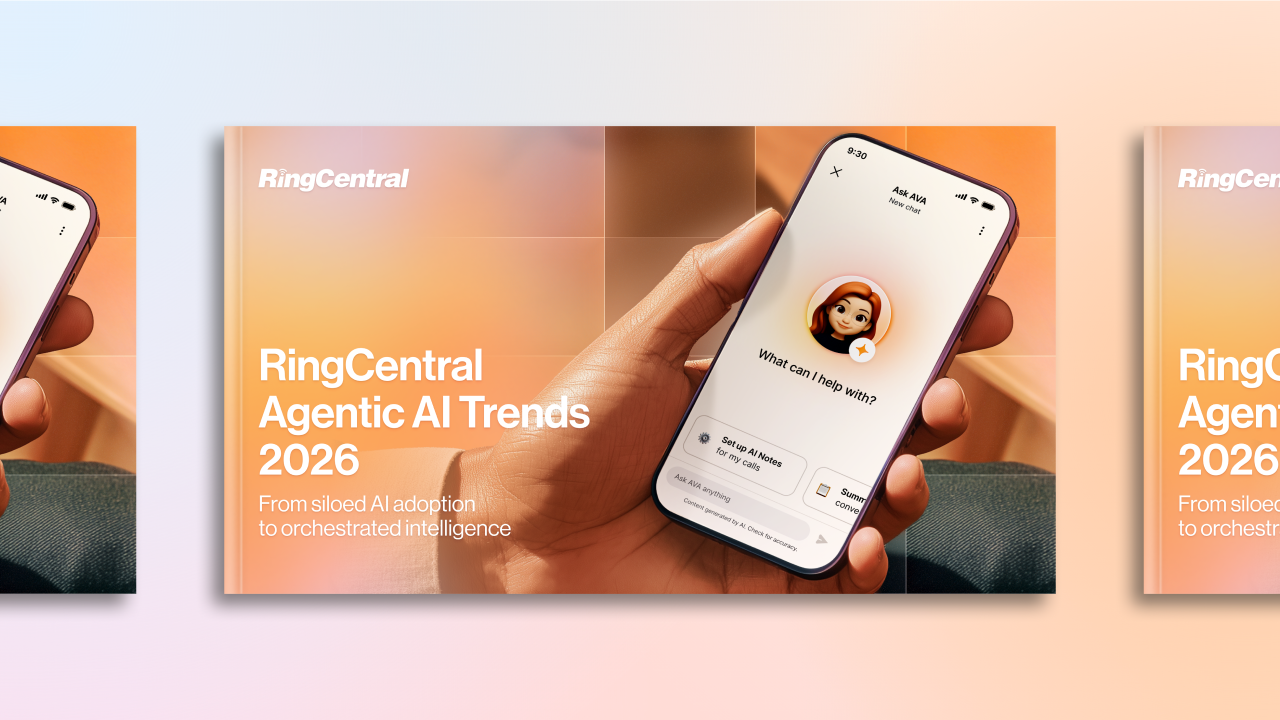

AI has become a standard part of business operations, changing how organizations work, serve customers, and support employees. RingCentral’s new research, the RingCentral Agentic AI Trends 2026 report, captures what happens after that initial wave of adoption.
Based on a survey of 2,000 IT, HR, and CX decision-makers across the US and UK, the research shows a market that has moved beyond experimentation and is now focused on making AI work across systems, teams, and conversations. Nearly every organization (97%) is using AI in some form today, and leaders are already seeing real gains in productivity, efficiency, and experience.
Why 97% of organizations have already adopted AI
The data points to widespread confidence in AI’s value. Organizations are rapidly rolling out AI initiatives, and most report returns within the first year. Satisfaction remains high as AI becomes embedded in everyday workflows across functions.
With adoption accelerating, it’s worth zooming in on what’s actually shifting today. Organizations didn’t start with generative AI. For years, AI has quietly powered predictive analytics, automation, and efficiency gains in isolated workflows, helping teams move faster, reduce manual work, and optimize decisions behind the scenes.
Now, generative AI, predictive analytics, and automation are common across organizations. AI agents, sometimes called digital workers, are increasingly part of that mix, with nearly half of organizations reporting some level of use today.
AI adoption is no longer a barrier. The focus has shifted to how capabilities connect.
What AI agents have already accomplished
Familiarity with AI agents is widespread. Leaders increasingly view them as essential for coordinating work across processes rather than supporting isolated tasks.
Where AI agents are deployed, organizations report higher productivity, faster workflows, and improvements in both customer and employee experience. These early gains reinforce confidence that agents can contribute meaningfully across end-to-end workflows.
As adoption grows, expectations rise as well. Teams find agents most effective when they can operate with shared context and collaborate across systems.
The integration gap: Why AI systems struggle to share context across platforms
As AI use expands, many organizations encounter the same friction points. Systems don’t always integrate cleanly. Context gets lost between interactions. Handoffs slow work down.
In practice, this shows up in familiar ways. For example, a customer repeats their issue across channels, a support agent has to manually pull details from multiple systems, or an AI assistant can’t “see” what happened earlier in the workflow, leading to delays, duplicated work, and inconsistent experiences.
The research shows that integration, workflow readiness, and governance are the primary factors shaping whether AI initiatives continue to scale. When early deployments surface these gaps, teams pause, refine, and adjust their approach.
This is where orchestration becomes critical. AI orchestration helps organizations move beyond adopting individual AI tools toward building connected, end-to-end systems. AI adoption typically involves deploying capabilities such as chatbots, predictive analytics, and task automation (often in isolated workflows). Orchestration goes further by connecting AI agents, systems, and people so they can share context, manage transitions, and coordinate work from start to finish. It turns siloed deployments into coordinated systems that can sustain impact over time.
Why voice matters for AI: How conversational channels capture intent better than text alone
As AI becomes more embedded in daily work, leaders expect agents to interact naturally across the same conversational channels people already use, including voice, video, chat, and messaging.
Voice stands out because it carries meaning that text often misses. In a few seconds, you can hear urgency, hesitation, confusion, or frustration. That context is especially important in customer interactions, where tone can matter as much as the words themselves.
The challenge is that most AI systems still treat voice like a one-off interaction. The conversation ends, the context disappears, and the next channel starts from scratch. That’s why customers repeat themselves, and why teams waste time reconstructing what happened.
When voice is captured as structured, shareable context, as part of Agentic Voice AI, it becomes far more useful than a transcript. It becomes something agents can act on, pass forward, and carry across the workflow. That’s how organizations reduce repetition and move work forward faster, across both customer and employee experiences.
Where businesses are in their AI journey: Beyond adoption and toward coordinated systems
The RingCentral Agentic AI Trends 2026 report reflects a market in transition. AI is widely adopted. AI agents are supporting real workflows. Early value is clear.
What differentiates organizations now is how effectively these capabilities are connected.
The report reveals how leaders are navigating this shift, where coordination is breaking down, and what conditions support sustainable scale as AI becomes part of core business operations.
Read the full RingCentral Agentic AI Trends 2026 report to explore the findings shaping the move from siloed AI adoption to coordinated intelligence.
Survey methodology note: RingCentral Agentic AI Trends 2026 is based on a Q4 2025 survey conducted by Opinium Research among 2,000 IT, HR, and CX decision-makers (manager level and above) from the US and UK, representing SMB, mid-market, and enterprise organizations across retail, technology, healthcare, legal, and financial services. In the study, “digital workers” refer to AI agents, defined as autonomous software-based workers capable of carrying out tasks and collaborating across workflows.
Updated Feb 27, 2026