AI Communications







Answer every patient call consistently, from scheduling to after-hours, without pulling staff away from the patients already in the office.
Your front desk is already stretched thin. One staff member is checking in a patient, verifying insurance, and pulling a chart, all while the phone rings for the third time that hour. Something has to give way, and it’s usually the call.
That’s a problem, because every unanswered call is a patient who might book somewhere else. A missed call during a busy Monday morning creates a scheduling gap, a no-show risk, and in some cases a new patient who never becomes a patient at all.
This article covers what a medical office answering service actually handles, how AI-based answering differs from live-agent services, and what to check before you choose one.
Key takeaways
- A medical office answering service covers scheduling, call routing, and after-hours coverage.
- Missed appointments already cost many practices thousands of dollars a year, and missed calls can create scheduling gaps even further upstream.
- AI-based answering differs from live-agent services in consistency, cost structure, and scheduling integration.
- Evaluate options on scheduling integration, call consistency, and appropriate handling of protected health information under the Health Insurance Portability and Accountability Act (HIPAA).
- RingCentral AIR Pro for Healthcare helps extend consistent call handling without adding front-desk headcount.
Why medical offices miss more calls than they realize
Your front-desk team isn’t ignoring the phone. They’re doing several jobs at once: check-in, insurance verification, and phone coverage, often with one or two people covering all of it during peak hours.
When the phone loses out to the patient standing at the counter, the caller doesn’t wait around. They either try again later, give up, or call the next practice on their list. Either way, you don’t know it happened until the appointment book has a gap.
The financial impact is bigger than most practices assume. According to Tebra’s State of Small Medical Practice Operations report, 31% of practices lose more than $7,500 a year to missed appointments alone. That figure covers appointments that get booked and then missed. It doesn’t include the calls that never turn into an appointment in the first place, which means the real cost to a practice’s schedule is likely higher.
New patient calls carry the most risk. An existing patient might call back or send a portal message if they can’t get through. A new patient calling to ask about your practice for the first time usually won’t. They’ll just call the next name on their list, and you’ll never know you lost that patient.
After-hours calls carry a different kind of risk. A patient calling about a symptom at 7 p.m. shouldn’t hit a generic voicemail box with no way to reach anyone until morning. That gap can create patient experience, escalation, and satisfaction issues that affect your practice’s reputation long after the call ends.
Weekends compound the problem further. A patient who can’t get through on Friday afternoon may not wait until Monday. They may search for another provider that same day, and by the time your office reopens, the appointment slot you could have filled is already gone.
What a medical office answering service covers
A medical office answering service exists to make sure the phone gets answered the same way every time, regardless of how busy your front desk is at that moment. Consistency is what separates a well-implemented answering service from a voicemail box with a professional greeting.
At its core, the service handles three jobs:
- It answers and triages incoming patient calls, including new patient inquiries that would otherwise go straight to voicemail.
- It schedules and reschedules appointments without a staff member picking up the phone.
- It covers after-hours and overflow periods so calls don’t default to a generic mailbox nobody checks until the next business day.
None of this replaces your front desk. It catches what your front desk physically can’t get to, whether that’s a lunch-hour rush, an early morning surge, or a call that comes in at 9 p.m. on a Tuesday.
Live-agent services vs. AI-based answering
Live-agent services staff a healthcare call center with people who answer on your practice’s behalf, following scripts you provide for scheduling and common questions. A caller reaches a person, but that person is working from a script and a shared queue across multiple client accounts, not your practice’s own systems.
AI-based answering services, including virtual assistants for healthcare, take a different approach. The AI answers the call directly, listens for what the caller actually needs, and routes or schedules based on that intent instead of a fixed script, closer to a conversational AI interactive voice response (AI IVR) phone system than a traditional menu tree. Because the AI answers directly, it can reduce the wait time that comes with shared live-agent queues.
The practical difference comes down to consistency and integration:
- A live-agent service depends on the agent’s training and how well your instructions were understood that day.
- An AI-based service can apply consistent workflows to every call, whether it’s the first call of the morning or the fiftieth call before close.
Integration depth and cost vary significantly by vendor—ask for specific figures against your practice’s actual call volume and scheduling system before committing.
What to look for when evaluating a medical office answering service
Not every answering service fits every practice, and the wrong fit shows up fast in patient complaints or double-booked slots. Here are the six things that matter most when you’re comparing options.
1. Scheduling integration
If the service can’t see your calendar, it’s just taking messages, and your staff still has to call every patient back to confirm a time. Ask any vendor exactly which practice management or scheduling systems they connect to before you sign anything.
2. Consistency
A service that handles a 2 p.m. call differently than a 7 a.m. call just moves your problem to a different hour of the day. Ask how the service handles a caller with an unclear request, since that’s where inconsistency shows up first.
3. HIPAA-appropriate handling of patient information
This one is non-negotiable. Any service that captures patient names, reasons for calling, or scheduling details needs to handle that data the same way your practice already does. Ask for documentation on how the vendor handles protected health information, and don’t accept anything less than a signed Business Associate Agreement (BAA).
4. Security infrastructure
Beyond HIPAA, ask how the service actually secures the call itself, not just the data it stores afterward. This matters even more if the service uses AI-powered security to screen calls or route them, since that introduces a separate layer of data handling worth understanding. Look for encryption in transit and at rest, role-based access controls (RBAC), and audit logs your practice can actually review.
5. Cost
Cost only matters once the first three factors check out. A cheaper service that mishandles patient data or can’t book directly into your calendar isn’t actually cheaper once you count the staff time spent fixing its mistakes.
6. Volume spikes
This is where a lot of services quietly fail. Flu season, a new provider joining the practice, or a local health scare can double your call volume overnight. A service that can’t absorb that surge without longer hold times or dropped calls will fail you exactly when you need it most. Ask any vendor how their system scales during a sudden jump in calls, and get a specific answer instead of a general assurance.
How RingCentral AIR Pro handles this for medical offices
Your practice needs patient calls answered professionally, but hiring dedicated staff just to cover the phone may not make sense for a small or mid-size office. RingCentral AIR Pro for Healthcare is built to close that gap.
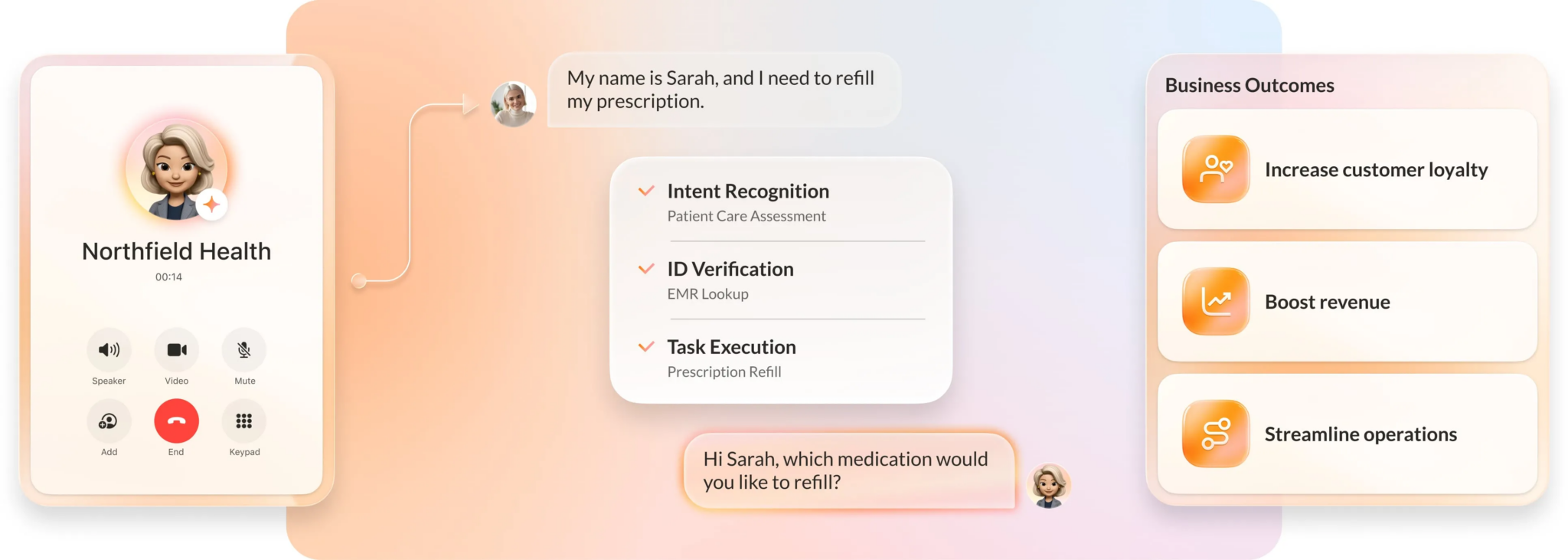
AIR Pro answers incoming calls automatically before a staff member has to pick up. It can verify patient identity and insurance, identify what the caller needs, help manage prescription refill requests, and support appointment and follow-up scheduling. If the caller needs a live staff member’s attention, AIR Pro hands the call off with the context already captured, so nobody has to ask the patient to repeat themselves.
AIR Pro also connects with scheduling and electronic health record (EHR) systems to support appointment booking during the call, so a patient calling to book or reschedule can complete that request during the call rather than waiting for a callback.
That means fewer calls default to voicemail during a busy shift, and fewer patients hang up before anyone from your practice talks to them. AIR Pro is HIPAA- and HITRUST-compliant, so your patient’s protected health information (PHI) is handled with appropriate security controls.
AIR Pro for Healthcare is currently in early access. Contact RingCentral to learn more.
Stop letting missed calls turn into missed appointments
Every unanswered call is a patient decision point, and right now too many of those calls default to voicemail during your busiest hours. Consistent call handling protects two things at once: the new patients trying to reach you for the first time, and the existing patients trying to keep their care on schedule.
The practices that fix this aren’t necessarily hiring more front-desk staff. They’re making sure every call gets the same quality of response regardless of who’s busy with a patient at that exact moment.
If your front desk is missing calls during peak hours or after close, look at how RingCentral AIR Pro for Healthcare can cover those gaps—and what consistent patient call handling looks like for your practice.
FAQs about medical office answering services
What does a medical office answering service do?
It answers incoming patient calls, triages what the caller needs, and often books or reschedules appointments without pulling a staff member off the front desk. Most services also cover after-hours and overflow periods so calls don’t default to a generic voicemail box. Coverage details vary by vendor and by whether you choose a live-agent or AI-based answering service.
Is an AI medical office answering service HIPAA-compliant?
This depends entirely on the specific vendor and product, so ask for documentation rather than taking a verbal claim. For RingCentral’s AI Representative (AIR Pro) specifically, it’s HIPAA-compliant and HITRUST certified.
Can a medical office answering service schedule appointments directly?
Yes, many AI-based services support direct appointment scheduling during the call rather than just taking a message for staff to follow up on. RingCentral AIR Pro for Healthcare can support appointment scheduling and rescheduling when connected with compatible scheduling and EHR systems.
How much does a medical office answering service cost?
Cost varies widely based on call volume, whether you choose live-agent or AI-based answering, and how deep the scheduling integration goes. Get a quote based on your practice’s actual call volume rather than relying on an average, since averages rarely match what a specific practice will pay.
Originally published Aug 09, 2026