Virtual assistant healthcare: Automate patient access at scale
RingCentral AIR Pro for Healthcare gives healthcare providers a voice-first agentic AI platform that handles patient calls, verifies coverage, and coordinates care.
Healthcare organizations field millions of patient calls every year. The majority of those calls involve scheduling, insurance verification, and administrative support—work that consumes staff time without always advancing care delivery.
Administrative staff carry a parallel burden: managing call queues, verifying eligibility, and coordinating appointments across systems that weren't designed to work together. The scale of that imbalance is significant.
The instinct is to frame this as a staffing problem. It isn't, at least not entirely. The deeper issue is workflow architecture. What changes the equation is AI built specifically for healthcare's operational and regulatory complexity. That means agentic AI that can authenticate callers, query live EHR data, execute multi-step workflows, and maintain HIPAA compliance across every interaction without requiring human involvement at every step.
What a virtual assistant does in healthcare
A healthcare virtual assistant is an AI-powered system that handles patient-facing phone interactions autonomously. It schedules appointments, verifies insurance eligibility, confirms patient identity, and routes calls based on intent without requiring a live agent. When a call exceeds the AI administrative assistant's scope, it escalates to a human with full context transferred.
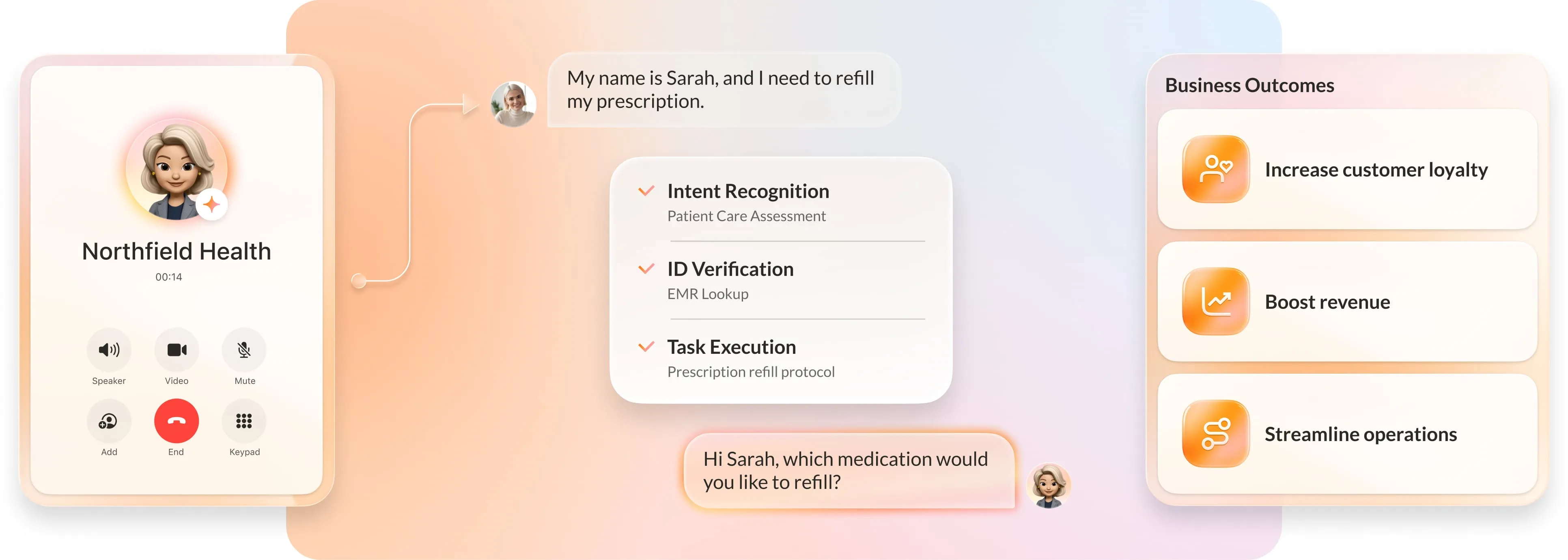
The goal is straightforward: reduce routine calls that consume your in-house staff's time without sacrificing patient experience impact. Medical virtual assistants streamline operations by automating high-volume, low-variability interactions.
A healthcare virtual assistant typically handles core administrative tasks like:
- Appointment scheduling and rescheduling: Patients book, change, or cancel appointments through natural conversation instead of navigating phone trees or waiting on hold. The AI confirms availability in real time and updates the schedule directly.
- Insurance verification and eligibility checks: The AI queries payer systems and EHR data to confirm coverage before appointments, reducing claim denials and front-desk workload.
- Patient intake and identity verification: The virtual medical assistant authenticates callers using structured data points before any protected health information is accessed or shared, keeping every interaction HIPAA-compliant.
- Post-visit follow-up and care coordination: The AI handles outbound follow-up calls, prescription refill reminders, and care gap outreach, freeing clinical staff for higher-acuity work.
Natural language processing (NLP) is increasingly used in virtual healthcare to automate tasks like symptom assessment, triage, scheduling, transcription, and documentation, with recent studies showing AI has a positive impact before, during, and after patient appointments.1 That shift reflects a fundamental change in what patients expect and what AI can reliably deliver: a conversation rather than a menu.
Why healthcare organizations are adopting AI-driven virtual assistants
Staffing pressure and patient volume growth are converging in a way that makes automation a necessity rather than a preference.
Medical practices are adopting AI because the alternative, absorbing more volume with fewer people, is no longer viable. The World Health Organization projects a global shortfall of 11 million healthcare workers by 2030.2 Recent healthcare AI adoption trends provide context for why this shift is accelerating, and these three industry realities drive the change:
1. Staffing shortages make automation a necessity
When qualified medical office staff are difficult to hire and expensive to retain, the calculus around automation changes. Offloading scheduling calls, eligibility checks, and routine follow-up to AI isn't a cost-cutting measure; it's a capacity strategy that lets existing staff focus on work that requires human expertise.
2. Patient volume growth outpaces administrative capacity
Call volumes at health systems continue to increase as patient populations grow and care models shift toward outpatient and telehealth settings. Administrative teams that handled yesterday's volume with yesterday's headcount are now managing significantly more interactions without proportional staffing increases.
3. EHR integration depth determines whether AI can actually complete workflows
Modern AI platforms integrate directly with EHR systems to read patient data, confirm eligibility, and write updates back to the medical record within a single interaction. That capability transforms AI from an answering layer into an execution layer.
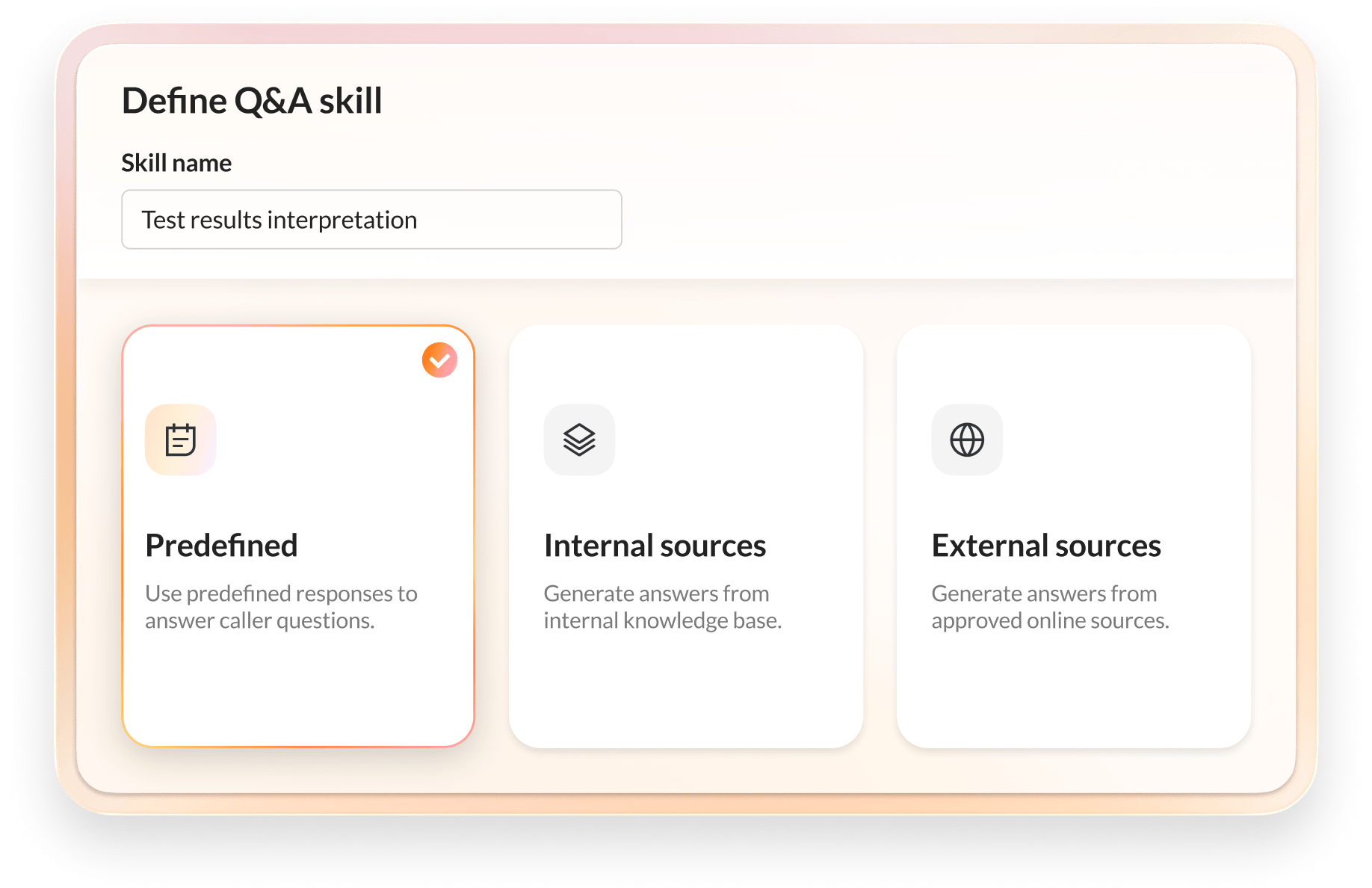
Integration depth is the single most important variable in virtual assistant performance. Read-only connections support patient information lookup but can't schedule an appointment, update a record, or verify eligibility against live payer data. Those actions require write-back capability, and without it, the AI can assist but can't resolve.
When AI operates on live system data rather than static scripts, the outcomes are measurable. AI-assisted scheduling at Weill Cornell Medicine produced a 47% increase in digitally booked appointments, according to data cited by MGMA.3
HIPAA compliance and security in healthcare AI deployments
Data security and HIPAA compliance consistently rank as the top adoption barriers for healthcare AI. Nearly 90% of healthcare organizations reported at least one AI-related breach or compliance incident in the past two years, according to research by Gravitee.4
Knowledge of AI security concerns in healthcare helps organizations evaluate platforms against specific, verifiable compliance controls before onboarding and deployment:
- HIPAA data handling standards: The platform must enforce data minimization, access controls, and retention policies that align with HIPAA's Privacy and Security Rules.
- Audit logging and interaction transparency: Every action the AI takes must be logged for compliance review, dispute resolution, or quality assurance.
- Role-based access controls: A well-configured AI platform must enforce access boundaries at the role level, ensuring that agents, administrators, and supervisors operate within defined permissions.
- Secure data transmission across all channels: Encryption in transit and at rest must apply consistently across voice, messaging, and digital channels.
Healthcare practices need full visibility into what the agent did, why it did it, and the data it accessed. Platforms that can't provide that transparency create compliance exposure, regardless of their underlying security architecture.
How agentic AI handles complex patient interactions at scale
Traditional interactive voice response (IVR) systems and basic AI receptionists handle linear, scripted patient communication well. However, they break down the moment a patient call involves multiple steps, a mid-call intent change, or a lookup that requires live system data.
Voice-first agentic AI operates differently: it recognizes intent, authenticates the caller, executes multi-step workflows, and hands off to a human agent with full context when escalation is needed.
Four workflow capabilities define agentic AI performance in patient access:
- Dynamic intent recognition routes patients on the first call: The AI interprets what the caller needs from natural speech, not a keypress, and routes accordingly.
- Real-time identity verification maintains compliance: The AI authenticates the caller before any protected health information is accessed.
- Multi-step appointment management completes within the call: It handles end-to-end booking, rescheduling, and cancellation, updating the EHR in real time.
- Seamless escalation transfers full context to human agents: When needed, the full interaction history passes to the agent, so patients don't repeat themselves and agents don't start from scratch.
Liesl Perez, cofounder of Colorado-based clinic Axis Integrated Mental Health, noted expanded capacity and improved responsiveness after the clinic deployed RingCentral’s AI Receptionist. That result reflects what agentic AI delivers at scale: consistent performance without proportional staffing increases.
“Our team can now focus on patients who are truly in crisis instead of spending time on routine scheduling and insurance questions,” said Perez.
AIR Pro for Healthcare: agentic AI built for patient access workflows
AI Representative (AIR Pro) for Healthcare is RingCentral's agentic AI solution built specifically for patient access. It goes beyond call routing to manage the full interaction: scheduling, verification, eligibility confirmation, and escalation, all within a single call and without staff involvement for routine workflows.
- Handle appointment scheduling, rescheduling, and cancellation within a single call, without requiring staff involvement at any step.
- Verify patient identity and insurance eligibility in real time using live EHR data across more than 80 connected systems, so every interaction starts with accurate information.
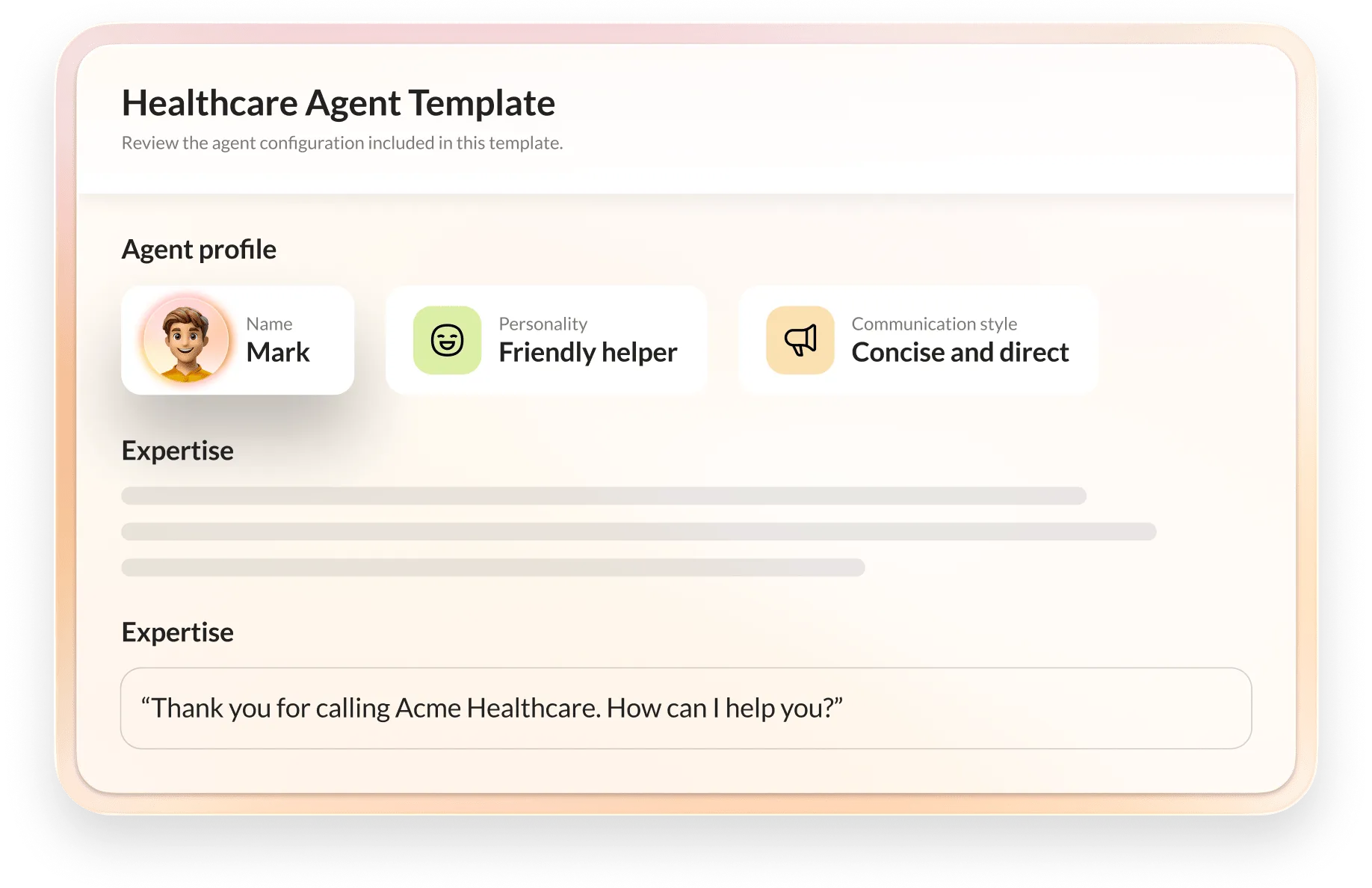
- Deploy pre-built healthcare workflow templates without engineering resources, using the no-code AIR Pro Studio environment to configure and launch in days instead of months.
- Maintain compliance and governance across every automated interaction with built-in audit controls, defined agent guardrails, and full interaction transparency.
- Escalate complex calls to human agents with complete interaction context transferred automatically, so patients don't repeat themselves and agents arrive informed.
AIR Pro for Healthcare is currently in early access, sign up and get your name on the list.
What to evaluate before deploying a virtual assistant in healthcare
Selecting the wrong platform creates compliance exposure, integration debt, and patient experience gaps that are difficult to reverse. Understanding selection criteria for healthcare call center software will help you build a shortlist aligned with your operational requirements and compliance obligations.
EHR integration depth and write-back capability
A platform that reads from the EHR can look up information. A platform that writes back can complete the interaction. Confirm whether the system supports real-time scheduling updates, record modifications, and eligibility verification within a single call.
HIPAA compliance controls and audit transparency
Verify that the platform enforces data handling standards, maintains complete audit logs, and provides interaction-level transparency for compliance review. Ask for specific controls and certifications.
Ability to handle multi-step, context-aware workflows
Single-turn AI can answer a question. Agentic AI can complete a workflow. Evaluate whether the platform can manage a caller who changes intent mid-call or needs a combination of scheduling, verification, and routing within the same interaction.
Escalation logic and human handoff quality
The quality of the escalation determines whether AI adoption improves or degrades patient experience. Confirm that the platform transfers full interaction context to human agents automatically.
Deployment speed and configuration flexibility
Platforms that require months of custom development create adoption risk and ongoing maintenance costs. Evaluate whether the system offers pre-built healthcare workflow templates and a no-code configuration environment.
Make every patient call count
Healthcare organizations that deploy purpose-built agentic AI for patient access can reduce administrative call volume, improve first-call resolution, and free staff to focus on care without increasing headcount or compromising compliance. The staffing shortages, call volume growth, and EHR complexity driving that need aren't temporary conditions. They're the operating environment.
AIR Pro for Healthcare is built for that environment: agentic AI with native EHR connectivity, pre-built healthcare workflows, and HIPAA-compliant governance controls. Contact us to see how AIR Pro for Healthcare can free up your team for more focused patient care.
Healthcare virtual assistant FAQs
- Scheduling and rescheduling appointments
- Verifying insurance eligibility
- Confirming patient identity
- Routing calls based on intent
- Managing post-visit follow-up
- Enforce data handling standards aligned with the Privacy and Security Rules
- Maintain complete audit logs of every agent action
- Apply role-based access controls to limit data exposure
- Encrypt data in transit and at rest across all channels
- Read-only connections: Support information lookup, confirming appointment dates, or pulling demographic data
- Write-back integrations: Enable scheduling, record updates, and insurance verification within the same interaction
Sources
1. Reis, T. C. (2025). Artificial intelligence and natural language processing for improved telemedicine: Before, during and after remote consultation. Atención Primaria, 57(8), 103228. https://doi.org/10.1016/j.aprim.2025.103228
2. World Health Organization: WHO. (n.d.). Health workforce. https://www.who.int/health-topics/health-workforce#tab=tab_1
3. Sizing up the market for AI chatbots, virtual assistants in medical practices in 2025. (2025, April 9). https://www.mgma.com/mgma-stat/sizing-up-the-market-for-ai-chatbots-virtual-assistants-in-medical-practices-in-2025
4. AI agents blamed for security incidents at 9 in 10 healthcare firms as ‘digital workforce’ goes rogue. (n.d.). The National Law Review. https://natlawreview.com/press-releases/ai-agents-blamed-security-incidents-9-10-healthcare-firms-digital-workforce