AI Communications






Employee experience directly affects customer satisfaction. According to RingCentral research, 89% of business leaders say broken workflow and low employee job satisfaction directly impact customer satisfaction and the bottom line. When internal teams can’t communicate effectively, customers experience delayed resolutions, inconsistent service, and fragmented support.
The solution is unified communication platforms that connect internal collaboration with customer-facing operations. This aligns with Gartner’s recognition that digital workplace initiatives are becoming critical for organizational success. Instead of treating employee communication and customer service as separate functions, leading organizations are creating connected workplaces where every internal interaction improves customer outcomes.
RingCentral’s AI-unified UC and CC: Creating a self-improving ecosystem
The future of connected workplaces isn’t just about unifying communication channels—it’s about creating intelligent systems that learn and improve from every interaction. Here’s how RingCentral’s AI-unified UC and CC platform is setting the standard for self-improving operations where every internal interaction enhances customer success:
Intelligent knowledge transfer: RingSense conversation intelligence captures insights from both internal RingEX team discussions and external RingCX customer interactions. This creates a continuous learning loop where successful internal problem-solving patterns are automatically applied to customer support scenarios. The AI learns from every collaboration, building an organizational knowledge base that makes every team member more effective.
Seamless expert escalation with AI assistance: AI Receptionist becomes a trained company expert, customized with your business knowledge, policies, and processes to handle inquiries intelligently. When customer needs exceed initial AI capabilities, the conversation seamlessly transitions to human agents supported by AI Agent Assist, which analyzes the conversation context and knowledge base to suggest the next best action, whether that’s escalating the issue to a specific team, connecting with an individual expert, or providing recommended responses. This creates a dynamic support network where AI-powered initial contact flows naturally into AI-assisted human expertise, making internal collaboration and customer service indistinguishable—customers experience continuous, intelligent support while internal teams receive contextual guidance that enhances their ability to resolve issues efficiently.
Continuous improvement through AI supervision: AI Supervisor Assist analyzes both internal team performance metrics and customer interaction quality, creating a feedback loop where better internal processes directly translate to improved customer satisfaction scores and resolution times. The system doesn’t just report on performance—it actively suggests improvements based on successful patterns across the organization.
The impact is measurable and growing. According to RingCentral’s RingCentral Trends 2025: The state of AI in business communications report, 42.24% of respondents have already fully integrated AI into their customer conversations, while 48.02% of companies are experiencing increased upsell opportunities through AI-powered voice data analysis. Looking ahead, 76.48% of respondents expect AI to impact the quality of service, while 68% believe it will affect customer lifetime value.
Perhaps most significantly, 97% of leaders anticipate increased spending on AI tools over the next three to five years, signaling that AI-unified communication platforms aren’t just a competitive advantage—they’re becoming a business necessity.
The Husband & Wife Law Team’s experience with RingSense illustrates this transformation. Their quality assurance process, which previously required reviewing entire call durations, now takes one-third of the time because “the AI finds the coachable moments in a call within a few minutes.” This efficiency gain allows their leaders to review more calls and spend more time coaching their team members, creating a compounding effect on service quality.
Real-world scenarios: When internal messaging drives customer outcomes
The most powerful customer success stories often begin with effective internal collaboration. When teams can quickly share insights, coordinate responses, and leverage collective expertise, customers experience faster resolutions and more personalized service, leading to greater customer loyalty and stickiness.
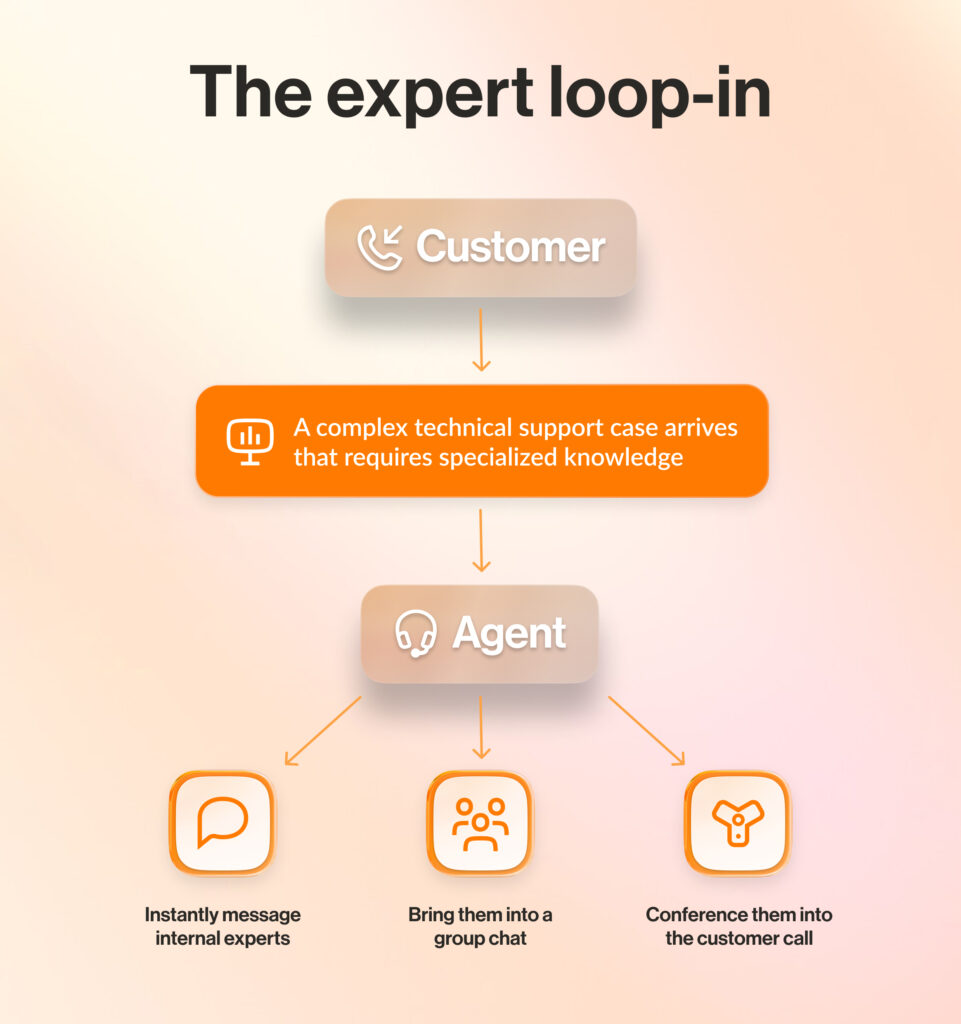
Scenario 1: The expert loop-in
A complex technical support case arrives that requires specialized knowledge. In traditional systems, this means transferring the customer multiple times, repeating information, and creating frustration. With unified platforms, the primary agent can instantly message internal experts, bring them into a group chat to collaborate on the solution, and even conference them into the customer call—all while maintaining context and customer relationship continuity.
Scenario 2: Proactive issue resolution
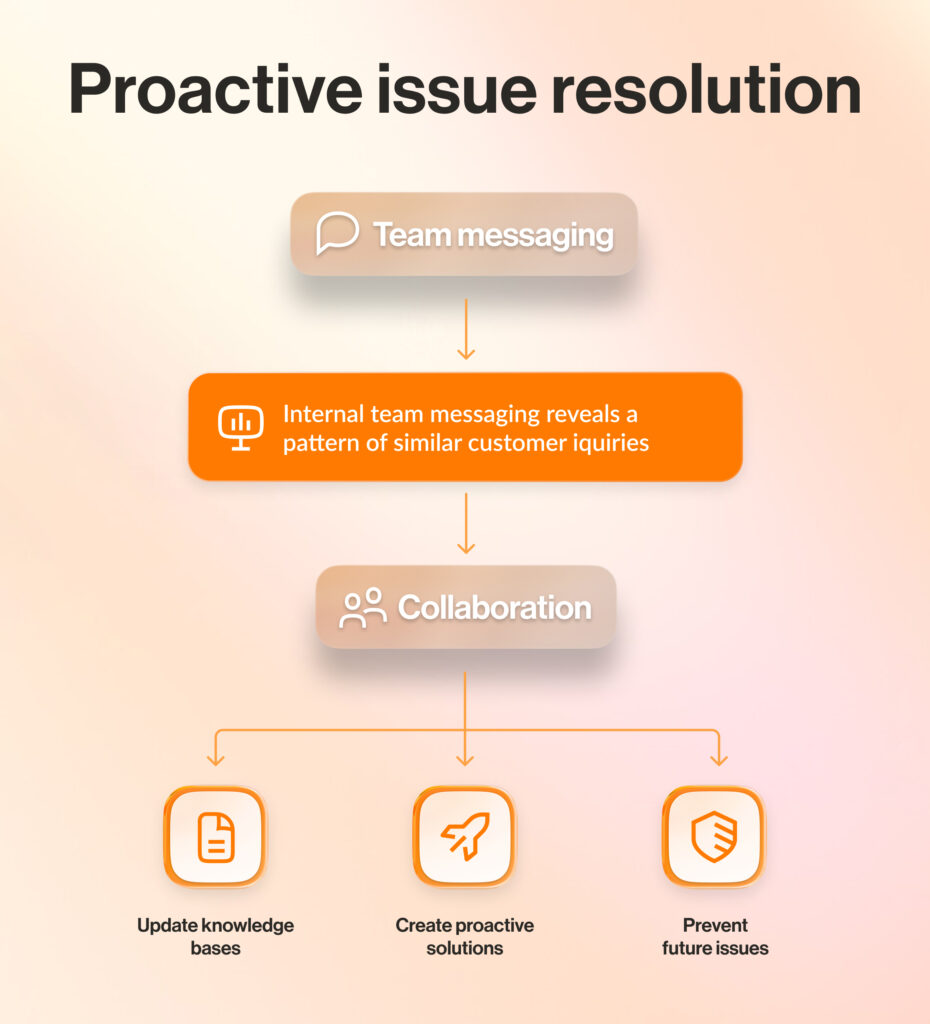
Internal team messaging reveals a pattern of similar customer inquiries across different channels. Instead of handling each case individually, teams can collaborate to create proactive solutions, update knowledge bases, and prevent future issues. This transforms reactive customer service into proactive customer success.
Scenario 3: Cross-department intelligence
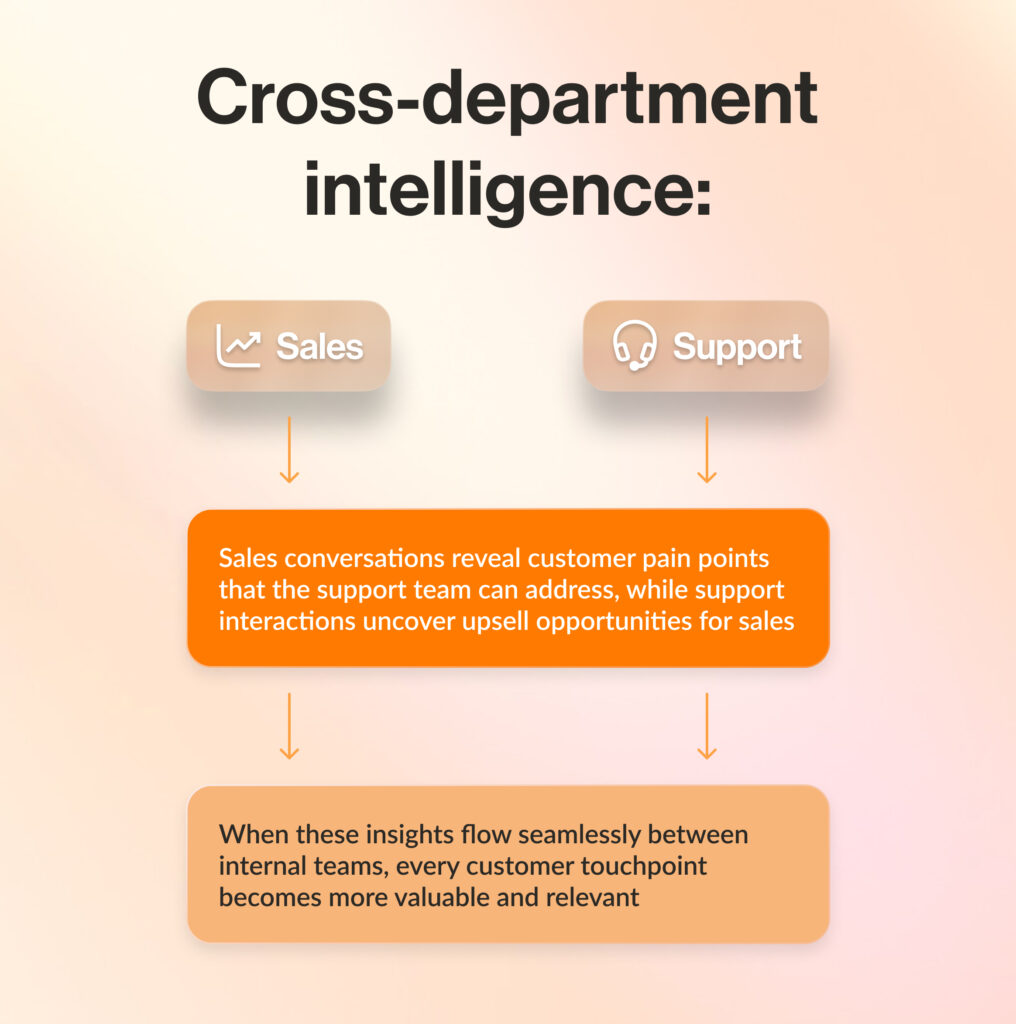
Sales conversations reveal customer pain points that the support team can address, while support interactions uncover upsell opportunities for sales. When these insights flow seamlessly between internal teams, every customer touchpoint becomes more valuable and relevant.
Worldwide Express, one of the logistics industry’s largest national providers, exemplifies this approach. After merging two companies with different communication systems, they implemented both RingEX for internal collaboration and RingCX for customer service across their 1,400-employee organization. Their real-time dashboards now enable managers to see customers on hold and instantly message available agents to grab calls, while their unified platform allows them to eliminate redundant systems and create seamless workflows between internal teams and customer-facing operations.
The business value of eliminating communication silos
The financial impact of breaking down silos between internal and external communications extends far beyond operational efficiency. Organizations that successfully unify their communication platforms see measurable improvements across multiple business metrics.
Productivity gains
When employees no longer need to switch between multiple communication tools, they can focus on value-creating activities rather than navigation overhead. Unified platforms eliminate the cognitive load of managing disparate systems, allowing teams to maintain momentum and context throughout their workday. This natural workflow convergence is evident in user behavior: 70% of RingEX traffic now follows contact center-like workflows, demonstrating how employees instinctively adopt unified processes that boost productivity.
Employee engagement impact
Unified communication platforms directly contribute to engagement by eliminating frustrating workflow barriers and enabling employees to do their best work. When technology supports rather than hinders daily tasks, employees experience less stress and greater job satisfaction, which naturally translates to better customer interactions. Employee preference for seamless systems is clear: over 50% of RingEX users now leverage call queues (traditionally a contact center feature), showing how unified tools align with how people actually want to work.
Cost optimization
Consolidating multiple communication tools into a single platform reduces licensing costs, maintenance overhead, and training requirements. Organizations can eliminate redundant systems while gaining enhanced functionality, creating immediate operational savings that compound over time. This convergence approach eliminates the need for separate UC and CC solutions, streamlining both technology costs and operational complexity.
Scalability advantages
Unified platforms make organizational growth more manageable by providing consistent tools and processes across locations and teams. Whether adding new employees, integrating acquired companies, or expanding into new markets, unified communications create a stable foundation that scales efficiently without requiring complete system overhauls. The results speak for themselves: organizations using unified platforms like RingCX see a 29% improvement in customer sentiment, demonstrating how scalable systems simultaneously enhance employee capability and customer experience.
AUTOPAY showcases these benefits as it faced rapid growth that stretched its 700-employee auto-loan operation to its limits. Traditional communication silos were creating bottlenecks that threatened service quality during their expansion. The RingEX and RingCX deployment transformed their operations: agents now save at least 10% of their time daily through streamlined workflows, while the organization reduced annual costs by at least $500,000 compared to their previous systems. More importantly, their loan specialists can now text directly with customers during calls to receive documents instantly, and managers can dial customer numbers directly from their CRM without switching applications. This integration of internal efficiency and customer experience improvements demonstrates how unified communications create compounding value across all four business areas.
Beyond silos: How unified platforms enable seamless escalation
Historically, traditional communication systems created unnecessary obstructions between internal collaboration and customer-facing operations. When a customer service agent needs expertise from a product specialist or when a sales inquiry requires technical input, the handoff process becomes a friction point that slows resolution and frustrates customers.
Unified platforms fundamentally change this dynamic by enabling seamless escalation from employee discussions to customer resolution. Instead of transferring customers between disconnected systems, agents can instantly bring internal experts into the conversation without losing context or momentum.
Consider the challenge faced by Journey Beyond, Australia’s leading tourism company. With multiple brands and diverse experiences ranging from luxury rail adventures to island tours, their customer service team regularly needed access to specialized knowledge from different divisions. After implementing RingCentral’s integrated UCaaS and CCaaS platforms, they achieved something remarkable:
“At a national integrated level, we can have subject matter experts in each of our experiences available to deliver unrivalled customer experience, with economies of scale so if one team is under duress in terms of call volumes, the call can be overflowed and picked up quickly by a consultant with secondary expertise in that brand.” – Nigel Brohier, General Manager, Travel Central and Holidays, Journey Beyond
This seamless expert escalation improves individual customer interactions and creates a knowledge-sharing ecosystem that makes the entire organization more responsive and informed.
The connected workplace advantage
The organizations thriving in today’s market understand a fundamental truth: internal collaboration and customer success aren’t separate initiatives—they’re interconnected elements of a single strategic advantage. By implementing AI-unified UC and CC platforms, forward-thinking companies are creating connected workplaces where every employee interaction contributes to customer success, every customer insight improves internal processes, and every communication becomes an opportunity for continuous improvement.
The statistics tell a compelling story, the case studies provide proof points, and the technology now exists to make this vision a reality. The question isn’t whether to embrace the connected workplace advantage—it’s how quickly you can implement it to stay ahead of competitors who have yet to recognize that the future of business success lies at the intersection of employee collaboration and customer experience.
Ready to transform your internal collaboration into a customer success driver? Discover how RingCentral’s AI-unified UC and CC platform can create your connected workplace advantage and drive measurable business outcomes across your organization.
Originally published Aug 13, 2025