AI Communications









In the early years of modern AI, text-based chatbots dominated the discussion. Organizations were quick to deploy chat interfaces, virtual assistants, and messaging bots as their main AI strategy. But while the world focused on typing, a quieter revolution was taking shape: voice AI agents have emerged as a powerful force in the customer experience arena, transforming how businesses communicate through humanity’s most natural channel.
Voice AI trends reveal a major transformation in enterprise strategy. Organizations are also looking beyond scripted responses and rigid phone menus toward conversational AI partners that understand context, detect emotion, and provide personalized experiences at scale. These advancements aren’t just improving call center efficiency—they’re fundamentally changing how customers interact with brands and how employees get work done.
For developers and business leaders alike, understanding these voice AI trends and their practical applications is essential for staying competitive in an increasingly AI-driven marketplace. The investment in voice technology now positions organizations for long-term advantage as voice becomes the connective tissue between customers and businesses. RingCentral is driving this transformation through its AI-powered unified communications platform, helping businesses integrate voice AI agents seamlessly into their customer experience and operational workflows.
Understanding the voice AI landscape
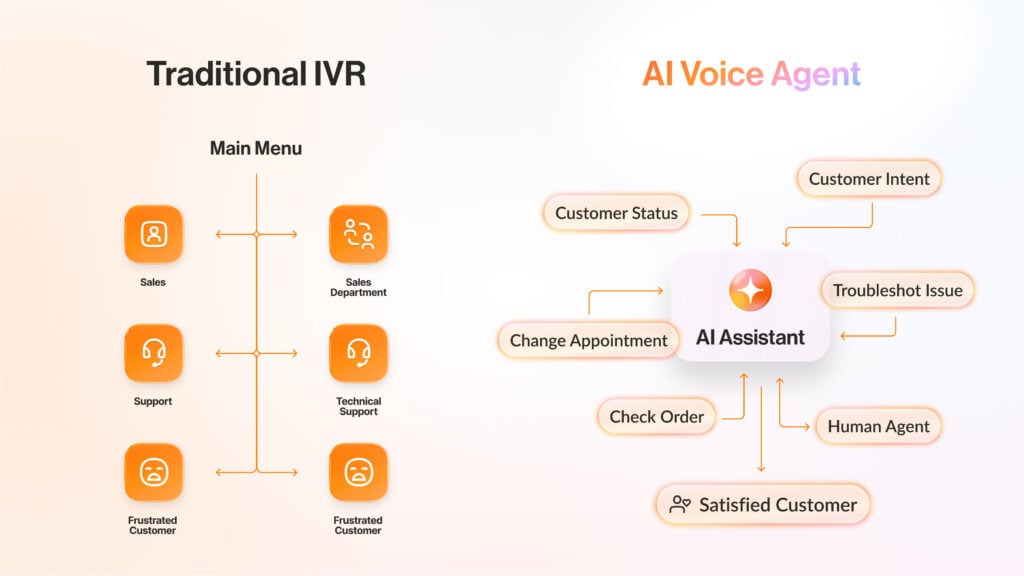
Voice AI agents represent a major evolution from traditional interactive voice response (IVR) systems. Where current systems forced callers through frustrating menu trees, modern AI voice agents engage in natural conversations, understand intent, and resolve issues without rigid scripts.
Today’s voice technology capabilities include sophisticated natural language understanding, real-time sentiment detection, intent recognition across accents and languages, and seamless integration with enterprise business systems. These voice agents can pull customer data, process transactions, and hand off to human agents with complete context—all while maintaining conversational flow.
What makes voice particularly valuable is the richness of the data it provides. Tone, pacing, word choice, and emotional cues create a comprehensive picture of customer needs and satisfaction that text alone cannot capture. This voice data becomes increasingly important as organizations build broader agentic systems that coordinate across channels.
The future of AI voice depends not on eliminating human connection, but on making every voice interaction more effective, whether handled by AI, humans, or both working together. RingCentral’s approach combines AI voice agents with human expertise within a unified platform, enabling businesses to scale customer interactions while maintaining the personal touch that drives loyalty.
What are the major voice AI trends transforming businesses
Voice AI trend #1: Real-time conversational intelligence
The most significant voice AI trend is the shift to truly natural conversation. Modern conversational AI systems process speech, understand intent, and generate contextually appropriate responses with minimal latency—creating interactions that feel genuinely human.
These systems maintain context throughout calls, remembering what customers said earlier in the conversation and adjusting responses accordingly. They recognize when clarification is needed, when to summarize information, and when to advance the conversation.
Advanced natural language processing enables AI voice agents to handle complex, multi-part questions without breaking conversational flow. A customer might say, “I need to change my delivery address for my order from last week and also check if you have the same item in blue,” and the voice AI agent processes both requests while maintaining natural dialogue.
This voice technology trend significantly improves customer satisfaction by eliminating the frustration of robotic interactions and endless repetition. For developers building these systems, the focus has shifted from scripting responses to creating authentic AI voice solutions that adapt dynamically.
The impact is measurable: according to RingCentral’s 2026 AI predictions, organizations using AI agents in customer experience are reporting faster resolution times and higher customer satisfaction scores, with voice serving as one of the richest sources of intent and context feeding these orchestrated systems.
Voice AI trend #2: Emotional awareness and adaptive responses
Voice AI agents now include sophisticated emotional intelligence. These systems detect frustration, confusion, urgency, or satisfaction through vocal patterns, tone, and speech characteristics, then adapt their responses in real-time.
When a voice agent detects rising frustration, it can shift to empathetic language, offer immediate solutions, or escalate to a human agent before the situation deteriorates. Conversely, when detecting satisfaction, it might introduce additional services or ask for feedback.
This emotional awareness extends to pacing and tone matching. If a customer speaks quickly and urgently, the voice AI responds with appropriate efficiency. If they speak slowly or sound confused, the agent slows down and provides additional clarification.
These emotional intelligence capabilities represent a crucial voice technology advancement because they address the primary concern customers have about AI interactions: the fear of being misunderstood or treated like a ticket number rather than maintaining human connection. The investment in developing natural voice responses pays dividends in customer satisfaction and brand loyalty.
Voice AI trend #3: Omnichannel voice integration
Voice no longer exists in isolation. A defining trend is seamless integration across channels—connecting phone conversations with chat histories, email exchanges, and customer relationship management data.
Modern AI voice agents access complete customer profiles during calls, understanding previous interactions regardless of channel. A customer who started an inquiry via chat yesterday can continue the conversation by phone today without repeating information. The voice agent has full context and picks up where the previous interaction left off.
This integration works in both directions. Voice conversations inform subsequent chat or email interactions, creating true continuity. Customers experience consistent, connected service rather than disjointed encounters with disconnected systems.
For enterprise organizations, this omnichannel orchestration has become a standard expectation, not a premium feature. Developers building voice AI applications must design with cross-channel integration as a core requirement.
RingCentral’s unified communications platform exemplifies this integrated approach. By combining voice AI agents with messaging, video, and collaboration tools within a single platform, RingCentral enables businesses to deliver truly seamless customer experiences. Voice interactions automatically connect to the full context of customer relationships across all channels, eliminating the silos that frustrate both customers and service teams.
Voice AI trend #4: Proactive voice engagement
Voice AI isn’t purely reactive. Businesses are deploying voice agents for proactive outreach: appointment reminders, payment notifications, order status updates, and personalized offers.
These AI-initiated calls deliver information efficiently while maintaining personalization. Voice AI agents can answer questions during outbound calls, process payments, reschedule appointments, or escalate to human agents when needed—all within a single proactive conversation.
Proactive voice engagement extends to feedback collection, post-purchase follow-up, and re-engagement campaigns. The scalability of voice technology makes personalized outreach economically viable for interactions that would never justify human agent time.
This trend transforms voice from a cost center handling inbound volume to a strategic channel driving brand engagement, retention, and revenue. The investment in proactive voice AI capabilities delivers measurable returns through improved customer lifetime value.
Voice AI trend #5: Voice biometrics and enhanced security
Security presents both a hurdle and an opportunity in voice AI development. Voice biometric authentication uses unique vocal characteristics to verify identity, replacing passwords, PINs, and security questions with a simple voice check.
This technology enables secure payment processing, account access, and sensitive information disclosure through voice channels while improving user experiences by eliminating cumbersome authentication steps.
Advanced voice agents also detect potential fraud through voice pattern analysis, flagging suspicious calls for additional verification. As synthetic voice technology improves, voice biometrics provide essential legal protection against deepfake impersonation attempts.
Voice AI now includes security as a core feature, building customer trust while enabling more functionality through voice channels. For developers, implementing ethical AI voice solutions with robust security measures is non-negotiable.
Technical innovations driving voice AI
Several technological breakthroughs underpin these voice AI trends.
- Speech recognition: Its accuracy has reached 95-98% for most accents and environments, making voice agents reliable enough for mission-critical enterprise applications.
- Natural language processing: Powered by large language models, it enables conversational AI to understand intent even when customers use unexpected phrasing, industry jargon, or casual language. These models generate contextually appropriate responses that sound natural, rather than scripted, creating high-quality AI voices that rival those of professional voice actors in naturalness.
- Text-to-speech technology: This technology evolved to create genuinely human-sounding voices with appropriate emotion, emphasis, and pacing. Organizations working with voice recording studios can now create distinct voice personalities that align with brand identity while maintaining authenticity and brand control.
- Cloud infrastructure: This provides the computational power and scalability required for real-time voice processing. Modern AI voice agents handle thousands of simultaneous interactions while maintaining consistent performance and sub-second response times.
- Integration capabilities: This allows voice agents to connect with CRM systems, knowledge bases, order management platforms, and other enterprise business applications, transforming voice interactions from information exchanges into action-oriented transactions.
For developers building voice AI solutions, these technical foundations enable the development of sophisticated applications, while continued investment in voice technology research promises even more advanced capabilities ahead. RingCentral leverages these innovations through its cloud-native platform, providing businesses with enterprise-grade voice AI that scales reliably while integrating seamlessly with existing business systems and workflows.
What’s next for AI voice technology
Looking beyond current voice technology trends, several emerging capabilities will shape the next evolution. Fully autonomous handling of complex, multi-step transactions will expand voice AI agent capabilities into areas currently requiring human expertise.
Real-time multilingual conversation translation will enable seamless communication across language barriers. Voice agents will continuously learn from every interaction, improving accuracy and expanding capabilities without manual retraining.
Multimodal integration combining voice with video and visual data will create richer interactions. Ambient voice intelligence in physical spaces will enable hands-free interactions in stores, hospitals, and other environments. In-car assistants will become more sophisticated, handling complex tasks while drivers maintain focus on the road.
Most significantly, voice AI includes deeper integration with broader agentic systems. Voice agents will coordinate with AI agents handling other channels and functions, creating orchestrated experiences that feel seamless across the entire customer journey. This vision of coordinated, multi-agent AI systems aligns with RingCentral’s platform strategy, where voice serves as a critical component within a broader ecosystem of AI-powered business communications.
For developers and businesses making strategic investment decisions, understanding this trajectory is essential. The voice AI product launch timing and feature prioritization should align with these emerging capabilities. Organizations that position themselves early in these trends will capture disproportionate advantage.
Frequently asked questions about voice AI agents
What’s the difference between voice AI agents and traditional IVR systems?
Traditional IVR systems force callers through rigid menu trees using touch-tone or limited voice commands. Voice AI agents engage in natural conversations, understand context and intent, detect emotion, and handle complex requests without scripts. They integrate with business systems to pull customer data and complete transactions, while legacy IVR systems simply route calls based on predefined options.
Can voice AI agents handle multiple languages and accents?
Yes, modern voice AI agents support multiple languages and recognize diverse accents with high accuracy. Advanced speech recognition technology and natural language processing enable these systems to understand regional variations, industry jargon, and casual speech patterns. Emerging capabilities include real-time translation, allowing voice agents to conduct conversations across language barriers while maintaining natural dialogue flow.
Will voice AI agents replace human contact center agents?
Voice AI agents augment rather than replace human representatives. AI handles high-volume, routine interactions efficiently, while humans manage complex problem-solving, emotional support, and situations requiring judgment or creativity. The ideal approach combines both: AI agents resolve straightforward inquiries instantly and escalate complex issues to humans with complete context, maximizing efficiency while maintaining quality and human connection.
The future of voice AI
Voice AI has matured from experimental technology into a strategic business tool delivering measurable results. Conversational AI systems now handle complex interactions, understand emotional context, integrate seamlessly across channels, and deliver personalized experiences at scale. As detailed in RingCentral’s 2026 predictions for agentic AI, enterprises are shifting from scattered AI features to coordinated agentic systems that orchestrate work across channels—and voice AI agents serve as critical components in this architecture, providing rich conversational data and context that feeds these broader systems.
For businesses and developers, the opportunity is clear: organizations that embrace voice technology thoughtfully—focusing on user experiences, human connection, and continuous improvement—will lead their industries. The question isn’t whether to adopt AI voice agents, but how quickly you can implement them effectively to transform your customer interactions and operational efficiency. RingCentral’s AI-powered unified communications platform provides the foundation for this transformation, enabling businesses to deploy voice AI as part of an integrated, intelligent communication strategy.
Updated Feb 04, 2026