AI Communications






Answer every patient call, even when the front desk is managing check-ins, insurance questions, and in-person patients simultaneously.
Every dental receptionist manages too many priorities at once. They greet arriving patients, verify insurance, process payments, answer clinical questions, and manage a constant stream of phone calls. When several things happen at once, the phone often loses.
The result is more than a missed call. It may be a prospective patient who hangs up, an existing patient who cannot reschedule an appointment, or someone with a dental emergency who immediately calls another practice.
A dental answering service helps close those gaps by ensuring every caller receives a timely, professional response, even during peak office hours, after hours, or when the front desk is fully occupied.
In this guide, you’ll learn what a dental answering service does, how AI-based solutions differ from traditional live-answering services, and what features matter most when evaluating providers.
Key takeaways
- A dental answering service helps cover calls the front desk cannot answer, including appointment booking, after-hours support, and overflow calls.
- Missed calls are a documented revenue challenge for appointment-based businesses, not just an operational inconvenience.
- AI-based answering services differ from live-agent services in consistency, scalability, and scheduling capabilities.
- Evaluate providers based on scheduling integration, HIPAA handling, consistency, and call management—not simply price.
- RingCentral AI Representative (AIR Pro) helps practices answer every call consistently without adding front desk headcount.
Why dental practices miss more calls than they think
Most dental offices don’t intentionally send patients to voicemail. It happens because front desk staff are responsible for multiple high-priority tasks at the same time.
A typical receptionist may be:
- Checking patients in
- Confirming insurance information
- Collecting payments
- Coordinating with clinical staff
- Responding to patient inquiries
- Managing appointment booking
- Answering incoming phone calls
When several patients arrive at once, the phone naturally becomes a lower priority. When those calls do reach voicemail, most callers won’t wait around. They may not even reach your voicemail at all.
According to Dental Economics, 80% of patients now prefer dentists who offer self‑scheduling over traditional phone booking, reflecting how many callers avoid engaging by phone when it’s not convenient.
Your self-service portals should also be intuitive and easy to access, which improves patient engagement while also ensuring you don’t lose a potential patient. When optimizing your self-service portal, there are three areas to focus on:
- Integration with core systems, like your electronic health record (EHR), scheduling, billing, and communication platforms.
- Accessible and easy-to-use features, including portal navigation, login and registration, and mobile access.
- Options for AI voice or chat and SMS so patients can choose to call, text, or chat online.
Think about what one missed new-patient call is worth. A single restorative or orthodontics case can run into thousands of dollars over the life of that patient relationship, not counting referrals. Multiply a 27% miss rate across a month of call volume, and the gap stops looking like a minor operational quirk and starts looking like a line item.
None of this requires more front-desk staff to fix. It requires a way to answer calls that doesn’t depend on whether someone happens to be free at that exact second. Even small businesses can benefit from AI adoption, and your dental practice gains benefits without additional staff, training, or workload.
What a dental answering service covers
A dental office answering service picks up where your front desk can’t. It answers the call, figures out what the patient needs, and either handles it directly or routes it to the right person.
Three jobs make up most of what these services do. New patient inquiries get answered on the first ring instead of routed to voicemail. Existing patients get help scheduling, rescheduling, or confirming appointments without waiting on hold. After-hours and overflow calls, the ones that hit during lunch, after 5 p.m., or during a lull, get covered instead of going dark.
That last piece matters more than practices expect. A patient calling at 6 p.m. to book an urgent appointment won’t wait until 8 a.m. if another practice answers first. Some practices pair this coverage with a virtual receptionist to handle general call routing alongside patient-specific scheduling needs.
Live-agent services vs. AI-based answering
Traditionally, virtual receptionists working in call centers have answered calls on behalf of dental practices. More recently, AI-powered reception services have expanded what’s possible.
Two models exist for handling calls your front desk can’t take:
- Live-agent services route the call to a staffed call center, where a person answers on your practice’s behalf and takes a message or books directly into your calendar.
- AI-based answering services skip the call center. The AI answers the call directly, figures out what the caller needs based on what they say, and routes or schedules accordingly. There’s no queue and no hold time for the caller.
The trade-offs come down to consistency and depth. Live agents can handle a conversation that goes off script, but quality shifts depending on who picks up. AI-based systems answer the same way every time, at any hour, without depending on a call center’s staffing levels that day.
What to look for when evaluating a dental answering service
Not every HIPAA-compliant answering service offers the same capabilities.
When comparing providers, focus on how well they support your existing workflows rather than simply comparing pricing.
Scheduling integration
If the answering service can’t see your practice management system, every call it answers still requires a staff member to go back and enter the appointment manually. That defeats the purpose. Ask a vendor directly whether it connects to the software you already run, not just whether it works with “scheduling tools” in general.
Consistency across every caller
Patients expect the same experience whether they call during lunch, after hours, or first thing Monday morning.
Ask questions such as:
- Does every caller receive the same greeting?
- Can the system answer multiple calls simultaneously?
- Are responses consistent regardless of time of day?
Consistency improves both operational efficiency and patient satisfaction.
A service that answers well at 10 a.m. but drops to a generic voicemail at 7 p.m. only covers part of your day. Many practices are moving off rigid, menu-driven phone trees to AI-powered IVR systems that understand intent instead of forcing callers through a menu.
Patient information handling
Dental practices collect protected health information on every call: insurance details, symptoms, appointment reasons. How a vendor stores and transmits that data matters as much as how fast they answer. Ask directly how the service handles Health Insurance Portability and Accountability Act (HIPAA)-related data before you sign anything, and don’t accept a vague answer.
Escalation path
Every vendor handles the easy calls fine. The harder test is what happens when a call doesn’t fit the pattern the service expects: an angry patient, a billing dispute, an emergency. Ask what the escalation path looks like when a caller needs a person immediately, and how fast that handoff happens once the AI or agent recognizes it.
How RingCentral AIR Pro handles this for dental practices
Hiring a dedicated staff member just to answer the phone isn’t cost-effective for most practices. Neither is an unanswered phone. That’s the bind RingCentral’s AI Representative (AIR Pro) is built to solve.
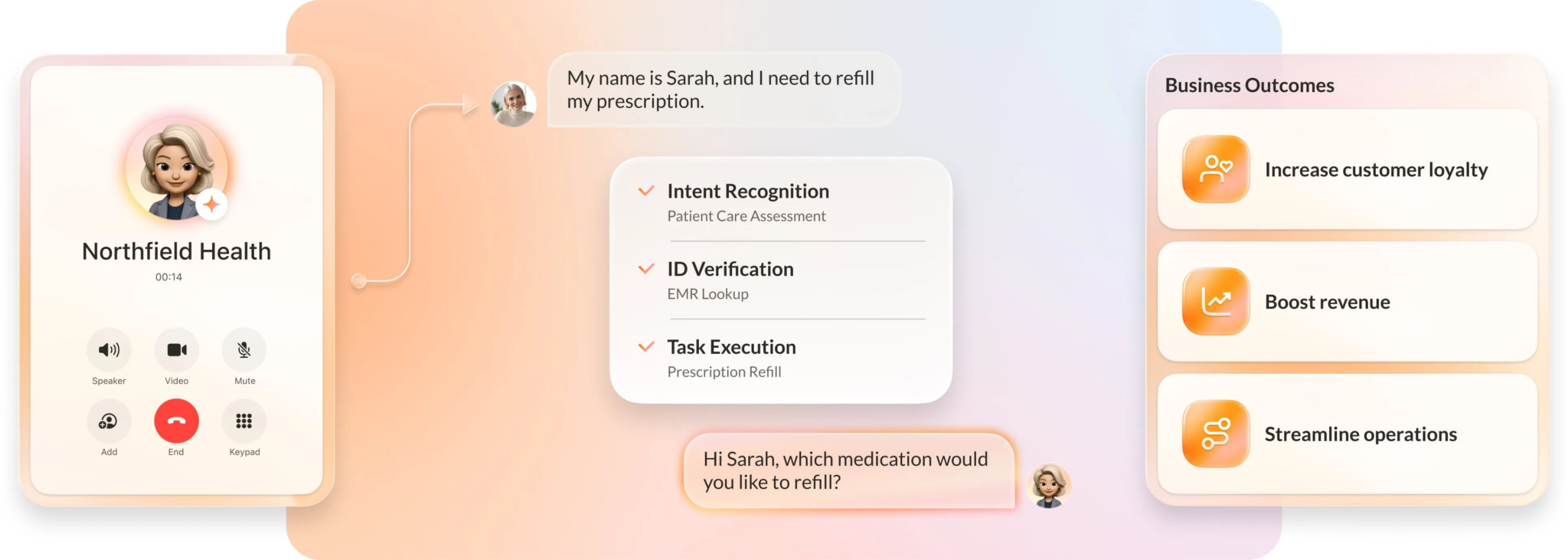
AIR Pro for Healthcare answers incoming calls automatically, before a call needs a human to pick up. It figures out what the caller needs, whether that’s booking an appointment, asking about a service, or reaching a specific person, and routes the call based on that intent.
For a dental practice, that means a patient calling at lunch to schedule a cleaning doesn’t hit voicemail because the front desk is checking someone in. AIR Pro answers the call and connects with your practice’s scheduling and EHR systems to handle the request directly, then hands off to a live team member when it needs a human touch.
AIR Pro is HIPAA-compliant and HITRUST-certified, the two most relevant compliance signals for a dental practice handling patient data. AIR Pro is currently in early access, so you can join the beta and see how AIR Pro handles inbound calls for your dental practice.
Stop letting a busy front desk decide who answers the phone
A missed call is a patient decision point. The practice that answers first usually wins that patient, whether it’s a new patient calling for the first time or an existing one trying to reschedule.
Consistent call handling protects both groups. New patients get through instead of hitting voicemail during your busiest hour. Existing patients get the same experience whether they call at 9 a.m. or 6 p.m.
Whichever model you choose, live-agent or AI-based, judge it on one thing: can it answer every call the same way, at every hour, without adding another system for your front desk to manage? See how AIR Pro handles inbound calls for dental practices and what consistent call coverage looks like in practice.
FAQs about dental answering services
What does a dental answering service do?
A dental answering service answers incoming calls when front desk staff are unavailable. Depending on the provider, services may include appointment booking, message taking, after-hours support, emergency call routing, patient inquiries, and call forwarding.
Is an AI dental answering service HIPAA compliant?
This depends on the specific vendor and how it stores and transmits patient information captured during a call. Ask any vendor directly for documentation on how it handles protected health information before signing a contract. For example, RingCentral AI Representative (AIR Pro) is HITRUST- and HIPAA-certified.
Can a dental answering service schedule appointments directly?
Yes. Many services, both live-agent and AI-based, can book, reschedule, or confirm appointments without a staff member picking up the phone. The depth of that capability depends on whether the service connects directly to your practice management system. Ask a vendor to confirm it connects to the specific software your practice already uses.
How much does a dental answering service cost?
Cost varies widely based on call volume, whether the service uses live agents or AI, and how deep the scheduling integration goes. There’s no standard price point across the category, so treat any flat number you find online as a starting point for questions, not a quote.
Originally published Aug 09, 2026