AI Communications




Every unanswered call is a potential customer who moves on. For small businesses, missed calls, delayed responses, and inconsistent after-hours experiences hit cash flow directly, and your team can only do so much when they’re busy serving customers.
There’s a better option. AI receptionists answer every call & texts 24/7, book appointments, capture leads, and route callers to the right person. It handles the calls your team can’t get to including after hours, during peak volume, and when every line is busy, so no opportunity slips through the gap.
This post breaks down how an AI receptionist solves those availability gaps, the real cost of missed calls, and which industries are getting the most value from the switch.
Key Takeaways
- AI receptionists answer calls 24/7, book appointments, send SMS follow-ups, and route calls with no time off, no sick days, and no after-hours gaps.
- RingCentral AIR works with any phone. Keep your existing number.
- Best fit for medical, legal, home services, real estate, and retail businesses where missed calls directly translate to lost revenue.
What is an AI receptionist for small business?
RingCentral AI Receptionist (AIR) is an AI-powered receptionist service for small businesses that answers calls & texts 24/7, books appointments, captures leads and routes callers based on intent Available as a standalone solution starting at $49/month or as an add-on to your existing RingCentral RingEX plan starting at $39/month. No IT setup required.
AIR makes sure your business never misses a customer, appointment, or opportunity, even when your team is on a job site, in a client meeting, or closed for the evening.
Unlike traditional auto-attendants that push callers through frustrating phone trees, a modern AI receptionist uses natural language processing to hold real conversations. It understands what a caller needs, answers from your own business knowledge base, and takes action, including booking, routing, or capturing details without bouncing anyone to voicemail.
For small business owners still learning to manage a business and already stretched thin, that’s not a nice-to-have. It’s how you compete with businesses that have a full front desk.
3 critical pain points solved by an automated front desk
1. Eliminating missed customer inquiries and after-hours communication gaps
According to RingCentral’s research, 38% of small businesses cite missed calls as a critical business concern. That number makes sense when you consider what actually happens to an unanswered call: the caller doesn’t wait. They move on to the next option in their search results.
An AI receptionist eliminates that gap entirely. It answers every call on the first ring, whether it’s at 2 PM on a Tuesday or 11 PM on a Saturday, and handles the conversation from there. No voicemail. No callback queue. No lead lost to a competitor who picked up.
2. Scaling operational capacity without expanding payroll
The traditional solution to high call volume is more headcount. A second receptionist, a part-time hire, a virtual assistant service billed by the hour. Each of those options adds overhead that scales with call volume in a way that AI doesn’t.
An AI receptionist handles one call or one hundred simultaneously. It doesn’t slow down during a busy season, take lunch, or require overtime pay for a holiday weekend. For businesses looking to cut costs without cutting service quality, scalability is the core value proposition.
3. Maintaining consistent, professional brand trust signals for callers
Every caller interaction is a brand impression. A caller who reaches a rushed, distracted front desk person, or worse, a voicemail box, forms a different opinion of your business than one who gets an immediate, professional, helpful response.
AI receptionists deliver the same quality of interaction on call number one and call number one hundred. The greeting is consistent, the information is accurate, and the experience reflects the professional image you’ve built. For small businesses where every customer relationship matters, that consistency is a competitive edge.
What missed calls are actually costing your business
Every missed call has a dollar value, and it’s not zero. When your team is with a customer, on another call, or closed for the evening, inbound calls don’t wait. They go to a competitor that picks up. For small businesses, where each new client relationship carries real weight, that gap compounds fast.
Running a front desk comes with fixed costs regardless of call volume. The question isn’t whether AI is cheaper than a person, it’s whether your current setup is covering every opportunity your business generates.
| Cost item | What you’re already spending |
| Base salary | $35,000–$40,000/year |
| Benefits (health, PTO) | $8,000–$12,000/year |
| Training and onboarding | $1,000–$2,000 |
| Turnover replacement cost | $5,000–$10,000 (avg.) |
| After-hours coverage | Not included |
| Total fully loaded cost | $48,000–$64,000+/year |
RingCentral AIR works alongside your team to make sure those gaps are covered. While your staff focuses on the customers in front of them, AIR handles incoming calls, answering questions, booking appointments, capturing leads, sending SMS follow-ups, and routing anything complex to the right person with full context. No missed opportunities. No overburdened team.
Real-world results reflect this. Big Think Capital recouped $3,000 per month by ensuring every inbound call was answered without adding headcount or sacrificing service quality.
For businesses actively looking to save money without reducing service capacity, an AI receptionist is one of the highest-ROI investments available.
What an AI receptionist for small business actually does
The feature set of a modern AI receptionist goes well beyond call routing. Here’s what RingCentral AI Receptionist handles in practice:
- Answers calls 24/7 – nights, weekends, and holidays, with no after-hours gap. Trained on your website, FAQs, services, hours, and pricing so it responds accurately from day one.
- Books appointments during the call – no redirecting callers to a booking page or asking them to call back
- Routes calls to the right person or department – AIR understands caller intent, no more confusing phone tree
- Captures lead information from every caller – name, contact details, reason for calling, all logged automatically
- Handles multiple calls simultaneously – no busy signals, no hold queues during peak hours
The AI receptionist setup process is faster than most businesses expect. There’s no new phone number to provision, no third-party software to integrate, and no IT team required. It works within your existing RingCentral system from day one.
AI receptionist use cases by small business type
Medical and healthcare practices
Medical offices field a high volume of routine calls, including appointment bookings, prescription refill questions, insurance verification, and after-hours urgent inquiries. An AI receptionist handles it all without tying up clinical staff. It books appointments directly into your calendar, routes urgent calls to the on-call provider, and manages after-hours inquiries with the consistent, professional responses patients expect. RingCentral AIR supports HIPAA-compliant configurations, making it a viable option for practices that need to protect patient information at every touchpoint.
Key feature: After-hours call routing with urgent escalation logic.
Legal practices
Law firms lose potential clients the moment a call goes to voicemail during intake. An AI receptionist captures every inbound inquiry, gathers the key case details a new client call requires, and routes the call to the attorney on duty or schedules a consultation. All these without putting a prospective client on hold. For firms that bill by the hour, every minute of front-desk automation is also a minute of billable time recaptured.
Key feature: Structured intake capture and intelligent attorney routing.
Home services and contractors
The missed-call problem is most acute in home services. Industry data shows that 62% of calls to home services businesses go completely unanswered. In a field where emergency calls (a burst pipe, a failed HVAC unit in summer) are high-urgency, high-ticket opportunities, missing that call means losing the job entirely. An AI receptionist answers every call instantly, captures job details, books service appointments, and routes genuine emergencies to the on-call technician.
Key feature: Emergency call detection and after-hours booking.
Real estate agencies
Property inquiries don’t wait for business hours. Buyers and renters call when they find a listing they’re interested in, and the agent who responds first often wins the client. An AI receptionist answers property inquiries at any hour, gathers buyer or renter details, books viewings, and routes calls to the right agent based on property type or location. For agencies managing multiple listings across a team, it’s the difference between capturing every lead and letting most slip away.
Key feature: Lead capture and agent routing by listing or specialty.
Retail and service businesses
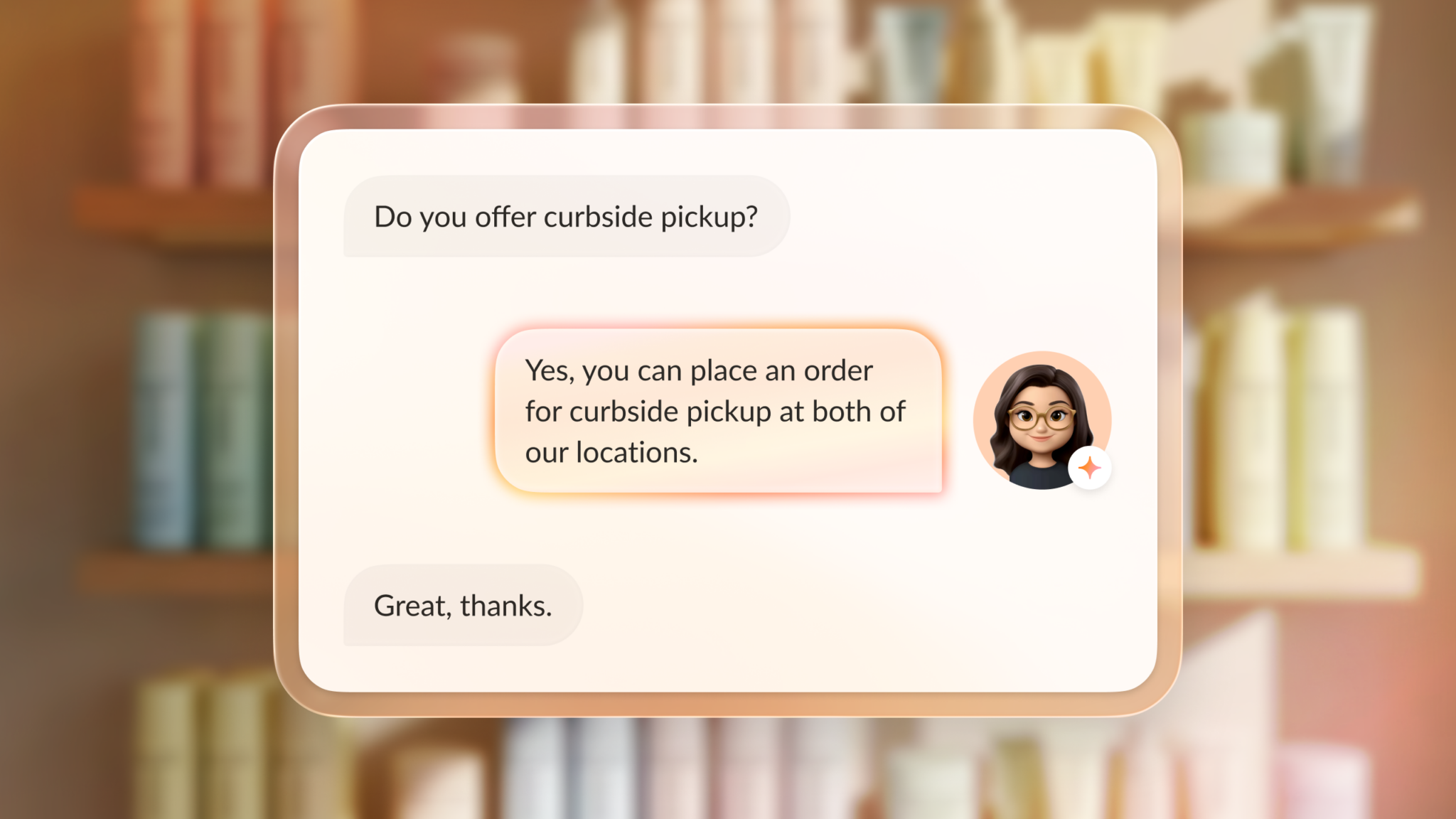
Retail and service businesses handle a predictable mix of high-volume, low-complexity calls: store hours, directions to the store, return policies, order status, and department routing. These are exactly the calls an AI receptionist handles best by resolving them instantly without tying up a staff member, and routing the edge cases that genuinely need a human. For multi-location businesses, consistent call handling across every location is a significant operational advantage.
Key feature: FAQ resolution and multi-location routing.
How to choose the best AI receptionist for your small business
The right AI receptionist depends on more than just price. Setup complexity, CRM and calendar connectivity, compliance certifications, SMS follow-up , and whether the tool works inside your existing phone system or adds another layer to manage. These are the factors that separate a good fit from a frustrating one.
The table below compares the five strongest options for small businesses across each of those dimensions, followed by a closer look at what each platform does well and where it falls short.
| Platform | Pricing model | Setup complexity | CRM integrations | Calendar integrations | Compliance | Call transfer | 24/7 coverage | Language support |
| RingCentral AI Receptionist (AIR) | Flat rate from $39/mo | Minutes – no IT needed | Yes – native | Yes – native | HIPAA, SOC 2 | Yes – intelligent routing | Yes – included | English + multilingual |
| Nextphone | From $199/mo | Low – guided setup | Limited | Yes | SOC 2 | Yes | Yes | English |
| Allo | From $18/mo | Low – self-serve | Limited | Google Calendar | Not specified | Basic | Yes | English |
| My AI Front Desk | From $20/mo | Low – self-serve | Zapier-based | Yes | Not specified | Yes | Yes | English + Spanish |
1. RingCentral AI Receptionist (AIR)
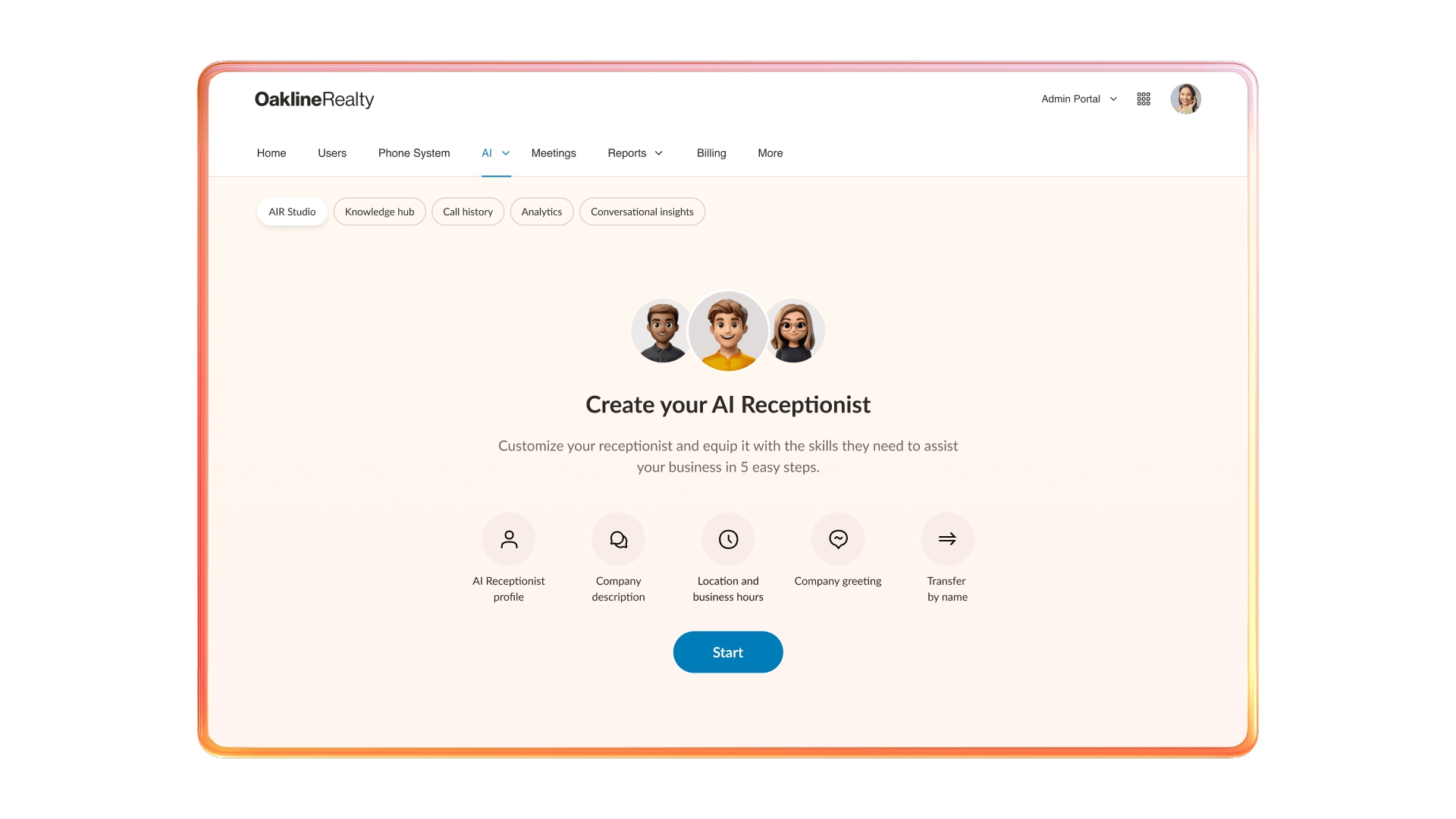
RingCentral AIR is your virtual front desk – always on, always professional, and powered by natural, human-like conversation. Available as a standalone product at $49/month or as an add-on to your existing RingCentral RingEX plan at $39/month, it activates on your current business number in minutes; no new app, no third-party integration, no IT project required.
What sets AIR apart from every standalone tool on this list: it uses LLM-powered reasoning to understand callers in natural language, not rigid menu logic. It builds itself from your website and FAQs automatically. It handles calls and inbound texts 24/7, books appointments, captures leads into your CRM, sends follow-up texts, and routes complex conversations to the right person with full context. It works with any phone setup, cloud, on-prem, or hybrid, without rip-and-replace. And it scales to handle multiple calls simultaneously, across multiple locations, without adding headcount.
Best for: Small businesses on any phone system that want a fast, no-IT setup with native integration into RingCentral.
Pricing: From $39/month (add-on) or $49/month (standalone).
2. Nextphone
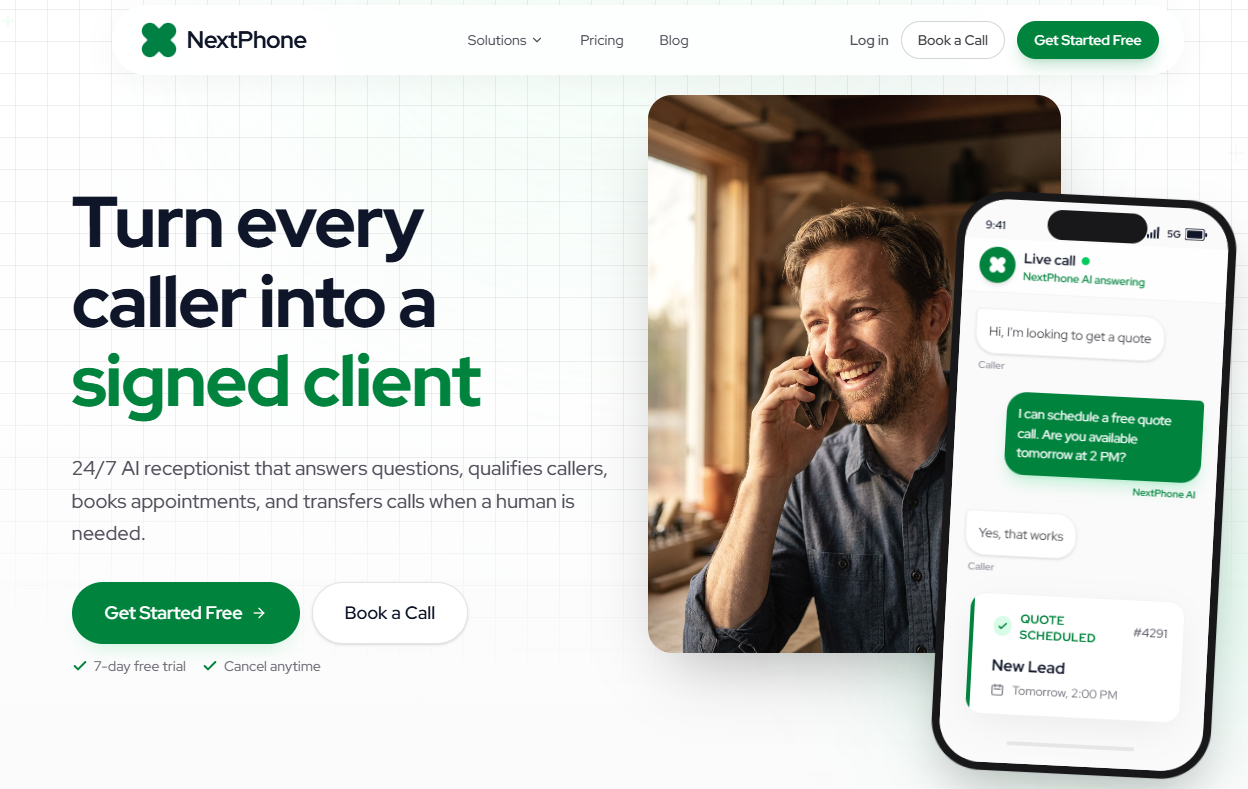
Nextphone is a standalone AI receptionist built specifically for small businesses, with a strong emphasis on call accuracy and natural-sounding conversation. It handles inbound calls, books appointments, answers FAQs, and routes callers, and its setup process is guided enough that most businesses are live within a day.
Where Nextphone falls short is integration depth. CRM connectivity is limited compared to more established platforms, and pricing increases quickly as call volume grows. For businesses with straightforward call handling needs and a limited existing tech stack, it’s a capable option. For businesses that need deep CRM or calendar integration out of the box, the gaps show.
Best for: Small businesses with moderate call volume and straightforward routing needs.
Pricing: From $199/month.
3. Allo
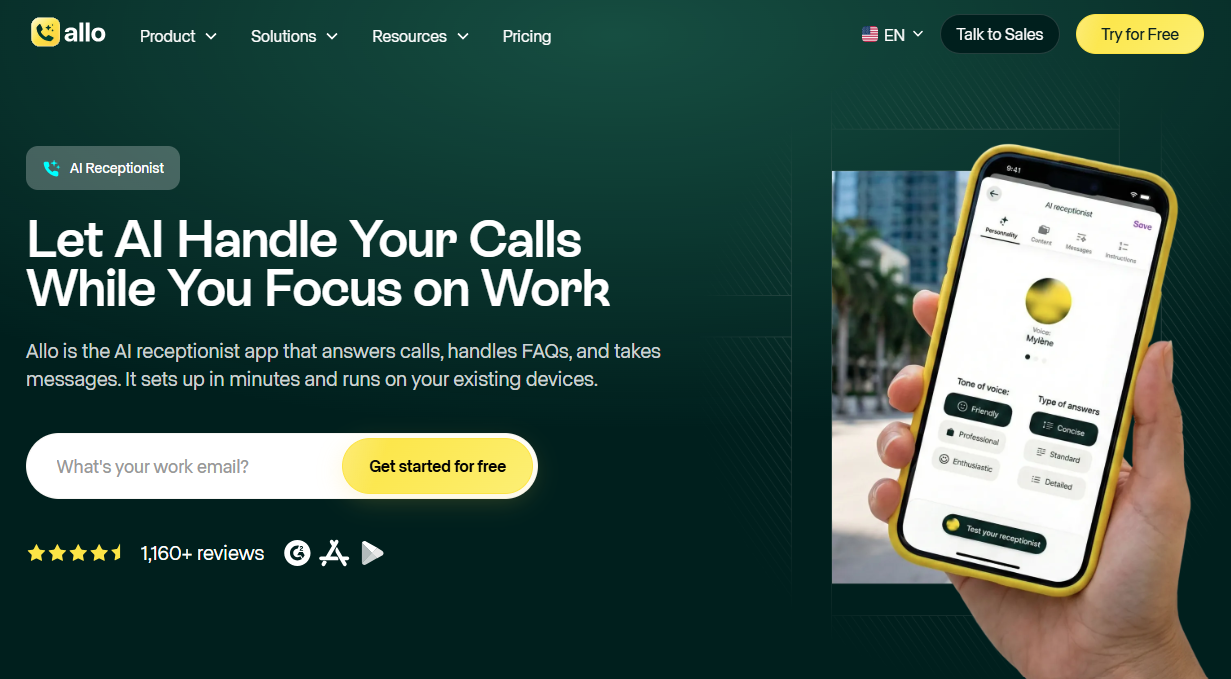
Allo positions itself as the most affordable entry point in the AI receptionist category, with plans starting at $18/month and a self-serve setup that gets most businesses live quickly. It handles call answering, basic FAQ resolution, and Google Calendar booking, making it a functional option for very small operations with simple needs.
The trade-offs are real. Compliance certifications are not clearly documented, CRM integration is limited, and the feature set doesn’t scale well for businesses with more complex call flows or multiple team members to route between. Allo works best as a starter solution for solo operators or very small teams who need basic after-hours coverage without a significant monthly commitment.
Best for: Solo operators and micro-businesses needing basic after-hours call coverage on a tight budget.
Pricing: From $18/month for 1 user.
4. My AI Front Desk
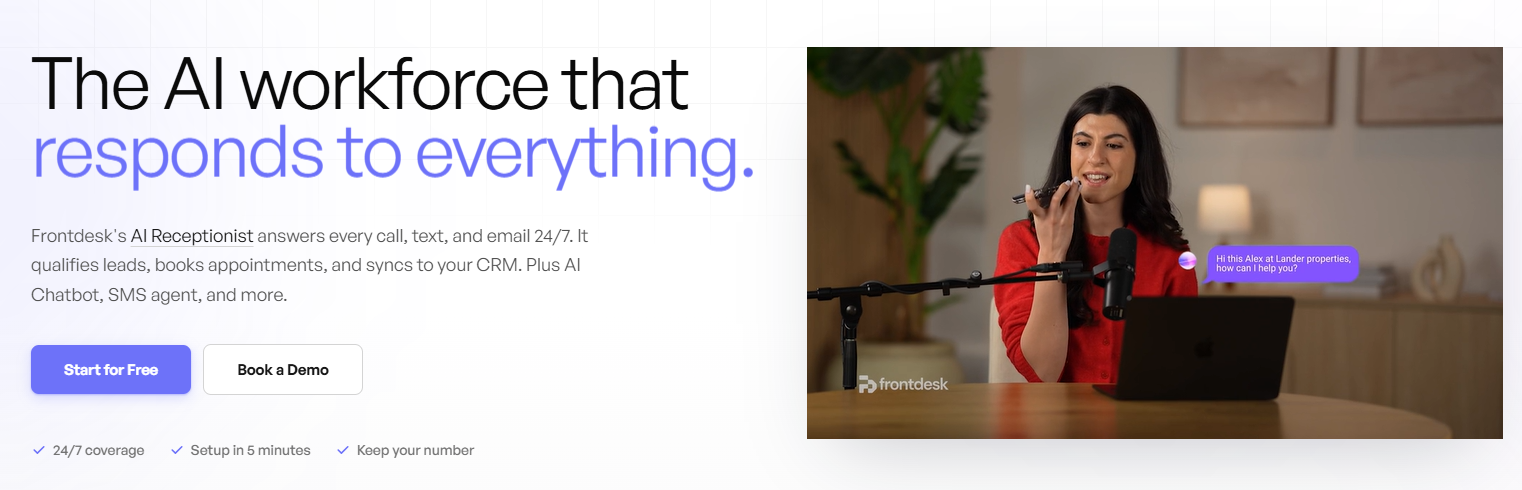
My AI Front Desk is a purpose-built AI receptionist with a notable strength in bilingual support. It handles calls in both English and Spanish, which makes it a meaningful option for businesses serving a bilingual customer base. It books appointments, answers FAQs, captures caller details, and routes calls, with Zapier handling integrations to external tools.
The Zapier dependency for CRM and workflow connections introduces a layer of setup complexity that some small business owners may find frustrating. It’s flexible in theory but requires configuration time to work well with existing tools. For businesses where Spanish-language support is a priority, it’s one of the few options in this price range that handles it natively.
Best for: Small businesses with a bilingual English/Spanish customer base.
Pricing: From $20/month.
How RingCentral AI Receptionist works for small businesses
Getting started with RingCentral AIR is a three-step process that most businesses complete without any IT involvement.
Step 1: Connect your existing phone number. No new phone number needed. AI Receptionist activates on your current business number, the one your customers already have on business cards, in your Google listing, and on your website.
Step 2: Add your website and business information. AIR learns from your website and knowledge base to accurately answer caller questions.
Step 3: Go live. AIR starts answering immediately. No IT team, no developer, no integration project. Changes to hours, FAQs, or routing rules can be updated in real time through the RingCentral admin portal.
What makes RingCentral AIR different from every standalone tool on the market:
- No new app to manage
- No per-minute billing
- No third-party integration to maintain
- Already inside the phone system you’re using
For small businesses that have evaluated other AI receptionist tools and walked away frustrated by setup complexity, hidden costs, or integration headaches, that’s the difference that matters.
FAQs about AI receptionists for small business
What is the best AI receptionist for small business?
The best AI receptionist for a small business is one that works inside your existing phone system, answers calls 24/, and requires no IT setup to deploy. RingCentral AI Receptionist meets all three criteria: it starts at $39/month, activates on your existing number, and goes live in minutes rather than days.
How much does an AI receptionist cost for a small business?
AI receptionist pricing ranges from $25–$285+/month depending on the provider and billing model. RingCentral AIR starts at $39/month as an add-on to RingCentral RingEX or $49/month as a standalone solution. Additional per-minute charges apply for usage beyond the included plan.
Can AI replace a human receptionist for a small business?
For the majority of front desk functions like answering routine calls, booking appointments, answering FAQs, SMS follow-ups, and routing to the right person, the answer is yes. AI handles these tasks automatically more consistently and at a fraction of the cost. Where human judgment still matters (complex complaints, sensitive conversations, nuanced client relationships), AI routes to the right person rather than attempting to handle it alone. The practical outcome for most small businesses is that AI handles 70–80% of inbound calls entirely, freeing staff for higher-value work.
Is an AI receptionist HIPAA-compliant?
Not all AI receptionists are. RingCentral AIR supports HIPAA-compliant configurations for healthcare practices, making it a viable option for medical offices, dental practices, and other providers handling protected health information. Always verify compliance certifications before deploying any AI tool in a healthcare setting.
Do I need a new phone number for an AI receptionist?
No. RingCentral AIR activates on your existing business number. Your customers keep dialing the same number they always have and the AI simply answers it on your behalf. This is a significant practical advantage over standalone AI receptionist tools, which typically require provisioning a new number and updating all your business listings.
Updated Aug 06, 2026