AI Communications









Learn how to implement AI to reduce CX costs, improve service quality, and scale your operations without causing disruption.
AI customer experience (CX) goes far beyond chatbots. At enterprise scale, it requires rethinking how every interaction unfolds across voice, digital channels, and internal collaboration. That means using data and automation to make customer interactions faster, more consistent, and more valuable.
For large organizations, success depends on choosing technologies that deliver real impact, implementing them without disrupting operations, and avoiding common pitfalls as you grow.
Key takeaways
- AI customer experience is a strategic capability that unifies conversational AI, real-time analytics, and intelligent routing across your entire customer journey
- Voice-first AI assistants, predictive analytics, and sentiment analysis deliver the most impact when they run on a unified platform
- Successful enterprise implementation requires clear use cases, deep system integration, continuous optimization, and strong governance
What is AI customer experience?
AI customer experience applies artificial intelligence strategically across the entire customer journey. Automating routine work, personalizing every interaction, and providing instant insight help teams meet customer needs better and faster.
In practical terms, AI customer experience coordinates capabilities like conversational AI, real-time analytics, speech recognition, summarization, and routing intelligence across:
- Inbound and outbound contact center interactions
- Self-service experiences
- Field service, sales, and account management conversations
- Internal collaboration between support, product, legal, and operations
For enterprises operating across regions, languages, regulatory environments, and lines of business, the stakes are high. Fragmented data, inconsistent journeys, and siloed teams translate quickly into higher costs and increased churn.
AI customer experience addresses these enterprise-specific pain points:
- Fragmented customer data: AI unifies data across telephony, contact center, customer relationship management (CRM), and collaboration tools, turning call recordings, transcripts, and interaction logs into searchable, usable insight.
- Inconsistent experiences across channels: AI solutions that run on a unified communications and contact center platform apply the same routing logic, knowledge, and personalization to voice, chat, social, and email.
- Governance and compliance: Enterprise-grade AI respects role-based access, retention policies, and regional data boundaries while making interaction data available for analytics and coaching.
- Operational efficiency and ROI: Intelligent automation, enhanced routing, and real-time agent assistance lower average handle time, reduce transfers, and improve first-contact resolution—directly impacting cost to serve and customer satisfaction.
Which AI technologies transform customer experience at enterprise scale?
The AI-driven technologies that matter most work in real time, manage voice at scale, and integrate cleanly with existing systems.
Below are the core AI capabilities reshaping enterprise CX. These deliver maximum ROI when they run on a unified platform that combines communications, contact center, and conversation intelligence.
Conversational AI and intelligent virtual assistants
Conversational AI and AI receptionists, also known as intelligent virtual assistants, anchor modern customer experience strategies, especially for voice-heavy operations. Voice-first AI handles real phone conversations rather than scripted chat.
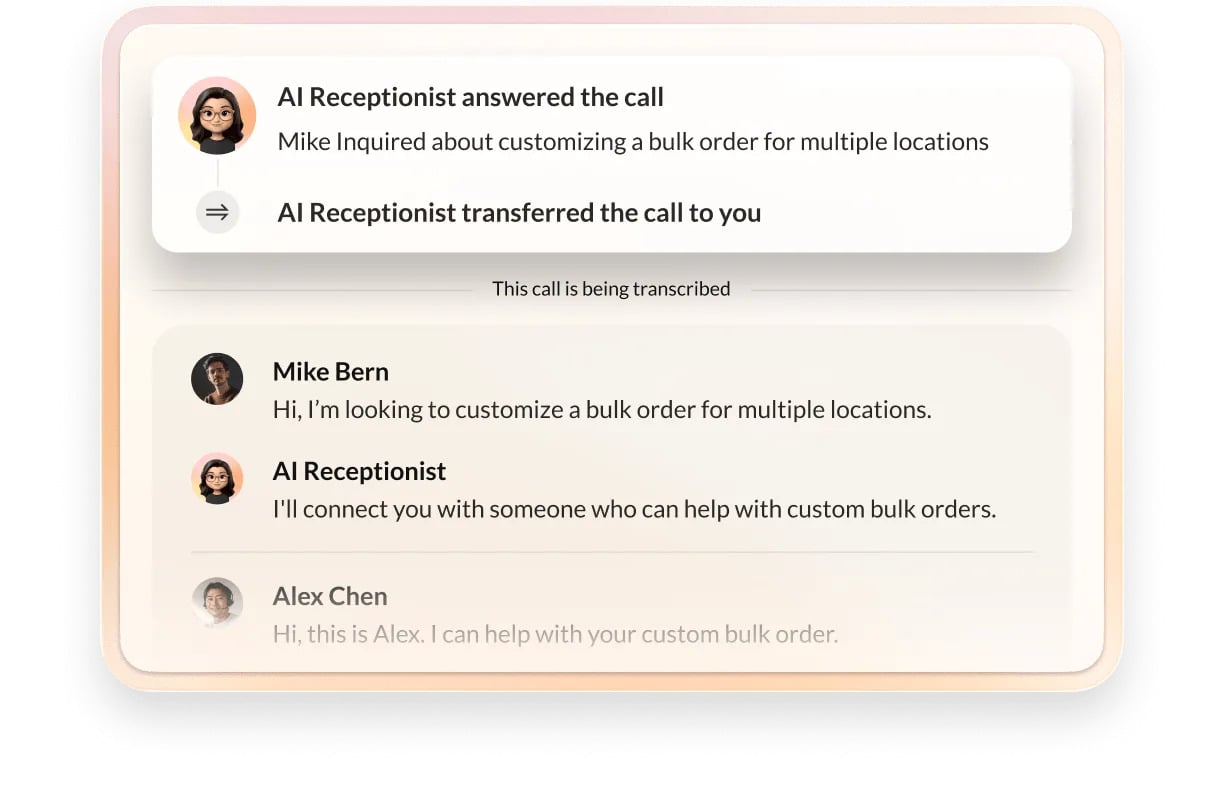
It can:
- Understand natural language so customers can speak freely instead of navigating rigid IVR menus
- Authenticate callers and gather intent before a human agent joins
- Self-serve routine requests like balance inquiries, order updates, and appointment changes
- Route calls based on intent, language, skills, and availability instead of just the dialed number
Predictive analytics and personalization engines
Predictive analytics and personalization engines shift business operations from reactive service to proactive engagement. AI analyzes patterns in your data to anticipate needs, recommend actions, and guide agents and systems toward better outcomes.

In practice, predictive AI enables:
- Predictive routing: AI matches customers to the right agent or queue based on past behavior, profile data, language, and intent.
- Next-best-action recommendations: AI suggests offers, troubleshooting steps, or retention tactics inside the agent desktop during live interactions.
- Churn and risk models: AI flags at-risk accounts based on contact history, product usage, or sentiment trends so you can intervene early.
- Capacity forecasting: AI uses interaction volume patterns to optimize staffing levels, deflection strategies, and callback policies.
AI that operates across channels and business units delivers personalized experiences, whether someone calls customer support, chats with sales, or interacts with a digital assistant. That consistency makes your brand feel coherent across every touchpoint.
AI-powered sentiment analysis and voice of the customer tools
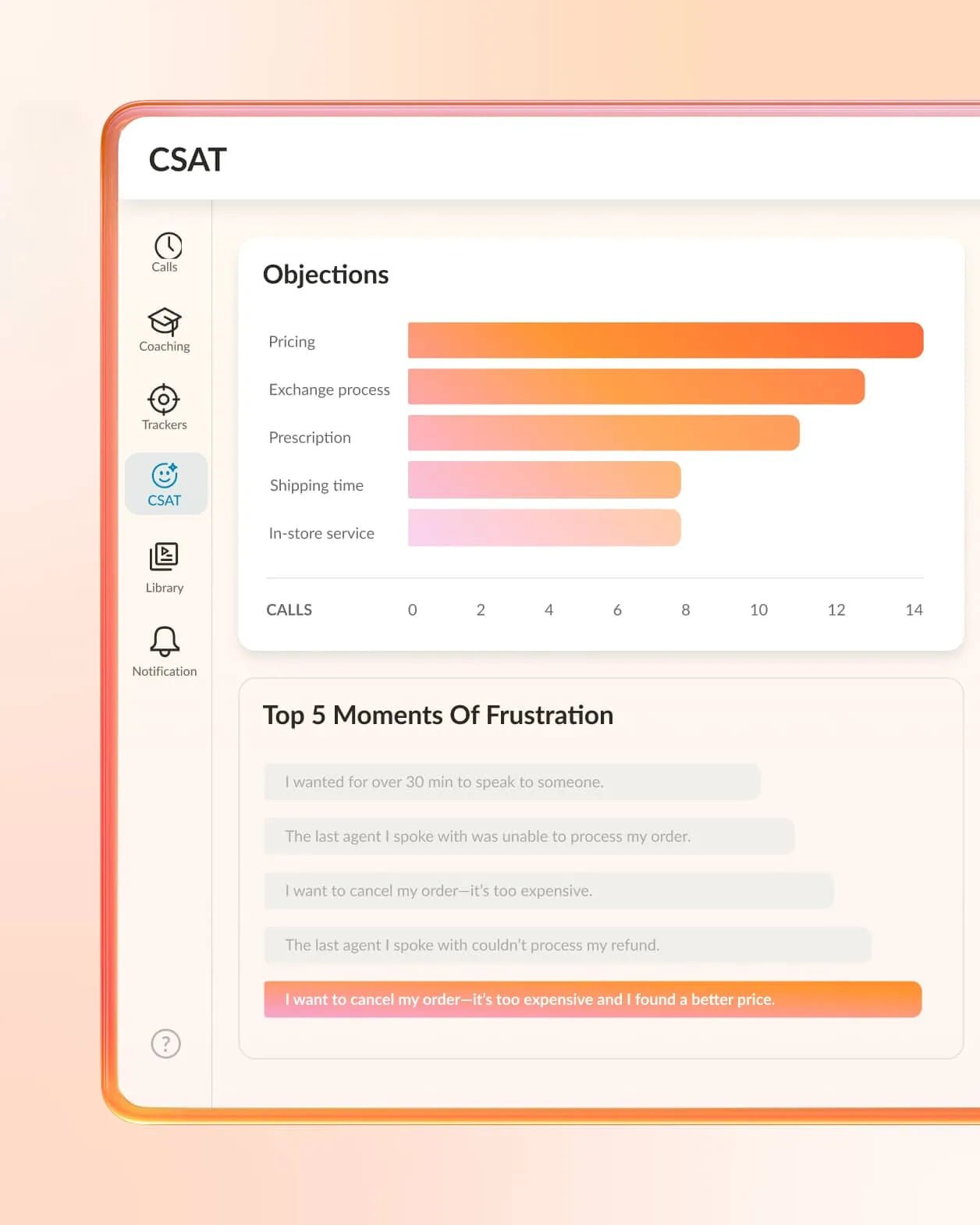
AI-powered sentiment analysis and voice of the customer (VoC) tools turn every conversation into continuous feedback. Instead of sampling a few calls or relying only on surveys, these AI systems analyze every interaction at scale to gather and assess:
- Near real-time transcription across multiple languages
- Sentiment and emotion scoring throughout each conversation at both customer and agent levels
- Topic and theme detection across millions of service interactions
- Concise summaries and action items for agents, supervisors, and downstream systems
This visibility strengthens sales coaching and enablement. It also identifies interactions needing review, supporting compliance and quality management.
How can enterprises implement AI to enhance customer experience?
Implementing AI customer experience across a complex enterprise requires a structured approach. To avoid disrupting operations or creating new risks, you must align AI investments with business outcomes, integration realities, and change management needs.
Approach your AI CX journey as an ongoing program with three clear stages: assess, integrate, and optimize.
Stage 1: Assess readiness and define use cases
Start by identifying where AI delivers measurable value without introducing unacceptable risk. This requires a realistic assessment of your current landscape and a focused set of use cases.
Answer three questions:
- Where are our biggest CX and cost pressures? Examine long handle times, high transfer rates, abandoned calls, and inconsistent service levels across regions or brands.
- What data and systems do we already have? Inventory your telephony, contact center, CRM, ticketing, knowledge management, and collaboration tools, mapping where you store interaction data and who owns it.
- What’s our risk tolerance? Determine which interactions AI can automate or assist today (general inquiries, status checks) and which require human leadership (high-risk financial advice, clinical decisions).
Next, define a small set of priority use cases and tie each to a specific goal. This focused approach drives better adoption and clearer ROI than trying to implement AI everywhere at once.
Stage 2: Integrate AI with existing CX and contact center systems
Once you define what you want AI to do, decide where it lives in your architecture.
There are three paths you can take:
- Upgrade to a unified platform with built-in AI
- Augment with specialized AI services
- Replace legacy systems that block AI adoption
When you evaluate vendors and integration models, examine:
- Data architecture: Ensure the platform processes and stores interaction data (voice, chat, video) at scale while respecting your governance policies.
- APIs and pre-built connectors: Look for mature integrations with your CRM, ticketing, and workforce management systems.
- Global reliability and latency: Seek out low-latency audio, high transcription accuracy, and consistent quality across regions for voice-first AI.
- Security and compliance controls: Confirm that data residency options, role-based access, encryption, and audit logs align with your regulatory environment.
Unified platforms deliver a clear advantage. When AI runs inside your core communications and contact center stack, you minimize risk and simplify rollout.
Stage 3: Measure KPIs and implement continuous improvement
For each AI use case you developed, align on a focused set of primary and secondary metrics.
These typically include:
- For self-service and virtual assistants: Containment rate, task completion rate, escalation rate, and customer satisfaction with the automated experience
- For AI-assisted agents: Average handle time, first-contact resolution, after-call work duration, and agent satisfaction with the tools
- For analytics and VoC: Time to insight, issues detected automatically, and improvements or initiatives driven by AI insights
Beyond the numbers, track adoption and sentiment among agents and supervisors. If they don’t trust the recommendations or find the tools hard to use, they’ll work around them, and you’ll miss most of the potential value.
Real-world examples of AI improving customer experience
Concrete results make the case for AI customer experience. While every organization differs, repeatable patterns show how enterprises use AI to improve CX, speed up resolution, and improve productivity.
Destination Pet replaced fragmented phone systems with integrated AI
Destination Pet, a leading pet supply retailer, consolidated fragmented phone systems onto RingCX with integrated AI.
- AI Receptionist handles initial inquiries across store locations. It routes calls by intent (product recommendations, order status, store hours) and answers routine questions about delivery, returns, and availability.
- AI Virtual Assistant provides real-time transcription and post-call summaries, reducing agent documentation time by over 40%.
The company’s customer service teams now spend less time on repetitive tasks and more time building relationships with pet owners. The result: higher satisfaction scores and faster resolution across all channels.
MSX streamlined global operations with unified AI-powered communications
MSX, a global customer experience provider serving automotive and technology brands, consolidated over 60 disparate systems across more than 80 countries onto RingCentral’s unified platform.
- AI Receptionist and AI-powered call routing automate Tier 1 support across multiple languages and time zones, reducing average handle time by 30%.
- AI Conversation Expert analyzes completed interactions to surface sentiment trends across voice and digital channels, helping supervisors identify training opportunities and intervene before issues escalate.
In both examples, the key isn’t just one AI feature. It’s the combination of reliable voice, integrated contact center capabilities, and AI services running on the same platform. Solutions like RingCX, working alongside RingCentral’s agentic voice AI capabilities, provide a stable foundation for enterprise-scale transformation.
5 best practices for implementing AI customer experience at enterprise scale
AI customer experience comes with real risks, especially for highly regulated or globally distributed organizations. The best practices below provide a clear roadmap to move quickly while protecting your business and building trust with your teams.
1. Establish strong compliance and data governance from day one
Map where interaction data is stored, how long it’s retained, and who can access AI-generated outputs. Choose platforms that support regional data residency, role-based access controls, and configurable retention policies aligned with your regulatory requirements.
Building governance into your architecture early helps you avoid costly remediation and maintain compliance as you scale.
2. Demand model transparency and maintain control
Understand which AI models power your features, how they’re updated, and what controls you have over prompts, outputs, and redaction. Require vendors to document model behavior and give you visibility into how decisions are made.
Transparency protects you from regulatory risk and helps you explain AI decisions to customers, auditors, and internal stakeholders. Control ensures AI behaves consistently with your brand and policies.
3. Invest in change management to build trust with your teams
Involve agents and supervisors in your AI pilots. Start with small groups, gather their feedback, and demonstrate how AI makes their work easier rather than replacing them. Use their input to refine tools before you roll out broadly.
When your teams trust AI as a helpful tool, adoption accelerates. Resistance and workarounds kill ROI faster than any technical limitation.
4. Avoid vendor lock-in by prioritizing interoperability
While unified platforms deliver clear advantages, ensure your vendor offers open APIs, standards-based integrations, and data export options. Verify that you can connect to your existing CRM, ticketing, workforce management, and analytics tools without custom development.
Interoperability provides flexibility as your needs evolve and protects you from being trapped in a closed ecosystem that limits innovation or forces expensive migrations.
5. Optimize total cost of ownership (TCO) across your AI stack
Look beyond per-seat or per-interaction pricing by factoring in licensing models, network costs, integration expenses, and the administrative overhead of managing multiple vendors. Model costs at scale, not just for your pilot.
Point solutions with usage-based AI pricing can become prohibitively expensive as adoption grows. A unified platform with predictable licensing often delivers better economics and simpler operations at enterprise scale.
A practical way to operationalize these best practices is to establish an AI governance group that includes IT, security, legal, compliance, CX leadership, and business stakeholders. This group defines approved use cases, reviews vendor architectures, manages risk assessments, and ensures you apply consistent standards across business units and regions.
The future of AI in customer experience
The next wave of AI customer experiences moves beyond isolated features toward fully agentic systems: AI that understands context, personalizes across multiple channels, and takes action on your behalf while keeping you in control. Experts from Forrester, Gartner, and more predict that AI personalization that feels human will be the difference between a successful customer experience and one that leaves customers dissatisfied.
For enterprises, this shift transforms both customer-facing interactions and internal operations. McKinsey found that top-performing organizations combine AI solutions with human judgment, change management, and training to create “hybrid intelligence.” Its 2025 survey found that high-performing organizations use multiple AI strategies, including human in the loop (65%), adaptive technology infrastructure (60%), and a well-defined AI roadmap (60%).
Start building your AI customer experience strategy
AI customer experience transforms how you serve customers at scale. To see real results, focus on three things: unified platforms that reduce complexity, AI capabilities that work across voice and digital channels, and governance frameworks that protect your business as it grows.
A successful rollout starts with assessing where AI delivers the most value. Map your biggest CX pain points, identify which interactions AI can improve today, and evaluate whether your current architecture supports the capabilities you need.
RingCX brings together contact center, conversation intelligence, and agentic AI on a single platform built for enterprise scale. Explore how RingCX can help you deliver faster, more consistent customer experiences without the risk and complexity of stitching together point solutions.
Originally published Mar 05, 2026