AI Communications




A platform-by-platform assessment of integration depth, analytics scope, compliance, and total cost of ownership.
Many enterprise teams default to Gong. They then spend the next quarter managing integrations Gong doesn’t own, analytics that stop at the sales call layer, and pricing that confuses more than it clarifies.
If you’re evaluating Gong competitors because your stack has outgrown a sales-centric tool, this guide is for you. The platforms below were assessed against the criteria that matter to IT and CX leaders: integration depth, analytics scope, compliance, and total cost of ownership.
Key takeaways
- Gong’s opaque pricing and sales-only architecture create hidden costs and coverage gaps at enterprise scale
- Enterprise conversation intelligence (CI) selection comes down to integration depth, uptime SLA, and both unified communications (UC) and contact center coverage
- Platform consolidation cuts vendor sprawl, reduces data silos, and improves adoption across sales and CX
- RingCentral’s AI Conversation Expert (ACE) analyzes interactions across voice, video, and digital channels without a separate vendor or data pipeline
Why enterprise teams outgrow Gong
Gong is the market leader in conversation intelligence for good reason. It pioneered AI-powered call analysis for sales teams and established the category. However, as enterprise needs have expanded beyond sales coaching, the following architectural limitations have become harder to ignore:
- Pricing opacity creates total cost of ownership (TCO) uncertainty. Gong pricing isn’t published. Every deployment starts with a custom quote, and this lack of transparency makes it difficult to forecast TCO or compare cost-effective alternatives on equal footing.
- Sales-only architecture leaves coverage gaps. Gong was built for sales call analysis. It doesn’t natively cover contact center interactions or the full multi-channel spectrum enterprise CX teams manage.
- Integration overhead adds vendor complexity. Gong integrates with customer relationship management (CRM) platforms like Salesforce and HubSpot, but it’s a standalone platform. That means a separate vendor relationship, a new data pipeline, an additional security review, and ongoing integration maintenance.
- Analytics silos fragment your data. Gong captures valuable insights from sales demos and calls, but those insights don’t flow cleanly across the rest of your communications stack without custom work.
5 Gong competitors for enterprise conversation intelligence
The following table of the best Gong alternatives can help you narrow down which platform aligns best with your requirements for analytics, integration depth, pricing transparency, and reliability.
| Platform | Analytics | Native integration depth | Pricing model |
| Gong | Sales calls, emails, and meetings | CRM integrations (Salesforce, HubSpot) | Custom enterprise (not published) |
| RingCentral ACE and RingCX | Cross-channel (voice, video, digital) across sales, service, and regulated industries | RingCX native AI + ACE add-on; Salesforce and HubSpot | ACE available standalone or as RingCX add-on; RingCX available by subscription |
| Chorus.ai (ZoomInfo) | Sales calls with buyer intent data | Deep Salesforce; requires ZoomInfo | Standalone or bundled with ZoomInfo |
| Salesloft | Sales calls, emails, pipeline visibility | Native Salesforce/HubSpot sync | Custom enterprise (not published) |
| Fireflies.ai | Meeting transcription and search | Broad compatibility (Zoom, Teams, Meet) | Tiered (free to custom enterprise) |
| Clari Copilot | Sales calls tied to pipeline stages | Integrated with Clari Revenue Platform | Custom (typically bundled with Clari) |
1. RingCentral AI Conversation Expert and RingCX
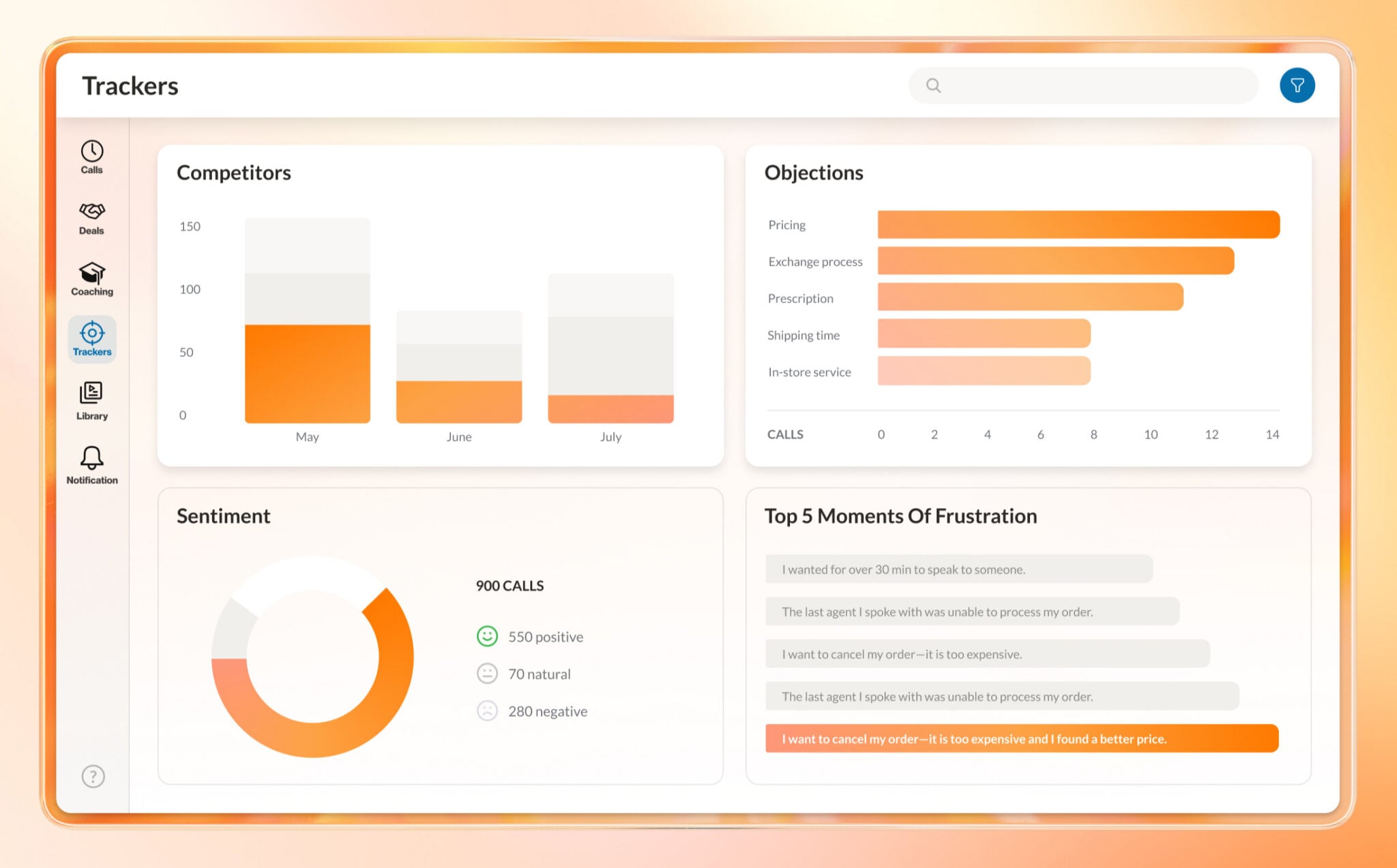
RingCentral AI Conversation Expert (ACE) uses agentic AI to analyze every customer interaction across voice, video, and digital channels, giving sales, customer service, and customer-facing teams full visibility into every conversation without manual review or sampling.
Unlike contact-center-only conversation intelligence (CI) tools, ACE analyzes every recorded interaction across the full range of customer-facing teams after the conversation ends. It captures 100% of interactions to surface coaching moments managers would otherwise miss, generates AI-powered coaching tips tied to specific calls, and flags the topics, objections, and product interests customers raise most often. Instead of reviewing a 10% sample by hand, managers see the full performance picture and a prioritized list of where to coach next.
ACE is available as a standalone product or as an add-on to RingCX, RingCentral’s contact center platform. RingCX also includes its own native AI capabilities, including AI Quality Management and AI Interaction Analytics, built specifically for contact center environments. Teams that need CI beyond the contact center can add ACE on top for broader coverage across sales and business communications.
For teams already running on RingCX, that means conversation intelligence across every customer-facing function, including your contact center, sales, and beyond, without adding vendors, integration overhead, or additional security review cycles.
- CRM and stack integration: ACE connects natively with CRMs, including Salesforce and HubSpot, pushing call summaries, action items, and coaching flags into the opportunity and account records sales and CX teams already work in. For teams running RingCX, conversation data flows across the contact center, sales, and business communications through a single platform, with no parallel data pipeline to build or maintain.
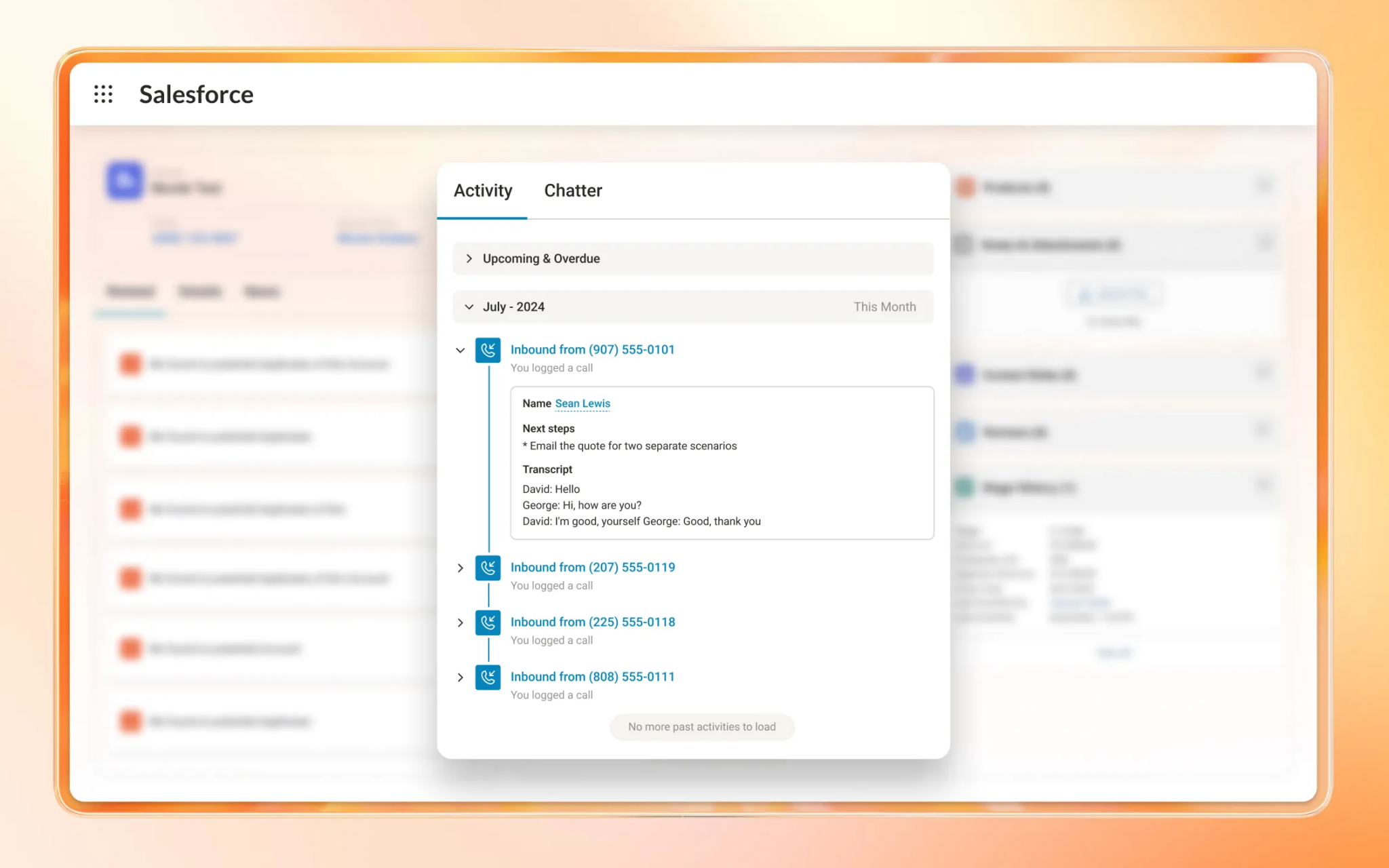
- Cross-channel coverage: It analyzes voice, video, and digital interactions across both UC and contact center environments, closing the gaps that sales-only tools leave open.
- Enterprise-grade reliability: RingCX provides a 99.999% uptime service level agreement (SLA) with compliance controls, including the Health Insurance Portability and Accountability Act (HIPAA), SOC 2, and the Payment Card Industry Data Security Standard (PCI DSS), for regulated industries.
- Unified administration: RingCX offers a single IT admin console with unified dashboards for user management, security policies, and analytics access across your entire communications stack.
ACE is the right fit for customer-facing teams already on RingCentral who want conversation intelligence without adding another vendor, whether that’s a sales team, customer service function, or a regulated industry team managing compliance across interactions. Teams running RingCX get native AI capabilities built for the contact center through AI Quality Management and AI Interaction Analytics, with the option to add ACE for broader CI coverage across the full business.
For teams currently paying for Gong on top of RingCentral, consolidating to ACE eliminates redundant costs and integration complexity without sacrificing coverage.
Test the ROI of RingCX AI capabilities
Find out how RingCentral AI improves customer engagement, reduces service costs, and drives stronger performance across your contact center.
2. Chorus.ai (ZoomInfo)
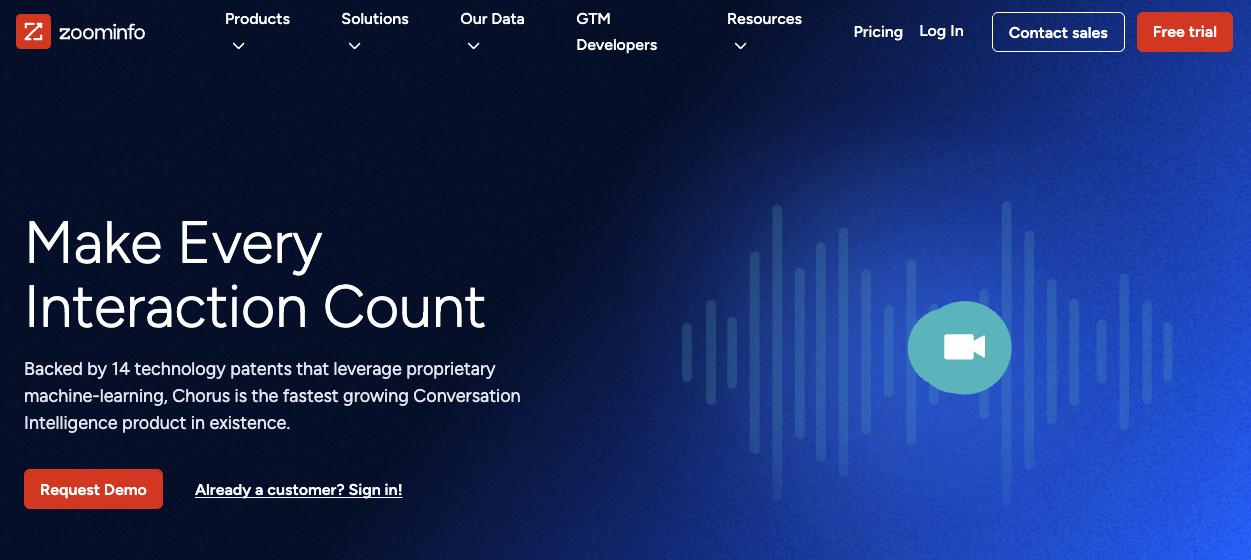
Chorus.ai, now part of ZoomInfo, provides enterprise CI enriched with ZoomInfo’s buyer intent and firmographic data for analyzing sales conversations. This layer adds context about who you’re talking to directly to call analysis, creating a differentiated view for B2B sales teams. For enterprises already running ZoomInfo for prospecting, Chorus eliminates context switching by blending prospect intelligence with conversation insights in a single workflow.
The platform delivers strong Salesforce integration, enterprise security controls, and robust B2B sales call analytics. However, Chorus may require an active ZoomInfo subscription to unlock its full value, and its analytics remain focused on sales calls with limited contact center coverage.
3. Salesloft
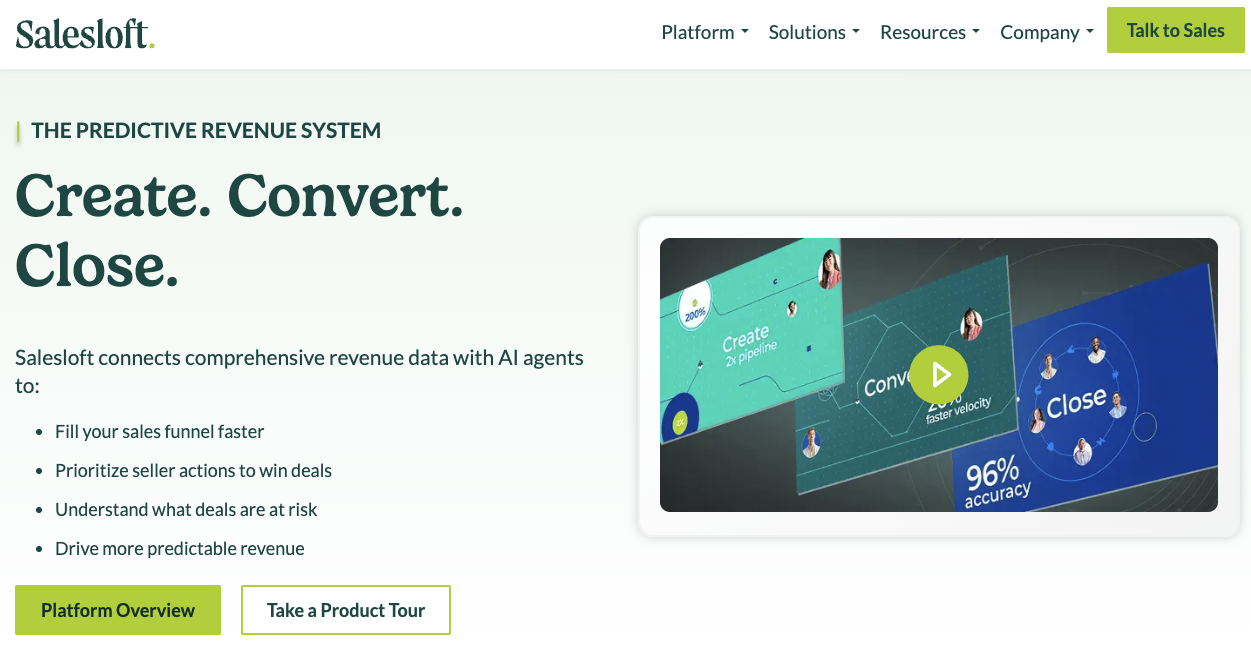
Salesloft embeds CI within an all-in-one sales engagement platform that includes outreach cadences, dialer functionality, pipeline management, and coaching tools. For teams running Gong plus a separate engagement tool, Salesloft unifies both under one vendor relationship, eliminating the integration overhead that comes with managing multiple point solutions.
The sales process execution platform delivers unified data and automated scorecards across calls, emails, CRM data, and pipeline stages, with native Salesforce and HubSpot integration. That said, conversation intelligence is a component of the broader engagement platform rather than a standalone product with the depth of dedicated CI tools.
Teams needing extensive interaction libraries or advanced call scoring may find ACE or Chorus more capable. Salesloft also lacks contact center coverage, limiting its applicability for CX leaders managing both sales enablement and support interactions.
4. Fireflies.ai
Fireflies.ai offers the broadest platform compatibility on this list, supporting Zoom, Microsoft Teams, Google Meet, RingCentral, Webex, and uploaded audio files. For IT leaders and sales managers working in heterogeneous environments, Fireflies provides consistent AI note-taking, real-time transcription, searchable follow-up libraries, and auto-generated action items without forcing platform consolidation.
Fireflies stands out for its transparent, tiered pricing. Unlike most Gong alternatives that require custom enterprise quotes, Fireflies offers a free plan, monthly options, and custom Enterprise pricing for teams requiring single sign-on (SSO) and advanced security controls.
However, Fireflies is primarily a meeting documentation tool. Real-time coaching features, deal insights and deal risk detection, and performance analytics are limited compared to Gong or ACE.
5. Clari Copilot
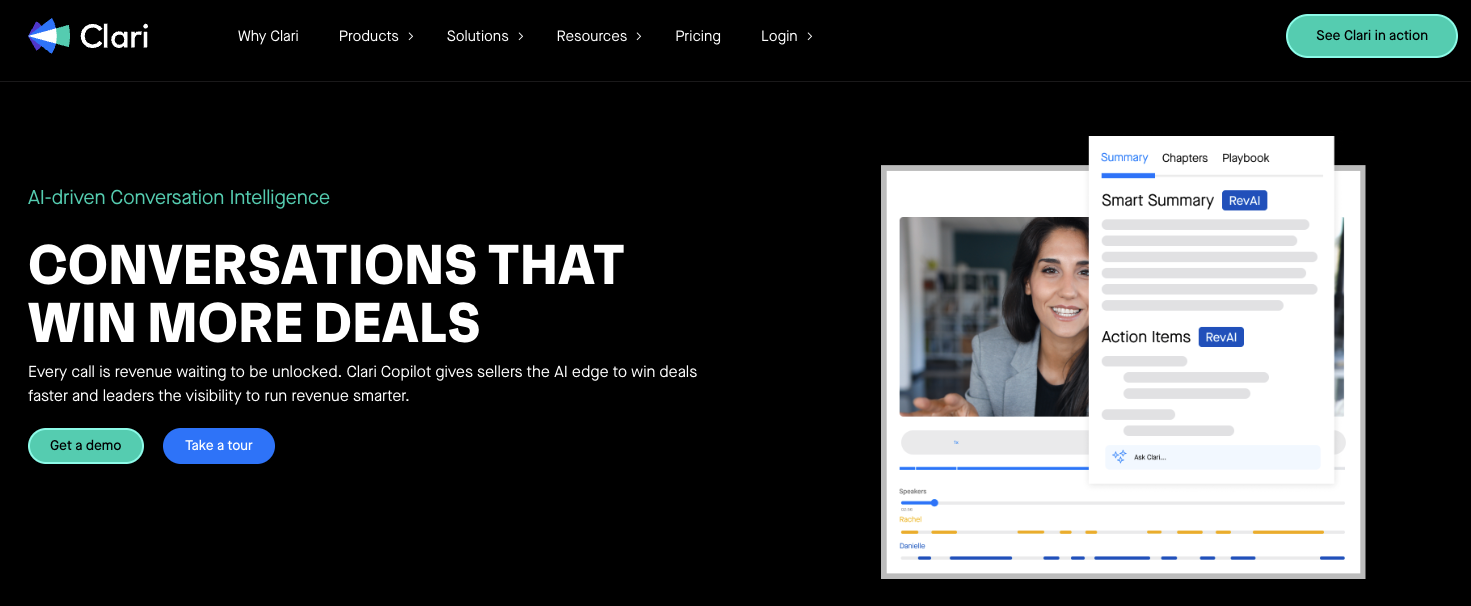
Clari Copilot layers CI onto Clari’s revenue intelligence engine, surfacing deal risk signals and sales forecasting insights within the pipeline workflows revenue operations teams already use. Call data is visible alongside pipeline stages, forecast categories, and deal health metrics.
The platform delivers real-time battle cards and coaching insights during live calls, with post-call analysis tied directly to deal stage progression. Copilot’s value scales with Clari platform adoption, though, so teams not running Clari for forecasting lose the primary differentiator.
On top of that, pricing isn’t published, and Copilot is typically bundled with the broader Clari Revenue Platform.
How to choose the right conversation intelligence platform
The right conversation intelligence platform depends on four criteria that matter to IT and CX leaders who own the stack decision.
Integration capabilities and technical requirements
Your CI platform needs to work with the systems and workflow automations you already run. That means native CRM integration with Salesforce, HubSpot, or Microsoft Dynamics, including bi-directional sync and automation that logs call data to opportunity records without custom development.
The key question for IT leaders: Does this tool require its own dialer, or does it integrate with your existing platform? Adding a separate dialer creates a parallel telephony stack you’ll need to support.
Contact center coverage is equally critical if you’re evaluating conversation intelligence for both sales and service teams. Most platforms on this list focus exclusively on sales calls and won’t analyze inbound support interactions in your CCaaS environment.
The real question isn’t just whether a tool integrates. It’s whether the platform is native to infrastructure already in your stack or adds a net-new data pipeline and security surface to manage.
Pricing and total cost of ownership
The right TCO question isn’t what a platform costs per seat. It’s what the tool costs, including the stack it requires around it. If you’re paying for a CI platform that calls for a separate dialer, CRM connector development, and ongoing integration maintenance, costs will compound quickly.
According to a recent survey of more than 1,000 IT professionals, 90% say software consolidation is a top priority. By eliminating the incremental per-user CI tool license and reducing the number of vendor relationships you need to manage, bundled pricing models like RingCX are built exactly for that shift. Ask vendors to break out platform fees, professional services, and ongoing support costs separately so you can model TCO accurately across a three-year contract.
AI accuracy and analytics depth
Transcription accuracy is the foundation of CI, but not all platforms perform equally across industry-specific terminology, accents, or non-English speakers. For regulated industries like healthcare or financial services, push vendors for benchmark accuracy rates and ask how the platform handles compliance-sensitive language.
Real-time platforms like Clari Copilot deliver coaching prompts and deal risk alerts during calls, giving sales reps a chance to adjust before the conversation ends. Post-interaction tools like RingCentral ACE, which analyzes every recorded call, meeting, and digital interaction, power manager coaching and surface customer-interest trends across the full book of business. The question isn’t necessarily which approach is better, It’s which layer your team actually needs, and some enterprises need both.
Platform reliability and enterprise support
According to ITIC’s 2024 Hourly Cost of Downtime Survey, 90% of mid-size and large enterprises say a single hour of downtime costs their organization more than $300,000, and 41% put that figure between $1 million and $5 million. Since a 99.9% uptime SLA allows for over 40 minutes of downtime per month, those interruptions not only translate to significant financial losses but also unrecorded interactions and incomplete analytics.
A 99.999% SLA reduces annual downtime to under five minutes, the standard for mission-critical communications platforms like RingCentral. Compliance certifications, including SOC 2, HIPAA, General Data Protection Regulation (GDPR), and Federal Risk and Authorization Management Program (FedRAMP), aren’t optional for regulated industries.
Downtime aside, enterprise-level support is essential for onboarding and integrating AI-powered CI tools in an enterprise. At this scale, you need assurances that a new platform fits cleanly into your existing stack and disruptions will be kept to a minimum.
Vendor stability also matters. Some platforms listed above are standalone products that could be acquired or sunset, while others are embedded in larger platforms with long-term roadmaps.
If your environment includes UC and contact center infrastructure, compliance requirements, and pressure to consolidate vendors, ACE was built for exactly this scenario. Native intelligence means no integration to maintain, no separate security review, and no additional vendor contract.
The consolidation case for enterprise conversation intelligence
Enterprise teams that treat CI as a point solution often find themselves managing integrations, reconciling data across vendors, and paying for coverage gaps that emerge as the business scales. The platforms that hold long-term value aren’t the ones with the longest key feature lists. They’re the ones embedded in your existing infrastructure.
The decision framework comes down to three questions:
- Does this platform fit the stack you’ve already standardized on?
- Does it cover the full interaction surface across sales calls, contact center conversations, and everything in between?
- Does it add a vendor relationship you’ll be managing in year two, or does it eliminate one?
For leaders managing unified communications and contact center infrastructure, AI Conversation Expert delivers a structural advantage. And when embedded in RingCX, it analyzes every voice, video, and digital interaction without requiring a separate tool, security review, or vendor relationship on top of your CCaaS platform.
Updated May 06, 2026