AI Communications




Ten tools compared on channels, AI, and the kind of team each one fits.
Customer engagement is split across more tools than most teams can count: a chat widget, an email platform, a phone system, a text messaging service, and none of them share what the others know. The result is a disjointed experience for the customer and a stack nobody fully controls. Customer engagement tools promise to connect those threads, but the category spans from service-focused contact centers and marketing lifecycle platforms, which solve different problems.
This guide compares ten tools on how they engage customers across channels and where AI adds value. Each entry covers strengths and limitations, so you can shortlist by your channel mix and by whether your goal is service or marketing-led engagement. The five criteria below separate a connected tool from a longer feature list.
Key takeaways
- Customer engagement tools span messaging, voice, self-service, and analytics.
- Connected channels matter more than a longer feature list.
- AI now assists both customers and the agents serving them.
- Measure engagement by resolution and retention, not activity.
- The right tool depends on channel mix and team size.
How we evaluated these customer engagement tools
Each tool was assessed on five criteria as of October 2026:
- Channels supported: The communication channels the tool engages customers across.
- AI capabilities: Self-service for customers and assist for agents, and how well they work together.
- Routing and workflow: How engagement reaches the right person or sequence.
- Analytics: Whether you can measure resolution and retention rather than raw activity.
- Integrations: How cleanly the tool connects to your customer relationship management (CRM) and existing stack.
Multichannel reach is now a baseline expectation. McKinsey’s 2024 B2B Pulse finds B2B customers now use an average of 10 interaction channels across their buying journey, up from 5 in 2016, so a tool that engages on one or two channels limits your reach.
Along with omnichannel reach, customer engagement tools should serve your strategy, not the other way around. So weigh each against your customer engagement strategies before comparing feature lists.
10 customer engagement tools at a glance
The 10 tools below fall into two broad categories. Some are service-led, engaging customers through support conversations across voice and digital channels. Others are marketing-led, engaging through campaigns, lifecycle messaging, and journeys.
Neither approach is inherently better, since they fit different jobs. The entries below show where each applies:
| Tool | Primary use case | Key features |
| RingCentral RingCX | Service engagement across channels | Voice and 20+ digital channels with AI |
| Intercom | In-app messaging and support | AI chatbot with messaging |
| Braze | Cross-channel lifecycle marketing | Journey-based campaign engagement |
| HubSpot | CRM with marketing and service | All-in-one hubs on one record |
| Zendesk | Omnichannel support suite | Ticketing across channels |
| Customer.io | Behavioral messaging automation | Event-triggered campaigns |
| Klaviyo | Ecommerce marketing | Email and SMS for online stores |
| Salesforce Marketing Cloud | Enterprise marketing automation | Journeys on Salesforce data |
| Twilio | Programmable communications | Developer-built engagement |
| Adobe Journey Optimizer | Enterprise journey orchestration | Real-time journeys in Adobe stack |
1. RingCentral RingCX
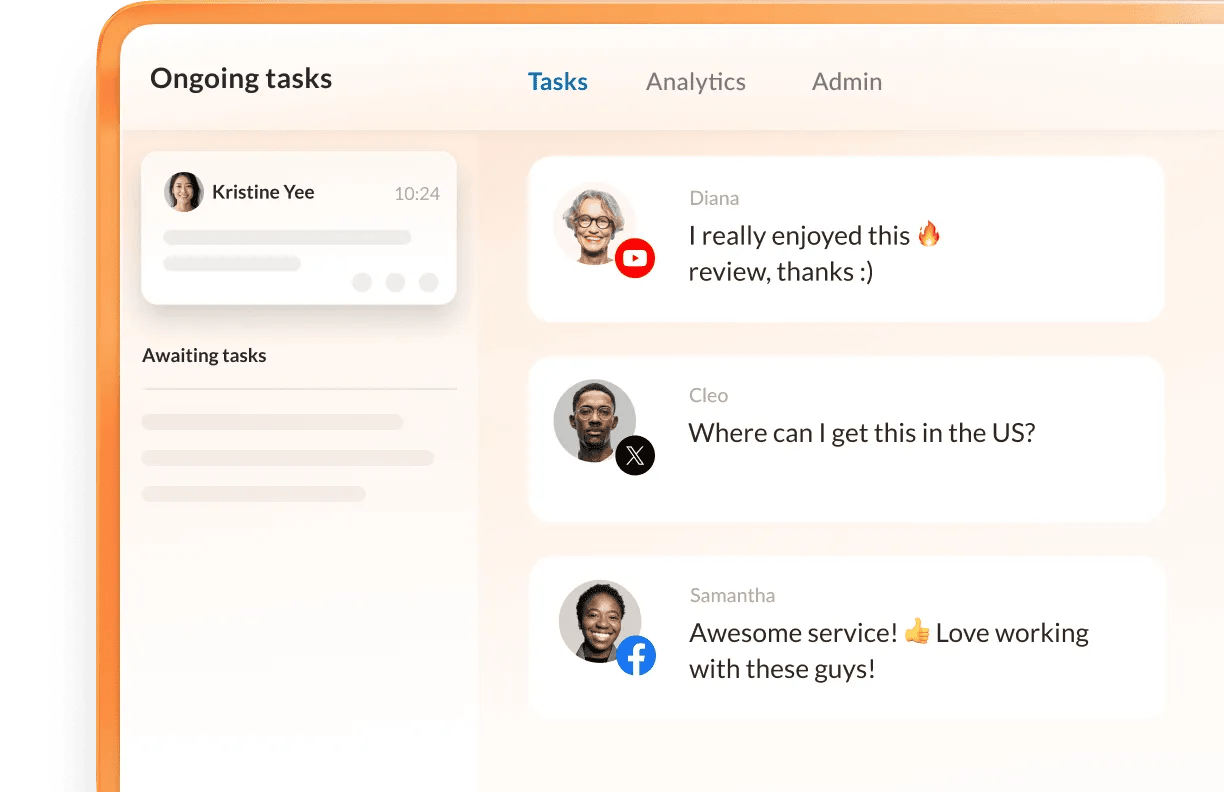
Teams engaging customers across chat, SMS, voice, and email usually run each in a separate tool, so no channel knows what the others did, and the customer experiences the disconnect. RingCX supports service engagement that stays connected across channels, with AI on both sides of the conversation.
What RingCentral does well:
- Engage across every channel: RingCX spans voice and 20+ digital channels, so engagement isn’t trapped in one tool.
- AI on both sides: AVA Agent Assist guides agents in real time while an intelligent virtual agent (IVA) offers customers self-service for routine requests, so agents can focus on complex cases.
- Act on what customers say: AI Interaction Analytics surfaces customer satisfaction (CSAT) trends, customer intent, and the frustration topics worth fixing across every customer interaction. AI Quality Management scores 100% of voice and digital interactions, so quality is measured on every conversation rather than a sample.
- Context that carries: Conversation history follows the customer, so engagement builds on what came before instead of starting over.

Where RingCentral RingCX has limitations: RingCX centers on contact center and communication channels rather than marketing-campaign automation, so a team whose engagement is lifecycle email and push campaigns needs a marketing tool alongside it.
Best for: Teams engaging customers across voice and digital service channels with built-in AI.
2. Intercom
What Intercom does well: Intercom leads with in-app and website messaging and an AI chatbot, with a strong fit for product-led software companies. Its messaging experience and self-service automation are common reasons teams adopt it.
Where Intercom has limitations: Its focus is digital messaging rather than voice, so teams with phone-heavy engagement look at other telephony options. Buyers should evaluate how its AI and seat pricing scale at their volume.
Best for: SMB and mid-market software teams engaging customers through in-app chat, especially where support and product sit close together.
3. Braze
What Braze does well: Braze is a cross-channel lifecycle engagement platform built for marketing teams, strong in mobile push, in-app messages, and email orchestrated as journeys. Consumer brands use it to engage at scale.
Where Braze has limitations: It’s marketing-led rather than a service contact center, so it complements, rather than replaces, voice and support operations. Realizing its value assumes a team to build and maintain the journeys.
Best for: Mid-market and enterprise consumer brands running lifecycle marketing at scale.
4. HubSpot Customer Platform
What HubSpot does well: HubSpot combines a CRM platform with marketing and service hubs on one record, which appeals to growing teams that want engagement and data together. It’s approachable and widely adopted.
Where HubSpot has limitations: Its service and voice depth is lighter than a dedicated contact center, so high-volume support operations evaluate those capabilities closely. Costs rise as hubs and seats are added.
Best for: SMB and mid-market teams that want CRM, marketing, and light service in one place.
5. Zendesk
What Zendesk does well: Zendesk is a mature omnichannel support suite built around ticketing, with broad channel coverage and a large app ecosystem. It’s a frequent choice for established support teams engaging customers through service.
Where Zendesk has limitations: Its ticketing core means voice is one channel among many rather than the center, so voice-heavy teams test telephony directly. Add-ons and seats can raise cost as you scale.
Best for: Mid-market and enterprise support teams engaging through a ticketing-led suite.
6. Customer.io
What Customer.io does well: Customer.io specializes in behavioral, event-triggered messaging, letting product teams engage based on what a user does. Its automation and data flexibility are its defining strengths.
Where Customer.io has limitations: It’s a messaging-automation tool rather than a voice or support platform, so it engages through campaigns, not live service conversations. Setting it up well assumes clean event data.
Best for: Product-led teams engaging customers through behavioral messaging.
7. Klaviyo
What Klaviyo does well: Klaviyo focuses on email and SMS marketing for ecommerce, with strong segmentation tied to store data. Online retailers use it to engage shoppers with targeted campaigns.
Where Klaviyo has limitations: It’s built for ecommerce marketing rather than service engagement, so it sits apart from voice and support operations. Its fit narrows outside retail and direct-to-consumer.
Best for: SMB and mid-market ecommerce brands engaging shoppers by email and SMS.
8. Salesforce Marketing Cloud
What Salesforce Marketing Cloud does well: Salesforce Marketing Cloud brings enterprise marketing automation and journey building on top of Salesforce data, with deep segmentation and scale. Large organizations already on Salesforce use it to orchestrate engagement.
Where Salesforce Marketing Cloud has limitations: It’s enterprise marketing automation, so it complements service operations rather than running them, and it assumes Salesforce investment and administration. Smaller teams often find it more than they need.
Best for: Large enterprises on Salesforce orchestrating marketing engagement.
9. Twilio
What Twilio does well: Twilio offers application programming interfaces (APIs) that let developers build engagement across messaging and voice into their own applications, with customer-data tooling to target it. The flexibility is extensive for teams with engineers.
Where Twilio has limitations: It supplies building blocks rather than a packaged agent or marketing workspace, so it assumes a developer team. Organizations wanting ready-made engagement look to a packaged tool.
Best for: Developer-led teams building engagement into their own product, with the engineering capacity to run it.
10. Adobe Journey Optimizer
What Adobe Journey Optimizer does well: Adobe Journey Optimizer orchestrates real-time, cross-channel journeys within the Adobe Experience Cloud, strong in personalization at enterprise scale. It suits organizations already invested in Adobe’s data platform.
Where Adobe Journey Optimizer has limitations: It’s an enterprise marketing orchestration tool, so it complements rather than replaces a service contact center, and it assumes the broader Adobe stack and the team to run it.
Best for: Large enterprises on Adobe orchestrating personalized journeys.
How to choose customer engagement tools for your team
Start the evaluation with how your team engages customers, not with a feature checklist. The right tool depends on where your interactions originate, how many channels you run, and how cleanly each option plugs into the systems your agents use.
Start with your engagement model: service-led or marketing-led
Name your primary engagement model before you shortlist a single vendor.
- If you engage customers mainly through support conversations across phone, chat, and email, you need a contact center platform with AI and shared context across those channels.
- If you engage through campaigns, lifecycle messaging, and journeys, you need a marketing automation tool built for segmentation and orchestration.
Plenty of teams run one of each rather than forcing a single tool to cover both, so map your spend to the model that carries the most volume first. If support conversations dominate, pressure-test your digital customer service coverage before you layer more tooling on top of it.
Map your channel mix against where customers already are
List every channel you support today and every channel your customers keep asking for. Rank them by interaction volume, then check each shortlisted tool against that ranked list rather than its full channel list.
A platform that covers 20 channels you’ll never staff is worth less than one that handles your top three without handoffs. Watch the handoffs between channels closely: that’s where customers end up repeating themselves, and where a tool either carries context forward or drops it.
Weigh CRM integration by depth, not by logo count
Treat the CRM connection as the feature that determines everything else, because the integration is what gives engagement its context. A logo on an integrations page tells you a connector exists, but it doesn’t tell you whether customer records, interaction history, and case data sync both ways in real time.
Ask vendors how deep the integration runs and what data travels with each interaction. The cost of getting this wrong is measurable: only 58% of customer interaction data can be accessed from a single system, according to analyst firm Valoir, so the rest is scattered where agents have to go looking for it.
Judge agent-facing AI on your real interactions
Evaluate agent-facing AI on how well it resolves your interactions rather than on a polished demo. This capability is now standard across service tools, so the differentiator is performance on your workload, not whether it’s included.
Pull a representative sample of real conversations and test each tool against them:
- What share it contains or deflects
- How often it surfaces the right answer
- What happens to first-contact resolution and average handle time when agents use it
A tool that resolves routine inquiries on your interaction types earns its place; one that only performs on scripted examples doesn’t.
Match the tool to how you engage customers
The common mistake is buying a tool built for the other kind of engagement, so a service team ends up with a marketing platform or a campaign team buys a contact center.
Decide whether your priority is resolving service conversations or running lifecycle campaigns, map your channels, and score your shortlist on connected channels and analytics before feature counts. Measure the result by resolution and retention, not by how many messages you sent. A tool that sends more and resolves less is working against you, however active it looks on a dashboard.
If engaging customers across voice and digital service channels is the priority, see how RingCentral RingCX’s smart combination of AI and agent tools can help.
FAQs about customer engagement tools
What are examples of CX tools?
Customer experience tools include:
- Contact center and communication platforms
- Intelligent virtual agents and chatbots
- Interactive voice response (IVR) systems
- Conversation analytics
- Help-desk and ticketing suites
- Marketing automation platforms
- Customer relationship management (CRM) platforms
Engagement tools usually combine several, and the split that matters most is whether the tool is built for service conversations or marketing campaigns.
What are the 5 C’s of customer experience?
The five C’s are commonly listed as:
- Customer
- Consistency
- Convenience
- Context
- Communication
They describe what a strong experience delivers: knowing the customer, staying consistent across touchpoints, making interactions convenient, carrying context between them, and keeping communication clear. Engagement tools help most with consistency, context, and communication, by keeping channels and history connected.
What is a CSM vs. CRM?
A customer relationship management (CRM) platform stores customer and deal data and supports sales and service.
Customer success management (CSM) software focuses on retaining and growing existing customers, tracking account health, usage, and renewal risk.
In short, a CRM manages the relationship record broadly, while CSM software concentrates on keeping current customers successful. Many organizations use both.
Originally published Nov 20, 2026