AI Communications









Streamline patient communications, reduce staff burden, and improve outcomes with secure, voice-first AI.
Patient demand is rising. Staffing is tight. Compliance risk never sleeps.
You’re expected to deliver faster access, better patient outcomes, and lower costs, all while securing protected health information (PHI) at every touchpoint.
Healthcare organizations now use conversational AI technology to modernize call handling, messaging, and digital engagement. When you embed artificial intelligence into your communications platform, you accelerate access, automate routine work, and reduce administrative strain, all without increasing headcount.
We’ll share how conversational AI technology works in a healthcare setting, where it drives measurable value, and what to evaluate as you compare platforms.
Key takeaways
- Scale access without scaling staff: Automate high-volume interactions and reduce abandonment
- Unify AI and communications: Integrate voice-first AI with core systems to run secure workflows
- Augment teams with intelligence: Surface real-time context and strengthen compliance at enterprise scale
What is conversational AI for healthcare?
Conversational AI enables patients and staff to interact using natural language while the system understands intent, takes action, and connects directly to clinical and business systems. While AI chatbots handle simple FAQs, conversational AI manages complete workflows.
A patient can call after hours, request an appointment change, and complete the task immediately. The same AI can answer billing questions via web chat or confirm appointments through SMS using real-time data from your electronic health record (EHR) and scheduling systems.
Why it matters now
Patient expectations have fundamentally changed. People now expect the same fast, intuitive, personalized experience from their healthcare provider that they get from their bank, their favorite retailer, or when booking a flight. Whether they’re checking lab results, paying a bill, or scheduling follow-up care, the bar is high.
That gap between expectation and reality has consequences. Limited access to care and difficulty getting an appointment with a preferred doctor are among the top reasons US patients switch providers. About 60% of surveyed consumers reported facing hurdles when trying to schedule appointments. Meanwhile, staffing shortages, clinician burnout, and tighter budgets mean adding headcount isn’t a realistic solution.
Conversational AI platforms offer a practical way forward. It handles routine interactions like appointment scheduling, directs complex requests to the right people, and gives staff real-time support so they can focus on higher-value work.
The result is a better experience on both sides of the interaction: healthcare organizations using RingCentral’s AI tools have reported a 42% increase in patient satisfaction. Their staff feels the difference too, with a 53% increase in employee satisfaction reported by RingCentral customers.
How conversational AI for healthcare works
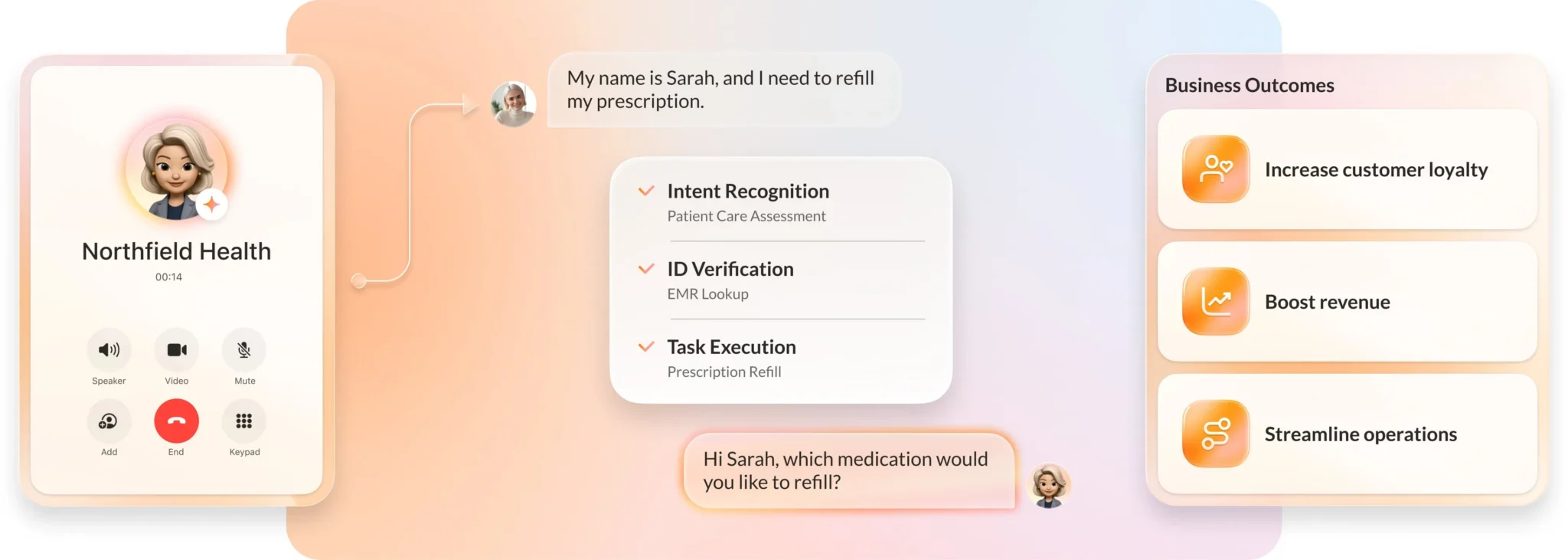
Conversational AI follows a simple logic: understand the request, decide the next step, and take action or route to the right human.
Here’s how that plays out in a voice-first, enterprise platform:
- Engagement begins on your existing channels. A patient calls your main number, sends a text, starts a web chat, or opens your app. Your unified communications or contact center manages call setup, routing, and media in the background.
- AI identifies intent in real time. Speech recognition and natural language understanding (NLU) analyze requests and detect urgency.
- The system applies your workflows. AI authenticates patients, follows policy-based logic, and determines next steps.
- The platform integrates with live systems. Secure connections to EHR, scheduling, billing, and CRM systems enable real-time action. The contact center AI pulls real-time data, updates records, verifies eligibility, or books appointments.
- AI responds naturally. The system delivers personalized responses across voice and digital channels.
- Escalation occurs seamlessly. If complexity increases, AI transfers the interaction with full context intact.
- You gain visibility. Analytics capture interaction data to improve quality, compliance, and performance.
Unlike traditional IVR systems that follow rigid scripts, healthcare-grade conversational AI handles live, adaptive conversations while staying within compliance guardrails. But the technology itself is only part of the equation. Voice quality, reliability, how deeply it integrates with your existing systems, and enterprise-grade security all determine whether it actually delivers in practice.
5 key benefits of conversational AI for healthcare organizations
You don’t invest in conversational AI tools for novelty. You invest to improve access, elevate experience, and increase operational efficiency. Here’s where organizations see measurable impact.
1. Reduce call abandonment and speed access to care
AI handles routine requests, so patients don’t have to wait in line for simple tasks. You shorten queues, reduce wait times, and lower abandonment rates, freeing staff to focus on clinically important conversations. The result is faster access to care without expanding headcount.
2. Increase patient satisfaction and retention
Patients judge your organization by how easy it is to reach you. Conversational AI delivers 24/7 multilingual, omnichannel access across phone, SMS, and digital tools. When interactions feel consistent and predictable, patients build trust and follow through on care plans.
In a survey by Tebra, 30% of providers said outdated technology was a regular barrier for scheduling and related processes, with 61% stating that AI would improve these areas. And with 18% of patients preferring online scheduling methods over phone or in-person interactions, it’s clear patients are looking for both easy scheduling and varied channels.
3. Control costs while maintaining quality
Automation shifts repetitive, low-risk tasks away from staff and toward AI. Your teams spend less time resetting passwords or confirming appointment times and more time resolving complex billing issues or clinical concerns.
You handle growing patient volumes without matching increases in labor costs, which helps protect margins while maintaining service quality.
4. Improve staff productivity and reduce burnout
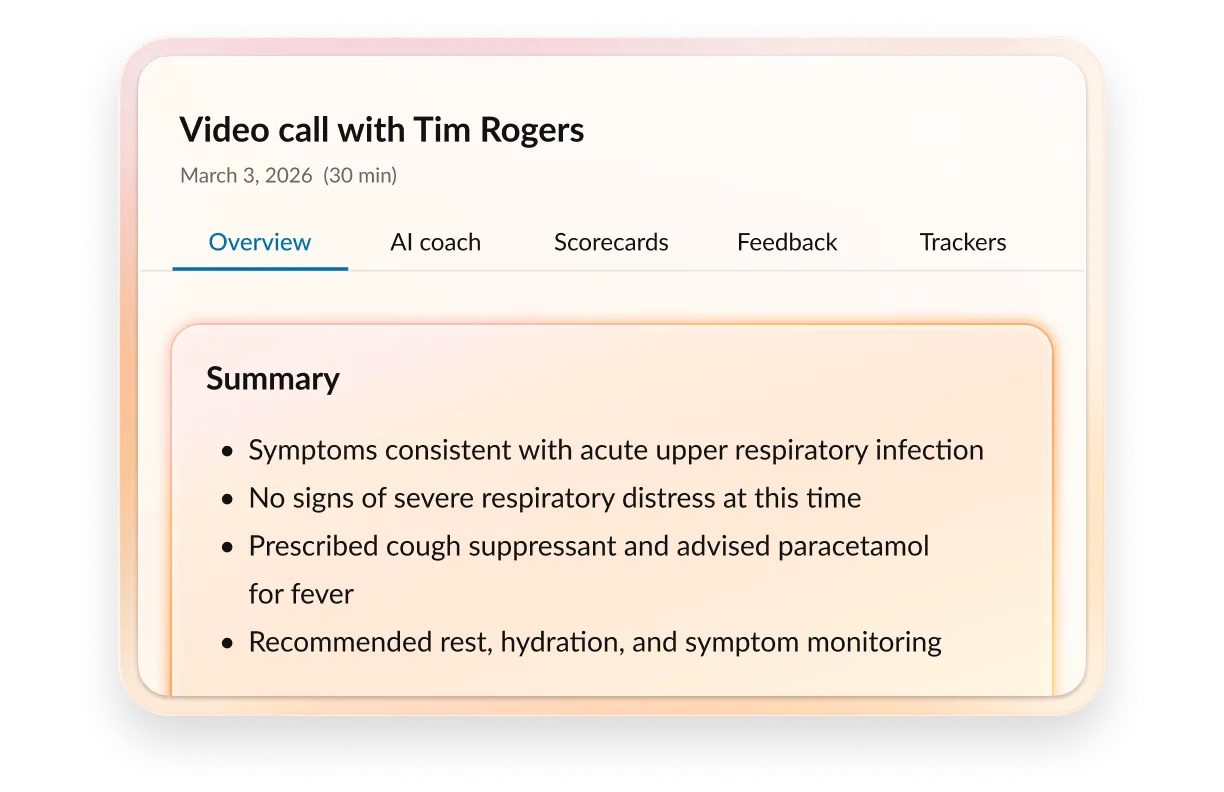
High interaction volume increases interruptions and leads to constant context switching, but conversational AI can keep both in check with streamlined workflows and relevant, real-time information.
For example, RingCentral uses AI to summarize prior interactions and highlights key details, reducing after-call work and improving consistency, so your teams spend less time toggling between systems and more time delivering meaningful patient care.
5. Strengthen visibility, consistency, and compliance
When interactions flow through a unified platform, you get a clear picture of demand patterns, intent trends, and service gaps. You can standardize scripts, disclosures, and triage workflows, and update them in one place as policies change.
Because you log every patient interaction, you have a full record that supports compliance, quality improvement, and governance.
Top use cases for conversational AI in healthcare
If you want measurable ROI, start with high-volume, repeatable workflows. The use cases below are where healthcare organizations consistently see strong returns.
Patient engagement and virtual health assistants
Virtual AI assistants provide 24/7, guided support without expanding staff. Instead of navigating rigid phone trees, patients state what they need, and the AI completes the task.
High-impact applications include:
- Appointment scheduling and rescheduling: Patients request a visit, and the system checks eligibility, pulls real-time availability, and confirms the booking.
- Automated reminders and prep instructions: AI sends reminders, shares pre-visit guidance, and enables easy confirmation or rescheduling.
- Medication and care plan prompts: The system sends adherence reminders and escalates when patients report concerning symptoms.
- Self-service FAQs: Patients get consistent answers about hours, parking, telehealth setup, or basic instructions across voice and digital channels.
Administrative automation and cost control
Administrative complexity drives unnecessary cost. Conversational AI reduces that burden by automating repetitive administrative tasks.
Common starting points include:
- Insurance verification and eligibility checks
- Pre-registration and demographic updates
- Billing inquiries and secure payments
- Intelligent call routing
AI authenticates patients, pulls real-time data, updates records, and routes calls without rigid menus.
Clinical support and real-time guidance
Conversational AI doesn’t replace clinical judgment; it supports it. Healthcare organizations use AI to:
- Summarize calls and telehealth visits to reduce documentation time.
- Support care coordination by collecting context before routing to nurses or coordinators.
- Guide standardized triage workflows for non-clinical staff.
- Highlight important details from your interactions with AI Conversation Expert, including post-conversation summaries, next steps, and protocol reminders.
These tools reduce cognitive load and context switching. Your teams access the right information at the right moment, handoffs improve, and patients experience more consistent care.
When you deploy conversational AI on a unified platform like RingCX, intake, service, and follow-up connect into a single workflow—giving you visibility and consistency across the entire patient journey, not just at individual touchpoints.
Common challenges of deploying conversational AI in healthcare and how to solve them
Conversational AI touches PHI, clinical workflows, and core systems. If you move too quickly or without alignment, you create operational risk instead of a strategic advantage.
Healthcare leaders should evaluate four critical areas when deploying conversational AI solutions.
1. Data security and HIPAA compliance
Protecting PHI isn’t optional. The platform must protect patient information at every step, from intake through follow-up. At minimum, require:
- HIPAA-ready architecture and a signed Business Associate Agreement (BAA)
- End-to-end encryption in transit and at rest
- Role-based access controls and strong authentication
- Clear policies governing model training and PHI use
- Comprehensive audit logging and reporting
Demand full transparency into how the platform stores, processes, and secures patient data. Involve privacy and compliance leaders early to ensure the deployment aligns with your regulatory obligations and risk tolerance.
2. Integration depth and interoperability
As you assess functionality, prioritize platforms that connect to your healthcare systems in real time. If your platform can’t access scheduling, eligibility, or patient records in real time, automation quickly breaks down. It’s important to prioritize:
- Proven integrations with leading EHR and practice management systems
- Support for Fast Healthcare Interoperability Resources (FHIR), Health Level Seven (HL7), RESTful APIs, and webhooks
- Open, well-documented APIs from your communications platform
- Secure identity and context sharing across systems
Strong integration turns AI from a front-end assistant into an operational engine.
3. Governance and change management
Governance determines scale and helps position you for success. You need to define:
- Which workflows you automate first
- How you handle clinical escalations and exceptions
- Who owns updates to scripts, policies, and prompts
- How you measure performance and refine over time
Aligning IT, clinical, compliance, and operations leaders before launch prevents stalled pilots, shadow tools, and fragmented patient experiences.
4. Patient experience and trust
Automation must feel helpful to your patients, not confusing or impersonal. Ensure your AI:
- Delivers natural, voice-first interactions
- Escalates seamlessly to humans when complexity or emotion increases
- Maintains consistency across phone, SMS, and digital channels
Poorly designed automation increases frustration. Well-designed orchestration builds trust and reinforces your brand at every touchpoint. A poor user experience erodes trust faster than any technical failure.
Future trends that are shaping conversational AI for healthcare
Conversational AI is advancing quickly. As you evaluate platforms today, make sure they support where healthcare engagement is heading and not just where it stands now.
Proactive patient engagement
AI is shifting from reactive support to proactive outreach.
Instead of waiting for patients to call, you can trigger voice or messaging outreach based on appointment history, engagement patterns, or care team criteria. That includes post-discharge follow-ups, preventive screening reminders, or chronic care check-ins.
This shift helps you close care gaps, reduce readmissions, and strengthen long-term patient relationships, all without adding staff.
Seamless, channel-agnostic experiences
Patients expect continuity. They may start with a call, switch to text, and follow up through a portal, but they want to complete each interaction without repeating information. Platforms built on unified voice, messaging, and video infrastructure support this continuity by maintaining shared context across touchpoints.
A unified communications foundation ensures AI extends consistently across every channel, not as a collection of disconnected tools.
Human-in-the-loop AI
The goal isn’t to automate everything. It’s to give your teams better support.
AI now summarizes interactions, suggests next best actions, conducts pre-assessments for specialist care transitions, and flags high-risk patients in real time. Healthcare professionals stay in control while AI handles routine work.
Generative AI is beginning to influence how platforms draft responses and summarize documentation, though healthcare governance requirements remain high.
Stronger governance and regulatory oversight
Healthcare AI regulation is becoming more defined. You need platforms that provide transparency into AI decision-making, enforce governance controls, and adapt quickly as standards evolve. Strong auditability and centralized policy management are competitive advantages, not optional features.
Strategic takeaways for healthcare IT and CX leaders
Conversational AI is an operational capability. To generate sustained ROI, you need focus, platform alignment, and governance from day one. Use these principles to guide your roadmap.
Prove value with focused, high-impact workflows
Start where volume is high and risk is low. Workflows like appointment management, billing inquiries, and after-hours call handling are ideal for pilot programs.
Once you pick a workflow, define your success metrics up front. These can include metrics like self-service completion rate or cost per interaction. The key is to measure early and optimize quickly. Once you see results, you can start expanding.
Build on a unified platform, not point solutions
Fragmented tools create fragmented experiences. Choose a platform that unifies communications, contact center, and AI in one secure environment.
With solutions like RingEX and RingCX, you manage automated entry points, live-agent conversations, and internal collaboration on the same foundation. That alignment reduces integration burden, simplifies governance, and gives you end-to-end visibility across the patient journey.
Lead with voice, reliability, and security
Healthcare still runs on voice. If voice quality or uptime falters, trust erodes quickly among patients and clinicians alike. It’s essential to prioritize an AI-powered platform with:
- Carrier-grade reliability and strong service level agreements (SLAs)
- High-quality speech recognition and natural voice experiences
- Healthcare-ready security and compliance controls
Design AI to augment, not replace, your teams
Automation should reduce workload, not remove human judgment. Create clear escalation paths to agents and clinicians.
Use tools like RingCentral’s AI Conversation Expert to summarize interactions, surface context, and reduce documentation burden. From there, make sure teams understand how AI fits into their work, and build feedback loops so you can continuously refine flows and prompts.
Establish governance before you scale
Ready to scale? Get your governance squared away first. Speed without governance creates risk.
Form a cross-functional group across IT, security, compliance, operations, and clinical leadership. Define:
- Which workflows qualify for automation
- How you manage PHI and data retention
- How you evaluate accuracy and fairness
- How you handle exceptions and edge cases
Treat deployment as an ongoing optimization cycle
Conversational AI should evolve alongside your organization. Use analytics from your communications platform to identify new automation opportunities, refine workflows, and improve performance over time. Revisit your roadmap as regulations, patient expectations, and technology shift.
When you approach conversational AI strategically, you create a scalable capability that improves access, protects compliance, and strengthens operational resilience across your health system.
Transform patient engagement with conversational AI
Conversational AI is a practical lever for improving access, efficiency, and patient experience—without expanding headcount or increasing operational risk. For healthcare IT and CX leaders, the path forward is clear:
- Prove value with high-volume workflows.
- Build on a unified communications and contact center platform.
- Lead with voice reliability and healthcare-grade security.
- Augment your teams, don’t replace them.
- Establish governance before you scale.
Patient expectations are rising, and the pressure on healthcare teams isn’t letting up. The organizations pulling ahead are rethinking patient needs and care delivery from the ground up. They’re working smarter.
If you’re ready to modernize patient communications, see how RingCentral helps healthcare organizations deliver secure, AI-powered engagement at scale.
Originally published Mar 24, 2026