AI Communications








Where banking chatbots cut costs, where they erode trust, and how to deploy one that does both jobs right.
Your queues fill with the same handful of requests every day: balance checks, card locks, payment inquiries. Agents spend their shifts answering questions a well-built flow could resolve in seconds. Handle time climbs, cost per contact keeps rising, and customer satisfaction (CSAT) sits flat.
A banking chatbot promises to absorb that routine volume and free your agents for the conversations that actually need a person. Plenty of contact center leaders have also watched the other version play out: a bot that loops customers, can’t authenticate them, and quietly erodes customer trust.
Both outcomes are real. The difference comes down to how you scope the bot, where you draw the line between automation and a human, and what you track once it goes live.
This guide walks through what banking chatbots handle well, the accuracy and security gaps that show up in regulated finance, and a deployment approach that ties the bot to containment, first-contact resolution, and CSAT. You’ll get a clear read on where these tools pay off, where they backfire, and how to build the handoff that protects the customer relationship you’ve spent years earning.
Key takeaways
- Deflection lowers cost only when scope is honest. A bot that “handles” 40% by answering half incorrectly just hides a second-contact queue behind the automation.
- The boundary is fixed: chatbots win on routine, low-risk tasks (balance checks, card locks, payment status) and lose customers on complex or money-movement decisions.
- No containment number is trustworthy alone. Read containment, first-contact resolution (FCR), CSAT, and escalation together, because the handoff is where trust is won or lost.
What a banking chatbot does
A banking chatbot is software that resolves customer requests through chat or voice, from simple FAQ lookups to authenticated account actions like reporting a lost card or checking a payment status. The good ones close out a request without a human ever touching it. The rest just delay the moment a customer asks for one.
Adoption stopped being a question years ago. As far back as 2022, the Consumer Financial Protection Bureau found that more than 98 million customers used their bank’s chatbot, and those chatbots saved $8 billion annually, or approximately 70 cents per customer interaction.
The stakes are clear from those numbers alone. But so is the boundary. Routine, high-frequency tasks are where a chatbot earns its cost savings. Complex, emotional, or money-movement decisions are where it starts to cost you customers instead.
The trap most teams fall into is measuring the win by volume deflected and stopping there. A bot that “handles” 40% of contacts by answering half of them incorrectly just defers the work, adding a second contact for every botched first one. Scope defines whether that 40% is genuine containment or a hidden queue building up behind the automation.
Rule-based bots vs. conversational AI vs. agentic assistants
Two products can both be called a banking chatbot but work nothing alike.
A rule-based bot follows a scripted decision tree. It matches a customer’s input to a preset path, and it breaks the moment someone phrases a question the script didn’t anticipate.
Conversational AI uses natural language understanding to interpret intent, so a customer can ask in their own words and still land in the right place. Here, the mechanics matter more than the label. In banking, that shows up in conversational AI use cases like resolving balance and transaction questions, guiding customers through card activation or replacement, and triaging fraud alerts before they reach a live agent.
Agentic assistants add another layer. They complete multi-step tasks, calling systems and taking action instead of only answering. More capability means more surface area for error, which is why scope and guardrails decide whether the upgrade helps or hurts.
Where banking chatbots pay off
The return comes from deflecting predictable, repetitive contacts so agents spend their time on revenue and risk conversations instead of password resets.
That deflection shows up directly in the metrics you own: containment rate, cost per contact, and average handle time. McKinsey found that a global bank’s chatbot removed wait times for almost 20% of its contact center requests within seven weeks. A fifth of your inbound volume answered without a queue is a real dent in cost per contact.
The savings compound on the calls a bot can’t handle. The same McKinsey research reported a 65% drop in average handle time (AHT) thanks to AI that helped agents find relevant knowledge. Deflection reduces inbound volumes while assist tools shorten the handle time on contacts that remain.
Run the math on your own numbers before you commit. If a chatbot deflects 15% of your monthly contacts and each contact costs a few dollars in agent time, the annual saving is easy to model and easy to defend in a budget conversation. The upside grows when you count the agents you don’t have to add to keep pace with volume growth. That’s the case a contact center leader can take to leadership.
How banking chatbots can lose customer trust
Chatbots fail in banking when customers stop trusting them with accuracy, security, or anything that touches their money. Speed rarely enters into it.
The research is blunt about it. In a Deloitte survey of 2,027 US banking customers, almost three-quarters (74%) preferred a human agent over a chatbot for routine queries, with 57% noting that accuracy was the main opportunity for improvement. The complaint that drives them away is a wrong answer about their own money.
Then there’s the neverending loop: the customer who needs a human, can’t find the exit, and cycles through the same menu until they give up or vent on social media. Every loop erodes the relationship, and in regulated finance a poorly deployed bot invites scrutiny that a staffing shortage never would.
The reputational cost lands harder in banking than almost anywhere else. A customer locked out of their own money by a bot that won’t escalate doesn’t just churn quietly. They post the transcript, they call the regulator, and they tell their branch manager. The strongest banking assistants stay focused on routine tasks and route higher-stakes requests to a person.
The fix is knowing exactly where the bot’s authority ends and building the exit before you need it. The way you improve customer experience in banking is by making the bot honest about its limits and fast to hand off.
How to deploy a banking chatbot that improves CX
A chatbot only helps if it is scoped within clear limits and escalates cleanly. The quality of the human experience after the bot is what protects trust, so build the sequence in this order.
Step 1: Scope the bot to high-volume, low-risk intents
Pull your last 90 days of contact reasons, rank them by volume, and start with the top three that carry no money movement, usually balance checks, card locks, and payment status. Set a containment target and an accuracy floor before you launch, and don’t add the next intent until the current one clears both. Prove it on the safe ones before you expand.
Step 2: Design authenticated account actions with compliance in the loop
Bring compliance and information security into the design review before build, not at final sign-off. Require identity verification before any account-specific action, log every authenticated step for audit, and define which actions the bot can complete versus only initiate. Money movement stays gated.
Step 3: Build fast, context-preserving escalation with no dead ends
Give the customer a visible path to a person on every screen, cap failed attempts before the bot auto-escalates, and pass the full transcript, verified identity, and intent forward so nobody repeats themselves. Test the exit path as hard as you test the happy path.
Step 4: Instrument containment, FCR, CSAT, and escalation rate together
Put all four metrics on one dashboard, segment them by intent, and review it weekly. One metric in isolation can mislead. Watch for the trap pattern, high containment with falling CSAT or rising repeat contacts, which means the bot is closing tickets rather than solving problems.
Step 5: Feed chatbot transcripts back into agent coaching and knowledge
Tag the questions the bot fails to resolve or escalates, and route the recurring ones into knowledge base updates and agent training on a set cadence. The bot’s failure log is a continuously refreshed map of where your content and coaching fall short, and it costs you nothing to read.
Where chatbots end and AI voice agents begin
A banking chatbot covers one channel, and customers don’t stay on it. It handles text well: quick balance checks, branch hours, card questions typed into a web widget. But the same person who starts in chat often picks up the phone when the stakes rise, and plenty more skip the chatbot and call first. A banking chatbot can’t answer that call.
This is where the two sides of a modern service strategy connect. The conversational AI that makes a good banking chatbot work, reading intent from natural language instead of forcing menu choices, now powers the voice channel too. Scripted bots from a few years ago could only match keywords.
Today’s AI answering services hold a real conversation, resolve routine requests on their own, and know when to bring in a person. Your chatbot and your voice agent run on the same intelligence, and customers expect both to know who they are as they move between them.
The handoff between them is where customer context has to carry over.
Carry customer context across the handoff
Every banking chatbot escalates. And the escalated contacts are the hardest, highest-stakes ones you have: the fraud scare, the declined mortgage payment, the customer who’s already frustrated. If the agent picks up with no context and asks the customer to repeat everything, the trust you were protecting evaporates in the first 30 seconds.

RingCentral’s AI Receptionist (AIR) is built for that front line. It answers inbound calls and text messages around the clock, resolves common questions from your website and uploaded documents, and routes more complex requests by the caller’s stated intent rather than a rigid menu. A routine balance or branch-hours question gets handled on the spot, and a lost-card call or a mortgage question reaches the right queue fast.
AIR also captures intake details and logs them to your CRM as the conversation happens, books and reschedules appointments against your calendar, and sends SMS follow-ups with whatever the customer asked for. When a rate change or a fraud alert drives a spike in inbound volume, AIR absorbs the surge across calls and texts instead of pushing every customer into a live queue.
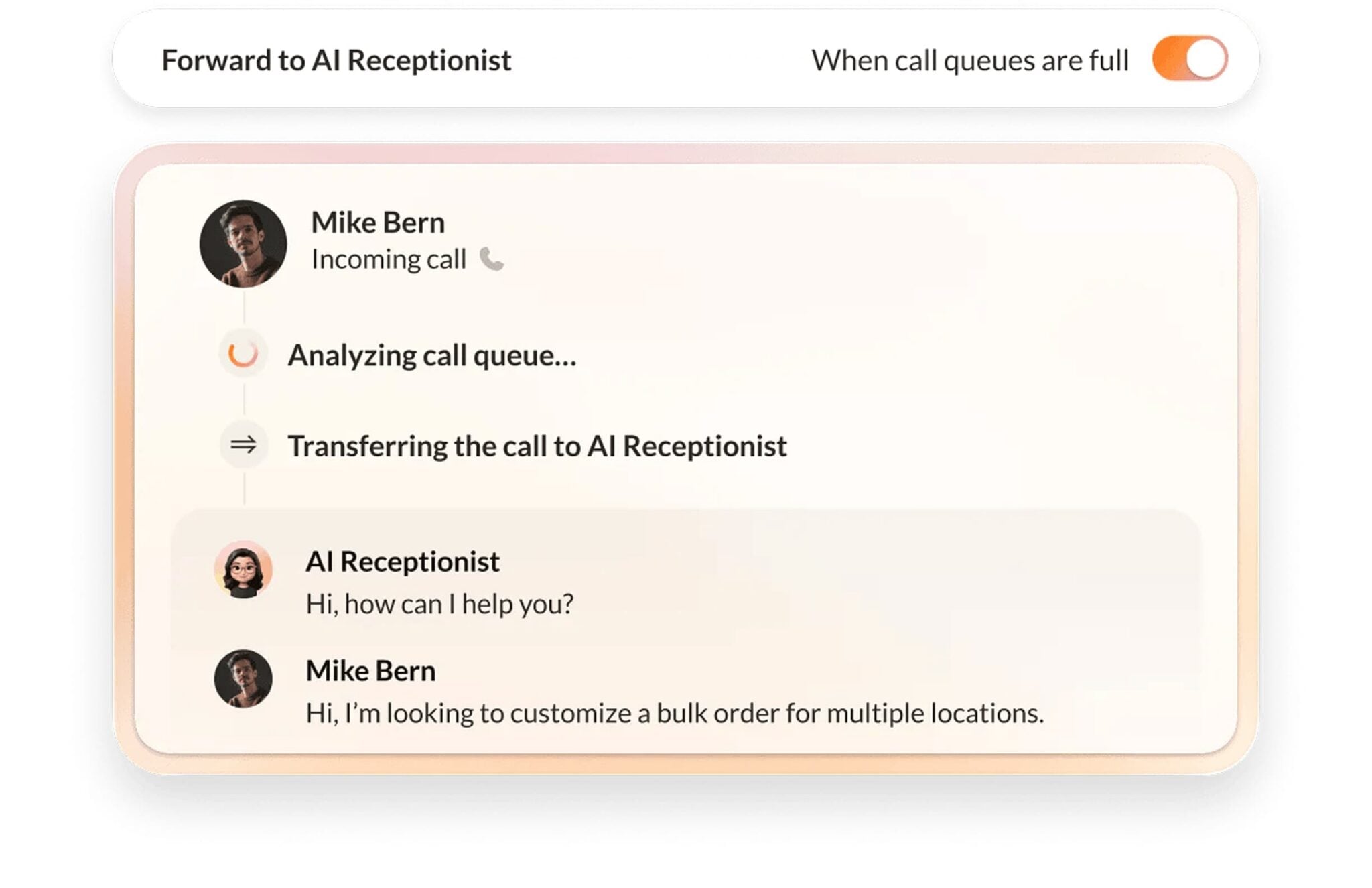
So the contacts that do need a person arrive with intent and intake details already captured. The agent opens the conversation knowing why the customer reached out, instead of asking them to start over. For banks standardizing service across branches, AIR gives every location the same fast, consistent front door on the phone and over text.
The payoff is fewer missed contacts, cleaner handoffs on the cases that matter most, and a first impression that holds up as volume climbs.
Make your banking chatbot an asset
Banking chatbots deliver value on routine volume, deflecting the requests that clog your queues and drain handle time. But the value calculation only holds when escalation and the human handoff are as good as the automation in front of them. Scope the bot tightly, measure containment alongside CSAT, and treat the moment a customer reaches an agent as the part you cannot afford to get wrong.
If you want to see how an AI receptionist answers calls and texts, resolves routine questions, and hands off the rest without dropping context, take a closer look at RingCentral AI Receptionist.
Banking chatbot FAQs
What is a banking chatbot?
From the customer’s side, a banking chatbot is the assistant that answers first when they open a chat window or call in. It handles the quick requests, like a balance or a card lock, and routes more complex requests to a human agent. For the bank, it’s a deflection layer that absorbs routine volume so agents can focus on higher-stakes conversations.
Are banking chatbots safe to use?
They can be, when identity verification, encryption, and compliance controls are built into every authenticated action. Most of the risk traces back to poor deployment: weak authentication, no clear escalation path, or a bot given authority over decisions it can’t safely make. Scope it to low-risk intents first and keep compliance in the loop.
What can a banking chatbot do for customers?
It handles high-frequency, low-complexity tasks: checking balances and transaction history, locking or replacing a card, confirming payment status, and answering common account questions. With authentication in place, it can complete some account actions directly. Complex or money-movement decisions should route to a human.
Do customers prefer chatbots or human agents in banking?
For anything beyond a simple lookup, most prefer a human. Deloitte found 74% of surveyed banking customers favored human agents over chatbots for routine queries, driven largely by concerns about accuracy. The lesson is to use the bot for speed on simple tasks and make the handoff to a person fast and clean.
How do banks measure whether a chatbot is working?
Track containment rate, first-contact resolution, CSAT, and escalation rate as a set, never one alone. High containment with falling CSAT signals customers are stuck rather than helped. Pair those with cost per contact to see whether deflection is actually lowering your operating cost.
Originally published Sep 08, 2026