AI Communications








Every unanswered call is a buyer or seller talking to a different agent within the hour. Here’s how to stop that.
A buyer calls about a listing at 7 p.m. and gets voicemail. An agent mid-showing feels the phone buzz in her pocket and can’t step away. A seller lead rings once, gets no answer, and moves on to the next name on the search results page. None of these are edge cases. They’re a typical Tuesday.
Real estate runs on a call volume pattern that doesn’t match a typical office schedule. Inquiries peak in the evenings and on weekends, exactly when agents are showing homes, hosting open houses, or off the clock. A missed call at any of those moments costs more than a lead. It costs the momentum that keeps a pipeline moving in a market where buyers and sellers act fast.
The right answering setup closes that gap without asking agents to pick up mid-showing. Compare the answering service models built for that reality: live services, AI receptionists, and hybrid setups, so you can match the right one to your transaction volume and team size.
Key takeaways
- Live, AI, and hybrid answering models fit different transaction volumes
- Lead qualification quality matters more than raw answer speed
- After-hours coverage is now a baseline expectation, not a differentiator
- RingCentral AI Receptionist (AIR) captures caller information and supports scheduling automatically
Why every unanswered call is a lead lost to a competitor
Real estate lead generation runs on speed—it’s the difference between a signed client and a lead who never calls back. The commission math makes this sharper than in most industries. A single missed call on an active listing can represent tens of thousands of dollars in commission. Buyers and sellers rarely wait for a callback when three other agents are one search away.
You can’t staff your way out of this by treating it as a slow-market problem to fix later. Call volume in real estate spikes unpredictably around new listings, price changes, and open houses, and every one of those spikes lands on top of an agent’s existing schedule of showings and closings. A setup that only works during business hours fails during the exact windows when leads are most active.
What a real estate answering service needs to cover
Evenings and weekends aren’t the exception in real estate call volume. They’re the norm. A service built around a 9-to-5 model will miss the majority of inbound interest before it ever reaches an agent. Here’s what coverage actually needs to include.
Buyer and seller inquiries on active listings
Buyers calling about a specific listing want two things fast:
- Confirmation the home is still available
- A path to see it
Seller leads calling in are often testing the water, comparing a few agents before committing, and a slow or generic answer reads as a lack of interest on the brokerage’s part.
Both call types need someone (or something) that can capture the listing address, the caller’s contact details, and their intent, then route that information to the right agent without making the caller repeat themselves later. Losing that context between the call and the follow-up is often what turns a warm lead cold.
Showing requests and scheduling
Showing requests are time-sensitive in a way most other business calls aren’t. A buyer who wants to see a home this weekend is often deciding between three or four properties, and the one that gets them in the door first has an advantage.
An answering setup needs to capture the requested property, the caller’s availability, and get that request onto a calendar, or at minimum into an agent’s hands, within minutes rather than hours. Manual back-and-forth by voicemail or email at this stage costs showings.
After-hours and weekend coverage
Most real estate inquiries land outside standard business hours, which makes after-hours coverage a baseline requirement. Buyers browse listings after work and on weekends, and that’s when they pick up the phone.
A brokerage that only answers calls 9 to 5 is effectively unavailable during its highest-intent windows. This is also where consistency matters most: a caller at 9 p.m. on a Saturday should get the same quality of intake as one calling at 10 a.m. on a Tuesday.
Live agents vs. AI receptionists vs. hybrid approaches
Once you’ve defined what needs coverage, the question becomes who or what actually answers the phone. Each model trades off differently on lead qualification depth, cost per lead captured, and consistency during high-volume stretches like open houses and new listing launches.
Live agents
Traditional live answering services route calls to trained human operators who can handle nuance, read tone, and adjust on the fly for an unusual question.
That flexibility is real, but it comes at a cost per call that adds up fast during high-volume periods, and quality can vary by shift, by operator, and by how busy the queue is at that moment. During a single open house weekend, call volume can overwhelm a live service at exactly the moment it peaks, which is the opposite of what a growing brokerage needs from its answering coverage.
AI receptionists
AI-native call automation answers every call the same way, at any hour, without a queue or a busy signal. Modern voice AI understands spoken intent and responds conversationally—a different experience from the rigid, menu-driven phone trees.
The tradeoff is nuance: an AI receptionist handles structured intake (caller name, listing, availability, intent) extremely well, but complex negotiation-style conversations still benefit from a human handoff when needed.
Hybrid approaches
A hybrid setup uses AI to handle first contact and routine intake, then hands off to a live agent for calls that need a human touch, like a tense negotiation call or a VIP client. This gets the consistency and around-the-clock coverage of automation without giving up the option of a live conversation when it matters.
For brokerages with a mix of high call volume and a handful of relationship-driven accounts, hybrid coverage often ends up being the most practical middle ground.
What separates a good answering setup from a great one
Answering the phone is the baseline. The real differentiator is what happens to the information after the call ends. A setup that does this well also cuts the manual triage work agents spend on repetitive requests; see how customer self-service tools handle that shift.
High-quality lead routing
Lead routing quality is the first differentiator. A lead sitting in a voicemail transcript or scrawled on a sticky note does an agent no good. It needs to land somewhere an agent will actually see it, ideally routed to the right person based on listing, territory, or availability, without a manual step in between.
Brokerages juggling call queues across multiple agents or locations should look closely at how routing and integrations are handled day to day.
Multilingual coverage
Bilingual coverage matters more than most brokerages plan for, particularly in markets with sizable Spanish-speaking buyer and seller populations. An answering setup that only operates in one language quietly turns away leads in a lot of metro markets.
Consistent customer intake and quick response times
Consistency across a brokerage is the third piece, and it’s where most setups fall apart. A brokerage with a dozen agents needs every caller to get the same standard of intake, whether they reach the top producer or the newest hire, and whether the call comes in at 2 p.m. on a Wednesday or 9 p.m. on a Sunday.
The data backs up why this matters: a 2026 Real Estate Lead Response Time Benchmarks report by Swiftleads AI notes that top-performing brokerages in terms of gross commission income are also the ones that respond to leads within five minutes or less. A consistent, always-on answering setup closes exactly that gap between best practice and typical performance.
How RingCentral AI Receptionist supports real estate call volume
An agent can’t be mid-showing and on the phone at the same time, and every minute an agent spends choosing between the two is a minute a lead spends deciding on someone else. RingCentral AI Receptionist (AIR) is built for this scenario. It answers every incoming call automatically so no inbound buyer, seller, or showing request goes to voicemail because an agent was busy with a client in person.
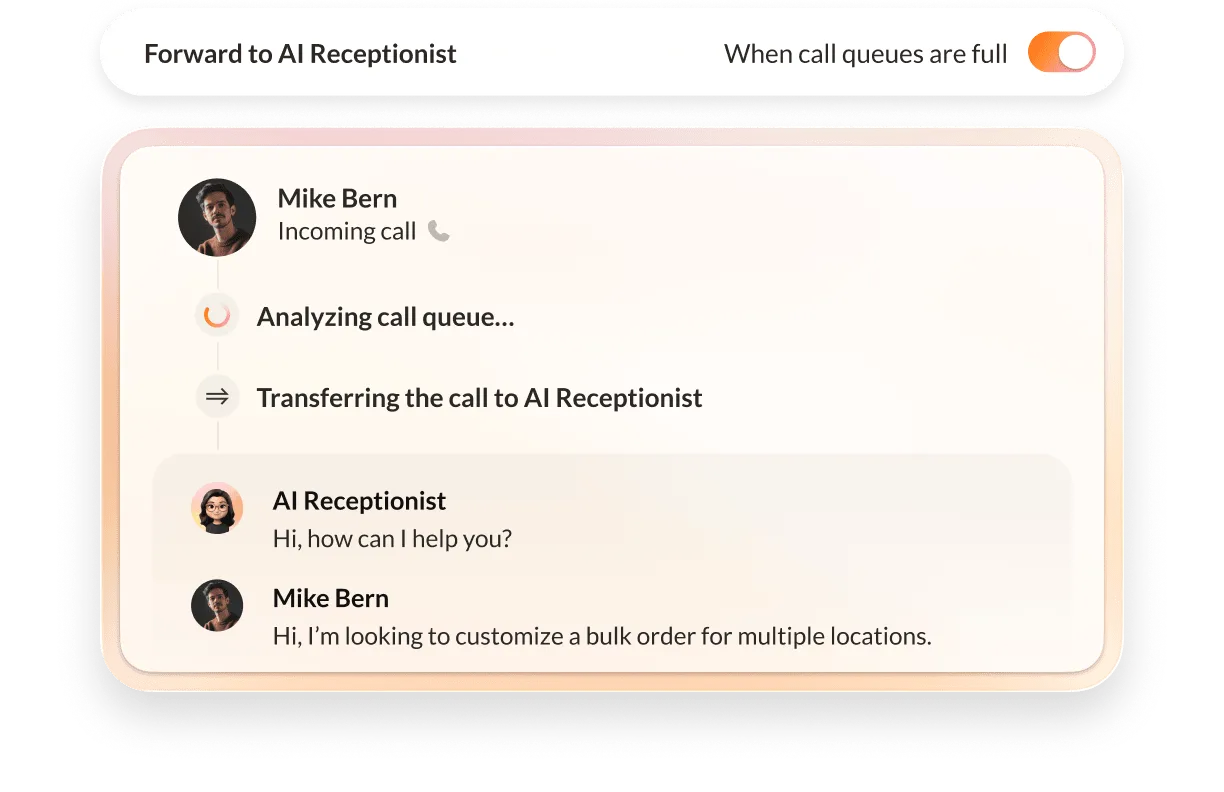
AIR uses context-aware routing instead of a rigid phone menu, directing callers based on what they’re actually asking for rather than forcing them to guess which button to press. A caller asking about a specific listing gets handled differently than one asking about scheduling a showing, without either of them sitting through a generic menu tree first.
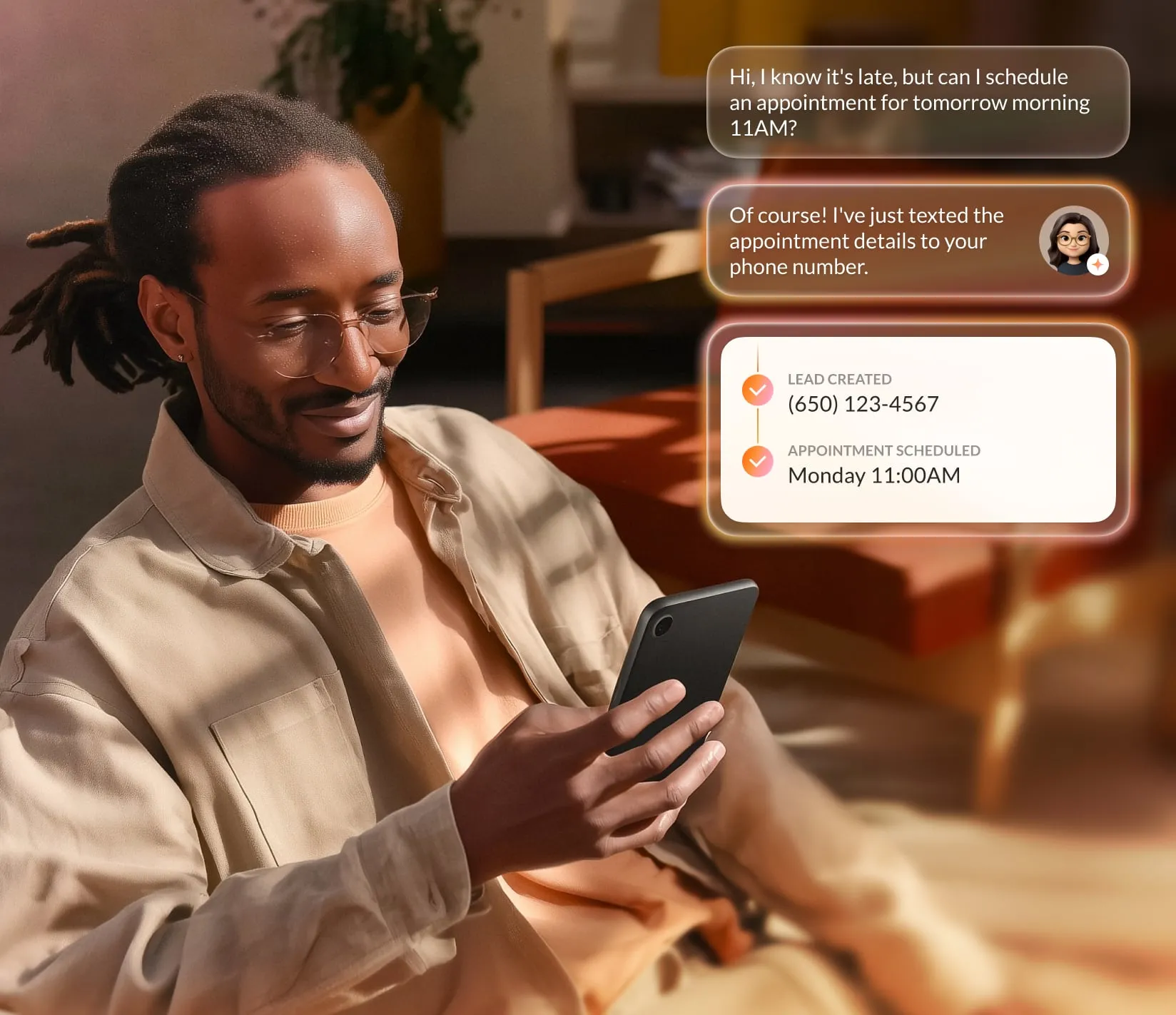
Beyond answering the call, AIR captures the caller’s information automatically, so lead details don’t depend on an agent remembering to write them down between showings. It also supports appointment scheduling directly through the call, letting a showing request turn into a calendar entry without a separate round of back-and-forth.
Turn every call into a tracked lead, not a guess
Fast, consistent call response is now a baseline expectation in real estate. Which answering service model fits, whether live, AI, or hybrid, comes down to your transaction volume and how many agents need coverage across how many hours.
What matters most is that every buyer, seller, and showing request gets captured the moment they call, instead of waiting for someone to check voicemail.
If missed calls are costing you leads you can’t trace, it’s worth seeing what automated call handling looks like in practice. Contact us to learn more about how RingCentral AI Receptionist answers, routes, and captures real estate calls around the clock.
FAQs about real estate answering services
Do real estate agents need a 24/7 answering service?
Most agents do, given that a large share of buyer and seller inquiries come in outside standard business hours. Evenings and weekends are peak windows for real estate calls, not exceptions, so coverage limited to office hours misses a meaningful share of inbound leads.
The exception is a very low-volume solo agent who’s comfortable trading some missed calls for a lighter setup.
What is the difference between a live and an AI real estate answering service?
A live answering service routes calls to trained human operators who can handle nuanced or unusual conversations, typically at a per-call or per-minute cost.
An AI receptionist answers every call the same way regardless of volume or time of day, handling structured intake like caller details, listing information, and scheduling without a queue.
Many brokerages land on a hybrid model that uses AI for first contact and reserves live agents for calls that need a human judgment call.
Can an AI receptionist qualify real estate leads?
An AI receptionist can capture the information that qualifies a lead, including:
- Caller contact details
- Call intent
- The listing or property in question
It can then route the customer to the right agent. RingCentral AI Receptionist handles this kind of structured intake and appointment scheduling automatically. It doesn’t replace an agent’s judgment on a complex or sensitive call, but it does make sure the basic qualifying details get captured every time.
How much does a real estate answering service cost?
Cost varies widely by model: live answering services typically charge per call or per minute, which scales up quickly during high-volume periods like open house weekends.
Most AI receptionist providers charge a flat subscription or usage tier regardless of call volume, which makes costs more predictable during spikes.
Hybrid setups usually cost more than AI alone but less than an all-live model, since AI handles the bulk of routine intake.
Originally published Jul 22, 2026