AI Communications











AI adoption is no longer a question of whether, but how. RingCentral’s Agentic AI Trends 2026 report found that 86% of surveyed organizations have a long-term AI strategy, while 83% have already launched at least one AI initiative.
Adoption is widespread, yet the research shows considerable variation in how companies approach AI and advance their deployments.
The research surveyed 2,000 respondents, and four industries yielded sufficient data for closer analysis: Financial Services, Technology, Healthcare, and Retail. Their responses reveal important differences in what organizations want from AI, how they deploy it, and how they evaluate results.
The research does not provide a definitive ranking of buyer readiness, but it does reveal distinct maturity patterns across these four industries, along with useful lessons for leaders preparing to scale AI.
For business leaders, these differences provide context for evaluating their own progress and deciding what the next stage of adoption should look like.
To assess readiness for AI adoption and continued advancement, I distilled the research findings into three themes.
- AI objectives: What organizations expect AI to achieve
- AI deployment: How quickly and extensively they are putting AI to work
- AI performance: What results they are seeing and how they respond when initiatives fall short
AI objectives across different business contexts
Before assessing AI maturity, it helps to understand what organizations expect AI to accomplish. Among the net base of 1,716 respondents with some degree of long-term AI strategy, the leading goals were:

Respondents could select multiple answers, and the range of objectives suggests many organizations still see AI as an all-purpose solution. This breadth may indicate that many companies have established an AI strategy before defining the priorities that should guide their investment decisions.
The top three goals are all relevant to customer experience, making the contact center a natural proving ground for AI. Task automation also extends across the business, aligning closely with AI’s core capabilities.
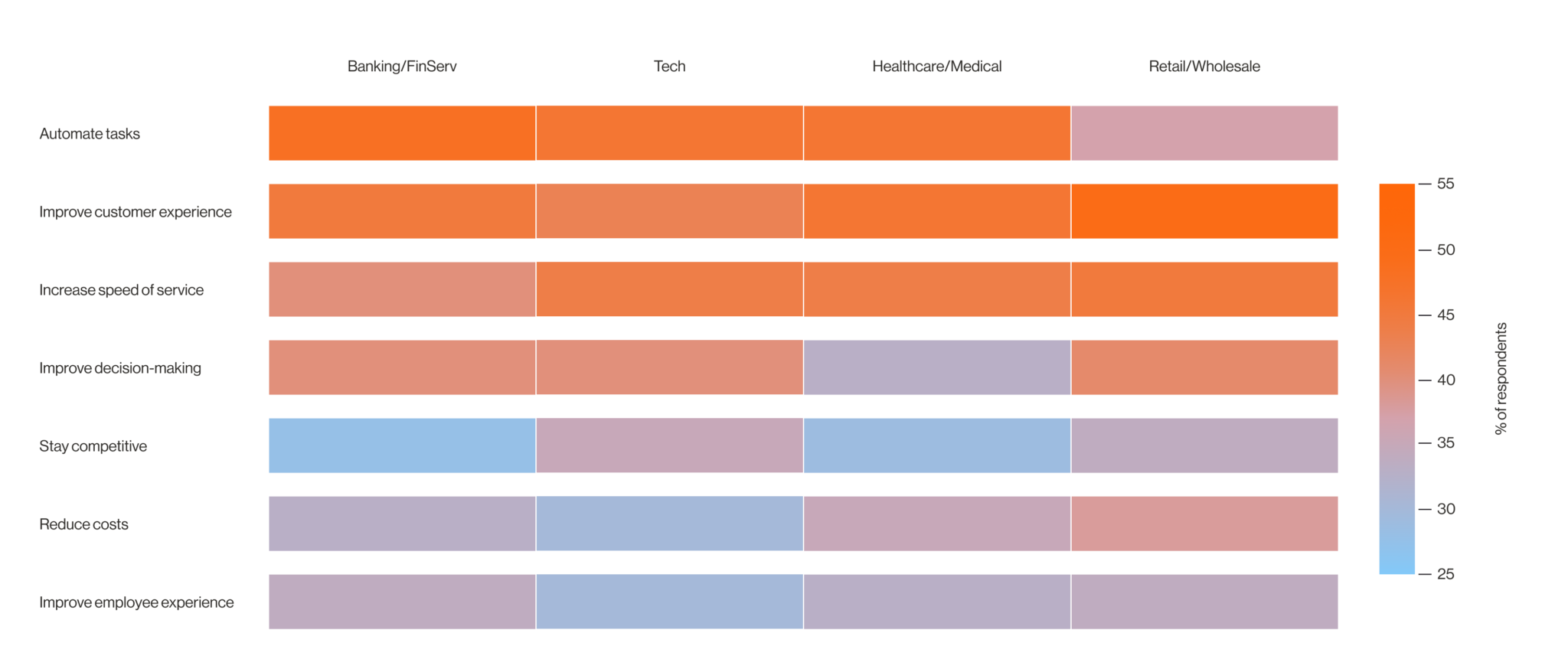
The industry comparisons show where those priorities begin to diverge.
- Financial Services places the greatest emphasis on task automation, reflecting the importance of transaction processing in daily workflows.
- Healthcare is less focused on AI-assisted decision-making. That may reflect the continued importance of human judgment and clinical expertise in high-stakes decisions.
- Retail places greater emphasis on customer experience and cost reduction, both of which are important in a highly competitive sector where loyalty and margins are under constant pressure.
Leaders can use these comparisons to test whether their AI priorities align with their industry’s needs. A broad strategy may help a company begin its adoption journey, while further progress requires clearer priorities and investment choices.
AI deployment and the limits of speed
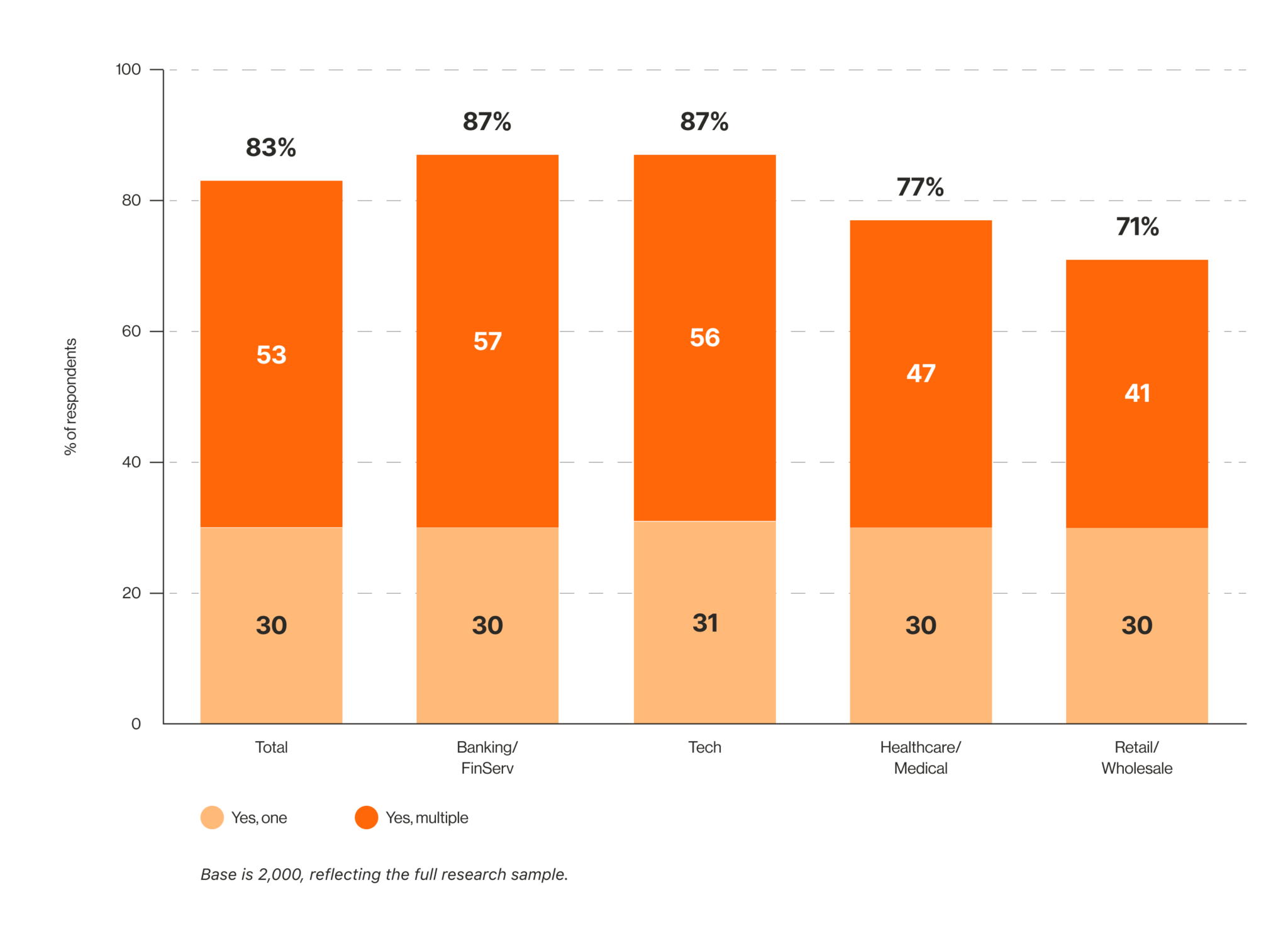
Deployment is another useful indicator of maturity. Overall, 83% of respondents have launched at least one AI initiative, and 53% have launched multiple initiatives. Financial Services and Technology lead the four industries, with 87% of respondents in each reporting at least one deployment. The figures fall to 77% for Healthcare and 71% for Retail.
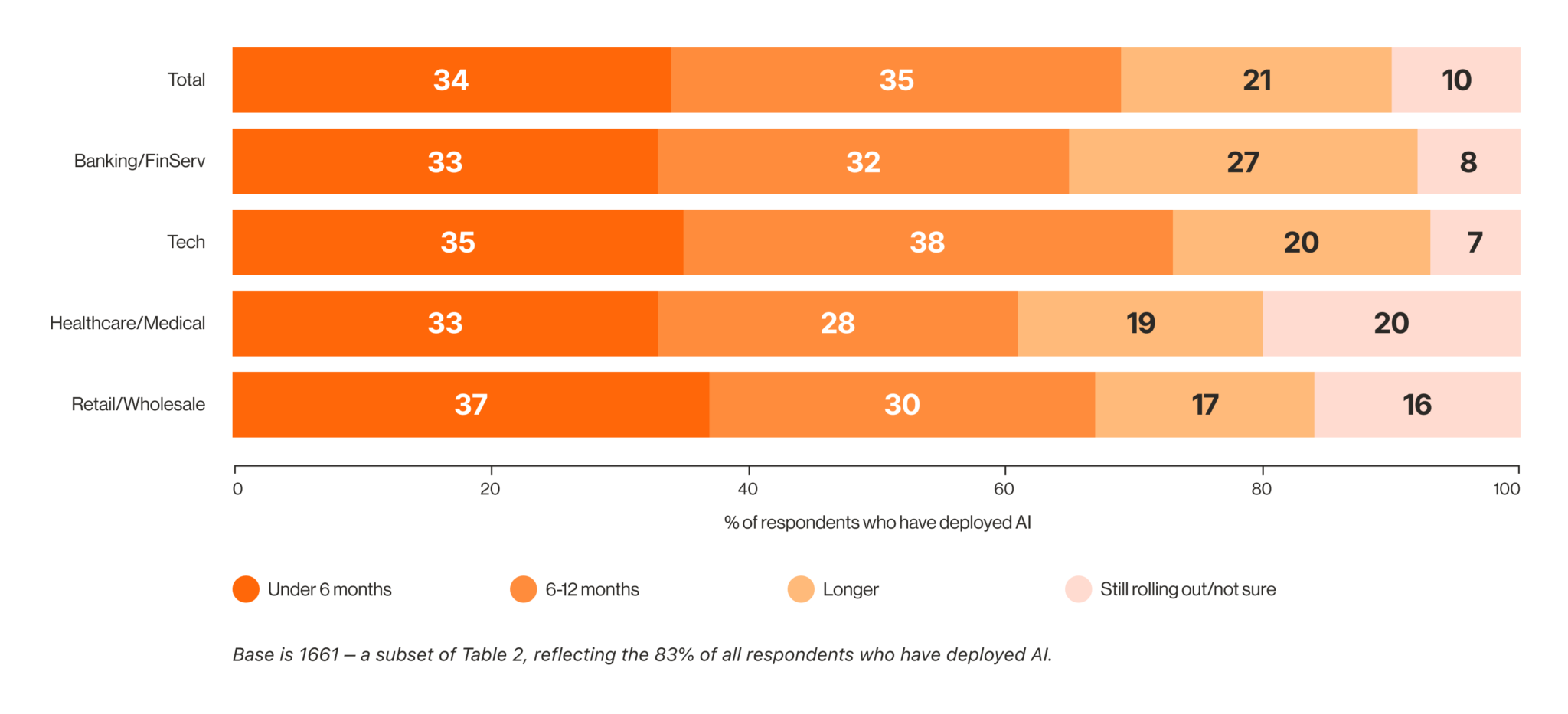
Most organizations also moved relatively quickly, with 69% deploying their first AI initiative within a year. But the time to deployment requires context, as industry conditions are essential to the differences beyond that figure.
Have launched an AI initiative (by %)
In Financial Services, 27% said their first deployment took longer than a year. Regulation and the use of sensitive financial data can extend implementation timelines, making a deliberate pace consistent with mature governance.
Healthcare shows a similar pattern: 39% took longer than a year or were still rolling out their first deployment, reflecting the demands of regulation and the handling of sensitive health information.
Retail moved faster, with 37% deploying in under six months. The relative simplicity of its initial use cases may help explain that pace.
Deployment speed reflects industry conditions and use-case complexity, making it an incomplete measure of maturity.
Time to deploy first AI initiative (by %)
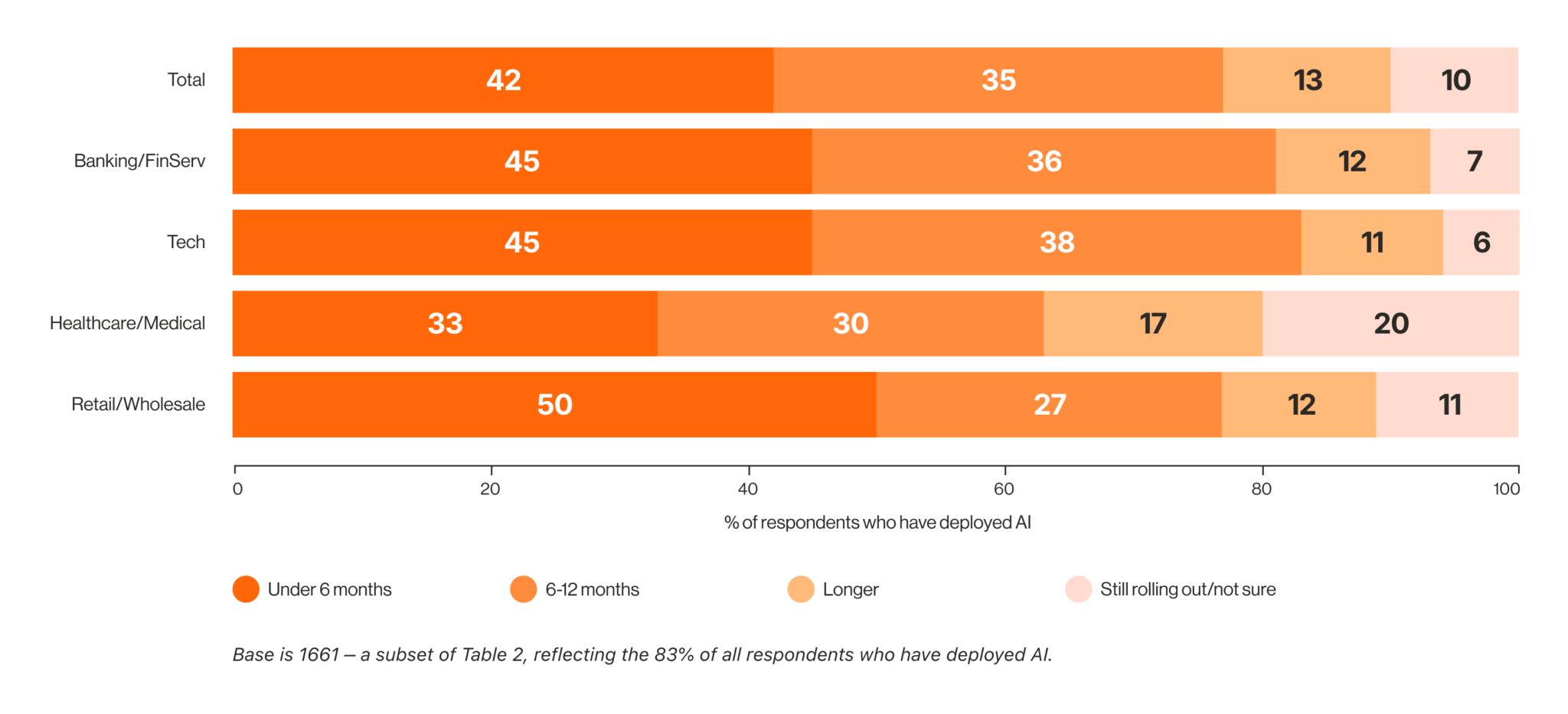
Time to ROI adds another dimension. Among organizations that had deployed AI, 77% reported seeing a return within the first year. Financial Services and Technology reported the fastest paybacks, despite deploying at different speeds. Meanwhile, 20% of Healthcare respondents had not yet seen an ROI or were unsure—possibly reflecting the difficulty of measuring outcomes such as improved patient care against more conventional customer experience metrics.
How long to see ROI from initial AI deployment (by %)
The use of digital workers provides a more specific measure of adoption. In Financial Services, 43% are either deploying digital workers at scale or have embedded them across operations. Technology reports the same combined figure. The corresponding results are 28% for Healthcare and 32% for Retail.
The depth of digital-worker adoption places Financial Services and Technology further along the maturity ladder. Both industries have progressed into broader operational use.
AI performance and the value of course correction
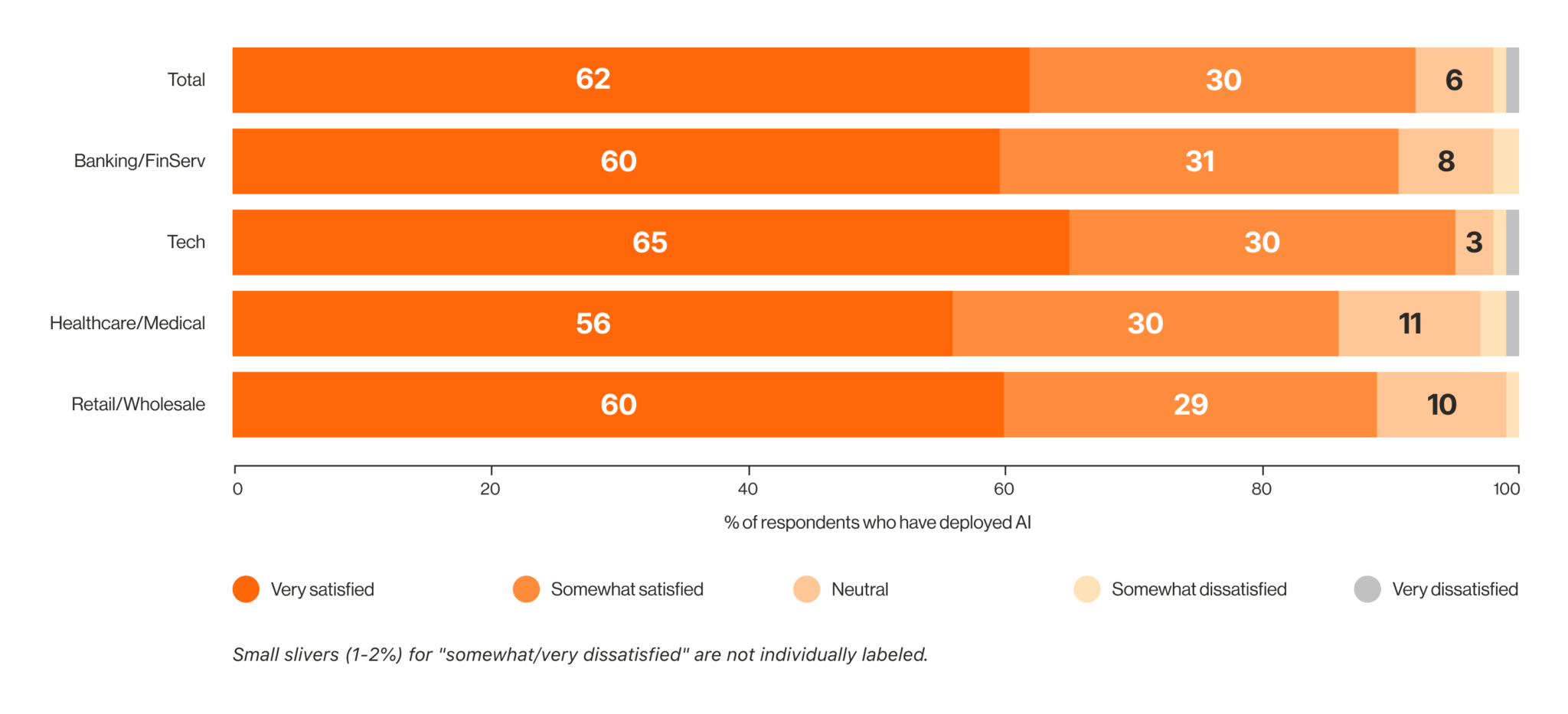
AI performance is essential to continued investment. The results are encouraging, and overall satisfaction is high: 92% of respondents reported being very or somewhat satisfied with their AI deployments. Technology recorded the highest combined satisfaction at 95% and the lowest neutral response at 3%.
At first glance, another finding seems difficult to reconcile with those results. High satisfaction exists alongside a substantial ratio of course correction 42% of respondents reported pausing or canceling an AI initiative. Technology had the highest incidence, at 54%, followed by Financial Services.
Satisfaction with AI deployment so far (by %)
Paused or cancelled any AI initiatives (by %)
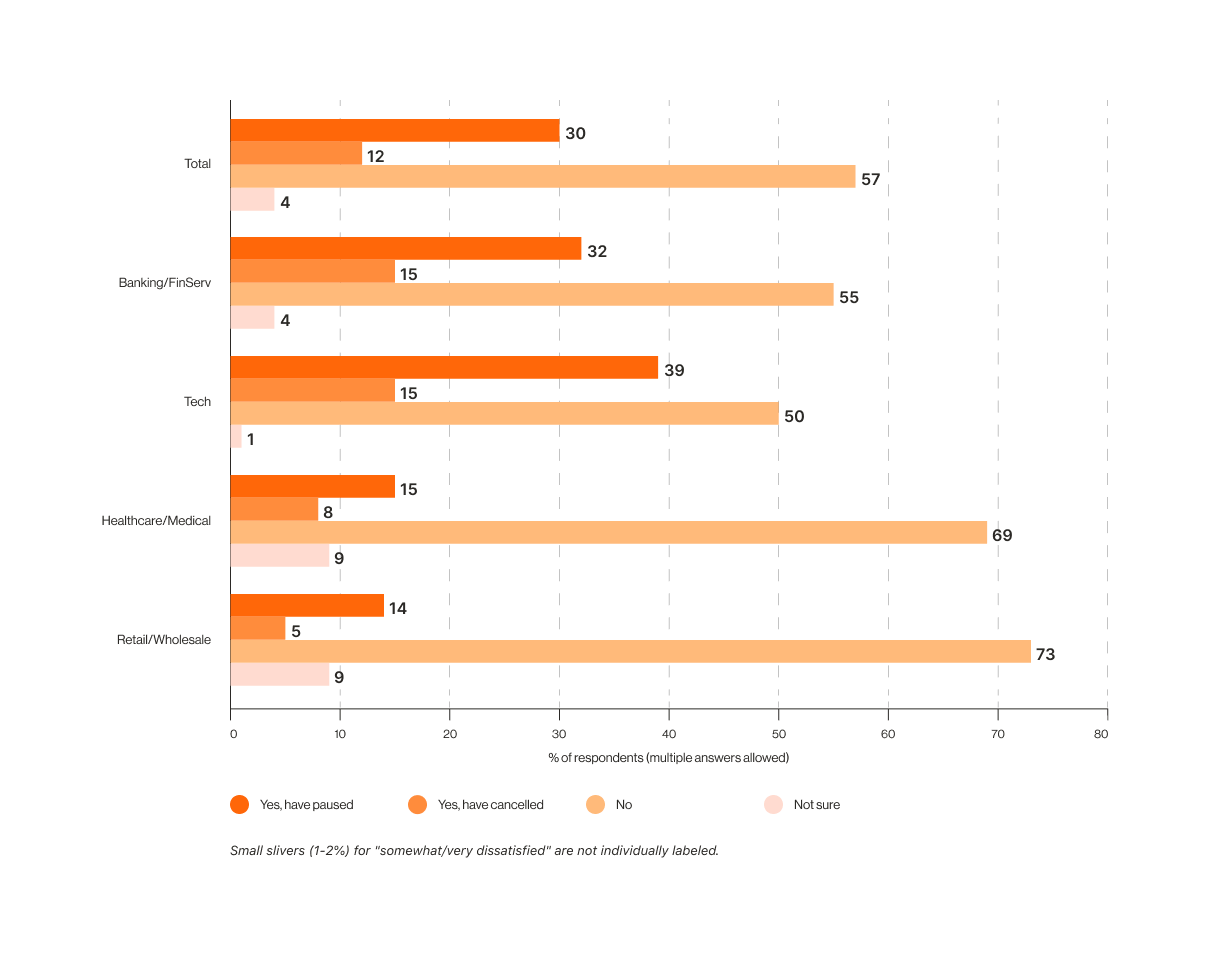
Note – the totals for this table slightly exceed 100% because some respondents provided multiple answers, all of which could have been legitimate. The best example would be scenarios where an organization has both paused and canceled AI deployments – possibly for the same initiative or for separate ones.
Technology’s higher rate of paused or canceled projects may reflect its greater experience in deployment. Companies running more initiatives have more opportunities to identify weak projects and redirect investment.
AI remains a work in progress for vendors and customers alike. Not every deployment will go to plan, especially when organizations are running multiple initiatives. The ability to test, learn, and stop a problematic project may therefore indicate greater readiness, not less.
Healthcare and Retail were less likely to report pausing or canceling initiatives. It is possible that their projects are more successful. But given their lower overall deployment rates, another explanation is that these organizations are more cautious and initiate projects only when they have a high degree of confidence in the outcome.
What can business leaders learn from the data and their peers?
Taken together, the findings place Technology furthest along the AI maturity ladder, with Financial Services close behind. Technology companies advance through frequent experimentation and active course correction. Financial Services companies pair broad deployment with the governance required in a regulated industry.
Healthcare and Retail are following different paths. Healthcare faces added regulatory and data complexity, while Retail can move quickly when use cases support customer experience or cost reduction.
These findings offer a directional view of buyer readiness rather than a definitive ranking. They show that AI maturity depends on how well each organization accounts for its industry conditions and risk tolerance.
The research also challenges assumptions carried over from earlier technology cycles. A rapid deployment provides limited evidence of maturity and does not guarantee a faster return. Deliberate governance and timely course correction can demonstrate that an organization is learning from its investments.
Business leaders can use these peer comparisons to assess their own position on the maturity ladder. Progress depends on setting clear priorities and evaluating performance with an understanding of industry constraints.
For a broader look at the barriers to early AI adoption at enterprise scale, explore RingCentral’s research on the AI scaling divide.
Originally published Aug 26, 2026