AI Communications







A side-by-side look at how the two platforms compare on features, reliability, security, scale, and cost.
You’ve narrowed your contact center search to two platforms, and now the real work starts. Five9 and RingCentral both demo well, and both check the boxes on the feature list.
The catch is that a features list can’t tell you which platform your agents will still find easy to use in six months. It can’t tell you which one will satisfy your finance team at renewal either. The difference that decides a Five9 vs. RingCentral shortlist is usually structural. One sells a contact center on its own, while the other runs a contact center inside a wider phone, messaging, and meetings platform.
This guide compares Five9 and RingCentral on channels, reliability, security, scale, and cost. See where each platform fits, so you can select the right platform with evidence and defend it to leadership.
Key takeaways
- Five9 is a good fit for teams wanting a mature, standalone cloud contact center
- RingCentral RingCX is a strong fit for teams unifying their contact center with business communications
- Both offer voice, digital channels, and AI capabilities
- Five9 publishes a 50-seat minimum, while RingCentral doesn’t publish a seat minimum
Five9 vs. RingCentral RingCX at a glance
The single difference that decides most shortlists is scope. Five9 is a contact center as a service (CCaaS) platform on its own. RingCentral RingCX runs a contact center alongside RingEX, which handles internal employee communications and collaboration.
| Five9 | RingCentral RingCX | |
|---|---|---|
| Best fit use case | Standalone contact center for voice-heavy teams | Contact center unified with business phone, messaging, and meetings |
| Highlighted features | Voice plus chat, email, text messaging, social, and video, with AI Agents, Agent Assist, and workforce management | Voice plus 20+ digital channels, Intelligent Virtual Agent (IVA), AVA Agent Assist, AVA Supervisor Assist, and AI Quality Management |
| Quality of service | 99.999% | 99.999% |
| Security | SOC 2, ISO 27001, PCI DSS, HIPAA, CCPA, GDPR | SOC 2 and SOC 3, ISO 27001, PCI DSS, HIPAA, GDPR, HITRUST, C5 |
| Scalability | Concurrent-user model with a 50-seat minimum | User-based model with no seat minimum |
| Pricing model | Priced per concurrent user per month, with multiple tiers | Priced per user per month, with multiple tiers |
| G2 rating (As of August 20, 2026) | 4.1 out of 5 | 4.5 out of 5 |
Five9 pros and cons
Pros
- AI built for the contact center, including AI Agents and Agent Assist
- Workforce management and interaction analytics inside the platform
- Integrations with Salesforce, ServiceNow, Microsoft, Oracle, and Zendesk
Cons
- Unified phone and meetings stack is separate
- 50-seat minimum may be harder for smaller teams to justify
- Voice coverage requires a higher-tier plan than the digital-only base plan

RingCentral RingCX pros and cons
Pros
- Voice and 20+ digital channels in one agent workspace
- Native AI Quality Management that scores 100% of interactions without sampling
- Pairs CCaaS with business phone, messaging, and meetings
Cons
- Deeper AI capabilities require a higher-tier plan or add-on
- RingCX-specific SLA and certification scope should be confirmed during procurement
- Advanced workforce or analytics needs may require plan review

Five9 vs. RingCentral RingCX features
The gap is consolidation, not call handling. Both support voice routing, digital channels, and AI capabilities. For a voice-heavy team, the difference may be less obvious at first.
| Feature | Five9 | RingCentral RingCX |
|---|---|---|
| Channel coverage | Voice and digital channels are separate | Unified voice and 20+ digital channels |
| Self-service AI | AI Agents, Intelligent Virtual Agent | Intelligent Virtual Agents (IVA) and AI Receptionist |
| Integrations | Salesforce, ServiceNow, Microsoft Office, Oracle, Zendesk, Microsoft Teams, Nextiva, Zoom, and more | Salesforce, HubSpot, Zendesk, Pipedrive, Microsoft Teams, NetSuite, Google Workspace, Gong, Slack, and more |
| Agent assist | Agent Assist | AVA Agent Assist and AVA Supervisor Assist |
Self-service is the capability to evaluate most carefully, as it decides how much volume never reaches an agent. Five9 offers AI Agents for autonomous self-service and an Intelligent Virtual Agent for guided resolution.
RingCX offers its own intelligent virtual agent, which resolves routine inquiries in natural language across voice, chat, and messaging. When it hands off, it passes the customer’s information and interaction history to a live agent, so the caller doesn’t start over.
RingCentral’s AI Agents extend that further. AI Receptionist (AIR) and AI Representative (AIR Pro) handle both inbound and outbound interactions across voice and digital channels, and they can act on a request rather than only answer it.

Integrations are also similar across the two platforms. Five9 names connectors for Salesforce, ServiceNow, Microsoft Office, Oracle, and Zendesk. Additionally, it connects to Microsoft Teams, Nextiva, Zoom, and RingCentral.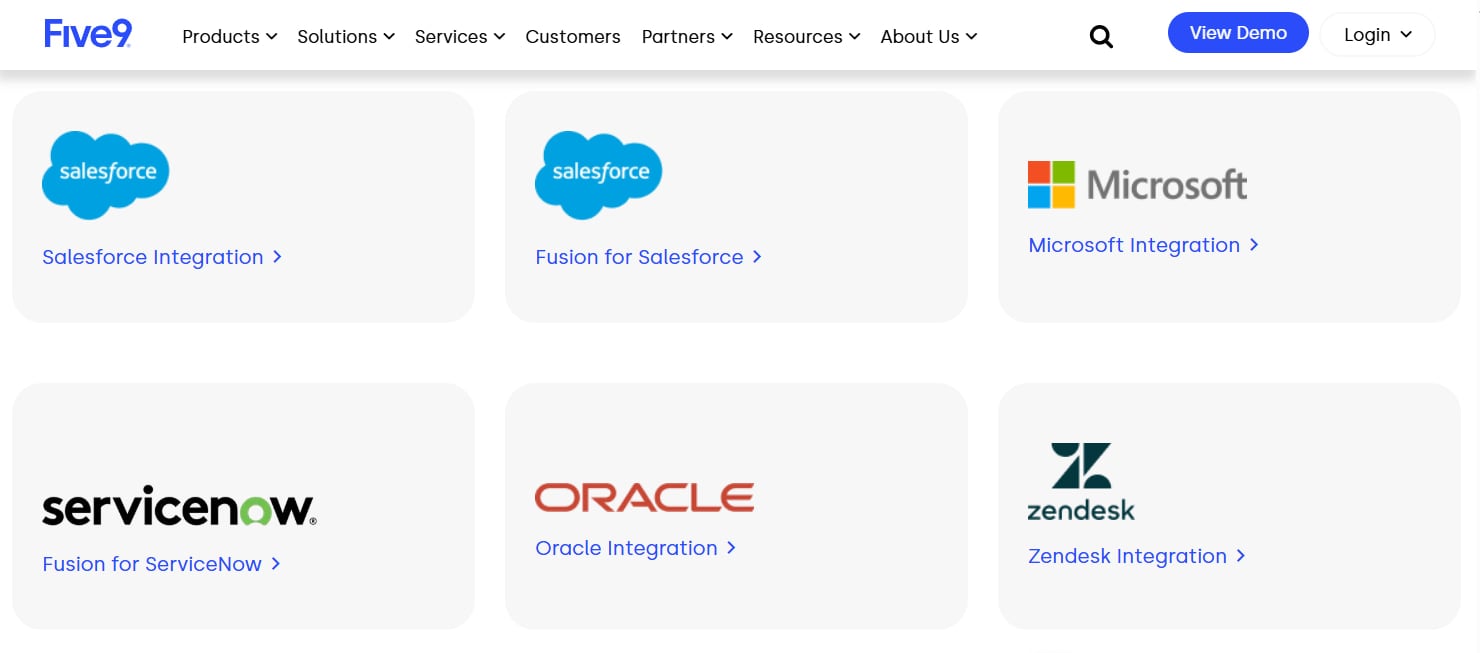
RingCX integrates with 300+ apps, including Salesforce, HubSpot, Zendesk, Pipedrive, Microsoft Teams, NetSuite, and Google Workspace. Its connectors range across analytics and customer support platforms to marketing automation and translation.
For a team standardizing on one CRM, both cover the common ground. For a team that wants calling, messaging, and the contact center under one admin console, RingCX keeps the count of tools lower.
Bottom line: RingCX pulls ahead for teams that want the contact center inside the same platform as its phone system and meetings, so agents and admins work in one environment rather than two. On core routing and channel coverage, the two are comparable.
Reliability and quality of service
Based on published SLA information, both Five9 and RingCentral list 99.999% uptime commitments.
A platform that runs your call queue has to hold up under a volume spike, so the status history matters more than the headline number. Use the RingCentral status page and Five9 status page to review historical uptime performance.
Questions to ask each vendor about reliability:
- What is your contact center SLA, and what historical status record sits behind it?
- How does the vendor credit downtime against the SLA?
- How does it notify you during an incident?
Five9 vs. RingCentral: Security and compliance posture
Security certifications are another area where Five9 and RingCentral RingCX differ—but only slightly. Match them to your industry requirements: HIPAA and HITRUST for healthcare, PCI DSS for payments, SOC 2 and SOC 3 for enterprise security.
Five9 security certifications
Five9’s security certifications cover many of the standards you’d expect, including:
- Health Insurance Portability and Accountability Act (HIPAA)
- Payment Card Industry Data Security Standard (PCI DSS) Level 1
- SOC 2
- General Data Protection Regulation (GDPR)
- California Consumer Privacy Act (CCPA) and California Privacy Rights Act (CPRA)
- ISO 27001, 27017
- Cyber Essentials
RingCentral security certifications
RingCentral publishes a broad certification set across its platform, including:
- HIPAA
- HITRUST
- PCI DSS
- SOC 2 and SOC 3
- GDPR
- ISO 27001, 27017, 27018, 22301, 9001
- C5
- Cyber Essentials Plus
Questions to ask when comparing security and compliance:
- Where does each platform store and process data?
- Which certifications cover the AI features specifically, not just the core platform?
Bottom line: Both platforms offer a wide range of certifications. The right fit depends on your industry-specific regulatory requirements.
How each platform scales
The scaling difference is mostly centered at the entry point, not the ceiling. Both platforms use user-based pricing, but the entry thresholds differ. No minimum user requirement may sway you toward RingCX.
- Five9 sets a 50-seat minimum on its published bundles. That floor suits larger or seasonal operations that flex a shared pool of agents.
- RingCX doesn’t publish a seat minimum. A smaller team starts without needing to clear a large seat floor.
For a mid-market team growing toward enterprise, RingCX mostly removes the entry hurdle. For a large concurrent operation, Five9’s model fits how most of those teams already staff.
Scaling is also an outbound question, not only an inbound one:
- If your team runs outbound campaigns, weigh the dialer options and how each platform paces calls at volume.
- If you run multiple sites or brands, weigh how each handles separate queues, routing rules, and reporting under one account.
The right answer follows the way your operation is shaped today, and the way you expect it to grow over the next contract term.
Verdict: RingCX scales better for small and mid-sized teams while offering enterprise-ready features. Five9 is ready for enterprise teams from the outset, and its 50-seat minimum may be harder for small and mid-sized teams to justify.
Five9 vs. RingCentral: How pricing models differ
Both platforms use user-based monthly pricing, but Five9 prices by concurrent user. Higher-tier plans cost more, so budget around the channel coverage, AI features, and user count you need.
| Pricing | Five9 | RingCentral RingCX |
|---|---|---|
| Model | Per concurrent user per month, with multiple plan tiers | Per user per month, with multiple plan tiers |
| Base plan channel coverage | Email, chat, text messaging, social media | Voice and 20+ digital channels |
| Base plan AI features | None | Routing and AI Receptionist + other available AI add-ons |
| Public pricing detail | Publishes per-concurrent-user plan bundles | Publishes plan-based pricing details or quote path |
The biggest difference between Five9 and RingCentral RingCX comes down to channel coverage:
- Five9’s base plan only covers digital channels (email, chat, text messaging, and social media). The next highest plan adds voice coverage alongside those digital channels.
- RingCX’s base plan includes voice along with 20+ digital channels. No plans make you choose between voice and digital channel coverage.
For teams that need full omnichannel coverage, RingCX is a strong fit. Its base plan also comes with AI Receptionist to help you cover simple customer self-service requests, and you have the option to add more AI features, like AI Quality Management and AVA Agent Assist, for an additional price. This makes RingCX a great starting point for small teams that don’t need a full AI suite yet, but need room to grow into one in the future.
Remember, you should price the total cost of ownership (TCO) not just the per-seat rate. A standalone contact center leaves the phone system, messaging, and meetings on separate contracts. A consolidated platform folds them into one relationship, which changes both the invoice and the admin load.
Count the platforms you still run alongside the contact center, and model the three-year total cost for both configurations before you compare a headline seat rate.
Other questions to ask about pricing:
- Check whether pricing is per concurrent or per named user.
- Confirm what usage adds on top.
- Find out where the seat floor sits, because that decides the entry cost for a smaller team.
Verdict: RingCX offers more flexibility and a lower starting point for smaller teams, with room to grow into a more robust CCaaS offering. Five9’s base plan may be less suitable for teams that need voice and digital coverage from day one, while higher-level plans may appeal to mature enterprise teams.
Match the platform to the contact center you’re running
Five9 fits a team that wants a mature, standalone contact center with deep workforce management and a self-contained AI set. RingCentral RingCX fits a team that wants the contact center unified with its business phone, messaging, and meetings, with voice and digital in one agent workspace.
Score the two on three things: channel coverage, the certification list each hands you, and how each fits the stack you already run. See how RingCX handles omnichannel volume and supports your team with AI features.
Five9 vs. RingCentral FAQs
What is better than Five9?
It depends on the specific use case. For a team that wants its contact center unified with business phone, messaging, and meetings, RingCentral RingCX is the closer fit, covering voice and more than 20 digital channels in one workspace.
For a standalone contact center with deep workforce management, Five9 is a mature option. There’s no single winner across every use case, so compare them on channel coverage, reliability, and how each fits your existing stack.
Who is RingCentral’s biggest competitor?
RingCentral competes across unified communications and the contact center, so the answer depends on the product. For RingCX, its contact center platform, the comparison set is other cloud
contact center providers such as Five9.
For RingEX, its business phone platform, the competitive set is other unified communications providers. Because RingCentral spans both, its strongest pitch is to a team that wants one vendor for the phone system and the contact center. Evaluate the options on channel coverage, AI, reliability, and total cost across the platform.
Originally published Sep 21, 2026