AI Communications








A guide to how conversational AI resolves customer requests, where it hands off to an agent, and what to measure to know it’s working.
Your contact volume climbs every quarter, but your headcount doesn’t move with it. Routine questions like order status, password resets, and store hours fill the queue. The complex cases that need a person wait longer than they should. Expanding headcount to match volume is rarely a viable option, and adding another point tool to the stack rarely helps.
The practical solution is to let software handle the requests customers repeat most, in natural language. Everything else routes to an agent with full context attached. Done well, that clears the queue and protects the experience your team has worked to build.
This guide covers what conversational AI does, the forms it takes, where it fits, and how you tell whether a deployment is working. The real question you’re weighing is which requests you can hand to software without eroding the experience. Start with what the technology is.
Key takeaways
- Conversational AI resolves routine customer requests in natural language across voice and digital channels
- Types range from rule-based bots to agentic virtual agents, matched by intent and channel
- Measurable payoff in containment, faster resolution, after-hours coverage, and consistent quality
- Success depends on clean handoff to an agent with full context
What is conversational AI for customer service?
Conversational AI for customer service is software that understands a customer’s request in natural language and responds across voice and digital channels. It resolves routine issues on its own and escalates the rest to a live agent. It combines natural language understanding, dialog management, and integrations with the systems that hold customer data.
Most readers arrive knowing the term loosely, so it’s worth separating from a related one. Conversational AI works in the moment, talking with the customer. Conversation intelligence works afterward, analyzing what was said to surface trends and coach agents.
How conversational AI for customer service works
Conversational AI works in four moves: Intent recognition, dialog management, system integration, and agent handoff. Each maps to a component you can evaluate.
Three capabilities work together underneath any conversational AI:
- Intent recognition reads what the customer wants, even when they phrase it in ways a script never anticipated.
- Dialog management tracks the conversation so context carries from one turn to the next.
- System integration connects the exchange to the customer relationship management (CRM) platform and the systems holding order and account data. That’s what lets the AI act on a request instead of only answering it. On the phone, the same integration turns a rigid touch-tone menu into an AI-powered interactive voice response (IVR), so a caller can say what they need instead of pressing through options.
The newer tier is agentic AI, software that takes action across workflows rather than following a fixed script. A scripted chatbot walks a customer down a decision tree. An agentic virtual agent can check an order, process a return, and update the record, then escalate if the request changes.
None of this replaces a person for the hard cases. Complex, emotional, and high-stakes conversations still need human judgment, and treating AI as a total replacement is how deployments stall.
In RingCentral’s 2026 Agentic AI Trends report, nearly 40% of organizations reported pausing or cancelling an AI project. The usual reason was misalignment on expectations, workflows, or training from the start. The failure modes are consistent: dead-end bots with no escalation path, context lost at the handoff, and over-automation that traps a frustrated caller in a loop. Each is prevented by design rather than by adding automation.
Benefits of conversational AI for customer service
The benefits show up as numbers a contact center already tracks: higher containment, faster resolution, coverage outside business hours, and more consistent quality. The technology earns its place when those metrics move, so anchor the business case to outcomes rather than activity.
Deflection is the most immediate return. When routine inquiries resolve without an agent, your team spends its time on the cases that need judgment. RingCentral RingCX handles those routine requests in natural language across voice, chat, SMS, email, and social. Call volume that previously entered the queue is resolved before it reaches an agent.
For everything that does reach an agent, intelligent routing sends each customer to the right person by intent rather than the next available agent. That cuts transfers and the repeat explanations that come with them. Consistency is the benefit that’s hardest to staff for and easiest to build in. RingCX automates post-interaction summaries and reduces after-call work, so documentation stays uniform whether it’s the first call of the day or the four-hundredth.
None of that matters if you can’t see it. Manual quality assurance samples a fraction of interactions, so problems surface late.

For example, RingCX’s AI Interaction Analytics and AI Quality Management analyze every contact center interaction rather than a sample. They track sentiment and surface the performance trends that show whether containment and customer satisfaction (CSAT) are holding. That post-interaction view is conversation intelligence rather than conversational AI, and the two work as a pair.
One clarification is worth making. AI Conversation Expert (ACE) delivers the same full-coverage analysis for customer-facing teams beyond the contact center. It’s a separate add-on rather than a native RingCX feature. Reach for it when sales or support teams outside the contact center need the same visibility.
Types of conversational AI for customer service
Conversational AI comes in five forms, and the right one depends on the channel and how much autonomy the request calls for.
For example, RingCX spans voice, chat, SMS, email, and social in one workspace. The type you deploy maps to the channel rather than a bolted-on point tool. Here’s how they differ, and which stay customer-facing versus supporting the agent.
Rule-based chatbots
Rule-based chatbots follow a fixed decision tree. They’re dependable for narrow, predictable tasks like checking a balance or sharing store hours, and they stall the moment a customer goes off-script. Use them where the questions are contained and the answers rarely change.
NLP-driven virtual agents
Natural language processing (NLP) virtual agents interpret intent rather than matching keywords. A customer can ask in their own words and still get a useful answer. They handle far more variation than a scripted bot, which is why they cover the bulk of routine requests across chat and messaging.
Voicebots and AI-powered IVR
Voicebots bring the same natural-language handling to the phone. They let a caller state what they need and then resolve or route the call from there. This is where spoken self-service replaces the old touch-tone tree, and it’s the channel most contact centers underestimate.
Agentic virtual agents
Agentic virtual agents are the autonomous tier. They take action across connected workflows rather than reading from a script. They complete tasks like processing a return or rebooking an appointment, then escalate when a request moves beyond their scope. This is the form closest to what a customer would recognize as help rather than a menu.
Agent-assist copilots
Agent-assist copilots are the exception in this list, because they don’t talk to the customer at all. They work alongside the agent, surfacing suggested answers and next steps in real time.
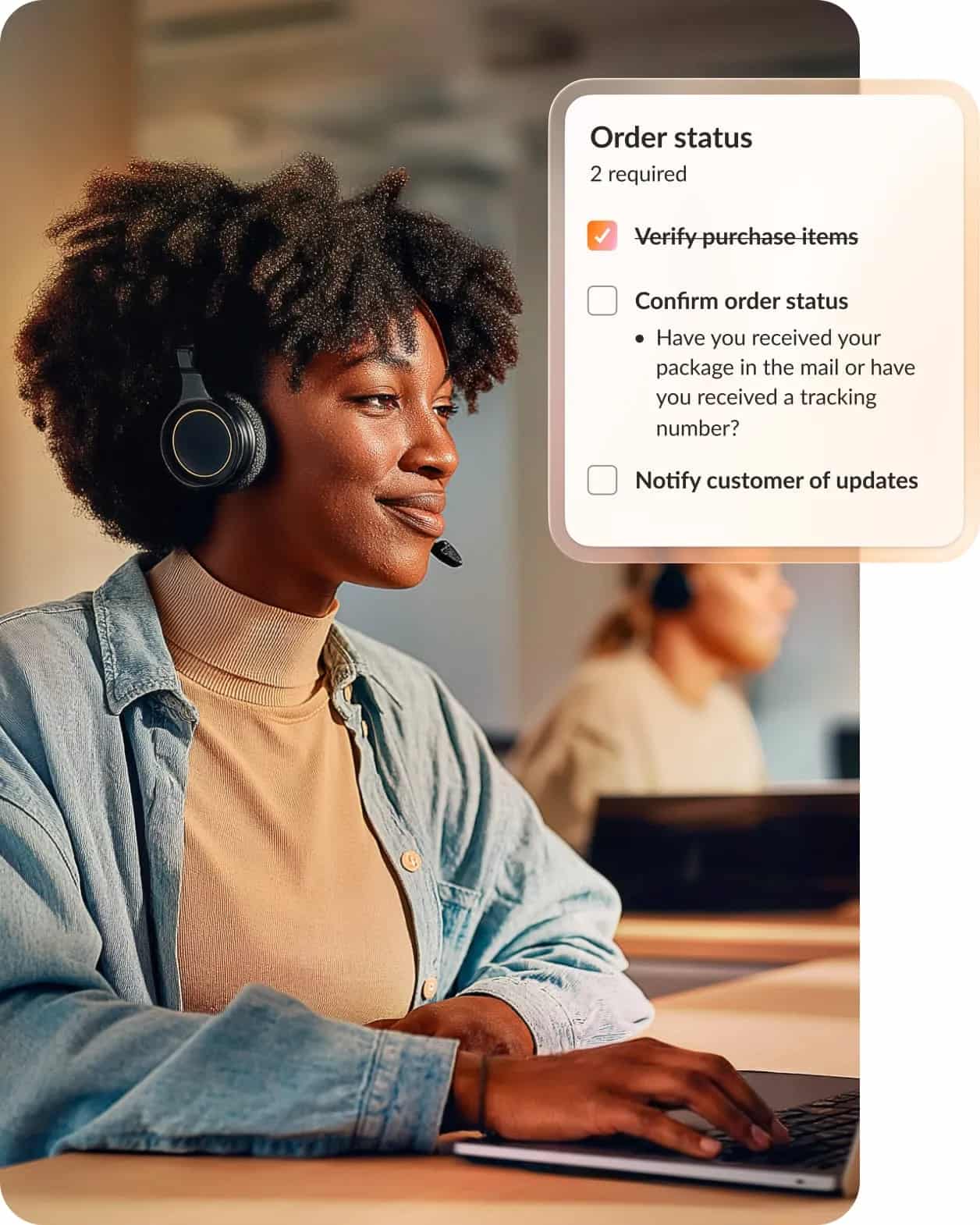
RingCX delivers this through AVA Agent Assist, which supports the person handling the interaction rather than replacing them.
Conversational AI use cases in customer service
The highest-value use cases clear volume without adding risk. Three stand out: Self-service deflection for repeat requests, intent-based routing for everything else, and after-hours coverage when no agent is available. Each is a place where automation carries real load and the cost of a mistake stays low.
Self-service deflection is the anchor use case. RingCX’s Intelligent Virtual Agent resolves routine inquiries in natural language across voice, chat, and messaging. It then hands off to a live agent with the customer’s information and interaction history attached. That handoff is the difference between deflection and a dead end.
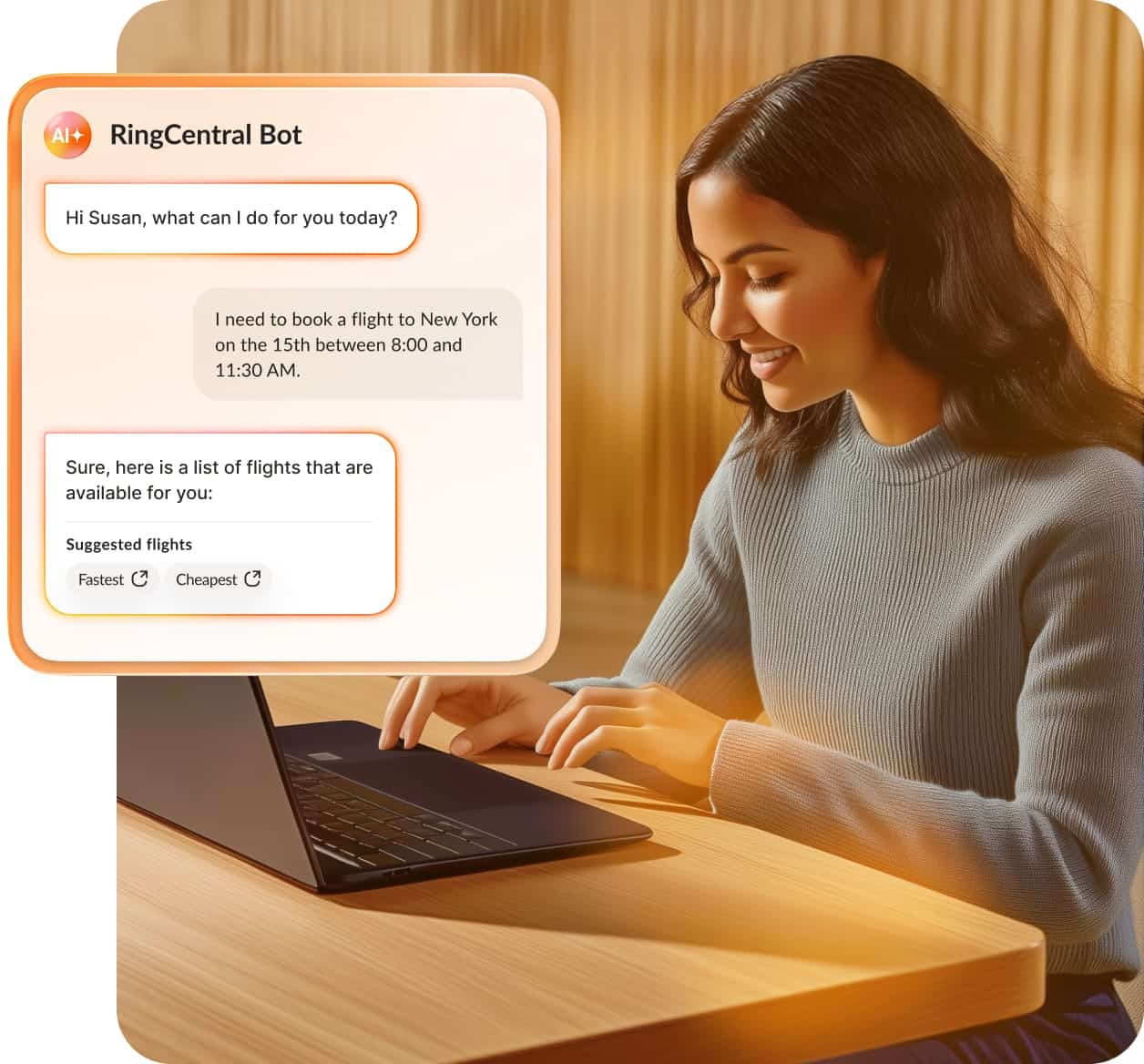
Intent-based routing handles what the agent should own. Instead of queueing by availability, the system reads intent and sends the customer to the person best equipped to help. After-hours coverage extends both, since the virtual agent keeps resolving routine requests overnight and logs remaining requests for follow-up when agents return.
Keep three roles separate as you map this:
- The Intelligent Virtual Agent faces the customer
- AVA Agent Assist supports the agent behind the scenes
- AI Interaction Analytics and AI Quality Management read every interaction after the fact
Collapsing them into one idea of “AI” blurs which tool does which job. In practice, start with the requests your customers repeat most, and design the handoff before you design the bot. The goal of automated customer service is carrying context to the agent so the customer never has to repeat themselves.
Bring conversational AI into your contact center
Most teams want the same thing from conversational AI: deflection without dead ends, and self-service that hands off cleanly the moment a request outgrows it. Closing the gap between that and a frustrating bot comes down to design more than budget.
RingCX’s Intelligent Virtual Agent is built for that handoff. When a request moves past what it should resolve on its own, it escalates to a live agent with the full customer record and interaction history attached. The agent picks up mid-conversation with that context already in view, so the customer never re-explains the account, the order, or why they called.
The through-line of this guide comes down to three moves. Automate the requests customers repeat most, route the rest by intent, and measure containment and satisfaction across every interaction. Start by listing the five requests your queue sees most, and decide which ones a virtual agent can own end to end. See how the handoff works with RingCX today.
Conversational AI for customer service FAQs
Can I use AI for customer service?
Yes. AI handles high-volume, routine requests in natural language. It resolves the routine ones on its own and routes the rest to a live agent with context attached. The practical question is which requests to automate first, starting with the ones customers repeat most.
What is the best conversational AI tool?
The right tool depends on your channels, your interaction volume, and how cleanly it hands off to a live agent. Evaluate it on three things. Does it cover your customers’ channels, read intent rather than match keywords, and pass full context at the handoff? A tool that deflects volume but strands customers at the escalation point costs more than it saves.
What is the best AI tool for customer service?
Match the tool to the job rather than looking for a single winner. Customer-facing requests call for a virtual agent that resolves and routes. Agents need real-time assist that surfaces answers mid-conversation. Supervisors need analytics that read every interaction instead of a sample. The deployments that hold up combine all three and measure the result on containment and customer satisfaction.
Originally published Sep 21, 2026