AI Communications









Answer the phone fast, and the next call becomes a booked job instead of a lost one.
You’re forty feet up a ladder when the phone rings. Or elbow-deep in a clogged sink. Or driving between two job sites with 15 minutes to spare and no hands free. The call goes to voicemail, and the homeowner on the other end doesn’t wait around. They hang up and dial the next contractor in their search results, and that job is gone before you even knew it existed.
This is the daily math of running a trades business: every hour on a job site is an hour the phone might ring unanswered. Office-based businesses can staff a front desk. Contractors can’t, because the work happens in trucks, crawlspaces, and other people’s homes.
A receptionist can’t ride along in a truck, but every one of those calls, whether it’s a new job, angry homeowner, or a quick question, still needs someone to answer it. A contractor answering service catches that call while you’re on the ladder, so the homeowner gets a live response instead of dialing the next name on the list. Three models deliver that coverage: live answering services, AI answering services, and hybrid setups that combine both. Here’s how they compare.
Key takeaway
- Crews on job sites can’t answer calls the way an office can
- AI answering services capture job details without adding office staff
- Emergency versus routine call triage matters as much as answer speed
- RingCentral AI Receptionist routes and captures every call consistently, shift to shift
Why a missed call costs contractors more than a bad review
A bad review stings, but it’s recoverable. A missed call usually isn’t. The homeowner with a burst pipe or a dead AC unit in July isn’t leaving a strained voicemail and waiting for a callback. They’re calling the next name that shows up, and in most markets, that takes seconds, not hours.
The data backs up what every contractor already feels in their gut. Research from call analytics firm Invoca found that fewer than 3% of callers who are sent to a service business’s voicemail actually leave a message. No message means no callback, no lead, and no way to even know you lost the job.
Speed matters just as much if the caller doesn’t leave a message. The caller has already searched, compared a few options, and decided that whoever answers first gets serious consideration. Responding quickly means the difference between a customer and a lost opportunity.
For contractors, this urgency compounds. Service and repair calls are frequently time-sensitive by nature, so the tolerance for “we’ll call you back” is lower than in most other industries.
What an answering service needs to handle for trades
A dispatcher answering calls for a law firm or a dental office works a predictable rhythm: business hours, a desk, a calendar. Contractors rarely operate under those conditions. Calls come in from a truck cab, between appointments, or mid-repair, and they cover a wider range of urgency and intent than most service businesses ever deal with.
An answering solution built for trades has to sort three distinct call types without slowing anyone down.
Emergency and same-day repair requests
A no-heat call in January or a flooding basement doesn’t fit into next week’s schedule. These callers need to know, immediately, that someone heard them and that help is coming.
An answering service for contractors has to recognize urgency from the first few seconds of the conversation, whether that’s a keyword like “flooding” or “no power,” and route the call to whoever can respond fastest. Treating an emergency like a routine scheduling request costs the job and damages the kind of trust that drives referrals in trades businesses.
Routine scheduling and estimates
Not every call is a crisis. A homeowner wants a quote for a kitchen remodel, or a customer needs to confirm next Tuesday’s appointment. These calls need to accurately capture:
- Scope of work
- Timeline
- Contact details
Ideally, all information is logged correctly so a callback doesn’t require the customer to repeat themselves. Basic answering services break down most often here. A rushed intake that gets the address wrong or skips the callback number turns a routine estimate request into a lost booking.
Vendor and supplier calls
Not every call is even from a customer. Suppliers confirming a delivery window, subcontractors checking in on a schedule change, or a permit office following up all compete for the same phone line as customer calls.
An answering setup that can’t tell a supplier call from a customer lead either interrupts the crew unnecessarily or buries a real customer call under low-priority traffic. Sorting these calls correctly keeps the crew focused on the work that actually needs their attention.
Live agents vs. AI answering services vs. hybrid models
Contractors evaluating answering options are really choosing between three categories, and each comes with real benefits and tradeoffs.
Live answering services
These services route calls to trained human agents, typically working from scripts for common scenarios.
Benefits
Live agents handle nuance and can improvise on unusual requests in ways a script can’t anticipate. This includes talking a panicked homeowner through a gas leak, negotiating a same-day slot for a VIP client, or catching that a “routine” call is actually an emergency based on tone alone.
Trained agents working from scripts cover common scenarios well, and a good agent who knows your business can quote accurately, cross-sell a maintenance plan, or recognize a repeat customer without pulling up a file.
Tradeoffs
Live agents cost more per call than automated options. That cost sometimes buys inconsistent quality since it varies by agent and by how well that agent actually knows your business, your service area, and your pricing. Turnover at the answering service means you’re periodically paying to get new agents up to speed.
Storm season or a summer heat wave can overwhelm live services the same way it overwhelms an in-house team: call volume spikes, agents get pulled thin, and callers end up back in a queue exactly when they need a fast answer most.
AI answering services
AI answering services answer every call the same way, at any hour, without hold times or agent turnover.
Benefits
Cost per call is generally lower and predictable, since there’s no staffing to scale up during busy stretches, no overtime for after-hours calls, and no ramp-up time for a new hire learning your services and pricing.
This category has matured enough that context-aware systems no longer feel like the rigid phone trees your customers have learned to distrust. They can pull from a knowledge base to answer service-area or pricing questions, schedule appointments directly into a calendar, and flag urgent jobs (a burst pipe, no heat in freezing weather) for immediate callback instead of routing them into a generic queue.
Tradeoffs
AI handles structured scenarios (booking, triage, lead capture) well, but unusual or highly emotional calls may still need a human handoff. A caller describing a multi-part problem, negotiating a quote, or venting about a botched job can push the system past what it can handle without a human handoff.
Contractors relying on AI alone need a clear fallback (a live transfer option or a same-day callback promise) so those calls don’t dead-end.
Hybrid models
Hybrid models pair AI for first contact and routine capture with live agents for complex or high-stakes calls. This combines the consistency of AI with a human safety net.
Benefits
AI answers immediately and captures the basics: caller name, job type, address, and urgency, so nothing gets missed during off-hours or call spikes.
Live agents step in for the calls that actually need judgment: an angry customer, a pricing negotiation, or a job that doesn’t fit the standard categories. Contractors get consistent intake around the clock without losing the human touch on calls where it matters most.
Tradeoffs
This can be the most expensive option, since it layers live agent costs on top of an AI system. It also requires clear escalation rules.
Contractors have to define upfront which call types trigger a handoff to a live agent, and vague rules lead to either too many unnecessary handoffs (driving up cost) or too few (leaving complex calls stuck with the bot). Setup takes more coordination than either standalone option.
For a contractor deciding between these, the right fit depends on call volume, crew size, and how often calls fall outside routine scheduling and emergency triage.
What separates basic call answering from real job capture
Answering the phone is the easy part. Turning that call into a job on the schedule is where most answering services, live or automated, fall short.
The gap shows up in three places:
- Accuracy of the details captured
- How fast the lead gets followed up on
- Whether the process holds up across multiple crews or trucks
Transcribing an address wrong, dropping a callback number, or writing a job description too vague to act on can turn even an answered call into a wasted one. This kind of mishandling doesn’t show up in call-answer-rate metrics, but contractors who track it closely tend to find it’s just as costly as calls that go unanswered outright.
Follow-up speed matters as much as capture accuracy. Logging a job detail correctly but sitting on it for six hours is nearly as costly as a call that went to voicemail, given how quickly homeowners move on to the next option.
Consistency across trucks and crews is where a lot of basic answering setups break down. A system that works well for one crew’s schedule but creates confusion for a second or third truck isn’t actually solving the problem. It’s just moving it.
This is the real benchmark for evaluating how your trades business can effectively use any answering service: not whether it answers, but whether it reliably turns a call into accurate, actionable, timely job information regardless of which crew, which shift, or which truck is handling service at the moment.
How RingCentral AI Receptionist handles contractor call volume
Contractors don’t have a front desk. Crews are in the field, trucks are on the road, and calls come in whether or not anyone is available to answer them. That’s when RingCentral AI Receptionist (AIR) becomes your ideal solution.
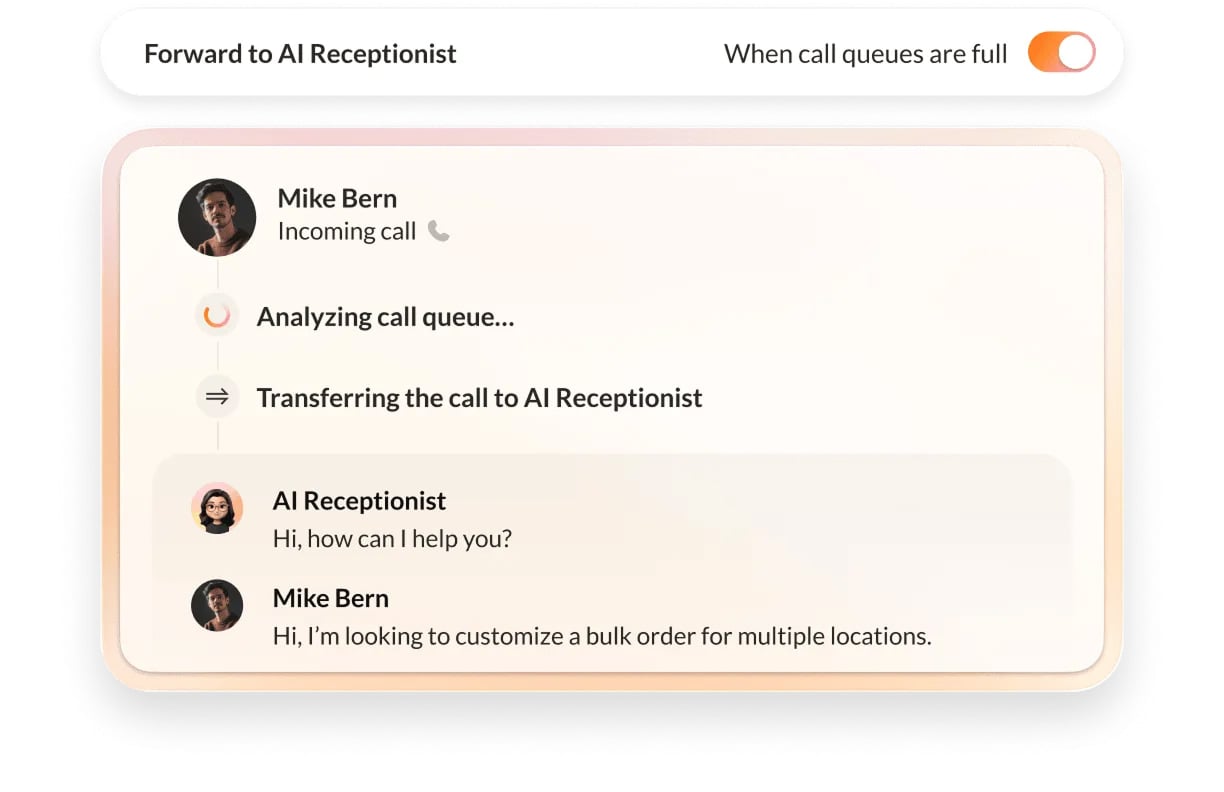
AIR answers every incoming call automatically, so a call during a busy install or a late-night emergency doesn’t just ring out to voicemail. Instead of forcing callers through a rigid menu of numbered options, AIR uses context-aware routing to understand what the caller needs and directs the call accordingly, whether that’s an emergency repair request or a routine scheduling question.
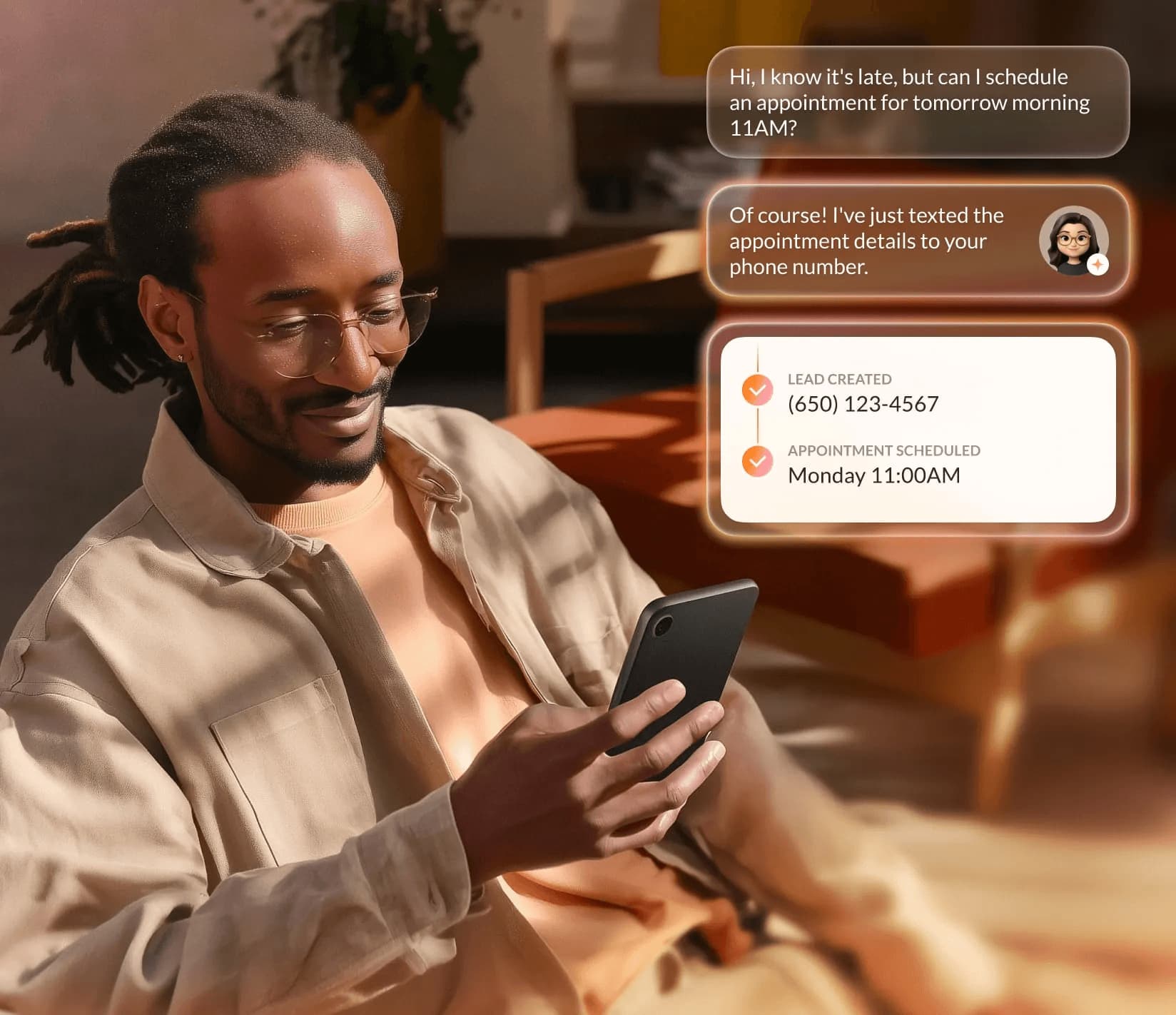
For the calls that turn into business, AIR captures lead details automatically, so job information doesn’t depend on whoever happens to answer the phone or how clearly they hear it over shop noise. AIR also supports appointment scheduling directly through the call, giving customers a booked time without a callback loop.
Because AIR handles every call the same way, it captures and routes intake consistently across every shift, every location, and every crew, solving the exact inconsistency problem that makes basic answering setups unreliable at scale.
Get every call answered, not just some of them
Consistent call handling is now a baseline expectation, the same way customers expect a quote within a day or a truck to show up on time. Which model fits best—live, AI, or hybrid—comes down to your crew size, your call volume, and how much of your business runs on emergency versus routine work.
The contractors winning more jobs aren’t the ones with the biggest crews. They’re the ones whose phone never goes unanswered. See how RingCentral AI Receptionist handles that for trades businesses of any size.
FAQs about contractor answering services
Do contractors need a 24/7 answering service?
Most contractors benefit from around-the-clock coverage, especially in trades with emergency call volume like plumbing, HVAC, and electrical work. A burst pipe or a no-heat call doesn’t wait for business hours, and the contractor who answers at 11 p.m. often gets the job by default.
What is the difference between a live and an AI contractor answering service?
A live answering service routes calls to trained human agents, which handles unusual requests well, but costs more and can struggle to keep up during volume spikes.
An AI answering service answers every call the same way at any hour, at a lower and more predictable cost per call, with less flexibility for highly unusual scenarios.
Can an AI answering service schedule jobs for contractors?
Yes. Modern AI answering services, including RingCentral AI Receptionist, support appointment scheduling directly during the call, so a customer can get a booked time without a separate callback.
How much does a contractor answering service typically cost?
Cost varies by call volume and model. Live answering services generally charge more per call or per minute due to staffing costs, while AI answering services typically offer flat or usage-based pricing that stays predictable even as call volume grows during busy seasons.
Originally published Jul 22, 2026