AI Communications




A guide to what call center voice analytics is, and what full-coverage analytics can catch in every call.
A five-point customer satisfaction (CSAT) survey tells you a customer was unhappy, but not the moment frustration started, the phrase that triggered it, or how many other calls hit the same trigger this week. That’s the gap manual quality assurance (QA) can’t close because nobody can listen to every call and track a feeling as it builds.
The shift from sampled QA to full-coverage analytics changes what “quality” means in a contact center. Instead of what a supervisor happened to review, it becomes the full voice of the customer, not just a sample of it.
This guide covers what call center voice analytics actually measures, how it differs from basic call recording, and what to look for when you’re evaluating a platform.
Key takeaways
- Voice analytics tracks sentiment, intent, and compliance signals across every call, not a sampled subset.
- Manual QA sampling can’t cover every call, so sentiment shifts and emerging complaints build unnoticed until they surface elsewhere.
- Evaluate platforms on sentiment and intent accuracy, and whether they extend beyond the contact center.
- RingCentral AI Conversation Expert (ACE), a contact center AI platform, applies conversation intelligence across customer-facing team, not just the contact center.
What are call center voice analytics?
Call center voice analytics software listens to every recorded conversation in your contact center. It turns speech into structured, searchable data that gives you a clear view of what agents said, how customers responded, and where the call went off script.
Instead of a supervisor manually scoring a fraction of calls, the software processes the full volume of daily interactions and flags what needs attention.
The distinction that matters for a contact center leader: analytics doesn’t just store the call. It interprets it, applying conversation intelligence to pull out sentiment shifts, compliance language, hold-time patterns, and recurring customer complaints without a human listening to each one first.
What voice analytics actually measure
Voice analytics platforms track sentiment and intent throughout the conversation, not just in a single post-call rating. The system can flag a customer’s frustration building in minute three, even if the call ends on a polite note. That’s a signal a survey score never captures.
They also automatically surface compliance gaps and procedural deviations. If an agent skips a required disclosure or a mandatory verification step, the platform flags it without waiting for a supervisor to notice. This closes a gap that compliance programs often struggle to cover through spot checks alone and cuts the compliance risks that build up in unreviewed calls.
Finally, these platforms build performance trend analysis over time, giving supervisors a clearer read on individual and team coaching needs. Supervisors get patterns across dozens or hundreds of calls, like an agent who consistently loses customers at the pricing conversation, which supports root cause analysis instead of a single anecdote from one reviewed interaction.
That trend view also works at the team level. A supervisor can see that hold times spike every Monday morning, or that a specific script change correlates with a drop in escalations, before either shows up in a monthly report, catching operational efficiency issues while they’re still small.
None of that is visible from a handful of manually scored calls, because the pattern only exists across volume a person can’t realistically review alone.
What manual QA sampling misses
Manual review, or traditional call monitoring, takes time, and time is the resource contact centers have the least of. A supervisor scoring calls by hand can realistically get through a small slice of total volume in a given week, which forces every team to extrapolate from a fraction of what actually happened.
That fraction is smaller than most leaders assume. McKinsey found that the manual assessment method is often limited to less than 5% of total conversations. The majority of calls go unreviewed, and any sentiment shift or emerging complaint pattern that lives in that unreviewed majority stays invisible until it’s already a problem.
Voice analytics vs. basic call recording
Call recording and voice analytics solve different problems. Recording captures the call and stores it for later. Someone still has to listen, which means recording alone doesn’t shrink the review bottleneck; it just gives you a bigger archive of calls nobody has time to hear.
Analytics interprets the call the moment it happens. It converts speech into text, tags sentiment and intent, checks for compliance language, and routes anything unusual to a supervisor’s queue. The result is a searchable, structured record of every interaction instead of a pile of audio files waiting for a reviewer who will never get to most of them.
For teams that already track call center metrics like average handle time (AHT) and first-call resolution (FCR), analytics adds the “why” behind those numbers instead of just the “what.”
That gap between sampled and full coverage shows up in customer satisfaction. McKinsey’s research also found that generative AI applied to customer conversations can yield a 5% to 10% improvement in customer satisfaction. Sentiment issues get caught and coached against while they’re still small, not after they’ve shaped a customer’s overall impression.
What to look for when evaluating a voice analytics platform
Most platforms can transcribe a call. Fewer can tell you what actually happened on it, and fewer still can prove that to a compliance team. These four factors separate the two.
Sentiment and intent accuracy
This is the first thing to check, and the easiest to overlook in a sales demo. Ask any vendor to run the platform against your own call recordings, not a curated example set, so you can see how it performs on your scripts, accents, and compliance language.
Push past a basic positive-or-negative score. A call can start frustrated and end resolved, and a platform that only tags one sentiment per call misses that shift entirely.
Ask how the system handles mixed sentiment within a single call, and whether it distinguishes intent categories that matter to your business, like:
- Churn risk
- Escalation risk
- Upsell signals
- Compliance red flags
A vendor that can only say “this call was negative” hasn’t given you anything you can act on. It’s also worth asking whether the platform supports real-time agent assist, surfacing next-best-action prompts while the call is still live, not just a score after the fact.
Reach beyond the contact center
This matters just as much if you’re trying to build one quality standard across every customer-facing function. Some platforms only analyze calls that pass through a formal contact center queue. Others, like a broader conversation intelligence layer, apply the same sentiment and intent tracking to sales calls and service interactions in other departments too.
The gap shows up the first time you try to compare data across teams. If your contact center runs one quality standard and your sales team runs none, you can’t tell whether a spike in customer frustration started with a support call or a sales conversation that overpromised.
A platform that only watches the contact center leaves you managing quality with half the picture.
Integrations
Confirm the platform connects to the software your teams already use, not just a generic claim that it’s “compatible with most systems.” Look for direct integrations with the following tools:
- CRM (Salesforce, HubSpot, or similar)
- Your phone or contact center platform
- Your helpdesk or ticketing system (Zendesk, ServiceNow)
- Any workforce management, quality management, performance management, or scorecards platform your supervisors already rely on
A platform that connects to all four means insights show up where your team already works. One that connects to none of them means someone’s exporting spreadsheets by hand.
Pricing
Get a clear answer on how cost scales as call volume grows. Sentiment analysis across every interaction is priced very differently than a sampled model, so ask how the vendor bills before volume, not after it.
The per-minute or per-seat rate is only one line item. Look past the sticker price to total cost of ownership. Ask about implementation and onboarding fees, the cost of building out custom integrations, training time for supervisors and agents, and any minimum volume commitments or overage charges once you exceed your contracted tier.
A platform with a lower list price can end up costing more once those pieces are added in, and a vendor who can’t walk you through all of them upfront is a sign you’ll find out the hard way.
How RingCentral’s AI Conversation Expert extends conversation intelligence beyond the contact center
Contact center leaders need visibility that doesn’t stop at the contact center’s walls. Sales calls, service interactions, and customer conversations in other departments carry the same compliance and coaching value, but most QA programs never touch them because they sit outside the formal contact center software.
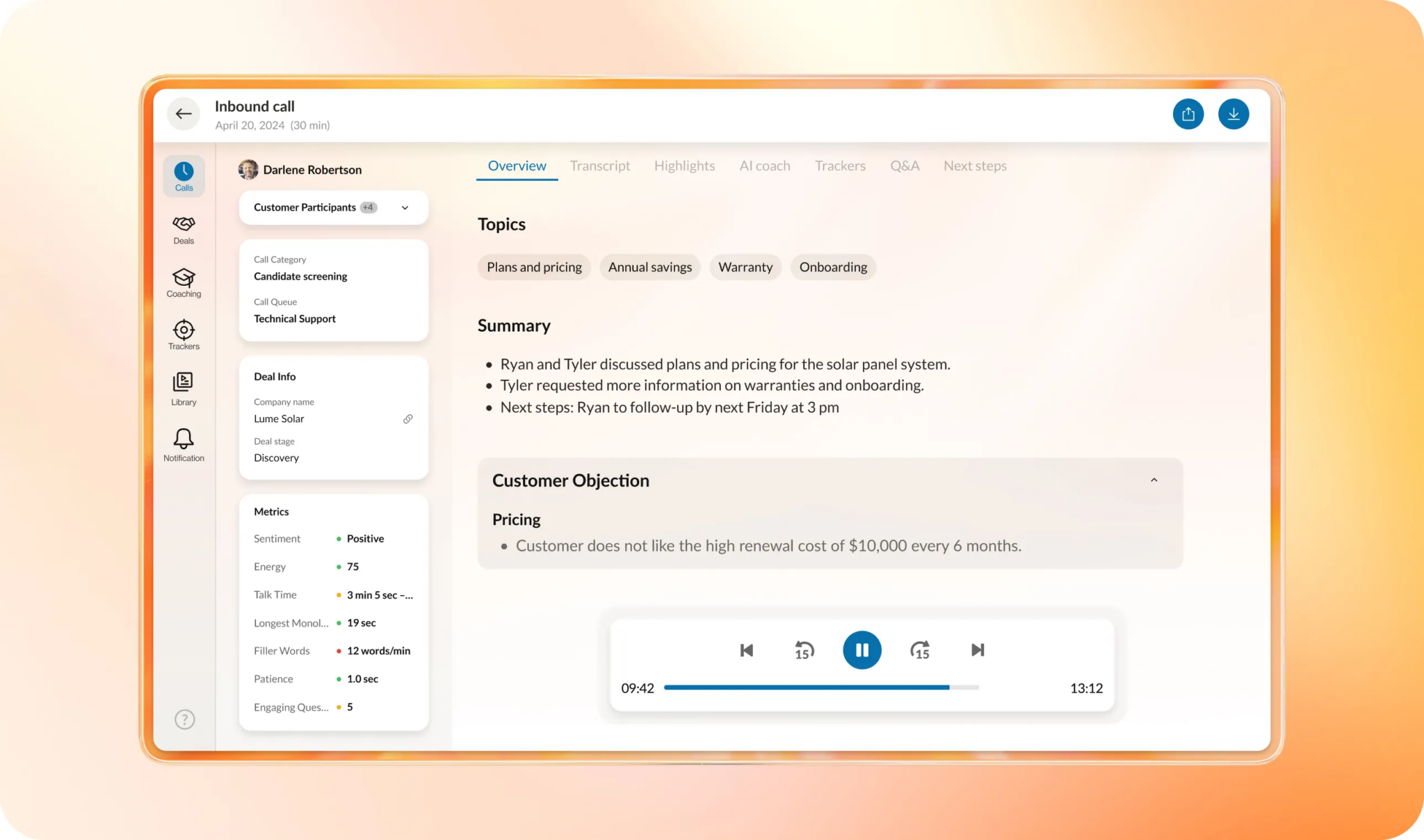
RingCentral AI Conversation Expert (ACE) analyzes 100% of customer interactions automatically, so nothing depends on a sample size or a supervisor’s available hours.
It generates conversation summaries, extracts action items, tracks customer sentiment and intent, and surfaces performance trends across sales, service, and any other customer-facing team, not only the agents sitting in a formal contact center queue.
That reach is what separates conversational AI built for a single department from a layer meant to sit across all of them.
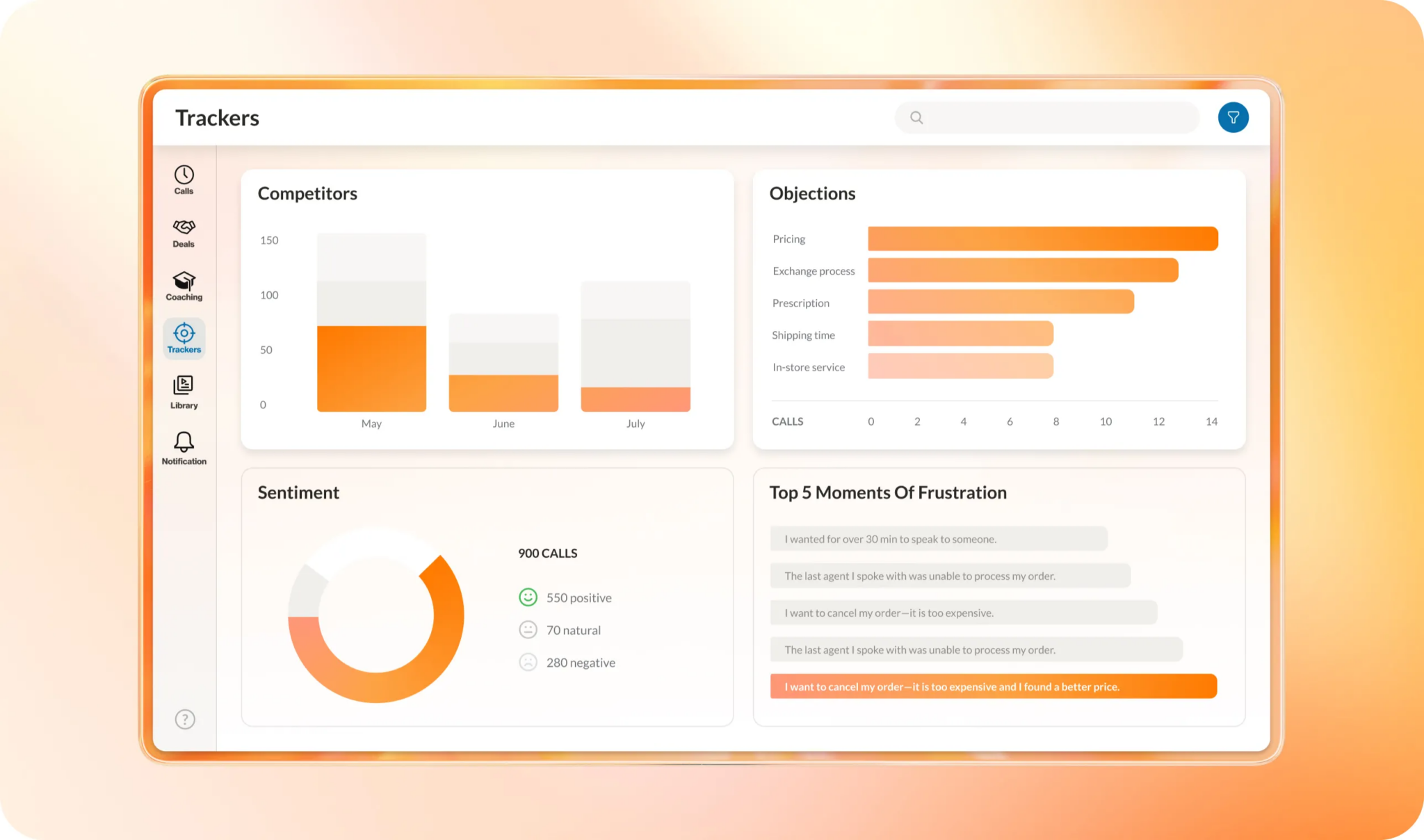
If your contact center already runs on RingCX, you likely have native AI Interaction Analytics built into that platform for contact-center-specific quality and compliance monitoring. The ACE add-on sits as a broader conversation intelligence layer on top of that, extending the same 100% coverage model to teams RingCX doesn’t reach.
For a leader trying to build a single quality and compliance standard across every customer-facing function instead of running separate tools per department, RingCentral ACE gives every team the same full-coverage visibility the contact center already relies on.
Move from sampled QA to full conversation visibility
Coverage is what separates modern voice analytics from legacy QA. A platform that reads every call gives you the sentiment and compliance picture sampling never could, without adding headcount to your review process.
Full coverage also tends to move first-call resolution rates in the right direction, since agents get feedback while the pattern is still fixable, not after it’s already cost a renewal.
The teams making this shift are redefining what “reviewed” means: from a fraction of calls to all of them.
See how RingCentral’s AI Conversation Expert analyzes every customer interaction across your teams, not just a sample of them.
FAQs about call center voice analytics
What is call center voice analytics?
Call center voice analytics is software that automatically transcribes and analyzes recorded customer calls to surface four types of insight:
- Customer sentiment
- Caller intent
- Compliance adherence
- Agent performance
Unlike traditional QA, which relies on supervisors scoring a small sample by hand, voice analytics evaluates 100% of call volume, so coaching decisions rest on measurable patterns rather than a handful of reviewed calls.
How is voice analytics different from speech-to-text transcription?
Transcription converts spoken words into text. Voice analytics goes further, analyzing that text and the underlying audio for sentiment, intent, compliance adherence, and behavioral patterns across many calls. Transcription gives you a record, while analytics gives you an interpretation of that record.
Does voice analytics require 100% of calls to be reviewed by a person?
No. The platform analyzes every call automatically, and supervisors only need to review the specific moments or patterns the system flags. That’s the core advantage over manual QA, which depends entirely on how many hours a reviewer has available each week.
Can voice analytics work across teams outside the contact center?
Yes. Platforms built as a broader conversation intelligence layer, like RingCentral AI Conversation Expert, apply the same sentiment tracking, action-item extraction, and trend analysis to sales calls, service interactions, and other customer-facing conversations, not only the contact center’s formal call queue.
Originally published Aug 12, 2026