AI Communications






CRMs were built on a straightforward premise: centralize customer data, reduce manual effort, and give sales teams the visibility they need to close deals. However, the reality today looks different. Validity’s 2025 State of CRM Data Management found that 37% of more than 600 CRM users and stakeholders surveyed reported losing revenue as a direct consequence of poor data quality. Even more telling, 76% indicated that more than half of their organization’s CRM data is inaccurate and incomplete.
Poor CRM data creates extra cleanup work and costs you deals. Forrester’s Data Culture and Literacy Survey revealed that more than a quarter of organizations affected by poor data quality estimate annual losses exceeding $5 million.
When your data is incomplete or unreliable, your team is left working with an inaccurate picture of the customer, which directly affects decision-making and follow-through.
This isn’t simply a software issue you can patch. It’s a limitation in how CRMs are built—one that becomes more costly as customer interactions grow more complex.
Key takeaways
- Agentic AI augments (not replaces) existing CRM automation, with the biggest gains in conversation capture, lead qualification, and post-interaction data accuracy.
- RingCentral agentic AI solutions can: answer inbound calls around the clock (AIR), capture leads directly into Salesforce, HubSpot, or AIR’s own leads database (AIR Pro), generate notes and summaries while guiding teams through complex workflows (AVA), and extract key signals from live conversations and sync them to CRM systems (ACE).
- Purpose-built agentic AI outperforms general AI assistants for deal intelligence, real-time coaching, and end-to-end workflow automation.
AI agents can scale judgment across high volumes of customer interactions, but clear boundaries, escalation paths, and review processes should be defined before full deployment. - The right agentic AI tools sync automatically, minimize manual entry, and maintain a complete record of every customer interaction, making CRM data quality a built-in outcome rather than an ongoing effort.
What CRM automation actually does and where it stops
CRM automation has been the backbone of the modern tech stack for years. It has saved teams thousands of hours by:
- auto-sending follow-up emails after a deal stage change
- triggering task reminders when a lead goes cold
- routing inbound inquiries based on form submissions
- updating pipeline records when a contract is signed
These capabilities are valuable, but they only go so far.
Workflow automation has a ceiling. Because it relies on structured data, it’s essentially blind to nuances of human interaction. As a result, there are clear limits to what traditional CRM automation can do. It cannot:
- adapt to a shift in tone or urgency mid-conversation
- read between the lines of what a customer actually said
- recognize when a deal is stalling based on behavioral signals, not just inactivity
- make a judgment call when a situation falls outside the defined rules
When something unexpected happens, automation either fails silently or does nothing at all—and important customer signals are never captured.
Details like the specific pain points mentioned on a call, the competitive reference a prospect dropped midway through a demo, and the urgency shift that happened in the final five minutes stay trapped in a salesperson’s memory or an untranscribed audio file.
What is agentic AI, and how does it differ from CRM automation
Agentic AI refers to autonomous systems capable of reasoning, planning, and executing complex workflows.
Unlike traditional automation, which follows a fixed if-then structure, agentic AI pursues outcomes rather than just responding to triggers—and it does so within the boundaries you define.
Intent and scale are what separate automation from agentic AI. The table below illustrates how that difference plays out in practice.
| CRM Automation | Agentic AI | |
| Intent | Reacts to triggers (if X, then Y) | Pursues outcomes (reach Goal Z) |
| Scale | Scales volume through repetition | Scales judgment through reasoning |
That difference in how each system operates is what determines whether customer signals get captured or lost.
Why agentic AI scales where automation reaches its limit
As customer interactions grow more complex—spanning more channels, involving longer sales cycles, and crossing multiple stakeholders—the cost of missed signals increases.
A deal may stall because no one caught the shift in urgency during a call. A churn risk goes unnoticed because the conversation data never made it into the CRM. A follow-up is sent with the wrong priority because the notes were incomplete.
Over time, the impact adds up, and most of it traces back to one gap: the signals your team needed were in the conversation, but the system had no way to capture them.
That’s where agentic AI extends the system, and organizations that have moved in this direction are already seeing results. Our RingCentral agentic AI trends report 2026 found that organizations deploying or testing AI agents experience increased productivity, faster workflows, improved customer service and satisfaction, and reduced operating costs.
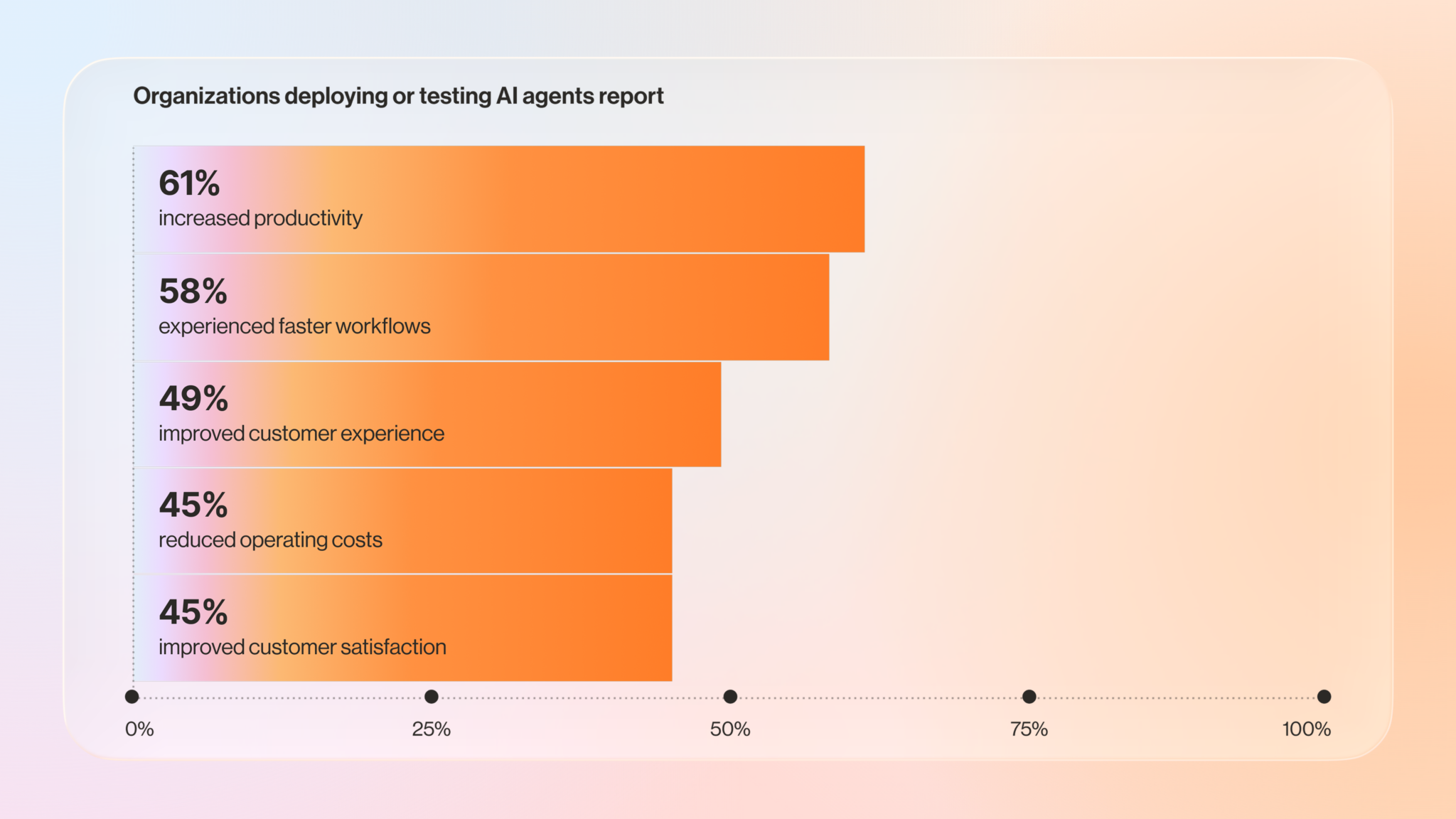
These aren’t hypothetical gains. They reflect what happens when AI moves beyond isolated task execution and starts coordinating work across systems, channels, and teams.
Importantly, agentic AI doesn’t replace your CRM. The CRM remains your system of record. Agentic AI becomes the layer that makes those records more accurate, more complete, and more useful.
A recent Gartner forecast predicts that by 2028, 33% of enterprise software applications will embed agentic AI capabilities—up from less than 1% in 2024—and at least 15% of day-to-day work decisions will be made autonomously. That shift is already underway: 57% of organizations in our RingCentral Agentic AI Trends 2026 report are now beyond the exploration and research stage with AI agents, with a growing share actively deploying or fully embedding them.
Five signs your CRM needs agentic AI support
If any of these scenarios sound familiar, your CRM is likely relying on automation in areas where agentic AI would be more effective:
- Post-call work is outpacing selling time: Your sales representatives spend only 28% of their week selling, with the remaining hours consumed by manual data entry and post-interaction tasks.
- Follow-up sequences depend entirely on memory: Messages go out without the full context of what was actually discussed because the notes were incomplete or missing entirely.
- Automation has no visibility into actual conversations: Your current automation has no visibility into what was actually said on a phone call, video meeting, or chat conversation; it only knows a task was completed.
- Inbound leads go cold after hours: You lose inbound leads outside business hours because no one is available to answer, qualify, and log the inquiry in real time.
- Pipeline reflects documentation, not reality: Your forecast is built on what the team had time to log, not on the full picture of what customers actually said.
Four ways RingCentral agentic AI improves CRM accuracy and sales follow-through
Capture leads your CRM misses after hours
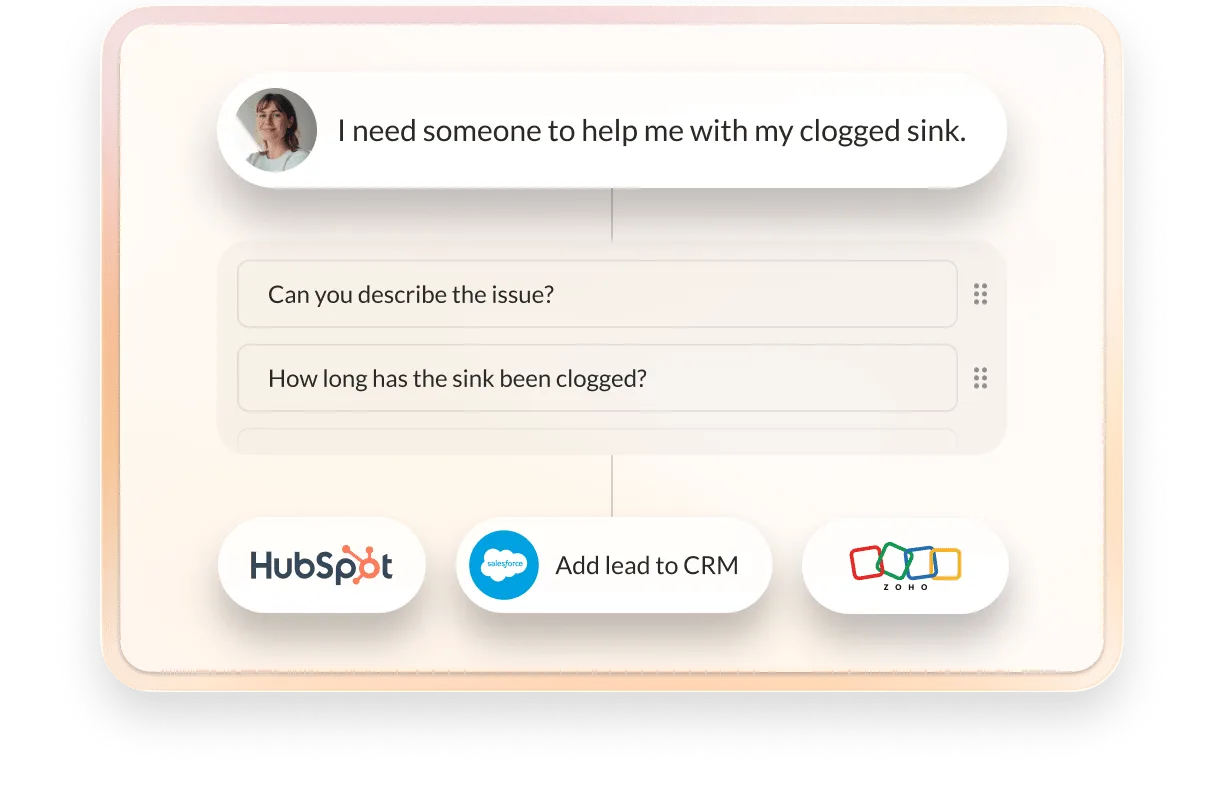
Traditional automation can’t help if a prospect calls your office at 8:00 PM and hangs up when they hit a generic voicemail. The lead never makes it into the CRM, and no one follows up because no one even knows the interaction occurred.
Agentic AI solves this by staying available around the clock, ensuring no inbound lead goes unacknowledged, regardless of when it arrives.
How RingCentral AIR helps: AI Receptionist (AIR) answers inbound calls 24/7. Rather than losing a prospect to voicemail, AIR greets callers naturally, captures their details, and syncs a complete summary directly to your CRM. This helps your team start each day with a full picture of every inquiry that came in, not just the ones that arrived during business hours.
Turn every conversation into accurate, CRM-ready data
The details that matter most—budget concerns, competitor mentions, timeline shifts—rarely survive the gap between a conversation and a CRM field.
Agentic AI closes that gap by capturing and processing conversations as they happen, extracting key signals, and updating the CRM automatically.
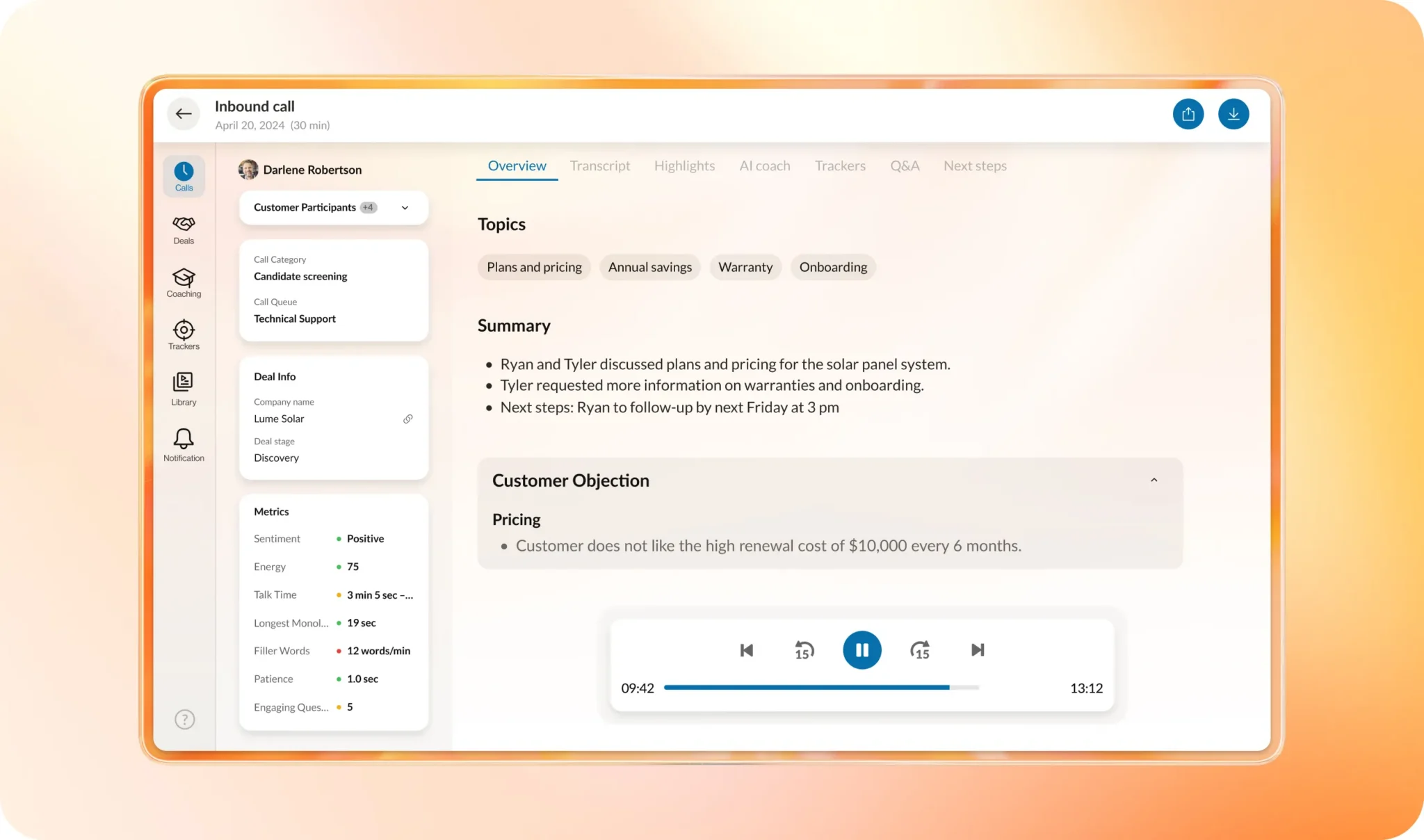
Where ACE makes the difference: AI Conversation Expert (ACE) transcribes and analyzes each interaction across calls, video meetings, and emails. It updates the CRM with key conversation points, surfaces deal signals, and delivers coaching prompts to reps while the context is still fresh and actionable.
Reduce the workflow friction that slows CRM adoption
One of the hidden costs of CRM underperformance is friction. Reps avoid logging because it takes too long. New team members take weeks to get up to speed. Administrative tasks pile up and pull focus away from selling.
Agentic AI reduces this friction by handling the repetitive, time-consuming tasks that typically slow teams down.
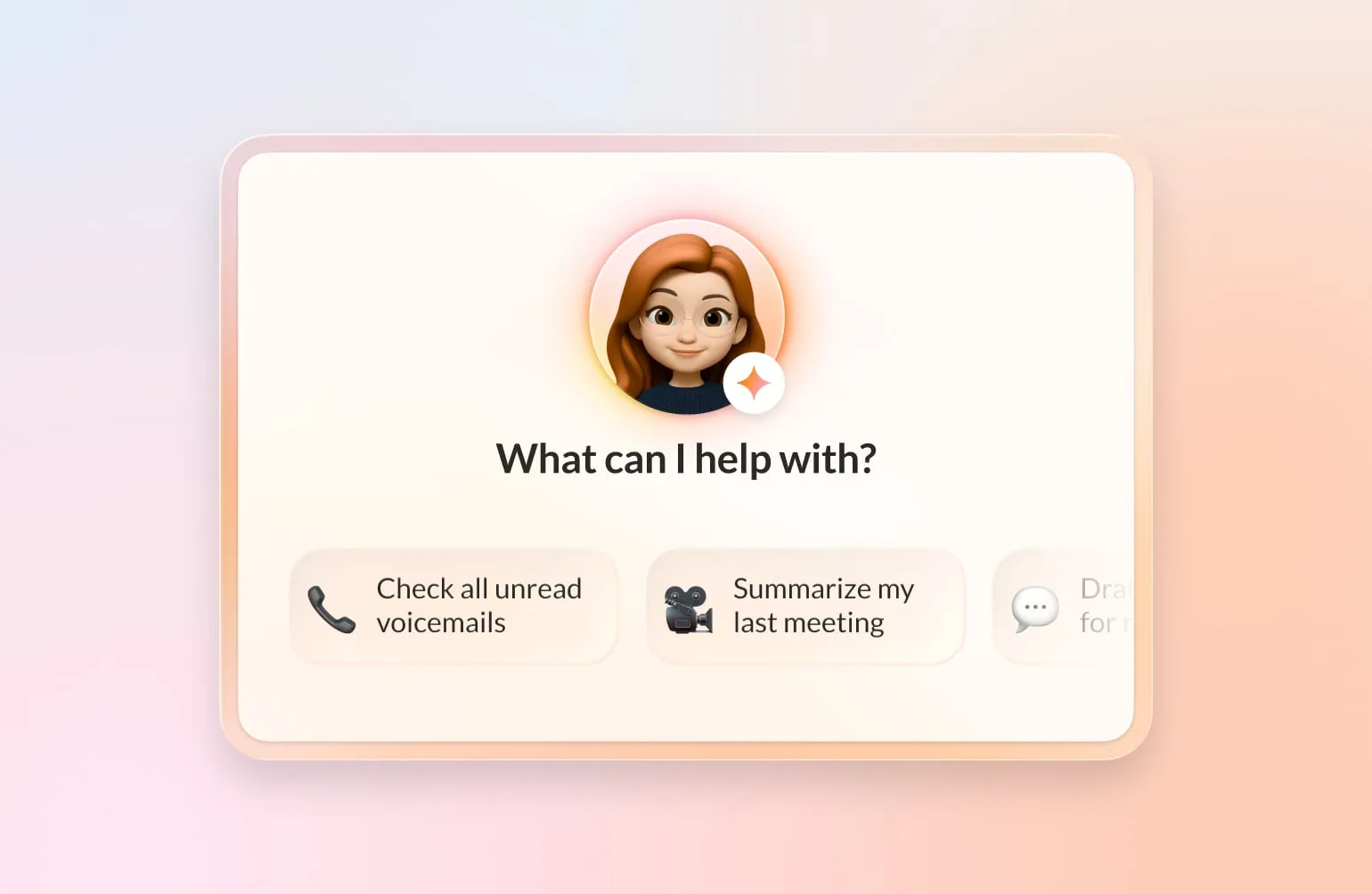
How AVA keeps your team focused: AI Virtual Assistant (AVA) takes the administrative weight off your team so they can focus on what actually drives revenue.
AVA captures real-time call notes and summaries, guides your team through processes with in-app prompts, and handles operational setup tasks like configuring call forwarding and out-of-office responses.
Build fully configurable AI agents across every channel
A customer reaches out via chat at noon, calls back via phone that evening, and expects a seamless experience across both. For organizations managing that kind of complexity, the opportunity is not just to fill individual gaps but to design AI agents that handle entire customer workflows—from the first inbound touchpoint to post-interaction follow-up—across every channel a customer might use.
Agentic AI agents manage multi-step workflows that span systems and channels. They handle inbound touchpoints, capture data, route intelligently, trigger follow-ups, and escalate to a human when needed, all while maintaining context at every step.
How AIR Pro connects every channel: With AI Representative (AIR Pro), your team can design and deploy fully configurable AI agents without writing a single line of code.
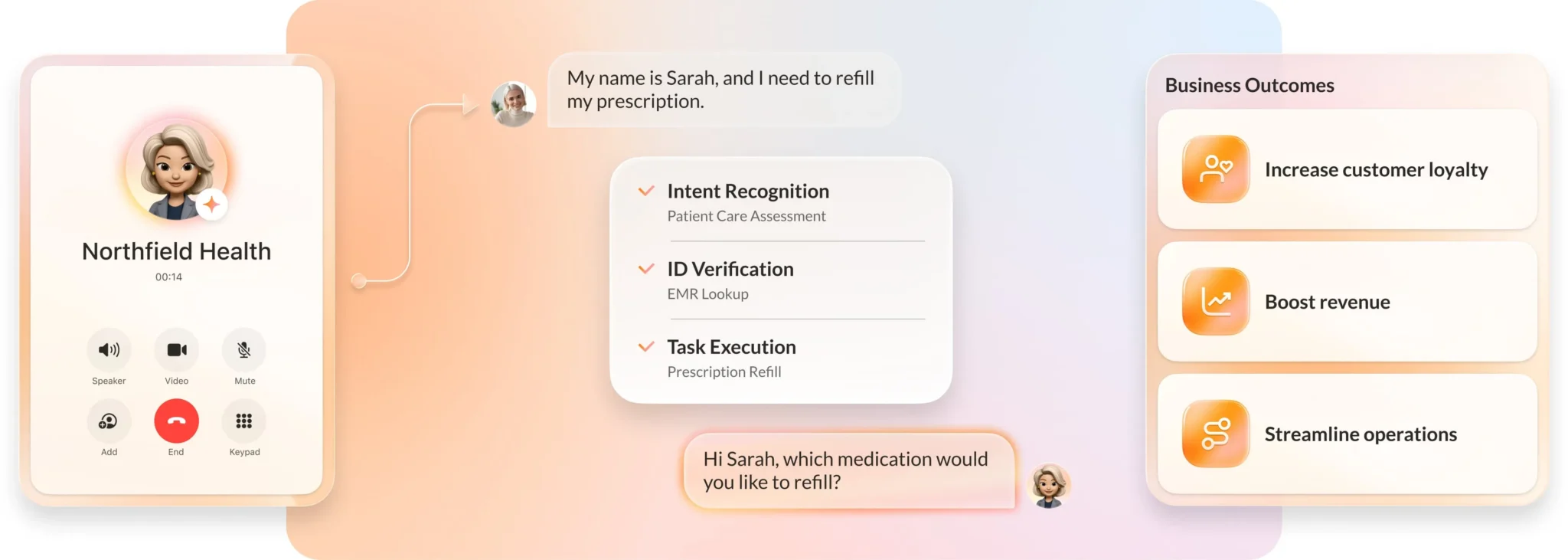
AIR Pro is built using natural language, operates within guardrails you define, and continuously improves based on real interaction data. Together, these capabilities move agentic AI from filling individual CRM gaps to driving end-to-end conversation intelligence across voice, SMS, chat, and every digital channel your customers use.
Bottom line: Better CRM performance starts with smarter AI at the point of interaction
Your CRM is only as useful as the data inside it. And today, much of the most valuable data, including the signals that reveal intent, urgency, and risk, exists within conversations that traditional automation was never designed to capture.
Agentic AI addresses this gap by extending your CRM’s reach into the conversations where the most valuable customer intelligence actually lives. Every interaction becomes a source of insight rather than a missed opportunity.
RingCentral’s agentic AI solutions are purpose-built to turn conversation intelligence into CRM-ready action. From capturing after-hours leads and reducing manual note-taking to deploying fully autonomous AI agents across voice and digital channels, RingCentral extends what your CRM can do—starting from the first word of every customer interaction.
Contact us today to explore how an agentic AI upgrade can make your CRM data more accurate, more complete, and more actionable.
FAQs
How is agentic AI different from regular AI?
Agentic AI takes independent action. Instead of simply generating a response or a recommendation, it completes tasks on your behalf.
Regular AI tools, like a chatbot or a transcription engine, respond to a single input and stop there. Agentic AI, on the other hand, pursues a goal across multiple steps, adapting as conditions change, until the outcome is reached.
What is the difference between CRM and agentic AI?
A CRM is a system for storing, organizing, and managing customer data, interaction history, and sales pipeline information. By contrast, agentic AI is an active layer of intelligence that can reason, make decisions, and take actions autonomously to drive customer outcomes.
Where a CRM captures and displays information, agentic AI uses that information to drive outcomes. It does not wait for a human to decide what happens next.
How does agentic AI affect CRM?
Agentic AI transforms CRM systems from passive data repositories into dynamic tools that surface insights and trigger action. The result is a cleaner, richer, and more actionable CRM, built not on what your team had time to log, but on the full picture of every customer interaction.
How will agentic AI impact customer service?
For customer service teams, the practical impact of agentic AI is 24/7 availability, faster resolution times, and more time for human agents to focus on complex, high-value interactions.
For example, a customer calling after hours can be greeted, helped, scheduled, and followed up with entirely through agentic AI. The result is a smoother customer experience and a more manageable workload for your team.
Updated Sep 30, 2026