AI Communications







Route every caller to the right person on the first try, so agents spend less time on transfers and more time solving problems.
A customer calls in, punches through three keypress menus, explains the issue, and still lands with the wrong agent. Now they’re repeating themselves while the clock on handle time keeps running. Multiply that by a few hundred inbound calls a day, and you’ve got a routing problem, not an agent problem.
This guide breaks down how AI call routing works, what changes operationally when you move off a traditional interactive voice response (IVR), and what to check before you commit to a platform. You’ll see where routing decisions go wrong today and what a better setup looks like in practice.
Key takeaways
- AI call routing matches callers to the right agent using caller intent and context.
- Misrouted calls add transfer time, force customers to repeat information, and drag down first call resolution rates (FCR).
- Look for platforms that combine caller data and channel data with real-time agent availability.
- Routing accuracy improves fastest when paired with visibility into decisions.
- The right setup reduces the manual IVR tree and automatic call distribution (ACD) maintenance burden IT teams currently carry.
What is AI call routing?
AI call routing (also called intelligent call routing (ICR) or automated call routing) directs an incoming call, chat, or text to the agent best equipped to handle it, based on what the customer needs and who’s available right now.
Instead of asking a caller to navigate a menu tree, the system listens to what they say (or reads the context from a prior interaction) and routes on customer intent.
For a contact center leader, that means fewer blind transfers. For an IT team, it means retiring the keypress logic they’ve patched for years. For a customer experience (CX) executive, it means a routing layer that gets smarter with every interaction instead of staying frozen at whatever state it was configured in three years ago.
Traditional routing asks the caller to sort themselves into a category. AI routing figures out the category itself, using natural language processing (NLP) and machine learning to weigh account history and channel data, then checks which qualified agent is free. Both steps happen in seconds, not through a chain of menu selections.
This matters most when call volume mixes complexity. A billing question and a technical escalation don’t belong in the same queue logic, and forcing them through identical menu trees is exactly why routing breaks down in the first place.
Why traditional call routing breaks down
Rigid IVR trees force callers into keypress menus that rarely match the reason they’re calling. A customer with a billing dispute has to guess whether that falls under “account services” or “general support,” and guessing wrong means a transfer. Or worse, having to redial a support number.
Every misroute also adds cost. The agent who picks up has to figure out why the call landed with them, the customer has to repeat what they already said, and handle time climbs before the actual problem gets touched. None of that shows up as a single dramatic failure, but as a slow bleed across thousands of calls a month.
IT teams feel this differently. Every new product, promotion, or policy change means another branch added to the tree of outdated IVR menus, and someone has to maintain it. That maintenance burden grows even as the tree gets less accurate, because static menus can’t account for new reasons customers call.
The fix requires a routing layer that understands intent before the customer finishes their sentence, which is where AI routing does the real work. According to Forrester, 25% of brands should see a 10% boost in self-service interaction success rates by 2026.
How AI call routing works
Intent-based routing replaces keypress trees with language and context signals. The system uses conversational AI to parse what the caller says (or, on digital channels, what they type) and matches it against known intents, account data, interaction history, and caller identification signals from prior contact. No menu required.
Skill- and availability-based matching (also called skills-based routing) runs alongside intent detection. Once the system knows what the caller needs, it weighs agent expertise and real-time availability, then checks which qualified agent is free. Routing that ignores availability just shifts the wait; it doesn’t remove it.
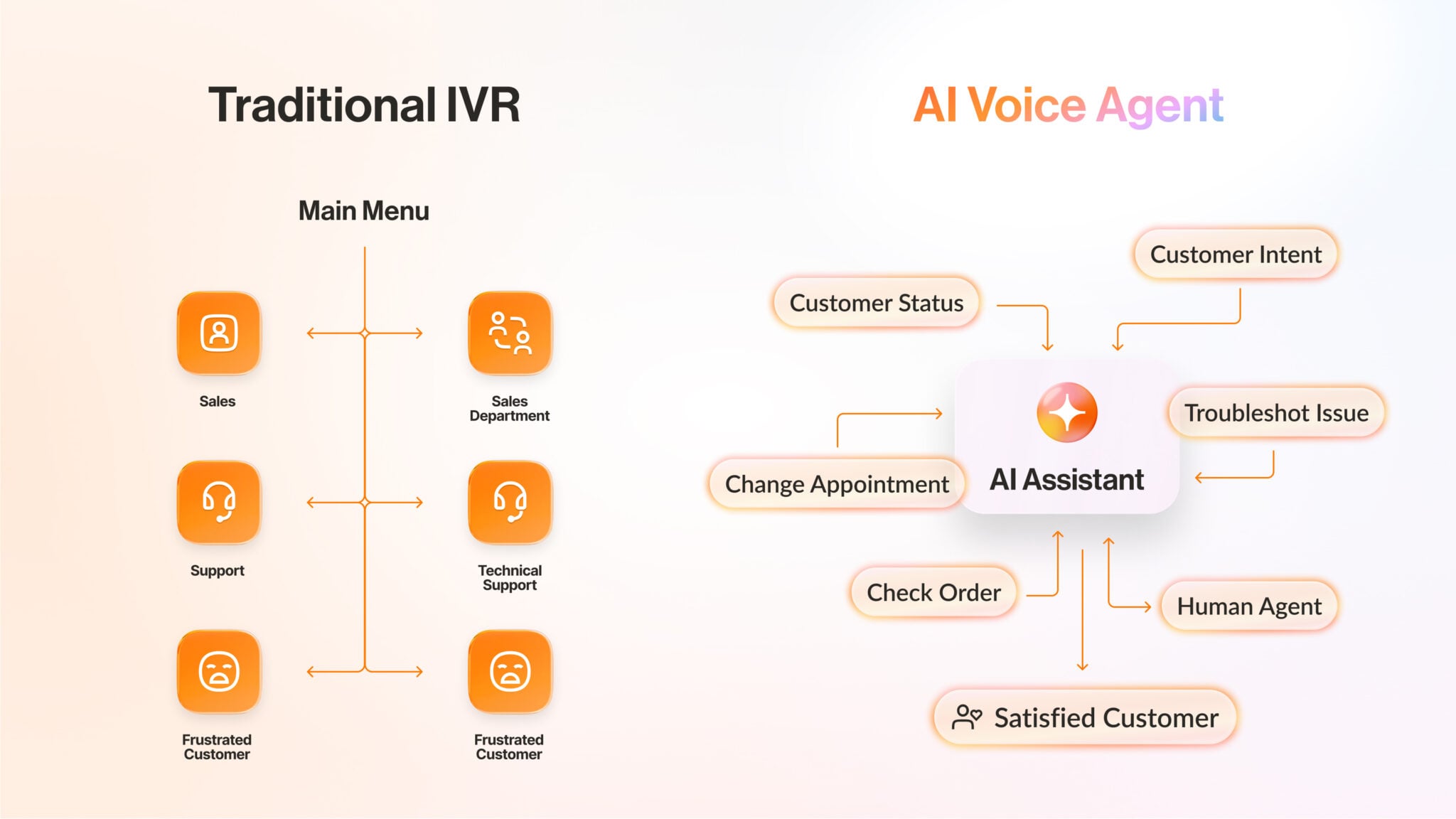
This is where IT and CX leaders usually push back: handing routing logic to an AI model feels like giving up control. That skepticism is fair, but it’s shrinking. The same Forrester article shows that a majority (78%) of decision-makers already trust AI’s outputs.Trust isn’t universal yet, but it’s no longer the exception.
The operational payoff is fewer dead-end transfers, shorter queues, and higher agent productivity for the agents who are actually equipped to help. That’s the entire point of pairing intent detection with real-time availability. Guesswork disappears from both sides of the interaction.
Voice vs. digital routing
Intent-based routing isn’t a voice-only capability. The same logic that parses a spoken request applies to a chat message or a text thread: the system reads what the customer is asking for and routes accordingly, regardless of channel.
That consistency matters for contact centers running voice, chat, and SMS through separate legacy queues. When routing logic differs by channel, customers get inconsistent experiences depending on how they reach out, and agents work from disconnected context.
Unifying the routing logic across channels doesn’t mean every channel performs identically. Voice carries more ambiguity than text, since spoken language is less structured than a typed message. When projecting the future of AI voice agents, we found that leaders expect voice conversations to inform future interactions, even across chat, email, or other channels.
What you can act on now: evaluate whether a platform applies one intent model across channels or bolts together separate systems for phone versus digital.
What to look for when evaluating call routing platforms
Not every platform that markets AI routing holds up once real call volume hits it. The differences show up in a few specific places, and knowing where to press separates a tool that routes accurately from one that just automates the same guesswork faster. Four criteria matter most:
- Intent accuracy across every channel your customers use. A platform that routes phone calls well but treats chat and SMS as an afterthought leaves gaps exactly where digital volume keeps growing.
- Integration depth with the tools your agents already use. Routing that can’t pull account history or case status from your existing systems forces agents to hunt for context manually, erasing the time savings routing was supposed to deliver.
- Reporting that shows why a call routed where it did, including any sentiment analysis applied to the interaction. A dashboard that confirms a call reached an agent tells you nothing about the logic behind that decision. You need visibility into the signals the system used, not just the outcome.
- Supervisor-level visibility into routing decisions. That reporting gap is where many platforms fall short. Teams end up debugging misroutes after the fact instead of catching patterns in real time. Strong workforce management depends on that same visibility, since staffing decisions are only as good as the routing data behind them.
Ask vendors directly how routing decisions get surfaced to supervisors. If the answer is a call log with no reasoning attached, you’re buying automation without oversight.
How AIR Pro recognizes caller intent and agent availability
Most routing systems commit before they know anything. A caller presses 2 for billing, waits in the queue, then reaches an agent who has to send them somewhere else. The menu never asked what the call was about, and it has no read on who can actually take it.
RingCentral AI Representative (AIR Pro) routes on intent instead of keypresses. It interprets why someone is calling from their own words, then weighs conversation context, connected business data, agent skills, and real-time availability to decide where the interaction goes. Routine requests AIR Pro can answer or complete on its own. The complex ones it routes to the right agent or workflow.
When a request does need a person, AIR Pro passes the full interaction context to the receiving agent, so the customer never restarts the explanation. And because its Orchestration Studio lets managers monitor how routing is performing and adjust in real time, teams catch patterns as they happen instead of debugging misroutes after the fact.
Start with routing you can actually see
Routing quality comes down to visibility as much as automation. When you can see why each call landed where it did, you can find what keeps sending people to the wrong place and correct it.
AIR Pro gets callers to the right agent based on intent and availability, and its Orchestration Studio’s analytics view shows how those routing decisions performed so your team can keep tightening them. See how AIR Pro routes on intent and availability.
FAQs about AI call routing
What is AI call routing?
AI call routing directs calls, chats, and texts to the agent best suited to handle them, based on intent and real-time availability rather than a keypress menu. It replaces static IVR logic with a system that interprets what the customer actually needs before assigning the interaction.
How is AI call routing different from a traditional IVR?
A traditional IVR asks callers to sort themselves into categories through menu selections, which rarely match the real reason for the call. AI call routing skips the menu and interprets intent directly from what the caller says or types, then matches that intent to a qualified, available agent.
Does AI call routing require a full contact center platform?
AI call routing typically runs as part of a broader contact center platform, since it needs access to agent availability, skills data, and interaction history to route accurately. A standalone routing tool without that context can only guess at availability, which limits how much it actually improves over a traditional IVR.
How fast can a business roll out AI call routing?
Rollout speed depends on how much existing IVR logic and CRM integration work needs to happen before the new routing model goes live. Platforms built AI-first from the start tend to deploy faster than legacy systems retrofitted with AI, since the routing and data layers don’t need to be bolted together after the fact.
Originally published Aug 17, 2026