AI Communications





The best AI agent assist tools don’t wait until after the call to help. They work while the customer is still on the line.
An agent is 90 seconds into a call. The customer has already asked the same question twice, and the agent is toggling between three systems, trying to find the one policy detail that answers it.
Multiply that moment by every shift, every queue, and every new hire still learning where the knowledge base lives, and the cost shows up everywhere. Average handle time creeps up, first-contact resolution slips, and the quality of a customer’s experience depends heavily on which agent answers. Supervisors want to fix this, but traditional QA only samples a small fraction of interactions, so the coaching that follows draws from an incomplete picture.
Agents need the right answer the moment they need it, inside the conversation itself. AI agent assist delivers exactly that: real-time guidance that replaces manual lookups and after-the-fact coaching.
This guide explains what AI agent assist is, how it works, and what enterprise leaders should evaluate when choosing a solution.
Key takeaways
- AI agent assist supports human agents in real time, not customers directly
- It surfaces answers, scripts, and next steps during live interactions
- Real-time guidance reduces handle time more than after-call summaries alone
- Supervisor-level visibility across 100% of interactions is now achievable
- RingCX delivers this natively with AVA Agent Assist, not a bolt-on tool
What is AI agent assist?
AI agent assist is an AI-powered tool that helps customer service agents resolve customer issues more efficiently by providing contextual assistance during live conversations.
Unlike customer-facing chatbots or virtual agents, AI agent assist works behind the scenes. As conversations unfold across voice or digital channels, it continuously analyzes customer intent using generative AI, LLMs, NLP, and NLU to understand the discussion in real time. It then surfaces the most relevant information, recommends suggesting responses, provides policy guidance, and automates administrative tasks before they become bottlenecks.
The investment case isn’t just about agent convenience. It’s about the call center metrics that show up on a scorecard:
- Average handle time (AHT)
- First-contact resolution (FCR)
- New-hire ramp time
- Compliance consistency across every interaction
When agents get the right answer during the call instead of after it, resolution happens on the first attempt more often, and ramp time for new agents shortens because the tool carries institutional knowledge they haven’t learned yet. The interaction record is easier to audit because the system documents guidance and responses as they happen.
Treat agent assist as strategic infrastructure, and it changes what a workforce can absorb: more channel complexity, more product lines, and more regulatory requirements without a proportional rise in agent tenure or headcount.
Why agents still spend the call searching instead of resolving
Most contact centers didn’t design their knowledge infrastructure for the volume of product lines, policies, and compliance requirements agents now have to track. The knowledge base exists, but it lives in a separate tab from the interaction itself.
This means every lookup requires a context switch: pause the conversation, search, scan, return, answer. That gap is where AHT inflates and FCR erodes, not because agents lack skill, but because the systems around them weren’t built to keep pace with the interaction.
The impact extends beyond a single interaction. Every manual search interrupts the flow of the conversation for both the agent and the customer. That’s why enterprise organizations are investing in agentic AI that unifies customer and agent experiences, delivering the right intelligence to the right person at the right moment.
According to the RingCentral Agentic AI Trends 2026 report, 97% of organizations now use at least one form of AI, highlighting how AI has become foundational to modern customer experience strategies.
For enterprises, this is an architecture problem. The knowledge exists somewhere in the organization, but the interaction layer and the knowledge layer aren’t connected in real time. That’s the gap AI agent assist closes, and it’s also the gap that determines the total cost of ownership on any contact center platform, whether that cost shows up in inflated handle time, repeat contacts, or the ramp period before a new agent reaches full productivity.
What AI agent assist actually does during a live interaction
Agent assist tools vary widely in what they do mid-call. The mechanism determines whether a tool changes call outcomes or just adds another dashboard.
Real-time knowledge and answer surfacing
During the interaction, the AI agent assist tool listens to the conversation (voice) or reads it (chat, email, SMS) and matches what’s being discussed against the organization’s knowledge base, policy documents, and prior interaction history.
For example, when a customer asks about a billing exception or a product limitation, the tool surfaces the relevant answer directly in the agent’s interface without the agent typing a search query or switching screens. The mechanism matches patterns against structured and unstructured knowledge sources at the moment a question arises, rather than relying on a static FAQ that the agent must consult.
Next-step and script guidance
Beyond answers, the AI agent assist tracks where the interaction sits in its lifecycle and recommends what the agent should do next. That could range from pulling up a compliance disclosure the agent must read verbatim, identifying a proper escalation path for a specific complaint type, or recommending a next-best-action based on what similar past interactions resolved successfully.
This shifts consistency away from individual agent memory and experience level toward a system that applies the same logic across every interaction, regardless of who’s handling it or how new they are.
Automated post-call summarization
After the interaction ends, the same system that guided the agent in real time generates a summary of what was discussed, what got resolved, and what follow-up the case still requires, if any.
Because the summary draws on the same real-time transcript and context that the system built during the call, agents don’t have to reconstruct the interaction from memory or notes, which reduces after-call work and improves the accuracy of what lands in the customer relationship management (CRM) platform or case management system.
Real-time assist vs. after-the-fact QA and coaching
Most contact centers already have a coaching process. The problem is that it evaluates a small slice of what actually happened.
Traditional QA relies on supervisors manually reviewing recorded interactions after the fact, a process that’s both labor-intensive and inherently limited in scope. According to McKinsey, manual quality assurance typically evaluates less than 5% of customer conversations, leaving most interactions unseen and creating blind spots in coaching and performance management. As a result, feedback is often based on a small sample that may not accurately reflect an agent’s day-to-day performance.
Real-time assist changes what supervisors measure and when. Instead of sampling after the fact, it operates during the interaction, so the agent gets guidance while they can still change the outcome of that specific call.
It also gives supervisors visibility into patterns across the full volume of interactions rather than a curated sample. This is a different measurement model entirely: continuous, in-line correction in place of periodic, retrospective review. Full-coverage visibility of this kind depends on conversation intelligence that can process every interaction as it happens rather than a sampled batch after the fact.
What to evaluate before adopting an agent assist tool
Not every product marketed as an AI agent assist delivers real-time guidance. Before adopting one, an enterprise buyer should evaluate a few specific dimensions rather than taking the vendor’s category label at face value.
Integrations
Integration depth matters more than feature count. Bolting a tool onto an existing platform introduces latency, additional points of failure, and a separate vendor relationship to manage during outages or updates.
A tool built into the platform’s core architecture shares the same data model as the rest of the interaction, which reduces both integration overhead and the risk surface a third-party dependency introduces.
Channel coverage
Some agent assist tools work only on voice, leaving chat, email, and SMS interactions without the same guidance or supervisor visibility. For an omnichannel operation, that’s a meaningful gap in both agent support and compliance posture, since the interactions without coverage are also the ones without an audit trail if a dispute arises later.
Coverage depth
Does the platform give visibility into 100% of interactions, or does it still rely on a sample? A tool that only surfaces insights on a subset of calls hasn’t solved the QA sampling problem. Ask vendors directly what percentage of total interaction volume the coaching and analytics layer actually processes, not just what percentage it’s capable of processing.
How RingCX delivers AI agent assist natively
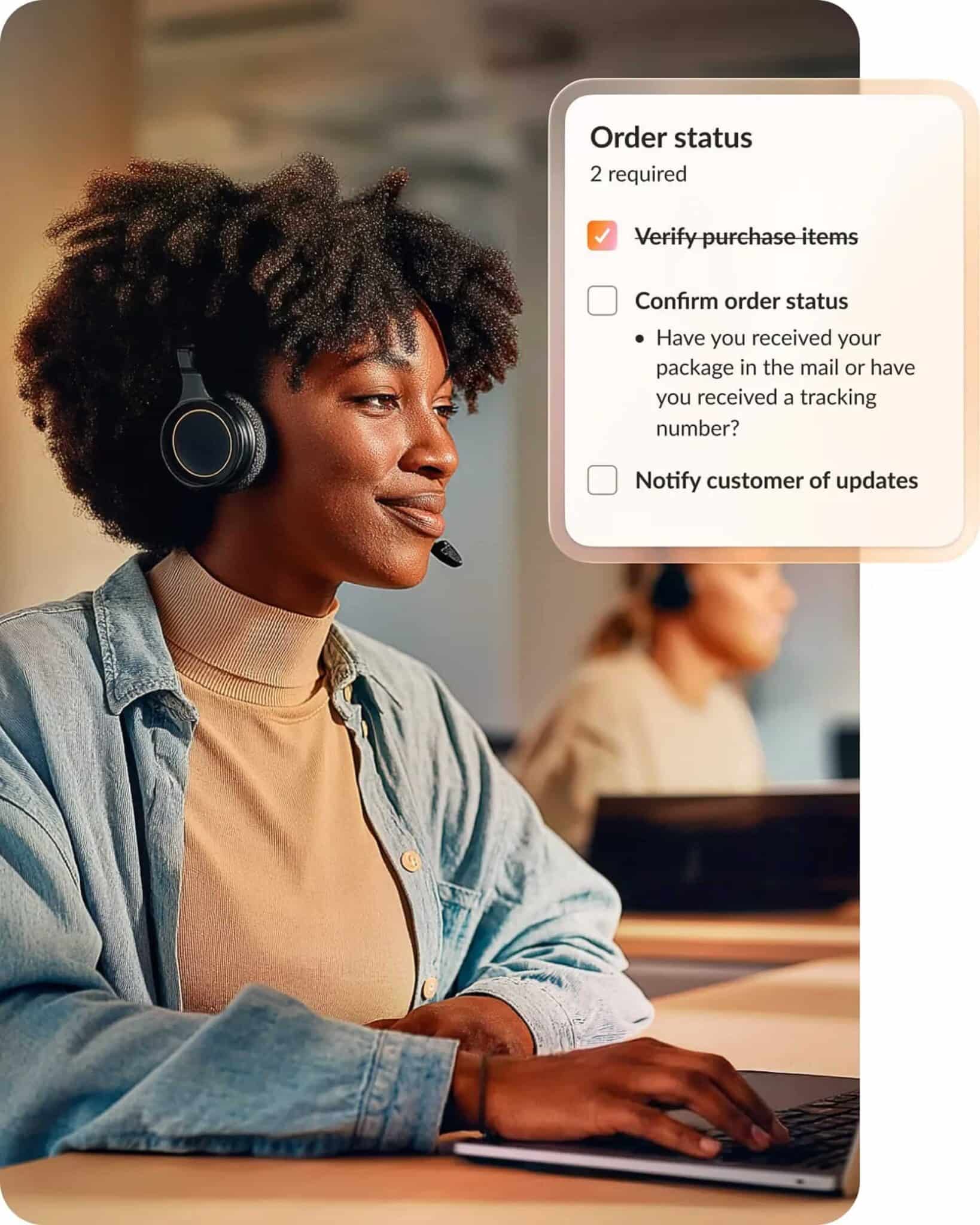
RingCX, RingCentral’s AI-first contact center platform, delivers agent assist as a native capability rather than an integration. AVA Agent Assist provides real-time guidance during live interactions. It surfaces relevant knowledge as the conversation happens, suggests next steps based on where the interaction sits in its lifecycle, and automates the post-call summary using the same context it built during the call.
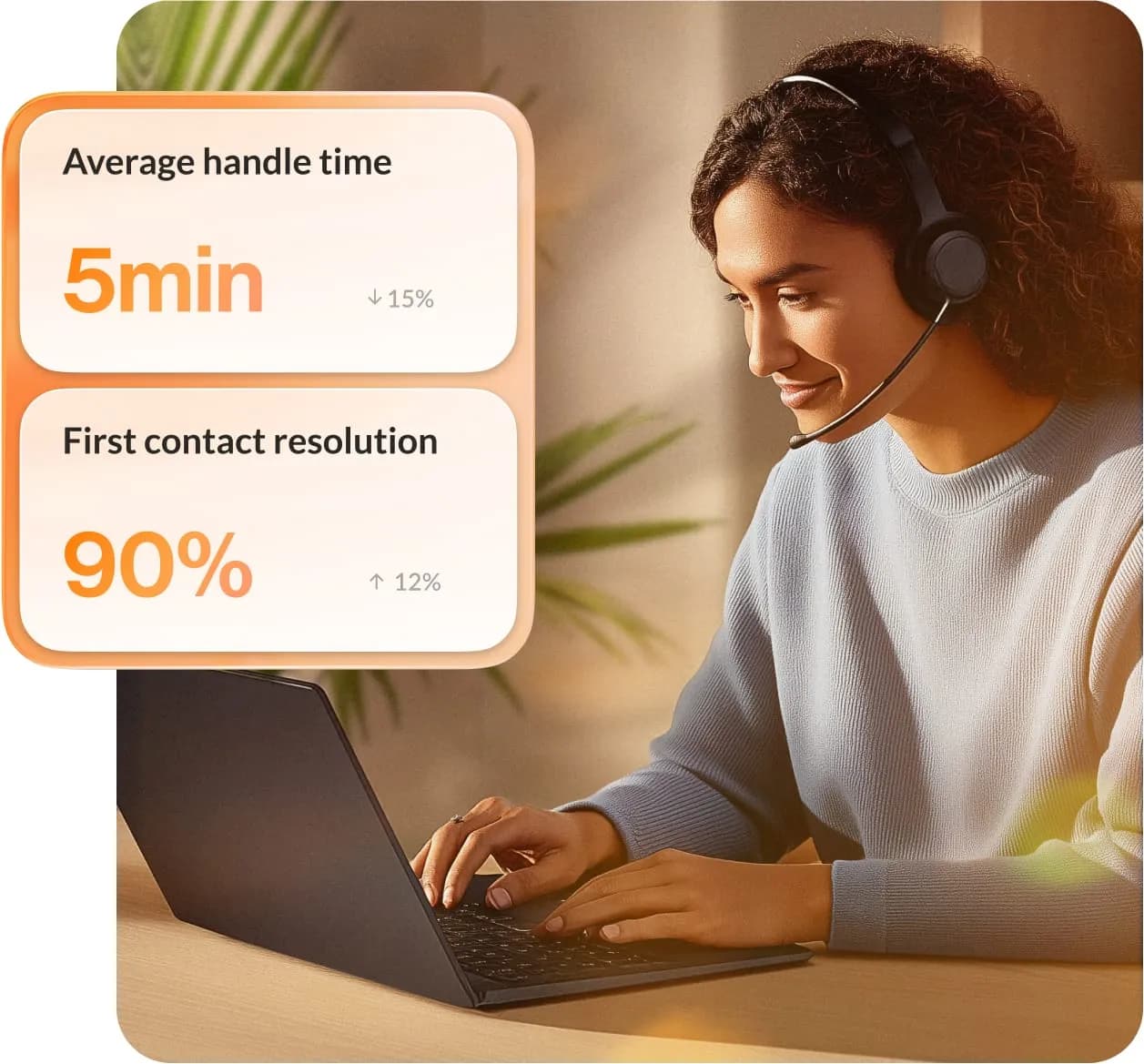
AVA Supervisor Assist extends that same real-time architecture to the coaching layer, monitoring 100% of interactions rather than a manual sample and surfacing AI-driven coaching insights across the full volume of calls, chats, and messages an operation handles.
Because RingCX builds AVA Agent Assist and AVA Supervisor Assist into its platform architecture rather than layering them onto a legacy contact center as a service (CCaaS) deployment, the guidance and coaching data share the same data model as routing, analytics, and workforce management.
Turn every call into a point of improvement
Real-time AI agent assist changes the outcome of the call itself, not just the record of what happened afterward.
That’s the core distinction between genuine agent assist and after-call summarization: one shapes the resolution while the customer is still on the line, and the other documents it once the opportunity to change the outcome has already passed. Integration depth, channel coverage, and full interaction visibility are the evaluation criteria that separate the two in practice.
See how AVA Agent Assist and AVA Supervisor Assist deliver 100% interaction monitoring and real-time coaching inside RingCentral RingCX.
FAQs about AI agent assist
What is the difference between AI agent assist and a chatbot?
A chatbot interacts directly with the customer, handling routine questions or intake without a human involved.
AI agent assist does the opposite: it works alongside the human agent, surfacing knowledge and next-step guidance during the interaction, without ever communicating with the customer directly.
The two solve different problems and often operate in the same contact center simultaneously.
Does AI agent assist replace human agents?
No. It supports the agent who is still handling the interaction, reducing the time spent searching for information and improving consistency in the guidance they give.
Complex, emotionally sensitive, or judgment-heavy interactions still require a human agent; agent assist changes how prepared that agent is, not whether they’re present.
How does AI agent assist reduce handle time?
It removes the manual search step that otherwise interrupts the conversation. Instead of pausing to look up a policy or past interaction, the agent receives the relevant information directly in their interface as the conversation happens, which shortens the path between a customer’s question and a resolved answer.
Can AI agent assist work across every contact center channel?
It depends on the platform. Tools built for voice-only environments won’t extend the same guidance or supervisor visibility to chat, email, or SMS.
Platforms built as unified, omnichannel systems, like RingCX, can apply the same real-time guidance and coaching visibility across every channel an operation supports, which matters for both consistency and compliance posture.
Originally published Jul 22, 2026