
Small Business
Enterprise
Developers
Talk to an expert:(800) 574 5290
Support
Plans & PricingCompany
  1. What is an outbound contact center?
  2. Inbound vs. outbound call centers: Key differences
  3. Types of outbound call centers
  4. Industries that rely on outbound call centers
  5. Why do outbound contact centers matter?
  6. TCPA, DNC registry, and STIR-SHAKEN compliance for outbound calling
  7. The best outbound call center software: Features you can't do without
  8. How AI is transforming outbound contact center performance
  9. Ready to build a more effective outbound program?
  10. Outbound call center FAQs
  11. Sources
  1. Home

TABLE OF CONTENTS

  1. What is an outbound contact center?
  2. Inbound vs. outbound call centers: Key differences
  3. Types of outbound call centers
  4. Industries that rely on outbound call centers
  5. Why do outbound contact centers matter?
  6. TCPA, DNC registry, and STIR-SHAKEN compliance for outbound calling
  7. The best outbound call center software: Features you can't do without
  8. How AI is transforming outbound contact center performance
  9. Ready to build a more effective outbound program?
  10. Outbound call center FAQs
  11. Sources

Products

  • RingEX
  • Team Chat
  • AI Meetings
  • Business Phone
  • Fax
  • SMS
  • Features
  • Outbound Call Centers
  • What is an outbound call center? Your 2026 guide to outbound contact center software

    RingCX gives outbound teams the AI-powered dialing tools, TCPA compliance safeguards, and CRM integrations they need to reach more customers and close more deals.

    • Outbound call centers initiate contact with customers; inbound ones receive it. The difference shapes your software, metrics, and compliance obligations.
    • Three federal frameworks govern US outbound calling: the Telephone Consumer Protection Act (TCPA), the National Do Not Call (DNC) Registry, and STIR-SHAKEN call authentication.
    • Core use cases include sales, lead generation, debt collection, fundraising, telemarketing, and market research.
    • Look for dialer flexibility, customer relationship management (CRM) platform integration, and built-in compliance tools when evaluating outbound software.
    • AI now works before, during, and after calls, reducing after-call documentation time and improving contact rates.
    Contact salesPlans & pricing

    Get all the outbound call center software features you need today

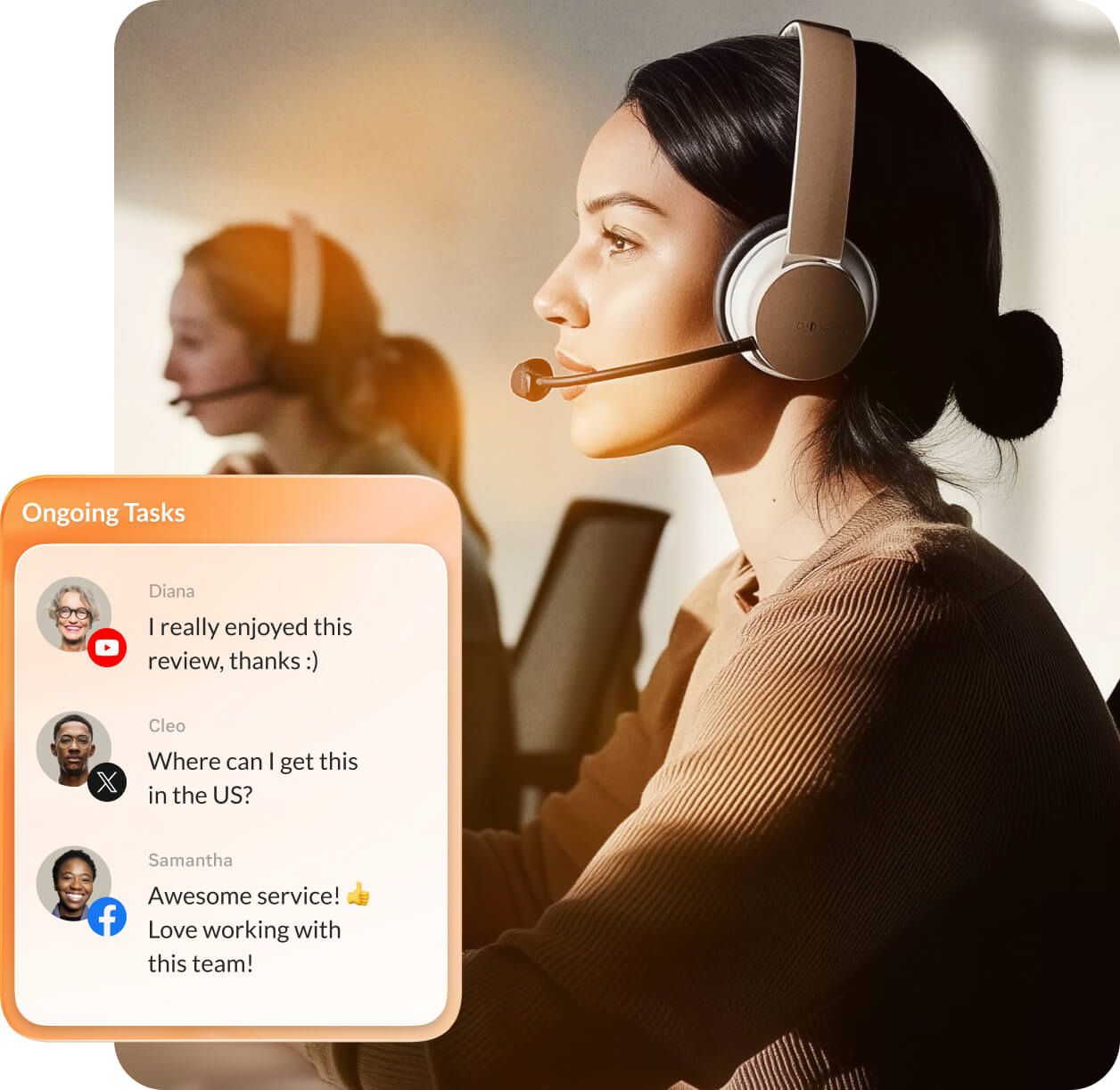
    A female contact center agent looking at ongoing tasks from different social media channels

    An outbound call center is a team of agents that initiates contact with customers and prospects on behalf of a business. You'll also hear the term "outbound contact center" in enterprise and omnichannel contexts, where teams reach people across phone, SMS, and digital channels rather than voice alone.

    Compliance has gotten more complex. Since February 2024, the FCC requires prior express consent even for AI-generated voices on outbound calls, which means the compliance obligations now touch AI-powered dialing workflows directly. Teams that haven't updated their consent processes are exposed.

    This guide covers how outbound call centers work, what types and use cases they serve, how to stay compliant in 2026, and what to look for when evaluating outbound contact center software.

    What is an outbound contact center?

    An outbound contact center focuses on initiating contact with external parties on behalf of a business. Agents reach out to prospects, customers, and others, often for lead qualification and sales efforts, rather than waiting for customers to call in.

    Historically, outbound operations were phone-only ("call centers"). Modern teams also use SMS, email, and live chat, which is where the broader term "outbound contact center" comes from.

    How does an outbound contact center work?

    A contact center is a business department composed of agents who interact with individuals outside of the company, usually customers or prospective customers.

    Traditionally, those interactions were all over the phone, hence these departments used to be known as call centers. Today, other communications channels, like live chat, are also popular. That’s why “contact center” and, by extension, “outbound contact center” are now more widely used.

    Inbound vs. outbound call centers: Key differences

    Outbound call centers initiate calls; inbound ones receive them. That single distinction drives real differences in the software you need, the metrics you track, and the compliance requirements that apply.


    Outbound

    Inbound

    Call direction

    Agents initiate

    Customers initiate

    Primary goal

    Revenue generation, lead qualification, outreach

    Many organizations run both. A sales team makes outbound prospecting calls while a service team handles inbound support requests. Some enterprise platforms manage inbound and outbound contact center solutions from a unified workspace so both operations share data and reporting.

    Types of outbound call centers

    Agents who work in an outbound contact center may connect with leads through a variety of methods and for a number of reasons.

    Those are determined, at least in part, by the type of outbound contact center it is.

    Sales-oriented outbound call centers

    These are the most recognizable examples of outbound contact centers.

    They’re designed to generate revenue by direct outbound sales calls or other examples of outreach. Agents or sales reps contact prospects with the intention of closing a deal.

    Lead generation outbound call centers

    These contact centers are similar in that their ultimate goal is to aid sales. Lead generation activities, however, happen earlier in the sales pipeline.

    Agents in this type of contact center aim to draw new prospects to the company so you can sell to them later.

    Market research and survey outbound call centers

    Outbound calling and outreach isn’t always about sales. A market research contact center is one where agents reach out to ask for peoples’ opinions or feedback, often via surveys.

    Proactive outbound contact centers for support

    You don’t always have to wait for customers to contact you with issues. An outbound contact center for customer service sees agents reach out to customers instead.

    Perhaps a product update means one of the functions will work slightly differently. Your outbound contact center agents might get in touch with existing customers and users to let them know before it causes a problem.

    Debt collection outbound call centers

    Debt collection teams contact customers about overdue accounts, payment plans, and account resolutions. They operate under Fair Debt Collection Practices Act (FDCPA) requirements on top of standard TCPA obligations, which makes scripted workflows and documented consent critical.

    Predictive dialers help maximize contact rates, while call recordings create the compliance documentation teams need if a dispute arises.

    Fundraising outbound call centers

    Nonprofits and political campaigns use outbound call centers to solicit donations, renew memberships, and mobilize volunteers at scale. High-volume dialing is the norm.

    Customizable caller IDs improve answer rates by displaying a local or organizational number rather than an unknown one, and progressive dialers keep agent idle time low while keeping calls personal enough to support donation conversations.

    Telemarketing outbound call centers

    Telemarketing teams contact prospects and existing customers to promote products, generate sales leads, or cross-sell services.

    TCPA prior-express-written-consent requirements apply to any marketing call made with an autodialer. Calling lists must be scrubbed against the National DNC Registry before each campaign launches, and 11 states maintain supplemental DNC lists with additional restrictions beyond the federal requirements.

    Industries that rely on outbound call centers

    Most industries with ongoing customer relationships use outbound calling in some form. The use case and compliance layer vary by sector, but the core model is consistent.

    • Financial services: Appointment setting, loan follow-up, payment reminders, and policy renewal outreach. Regulated under TCPA and, for broker-dealers and registered investment advisers, Financial Industry Regulatory Authority (FINRA) rules on call recording and supervision.
    • Healthcare: Appointment reminders, post-discharge follow-up, care gap outreach, and prescription refill reminders. Health Insurance Portability and Accountability Act (HIPAA) compliance requirements apply to any outbound call involving protected health information.
    • Real estate: Lead nurturing, open house invitations, and buyer and seller follow-up across the transaction cycle. High call volumes and competitive response time requirements make dialer efficiency a priority.
    • Insurance: Policy renewal calls, claims follow-up, and cross-sell outreach to existing policyholders. TCPA consent management is especially important given the high frequency of touchpoints.
    • Telecommunications: Customer retention campaigns, upsell and upgrade calls, and win-back programs for churned subscribers.
    • Nonprofits: Fundraising, pledge renewals, volunteer coordination, and event outreach. Budget constraints make per-contact efficiency a priority.
    • Retail and e-commerce: Abandoned cart recovery, loyalty program outreach, and post-purchase satisfaction calls.
    • Automotive: Service reminders, trade-in offers, and follow-up after a dealership visit or test drive. Timing matters more in this segment than most.

    Why do outbound contact centers matter?

    Outbound contact centers provide significant value to businesses across multiple dimensions. Understanding their impact can help determine whether implementing one aligns with your business objectives.

    The principal benefits of outbound contact centers include:

    They help drive revenue

    Outbound contact centers used for the traditional sales purposes are effective in reaching more prospects, closing deals, and driving revenue.

    The AI-assisted case for this is getting clearer. McKinsey's contact center research found that customer care interactions have potential for a 30 to 45% productivity increase. As much as 50% of that activity can be automated. 1 For outbound teams, that productivity gain translates to more dials, more live connections, and more pipeline.

    They help you build better customer relationships

    Proactive customer support via an outbound contact center is good for your customer relationships. Reaching out to them to offer help or guidance, sometimes that they didn’t even realize they needed, shows how much you care.

    For businesses interested in exploring how proactive customer support can elevate their operations, it's worth taking a closer look at the demo customer service capabilities RingCentral offers.

    It helps to build trust and therefore loyalty with your customers. Those are the foundations for longer-lasting relationships and increase your chances of turning customers into brand advocates.

    They boost productivity

    Getting in touch with customers proactively can also be a boon for productivity. After all, forewarning customers of changes or potential issues means fewer panicked calls if things do go wrong. McKinsey found that 57% of customer care leaders expect call volumes to increase by as much as one-fifth over the next one to two years. 2 Outbound programs that address those anticipated calls before they land protect agent capacity across the whole contact center.

    Using autodialer software , you can streamline outreach even further and ensure agents connect with the right leads at the right time.

    What’s more, if you choose the right outbound contact center solutions they can integrate seamlessly with other tools to create more efficient workflows across your center.

    To further enhance efficiency and control across touchpoints, businesses can benefit from using a centralized call management app that integrates seamlessly with outbound and inbound communication tools.

    TCPA, DNC registry, and STIR-SHAKEN compliance for outbound calling

    Outbound call centers operating in the US must follow three federal compliance frameworks. Those are TCPA, the National DNC Registry, and STIR-SHAKEN call authentication.

    Telephone Consumer Protection Act (TCPA)

    TCPA governs who you can call and how. It requires prior express consent for calls made with an autodialer or prerecorded message, and prior express written consent for marketing calls. Violations carry per-call penalties of $500 to $1,500. Class action suits are common. 3

    The compliance picture for AI-powered outbound hardened in February 2024 when the Federal Communications Commission (FCC) unanimously confirmed that AI-generated voices constitute "artificial voices" under TCPA. 4 Any outbound call using AI-generated voice content requires prior express consent, even when a human agent also participates. The enforcement posture is serious: in March 2024, the FCC imposed a $2,880,000 fine for an unauthorized robocall campaign in violation of TCPA. 5

    The National Do Not Call Registry

    The National DNC Registry requires businesses to scrub calling lists before each campaign. Any registered number that hasn't given prior consent must be removed. 6 Beyond the federal list, 11 states maintain supplemental DNC lists with additional restrictions. Multi-state programs need to account for all of them.

    STIR-SHAKEN

    STIR-SHAKEN is the call authentication framework that verifies caller ID and reduces spoofed numbers. Carriers use SHAKEN attestation levels to mark calls as verified or unverified in their interfaces, which directly affects answer rates. Operating on a compliant carrier and maintaining verified numbers helps outbound programs avoid the "spam likely" designation that kills contact rates.

    RingCX includes built-in DNC list scrubbing and TCPA-compliant outbound dialing tools to help outbound teams call within regulatory boundaries. See RingCentral compliance certifications for the full compliance posture.

    See RingCX in action

    Play video: RingCX: Effortless Customer Experiences with AI

    The best outbound call center software: Features you can't do without

    Today, outbound contact center solutions are typically software-based. The best outbound contact center services are critical to meeting your organizational goals, whether they be in the areas of sales, customer service, or something else entirely.

    If you're looking to enhance your team's efficiency even further, consider using a dialer for sales that can automate and optimize outbound calling efforts.

    RingCentral RingCX is an omnichannel solution which includes all of the following outbound contact center software features, and a whole lot more besides:

    Dialer tools

    Arguably the most fundamental features of an outbound contact center solution are customizable dialer tools. Outbound software uses a variety of dialer tools to efficiently connect businesses and customers.

    With a solution like RingCentral RingCX, these tools include predictive dialers , preview dialers , and progressive dialers :

    Predictive dialers

    These tools use a combination of data and algorithms to “predict” when an agent will finish their current call. In the meantime, they autodial new numbers to limit the amount of agent downtime.

    Some calls end in voicemails, busy signals, or disconnected numbers, so the dialer also estimates the number of calls that will go through to keep agents busy and queues full. A predictive dialer improves efficiency and frees up agent time so they can focus on connecting with customers, not making more calls.

    Preview dialers

    The unknown can be one of the worst parts of cold calling. With a preview dialer, you can give your agents helpful information about the customer—before the call connects.

    This preparation is invaluable to outbound contact centers. Agents can see and understand all of the info you have on that particular lead before speaking with them. It gives agents time to adjust their strategies and mindset to increase the likelihood of getting the response they need. This support helps your employees feel and perform better, keeping everyone happy.

    Progressive dialers

    Progressive dialers address the most frustrating flaw of automated dialing; connecting agents to dead calls and voicemails. Rather than dialing more to make up for unsuccessful calls, this dialer focuses on the quality of the calls it makes.

    By making fewer calls, it ensures that agents and customers always connect to a person immediately. Your agents will be able to spend more time having valuable conversations and less energy on calls that don’t provide results.

    Customizable caller IDs

    The number or other information that appears on a call recipient’s phone can make a big difference to how likely they are to answer the call. That’s why you want any outbound contact center app to allow you to customize your caller IDs.

    With RingCentral RingCX you can set up caller IDs for campaigns or users, and manually select your chosen ID for calls, too.

    Call recording

    Call recording is another must-have of any outbound contact center software. Sometimes, recordings may be mandatory for compliance purposes, and they can always prove useful for training. A healthy database of recorded calls—both good and bad—is great for guiding agents to improve their own calls. Supervisors and managers can listen to the recordings, pick out strengths and weaknesses, and tailor training accordingly.

    CRM integrations for outbound call centers

    The best outbound software connects directly to your CRM, so agents spend less time entering data and more time on calls. When a call ends, outcomes log automatically to the right contact record.

    The four integrations that come up most in enterprise buying decisions:

    1. Salesforce syncs call outcomes to opportunity records
    2. HubSpot connects calls to deal pipeline stages
    3. Microsoft Dynamics feeds contact history to agents mid-call
    4. Zendesk ties call dispositions to support tickets for teams that handle both outbound and inbound.

    How AI is transforming outbound contact center performance

    AI is changing outbound contact center work in three places: before the call, during the call, and after the call.

    Before the call, AI analyzes contact history, intent signals, and prior outcomes to prioritize which contacts to reach and when. Intent scoring and next-best-action logic help teams focus dials on contacts most likely to respond, rather than working down a static list in order.

    During the call, real-time AI monitors conversation sentiment, flags coaching moments for supervisors, and tracks script adherence. Agents get live guidance without putting the call on hold or flagging a supervisor manually.

    After the call, AI generates summaries, logs outcomes to the CRM, and identifies follow-up actions automatically. For teams handling hundreds of calls a day, eliminating manual after-call documentation adds up to significant time savings per agent per shift.

    The adoption numbers back this up. According to the PwC 2025 Global CEO Survey, 56% report efficiency gains from GenAI deployments. 7 Outbound teams integrating AI into their dialing workflows are seeing it in contact rates and after-call work time.

    RingCX's AI-assisted outbound tools cover all three stages: real-time sentiment monitoring, live agent coaching, and automated post-call summaries.

    Ready to build a more effective outbound program?

    High-performing outbound programs have a few things in common: the use case matches the dialing approach, agents have the context they need before they dial, and the software handles compliance and CRM logging without adding overhead.

    RingCentral's RingCX gives outbound teams AI-assisted dialers, TCPA compliance tools, and native CRM integrations to run a compliant, high-volume outbound operation. Explore RingCX outbound features .

    Outbound call center FAQs


    Sources

    1. Blackader, B., Buesing, E., Amar, J., Raabe, J., Mehndiratta, M., & Gupta, V. (2025, March 19). The contact center crossroads: Finding the right mix of humans and AI. McKinsey & Company. https://www.mckinsey.com/capabilities/operations/our-insights/the-contact-center-crossroads-finding-the-right-mix-of-humans-and-ai

    2. Buesing, E., Haug, M., Hurst, P., Lai, V., Mukhopadhyay, S., & Raabe, J. (2024, March 12). Where is customer care in 2024? McKinsey & Company. https://www.mckinsey.com/capabilities/operations/our-insights/where-is-customer-care-in-2024

    3. Federal Communications Commission. (n.d.). Rules and regulations implementing the Telephone Consumer Protection Act of 1991 [PDF]. https://www.fcc.gov/sites/default/files/tcpa-rules.pdf

    4. Federal Communications Commission, Consumer and Governmental Affairs Bureau. (2023, January 23). CGB announces compliance date for amended Telephone Consumer Protection Act rules on prerecorded calls [Public Notice No. DA-23-56]. https://www.fcc.gov/document/fcc-announces-compliance-date-amended-tcpa-rules

    5. Federal Communications Commission. (2021, August 24). FCC proposes $5 million robocalling fine against Jacob Wohl and John Burkman [News Release No. FCC-21-97]. https://www.fcc.gov/document/fcc-proposes-largest-robocalling-fine-under-tcpa

    6. Federal Trade Commission. (n.d.). National Do Not Call Registry. https://www.donotcall.gov/

    7. PwC. (2025, January 20). Nearly three-in-five CEOs optimistic about global economic outlook as they plan headcount increases and continued AI rollout: PwC 2025 Global CEO Survey [Press release]. https://www.pwc.com/gx/en/news-room/press-releases/2025/pwc-2025-global-ceo-survey.html

    RingCX
  • Webinars & Events
  • Features
  • Phones and headsets
  • Partners

    • Global service providers
    • Channel partners
    • ISV partners
    • Hardware partners
    • Connectivity partners
    • Affiliate partners
    • Strategic alliances

    Open Ecosystem

    • Developer platform
    • APIs
    • App gallery
    • LLM Plugins & MCPs

    Learning

    • What's new
    • Resource center
    • Blog
    • Customer stories
    • Newsroom
    • Events & Webinars

    Company

    • About Us
    • Leadership
    • Investor relations
    • Ventures
    • Trust Center
    • Corporate Responsibility
    • Careers

    Help & Support

    • RingCentral app login
    • Admin portal login
    • Customer support
    • Download app
    • View demo
    • Contact sales

    How can we help? Contact us

    LegalPrivacyCookie NoticeSite MapAccessibilityContact Us

    Customer support, issue resolution

    Core team

    Sales reps, sales development reps, collections agents

    Support agents, service specialists

    Core technology

    Predictive/preview/progressive dialers, DNC scrubbing

    Call routing, IVR, ticketing integration

    Key metrics

    Answer success rate, calls per agent, conversion rate

    First-contact resolution, handle time, customer satisfaction

    Typical use cases

    Sales, fundraising, debt collection, appointment reminders

    Help desk, billing support, order inquiries


    Cookie Preferences
    Do not sell or share my personal data
    © 2026 RingCentral, Inc. All rights reserved.
    Country

    By clicking the button, you consent to receiving calls and emails from RingCentral. Calls may be made using automated technology.

    Privacy Policy
    *Required fields