When call volume spikes from a product issue, seasonal rush, or service outage, your team's ability to handle it comes down to one thing: how calls get distributed.
The method you choose shapes whether every call lands with the right agent—or doesn't.
Leverage AI-powered insights, real-time analytics, and intelligent routing to optimize performance, improve CX, and empower your workforce.
When call volume spikes from a product issue, seasonal rush, or service outage, your team's ability to handle it comes down to one thing: how calls get distributed.
Misrouted calls create wait times. Wait times create repeat contacts, escalations, and agents spending half their shift on issues they're not equipped to handle. For operations leaders managing contact centers at scale, call routing software determines whether your team survives the spike or collapses under it.
This guide covers what call routing software does, how it works, the routing options that fit different team types, and how to choose the right call routing solution for your environment.
Call routing software automatically directs incoming calls to the right agent, team, or destination based on predefined rules and real-time data. Instead of manual triage or a basic phone tree, the system applies logic to connect each caller with the person best positioned to help them.
Two core components power every call center software routing system: interactive voice response (IVR) menus and automatic call distribution (ACD).
IVR and ACD form the engine that powers every routing decision. The rules you set—whether based on agent skills, call volume, time of day, caller priority, or channel—determine how that engine performs. More sophisticated systems add real-time data and AI-driven logic to make routing decisions dynamically, adjusting to queue conditions and caller intent as they change.
The result: reduced wait times, improved first-call resolution, and every caller reaching a qualified agent without unnecessary call transfers.
Call routing follows a three-phase process: qualifying, queueing, and distribution. Each phase handles a specific part of the journey from incoming call to connected agent.
In most inbound call centers , the first step is directing the call to an IVR tool. The IVR system determines why the caller is contacting you through a series of automated questions. This information travels with the call to the next phase, so agents know the caller's reason before picking up.
The caller's responses go to the automatic call distribution (ACD) system for queuing. The ACD queues calls based on intent, skills, or wait time, with priority determined by your routing rules. When configured correctly, call queuing keeps callers from abandoning and ensures agents receive calls in the right order.
Once calls are queued, the ACD routes them to your agents based on your configured rules. For example, talk-time distribution routes callers to the agent with the least accumulated time on calls, which minimizes idle time and keeps workloads balanced. The distribution method you choose directly affects first-call resolution rates and agent efficiency.
The routing method you choose determines how well your system matches callers to agents and how your team handles volume spikes, after-hours calls, and high-priority customers. Here's a breakdown of the most common routing types and the business scenario each one solves.
Call routing speeds up waiting times and ensures that your customer experiences a swift and successful resolution to their problems. It can also optimize your workflow operations, improving your agent’s productivity and efficiency.
For businesses handling high call volumes, using advanced call queue software can further reduce wait times and improve the overall customer journey.
Routing calls to the right agent from the start reduces the number of transfers a customer experiences and shortens the time it takes to resolve their issue.
Consistent routing rules across every location mean customers receive the same quality of handling regardless of which number they call or which time zone they're in.
Automated call routing removes manual triage. Agents receive phone calls matched to their skills and availability, spending more time resolving issues and less time on transfers.
Workload distribution methods like round robin routing prevent any single agent from absorbing a disproportionate share of volume. When agents handle customer calls they're qualified for, they resolve them faster, improving customer satisfaction and productivity .
Supervisors need real-time visibility into queue performance, agent availability, and call distribution. Call routing software gives managers that view without requiring them to manually review individual interactions.
Platforms like RingCX extend this further. AI Quality Management monitors 100% of interactions and surfaces performance trends and coaching insights automatically. Supervisors can see where routing rules are working, where queues are building, and which agents need support, all without waiting for end-of-day reports.
Setting up an effective call routing system takes more than selecting a routing method. The steps below cover the full configuration process, from defining your objectives to monitoring performance after launch.
Start by researching your callers. Identify the most common reasons customers contact you, the typical caller demographics, and the volume patterns across times of day and days of the week.
This information shapes every routing decision that follows. When you understand what your callers need before they dial, you can build routing rules that anticipate those needs rather than react to them.
Select the distribution method that fits your team size and call volume. For example:
Some contact centers combine methods, using skills-based routing during peak hours and time-based routing after hours. Choose the approach that reflects how your team actually operates.
If you're using skills-based routing, create skill profiles in your ACD, then:
Outdated skill profiles send callers to the wrong agents just as reliably as no routing system at all.
Once routing is configured, layer in the call management features that support ongoing performance.
After launch, review your routing metrics regularly. Queue data will surface patterns that weren't visible during initial setup, and adjusting your rules based on real performance data keeps your routing system accurate as call volumes and team composition change.
When routing logic lives across separate platforms for voice, chat, and email, every channel operates differently. Supervisors lose visibility into the full picture. The result is longer wait times, more transfers, and customers who reach agents unprepared to help them.
RingCentral RingCX solves this. It's an AI-first omnichannel contact center platform that manages intelligent routing across voice, chat, SMS, email, and social from a single workspace. Routing rules apply consistently across every channel, so customers receive the same quality of handling regardless of how they contact you.
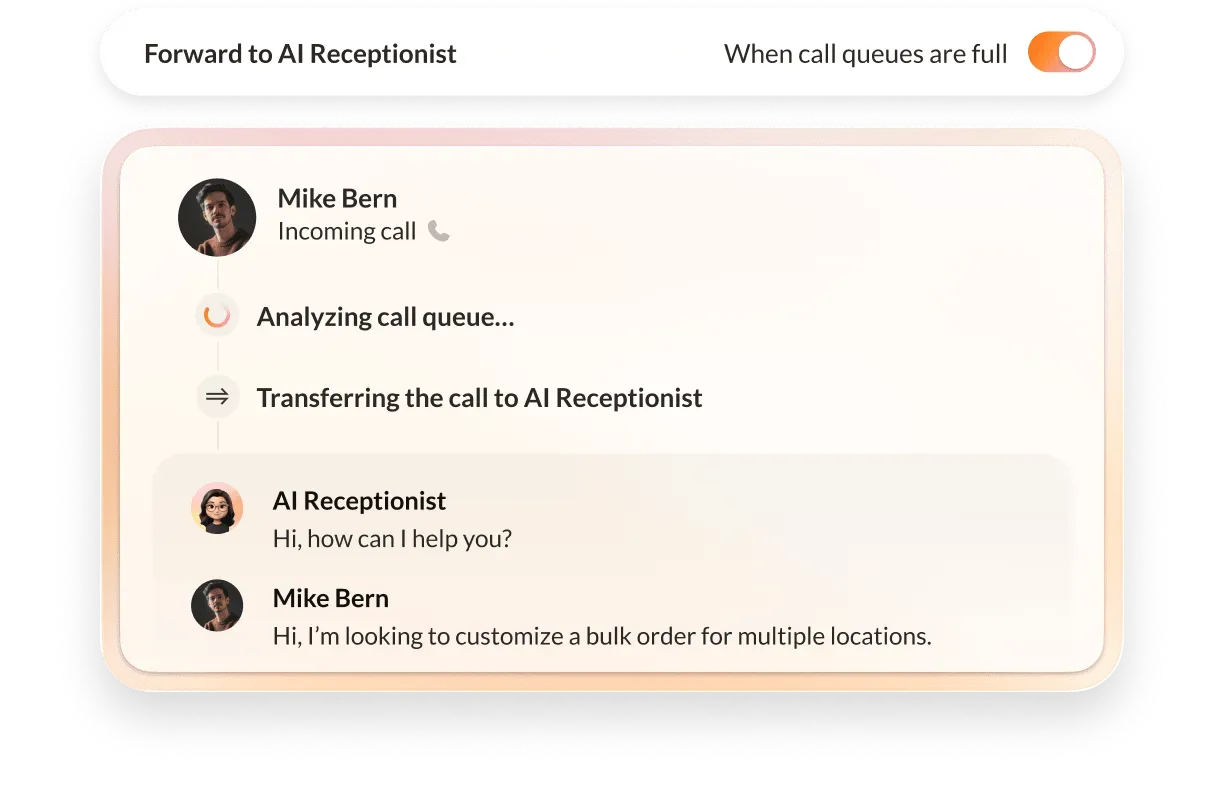
AI Receptionist (AIR) handles the layer before a human agent joins. AIR answers inbound calls, captures caller intent using natural language processing, and routes the interaction to the right destination. For after-hours calls, AIR handles intake and scheduling without requiring additional headcount.
Here's what RingCX routing delivers for your team:
Call routing software connects every caller to the right agent across every channel. When routing decisions are accurate and consistent, customer satisfaction improves, agents handle customer calls they're equipped to resolve, and supervisors have the visibility they need.
RingCX delivers that infrastructure at scale, whether you're managing a small business or a distributed call center across multiple channels. The result is fewer abandoned calls, lower handle times, and a customer experience that holds up under volume.
See how RingCentral RingCX routes calls for your team.
1. SQM Group Staff Writers. "Using Intelligent Skill-Based Routing to Deliver Great Customer Service." SQM Group, October 5, 2021. https://www.sqmgroup.com/resources/library/blog/intelligent-skill-based-routing .
Partners
Open Ecosystem
Learning
Company
Help & Support