Call center optimization: KPIs, strategies, and a 90-day plan

A practical framework for improving efficiency, reducing costs, and delivering better customer experiences at scale.

    • Optimization improves cost, CX, and compliance simultaneously
  • Metrics matter, but only when tied to operational changes
  • Artificial intelligence enables real-time optimization across every interaction
    • The most effective approach spans before, during, and after the call
Contact center leaders are under pressure from every direction. Customers expect instant, personalized service across channels, operational costs continue to rise, and compliance risks leave little room for error. Most teams try to solve these challenges in isolation: reducing handle time, adding headcount, or layering on new tools. But without a unified approach, these fixes create new inefficiencies instead of solving underlying problems.
Call center optimization is the process of improving how your contact center handles customer interactions across people, processes, and technology to reduce costs, improve customer experience, and increase operational efficiency. For contact center leaders, optimization must be an ongoing discipline that includes real-time visibility, consistent execution, and the ability to adapt quickly.
This guide walks you through a practical call center optimization framework, including the KPIs that matter most and a 90-day roadmap you can execute without disrupting service delivery.

What is call center optimization?

Call center optimization is the process of improving operational efficiency, agent performance, and customer experience (CX) through data-driven workflows and integrated technology. It goes beyond cost-cutting by creating an environment where call center agents resolve issues faster, customers receive consistent service across channels, and leadership has clear visibility into what's working.

Why it matters for customer experience, cost, and risk

Contact center optimization addresses three critical business priorities:

  • Customer experience and competitive differentiation: Optimization reduces wait times, improves first-call resolution, and delivers consistent experiences that build customer loyalty and differentiate your brand.
  • Cost management and operational efficiency: Better workforce management, smarter routing, and AI-assisted automation reduce handle times, minimize overstaffing, and help you do more with existing resources without sacrificing service quality.
  • Risk mitigation and compliance: Automated quality monitoring and conversation intelligence help you maintain consistent adherence to scripts, disclosures, and customer data protocols across touchpoints and interactions.

Where traditional call center optimization falls short

Traditional call center optimization focuses on isolated metrics like handle time, service level, or cost per contact. But these metrics only reflect outcomes, not the underlying performance drivers.

Modern optimization requires a lifecycle approach: improving what happens before, during, and after every customer interaction:

  • Before the interaction: Optimizing intake, routing, and demand shaping helps reduce missed calls and route customers to the right agent faster.
  • During the interaction: Providing guidance and context boosts agent performance and enables consistency, which reduces handle time and improves first call resolution rate.
  • After the interaction: Analyzing 100% of your team’s interactions rather than just samples allows leaders to identify trends, compliance risks, and coaching opportunities. You can feed insights back into your routing, training, and other workflows for continuous improvement.
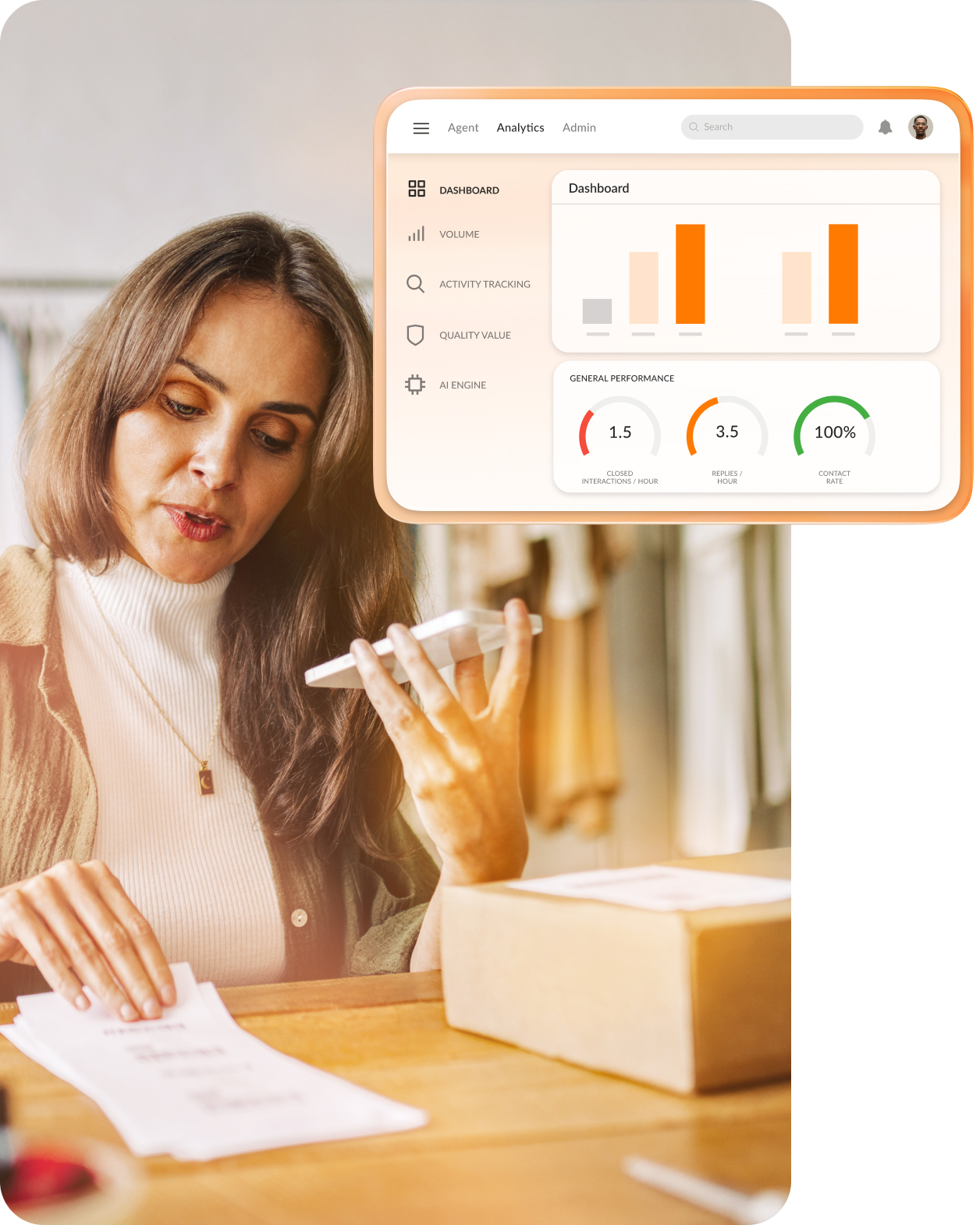
RingCX includes AI insights and analytics to help you improve customer experience across every stage of each interaction

AI call center tools make these optimizations easier to achieve and consistently implement. A unified solution ensures all interaction insights connect to customer and revenue data, such as sentiment and churn risk, helping your team mitigate risks and seize opportunities to strengthen customer relationships.

Metrigy’s 2025–26 AI for Business Success study shows that companies strategically using AI optimization tools see improvements between 20% and 32% across four key metrics: revenue growth, cost reduction, customer satisfaction (CSAT), and employee efficiency.

How to use call center KPIs to drive optimization

Tracking call center metrics is easy. Using them to improve performance is where most contact centers struggle. Here’s how to turn your KPIs and metrics into action.

Step 1: Map each KPI to an optimization lever

Instead of tracking metrics in isolation, connect them to specific operational improvements. Below are a few common contact center key performance indicators, what they reveal,  and how to use each one to optimize your call center.

Average handle time (AHT)

  • What it reveals: Inefficiencies during interactions
  • What to optimize:
    • Real-time agent assistance
    • Call routing accuracy
    • After-call work automation

First call resolution (FCR)

  • What it reveals: Whether customer issues are fully resolved
  • What to optimize:
    • Skill-based routing
    • Knowledge base accessibility
    • Agent coaching and training programs

Service level

  • What it reveals: Alignment between demand and staffing
  • What to optimize:
    • Forecasting accuracy
    • Scheduling adherence
    • Queue management

Customer satisfaction (CSAT) and customer effort (CES)

  • What it reveals: Experience quality and friction
  • What to optimize:
    • Consistency across agents and channels
    • Resolution speed and clarity
    • End-to-end customer journey design

Cost per contact

  • What it reveals: Operational efficiency
  • What to optimize:
    • Automation
    • Self-service options
    • Overall workflow efficiency

Step 2: Focus on relationships, not individual metrics

The most valuable insights come from how metrics interact. For example:

  • If AHT decreases while FCR drops, agents may be rushing customer support calls.
  • If service level improves while CSAT declines, agents might be prioritizing speed over quality.

Modern platforms with integrated analytics and AI help surface these relationships automatically so you can address root causes, not just symptoms.

Step 3: Build a KPI-driven optimization loop

To treat metrics as a continuous feedback loop rather than a static report:

  1. Measure performance across top KPIs
  2. Identify pain points and root causes
  3. Apply targeted improvements
  4. Track impact and refine

This cycle transforms raw data into a repeatable, scalable system for growth.

7 call center optimization strategies that drive measurable results

Call center optimization works best as a three-phase operating model that creates sustainable performance gains without disrupting service delivery. Instead of implementing isolated fixes that lead to new bottlenecks, the seven strategies below address root causes while building the infrastructure for ongoing refinement.

1. Diagnose demand and routing inefficiencies

Start by understanding where your operation actually breaks down. Analyze call volume patterns across time periods, channels, and customer segments to identify when and where demand exceeds capacity.

Look beyond averages by examining:

  • Queue abandonment rates
  • Follow-up requests
  • Repeat contacts
  • After-hours demand

Then, evaluate your routing logic:

  • Are high-value or urgent issues prioritized correctly?
  • Do complex customer inquiries get routed to agents with the right skills?
  • Where do transfers and escalations occur most often?

Modern platforms like RingCX include built-in analytics and AI that surface these patterns automatically, helping you move from reactive reporting to proactive improvement.

2. Align staffing with real demand patterns

Once demand is clear, align your workforce accordingly. Many contact centers rely on static forecasts that fail to reflect ongoing channel and time-period variability.

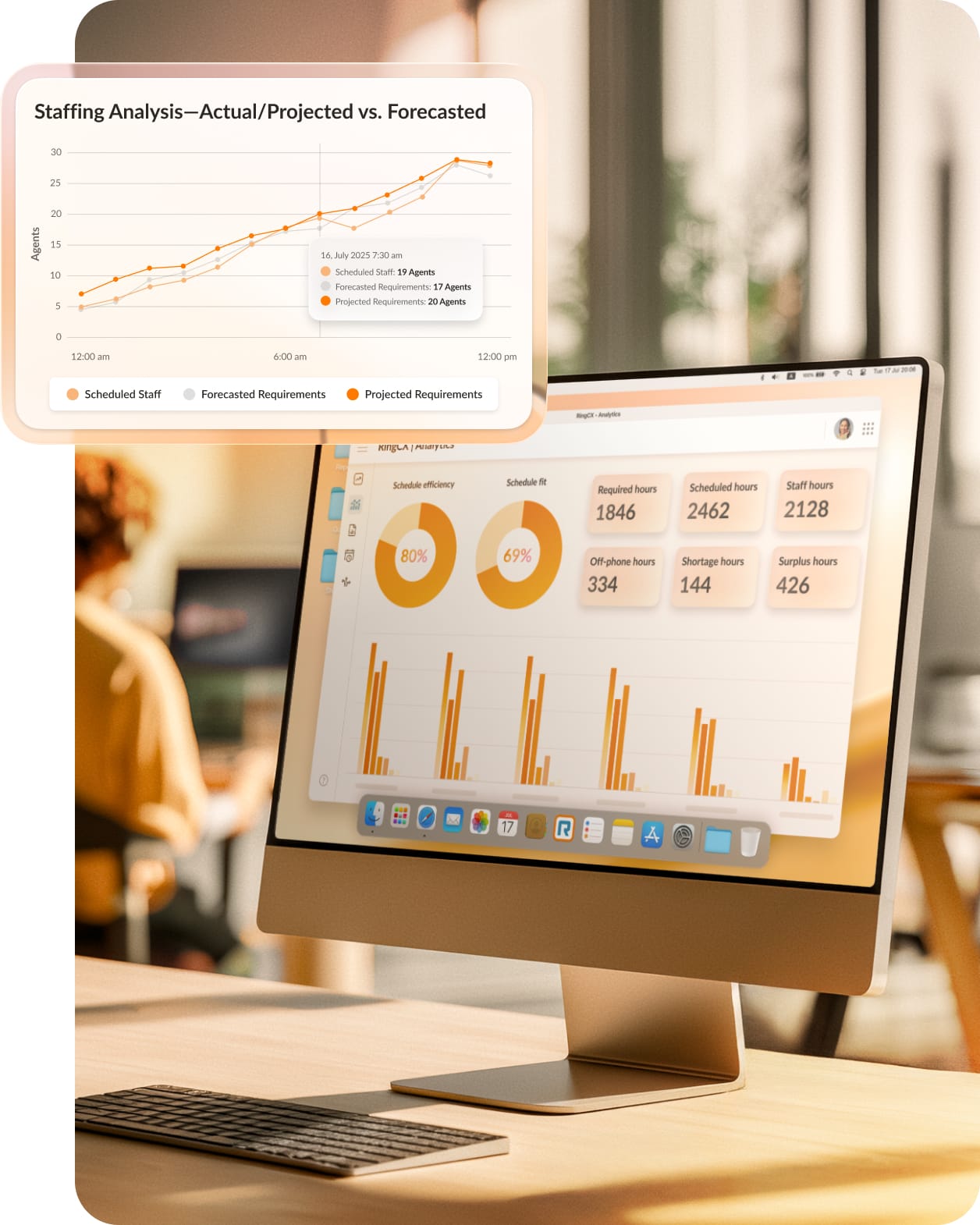
RingCX includes workforce management tools that forecast and track staffing needs

To improve staffing accuracy:

  • Use historical and real-time data to refine forecasts
  • Account for after-call work, training, and shrinkage—not just talk time
  • Adjust staffing levels based on live demand signals

The goal is to maintain service levels without overstaffing or driving agent burnout. When staffing aligns with actual demand, you stabilize performance across service level, occupancy, and cost per contact.

3. Standardize quality and coaching

Inconsistent execution is a primary driver of poor performance. Standardizing what “good” looks like and reinforcing it through coaching reduces unnecessary variation across agents and teams.

Focus on:

  • Clear quality standards across interaction types
  • Structured coaching frameworks tied to measurable behaviors
  • Consistent evaluation criteria across supervisors

AI-powered quality management can accelerate this process by analyzing every interaction and identifying coaching opportunities. This allows supervisors to provide targeted coaching that improves outcomes at scale.

4. Centralize knowledge and workflows

Call center agents can only perform as well as the systems that support them. When knowledge is fragmented or workflows require constant context switching, handle time increases and quality suffers.

To improve execution:

  • Centralize knowledge so agents can access accurate information instantly
  • Integrate systems so context flows across channels and interactions
  • Streamline workflows to reduce manual steps during and after calls

Platforms that unify communications, routing, and knowledge reduce friction for agents, helping them resolve issues faster and more consistently.

5. Automate quality monitoring and compliance

Traditional quality assurance relies on manual sampling, typically reviewing just 1% to 3% of customer interactions. This leaves significant blind spots, especially in regulated environments.

Automation changes this dynamic by allowing you to:

  • Analyze 100% of interactions across voice and digital channels
  • Detect compliance risks in real time
  • Identify patterns in agent performance and customer sentiment

McKinsey research indicates that the organizations that capture the most enterprise value from AI automation technology establish clear processes for where human validation is most critical. By using AI to surface the highest-risk interactions, call center leaders can focus their expertise on preventing issues before they escalate.

6. Use analytics to surface hidden inefficiencies

Metrics alone don’t reveal why performance issues occur. Advanced analytics and conversation intelligence provide deeper insight into what’s driving outcomes across your contact center.

Look for signals such as:

  • Repeated customer questions that indicate knowledge gaps
  • Interaction patterns that suggest routing inefficiencies
  • Sentiment trends that point to experience breakdowns

These insights can help you identify root causes and prioritize improvements that deliver the greatest impact.

7. Build a continuous optimization loop

The final step is turning optimization into an ongoing capability rather than a one-time project.

To close the loop between data, action, and outcomes:

  • Feed insights from analytics into routing, staffing, and agent training decisions
  • Continuously refine self-service and automation based on real interactions
  • Monitor performance in real time and adjust proactively

AI-powered platforms make this loop scalable by automatically identifying trends, recommending actions, and measuring impact across all interactions.

Essential call center optimization technology

Your technology stack determines whether optimization scales or stalls. When routing happens in one place, quality control in another, and workforce management somewhere else, you end up with fragmented data, slower decision-making, and inconsistent performance.

High-performing contact centers use an omnichannel contact center that connects every interaction, agent workflow, and performance metric in one place. To choose the right platform, look for these core capabilities and features.

Core capabilities

Your stack should work as a system, not a collection of tools. Start by seeking out the following capabilities:

  • Omnichannel routing: Distribute voice, chat, SMS, and email based on skills, availability, and context to reduce transfers and improve first contact resolution
  • Workforce management (WFM): Forecast channel demand accurately, optimize schedules and monitor real-time adherence, and adjust staffing dynamically based on actual conditions
  • Quality management (QM) and analytics: Evaluate 100% of interactions to detect coaching opportunities, compliance risks, and sentiment trends while using AI-driven insights to understand why outcomes happen
RingCX AI analyzes interactions and uses conversational intelligence to detect sentiment, questions, and resolutions

Integration is the key differentiator. When routing, WFM, and QM operate together, you can act on insights immediately instead of reconciling data across systems. RingCX brings these capabilities together to give you real-time visibility across performance, quality, and staffing without added complexity.

Enterprise call center requirements

At enterprise scale, your platform must integrate, secure, and perform without failure. That means your integrations and data flow must:

  • Connect seamlessly with CRM, BI, and business systems
  • Support real-time, bidirectional data exchange
  • Provide agents with comprehensive interaction context across every channel

At the same time, enterprise security and compliance requirements mean your platform needs:

  • End-to-end encryption and role-based access controls
  • Built-in support for frameworks like Payment Card Industry Data Security Standard (PCI DSS) and Health Insurance Portability and Accountability Act (HIPAA)
  • Clear audit trails and data residency controls

Reliable scaling is also essential. This can include:

  • High availability across distributed infrastructure
  • Automatic failover and redundancy
  • Proven uptime backed by SLAs

RingCentral supports these requirements with enterprise-grade security certifications and carrier-level reliability so your contact center can operate with confidence at scale.

90-day call center optimization roadmap

A structured 90-day roadmap transforms call center improvement and optimization from an abstract goal into a measurable, milestone-driven transformation. The following timeline balances quick wins that demonstrate immediate value with foundational changes that enable sustained improvement.

Days 1–30: Identify quick wins and eliminate inefficiencies

Before making changes, you need a clear picture of where time, effort, and demand are misallocated. In most contact centers, a small number of call types drive a disproportionate share of volume, and identifying these patterns early allows you to prioritize improvements that deliver immediate impact.

Begin by:

  • Analyzing call drivers, routing patterns, and repeat contacts
  • Identifying high-volume, low-complexity interactions
  • Deploying targeted self-service or automation options

Expected impact:

  • Reduction in handle time
  • Lower cost per contact
  • Improved customer effort scores

Days 31–60: Standardize execution and scale consistency

Once you understand demand, shift your focus to execution. The goal is to reduce variability to ensure every agent delivers consistent, high-quality outcomes.

Your plan should include:

  • Standardizing quality and coaching frameworks
  • Implementing workforce optimization and scheduling improvements
  • Expanding automation across routine workflows

Expected impact:

  • Improvement in first call resolution
  • Increased schedule adherence
  • Reduced manual QA effort

Days 61–90: Operationalize intelligence and continuous improvement

This phase is about turning insight into action. Instead of waiting for metrics to decline, continuously surface trends, identify risks, and adjust in real time.

To operationalize your data, focus on the following tasks:

  • Deploying conversation intelligence to uncover trends and root causes
  • Automating quality monitoring and compliance detection
  • Feeding insights into staffing, routing, and training decisions

Expected impact:

  • Reduction in quality review time
  • Improvement in customer satisfaction scores
  • Measurable gains in retention or revenue per interaction

Tie every initiative to measurable outcomes

Each phase builds on the last, but progress only matters if it’s measurable. Tying every initiative directly to a business outcome creates alignment across teams and ensures stakeholders can clearly see the impact of each change.

Track progress across:

  • Operational efficiency (AHT, cost per contact)
  • Customer experience (CSAT, FCR, CES)
  • Business impact (revenue, retention)

When you connect improvements to results, optimization becomes a repeatable, scalable capability.

Optimize every interaction, not just your metrics

Successful call center optimization strategies build a system that consistently delivers better outcomes. The most effective teams treat optimization as an ongoing discipline: continuously diagnosing demand, standardizing execution, and using real-time insights to refine performance across every interaction.

To put this into practice, start by aligning your call center operations around what drives results. Identify where demand, routing, and staffing are misaligned, connect your KPIs to specific operational changes, and invest in tools that unify routing, workforce management, and analytics. When these elements work together, you create a continuous loop where insight drives action and action drives measurable improvement.

RingCX makes this easier by bringing omnichannel routing, AI-powered quality management, and real-time analytics into a single system. Instead of stitching together tools, you get a unified view of every interaction so you can optimize call center performance at scale.

Explore how RingCX can help you streamline operations, improve agent performance, and deliver more consistent customer experiences without adding complexity.

Call center optimization FAQ

The fastest way to start call center optimization is to analyze your existing data before making any operational changes. Begin with analytics and observation: review call data, recordings, and performance trends to identify where inefficiencies exist. Focus on patterns in call volume, handle time, transfer rates, and customer satisfaction.
Most contact centers already have this data, so you can start immediately without disrupting service. This diagnostic phase typically takes two to three weeks and helps you prioritize improvements based on real impact, not assumptions.
​​The most important call center metrics for optimization are average handle time (AHT), first call resolution (FCR), and service level.
These metrics directly connect operational efficiency and agent productivity to customer outcomes at scale:
  • AHT shows how efficiently agents handle interactions
  • FCR indicates whether issues are fully resolved
  • Service level reflects how well staffing matches demand
Track these together, not in isolation. For example, if AHT decreases while FCR drops, agents may be resolving issues quickly without solving them entirely.
Also, monitor occupancy rate to avoid burnout, as sustained levels above 90% often lead to lower quality support and higher turnover rates.
Conversation intelligence and AI-powered quality management deliver the fastest impact for call center optimization. These tools analyze 100% of interactions across voice and digital channels, helping you identify performance gaps, compliance risks, and customer sentiment trends to enable more effective coaching and issue management.
With this visibility layer in place, you can expand into workforce optimization and automation with confidence, knowing where improvements will have the greatest impact.
Platforms like RingCentral support this approach by integrating conversation intelligence and quality management directly into the contact center so you can act on insights without adding complexity.

Smarter call center optimization starts here

Get real-time insights, automate workflows, and empower agents with RingCentral. Talk to an expert today.

Full name*

Enter a valid full name

Work email*

Enter a valid email address

Business phone number*

Enter a valid phone number

Company name*

Enter a valid company name

Number of employees*

Enter a valid number of employees

*Required fields
By clicking the button above, you consent to receiving calls and emails from RingCentral. Calls may be connected using automated technology.
Thank you for your interest in RingCentral
A sales advisor will contact you within 24 hours. If you'd like to speak to someone now, please call (800) 574 5290