Cloud contact center and call center software: Platforms, features, and how to choose
Discover how call center software helps you scale operations, surface real-time visibility, and build a single, unified customer experience.
What is cloud contact center software?
Cloud contact center software is a customer communications platform your vendor hosts and manages. You configure routing, channels, and AI workflows. They handle the servers, updates, and uptime.
Current platforms run on multi-tenant cloud infrastructure with native API connectivity and AI built directly into core workflows. Updates deploy automatically. Scaling up doesn't require hardware purchases or long procurement cycles.
For anyone evaluating call center software today, the architecture question is largely settled. The terms "cloud contact center software" and "call center software" point to the same category of modern, internet-delivered solutions. Knowing the architecture helps you ask sharper questions when comparing vendors.
Cloud contact center vs. on-premises call center software
On-premises contact center systems put your organization in charge of hardware, software licensing, and ongoing maintenance. For years, that was a selling point for teams that needed tight infrastructure control. Cloud platforms changed the calculus.
Cloud platforms shift that burden to the vendor. You get automatic updates, built-in disaster recovery, and the ability to add agents, channels, and capabilities without a capital expenditure cycle. Total cost of ownership typically runs lower, and deployment timelines shorter.
For most mid-market and enterprise teams, the evaluation question has moved past cloud vs. on-premises. The real question is which cloud platform fits your channel mix, compliance requirements, and growth plan.
What is call center software and how does it work?
Modern contact center software is a cloud platform that coordinates every inbound and outbound interaction your team handles across voice, digital channels, and AI-driven self-service. Instead of juggling separate tools for phone, chat, email, and analytics, you run everything through one orchestrated solution.
The platform connects your telephony and omnichannel capabilities to intelligent routing, agent desktops, and your existing business systems. Since leading call center software is cloud-based, you don't have to manage phone system hardware, such as on-premises dialers, interactive voice response (IVR) units, or reporting servers. Your provider hosts the infrastructure, and you access everything securely over the internet.
Call center software vs. contact center software
Call center software and contact center software are closely related, but they're built for different levels of engagement and customer relationship management.
Call center software focuses primarily on voice calls. It handles inbound and outbound phone interactions with tools like call routing, queues, call recording, and basic reporting.
Contact center software is designed for omnichannel customer engagement. In addition to voice, it supports channels like SMS, chatbots, email, and social messaging in a single agent workspace.
Modern contact center platforms also layer in AI-driven capabilities and integrations like agent performance analytics, customer relationship management (CRM) system connections, and intelligent routing.
What are the benefits of cloud contact center software?
When you move from legacy or fragmented systems to a modern cloud platform with embedded AI, four metrics typically move in the right direction: customer satisfaction, operational efficiency, agent retention, and compliance coverage. You'll typically see the following benefits:
- Increased customer satisfaction: Reduce wait times and improve the customer experience with consistent omnichannel communications, AI-powered self-service options, and intelligent routing.
- Improved operational efficiency: Better staffing forecasting, automated call summaries, and real-time agent assist reduce handle times and free agents from repetitive manual tasks.
- Better agent engagement and retention: A unified dashboard eliminates app switching and simplifies daily tasks. Agents who feel equipped and well-supported are far more likely to stay, keeping trained expertise in house.
- Stronger risk and compliance control: Centralized call recording, AI-driven quality assurance, and automatic policy enforcement give compliance teams full coverage. These tools flag violations automatically, reducing the manual effort required to review every interaction.
- Better visibility into what's working: Real-time and historical data help you spot emerging trends, fix systemic issues, and understand why customers are reaching out. Sentiment analysis and intent mapping go further than call volume counts alone.
What are the top features to look for in call center software?
To keep pace with rising customer expectations, you need a call center platform that can support your current volume and channels and has room to grow.
These five features consistently separate leading platforms from the rest:
1. Intelligent call routing and queue management
Intelligent routing and queue management determine how quickly customers reach the right resource.

Modern call center software should give you:
- Flexible routing strategies: Use skills-based, priority-based, and intent-based routing to direct contacts to your most capable agents.
- Queue management: Set rules for maximum wait times, callback options, overflow queues, and conditional transfers to protect service levels.
- Self-service options: Handle simple or after-hours requests via AI-powered IVR or virtual agents, with automatic handoff to live agents when needed — including full conversation context.
- In-depth analytics: Use real-time metrics and historical data to adjust routing logic and staffing based on live queue activity.
2. Real-time analytics and reporting dashboards
If you can’t see what’s happening in your contact center, you can’t control it.

When you evaluate call center software, look for:
- Live dashboards: View up-to-the-minute key metrics like average speed of answer (ASA), average handle time (AHT), and queue depth with the ability to drill down by team or site.
- Customizable reports: Tailor reports to your specific KPIs and share them with stakeholders across the business.
- Quality and interaction analytics: Analyze voice and digital interactions to reveal trends in topics, sentiment, and compliance.
- AI-assisted insights: Generate call summaries, detect keywords, and surface coaching recommendations to inform supervisors and development plans.
3. Omnichannel customer engagement capabilities
Your customers expect to reach you on the channel that’s most convenient for them. They also expect you to pick up the conversation where they left off, even if they switch channels.
This means your call center software should support:
- Voice plus digital channels: Manage phone, SMS, email, web chat, in-app messaging, and major social and messaging apps from a single agent desktop.
- Consistent routing across channels: Use a universal queue to prioritize interactions based on your business rules rather than the channel they arrive on.
- Context persistence: Maintain conversation history and customer data as customers move from self-service to a live agent or from one channel to another.
4. Workforce management and agent productivity tools
Workforce management and call center agent productivity tools are essential for running an efficient, resilient operation.
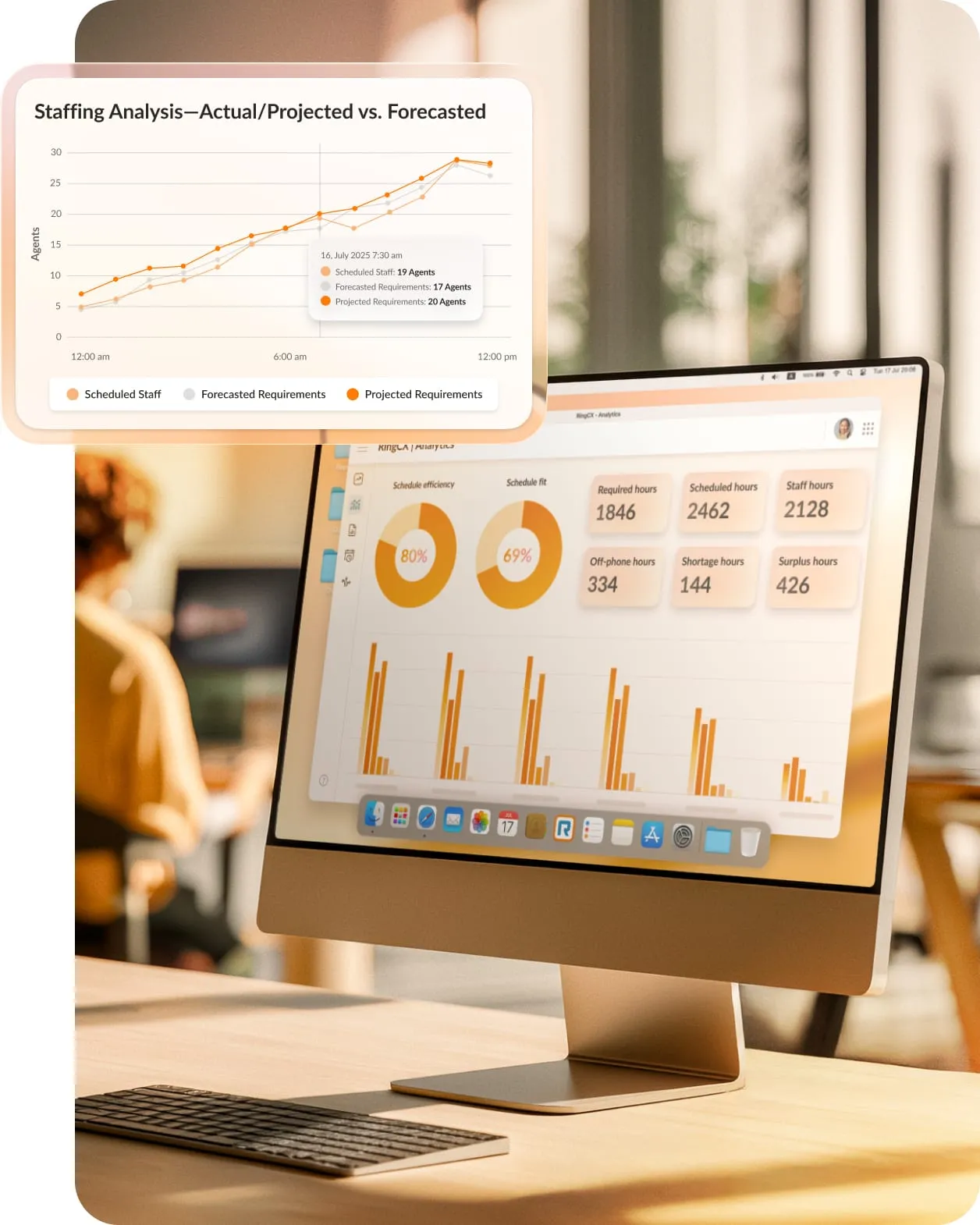
Key capabilities to look for include:
- Forecasting and scheduling: Use multi-skill scheduling and historical data to manage staffing needs, time-off requests, and shift bids.
- Real-time adherence: Monitor live views of agent schedule compliance and receive automatic alerts when adherence drops.
- Quality management: Use screen and call recording to tie performance data directly to agent training and development.
- Agent assistance: Use AI support for knowledge suggestions, script guidance, and automatic call summaries (dispositioning).
5. AI and automation capabilities
AI has become a core evaluation criterion, and the leading platforms build it into every interaction from the start.
Key capabilities to assess:
- Automated call summaries: After-call work drops when the platform handles documentation automatically, freeing agents to move to the next interaction faster.
- Virtual agents with intent detection: AI-powered IVR that interprets natural language and routes customers based on what they actually need, without requiring menu navigation.
- Real-time agent assist: In-the-moment guidance that surfaces relevant knowledge and next-best-action suggestions during live interactions.
- AI-driven QA scoring: Automated quality management across 100% of conversations, with no manual sampling and no coverage gaps.
Contact centers running AI-native platforms typically see reductions in after-call work and average handle times across the full agent population.
How to choose the best call center software for your business
The best call center solution is the one that aligns with your operating model, regulatory environment, and growth plans without locking you into rigid architectures or expensive custom work.
Here’s how to compare options objectively:
Assess your current needs and growth objectives
Start with where you are today and where you need to be. This clarity keeps you from overbuying features you won’t use or choosing a platform you’ll quickly outgrow.
Ask yourself:
- What’s your current split between voice and digital?
- Which channels are growing fastest and where are customers asking for options you don’t yet support?
- Where do customers typically get stuck?
- Are we struggling more with staffing, forecasting, quality, compliance, or reporting?
- What do supervisors say they can’t see or control?
- Which industry regulations apply?
- Which internal risk or security teams need to sign off?
- How will call volumes, geographies, languages, and business lines change over the next three to five years?
Use your answers to divide features into non-negotiables and nice-to-haves. For example, if you operate a small business where everyone helps with customer service, you might list AI-powered self-service as a non-negotiable so you can handle customer requests without adding staff.
Evaluate integrations, scalability, and support
Next, look beyond features and focus on how well each platform fits into your ecosystem and supports your long-term goals.
Ask yourself:
- Does the platform offer pre-built connectors and open APIs for our CRM, ticketing, billing, and custom apps?
- How easy is it to sync data bi-directionally so agents see a single source of truth?
- Can we add sites, queues, channels, and agents quickly without re-architecting?
- What service-level commitments does the vendor make?
- Does the provider meet our industry’s security and privacy requirements with clear documentation and audit support?
- Will we receive dedicated onboarding resources, migration assistance, and ongoing success management?
RingCentral tip: A unified platform often delivers the best combination of reliable support and low total cost of ownership. By using a single call center solution, you ensure your entire ecosystem remains supported without having to stitch together multiple apps via integrations or manual legwork.
Top call center and cloud contact center platforms compared
Choosing the right contact center platform requires research into your specific situation. The right fit depends on your current channel mix, compliance requirements, team size, and growth trajectory.
This comparison evaluates platforms across six criteria: omnichannel channel coverage, AI depth (built-in vs. added on), deployment speed, integration ecosystem, workforce management maturity, and total cost of ownership. Use it as a starting framework for your own evaluation.
1. RingCentral RingEX and RingCX
RingCentral offers a unified cloud communications platform designed for organizations that need enterprise-grade reliability with a strong emphasis on voice quality and AI-assisted experiences.
RingEX makes it easy to manage high-quality internal and external voice interactions. It supports essential call center capabilities like intelligent call routing, call queues, call recording, live monitoring, and comprehensive historical reporting, all within a single, cloud-based app.
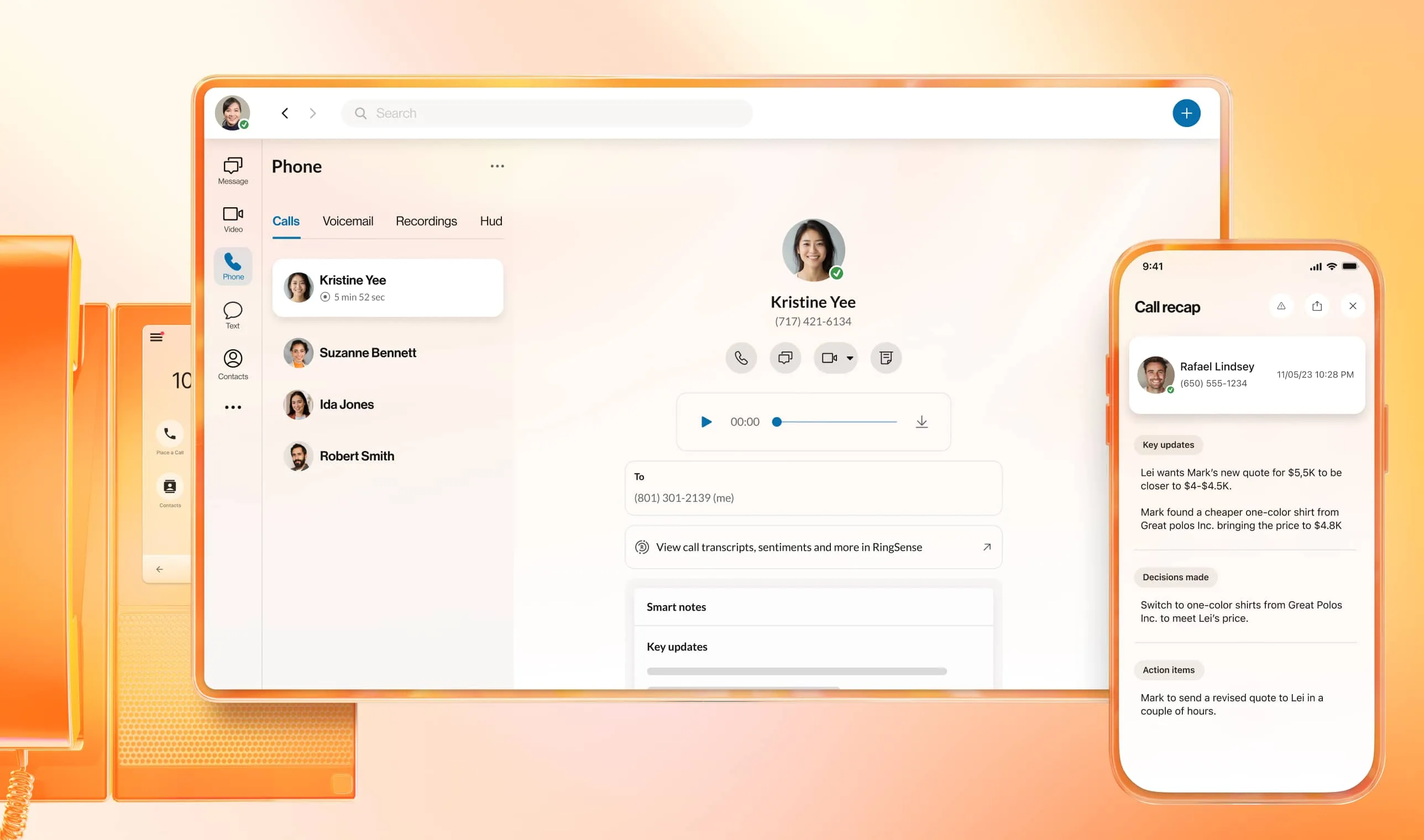
RingCentral’s AI-powered contact center platform, RingCX, supports omnichannel customer engagement at scale. It brings voice, SMS, chat, email, and social channels together in one agent workspace with intelligent routing, real-time analytics, and built-in workforce and quality management. The native AI automates routine interactions, coaches agents as they work, and uncovers insights from every conversation.

RingCentral also builds AI features directly into its platform:
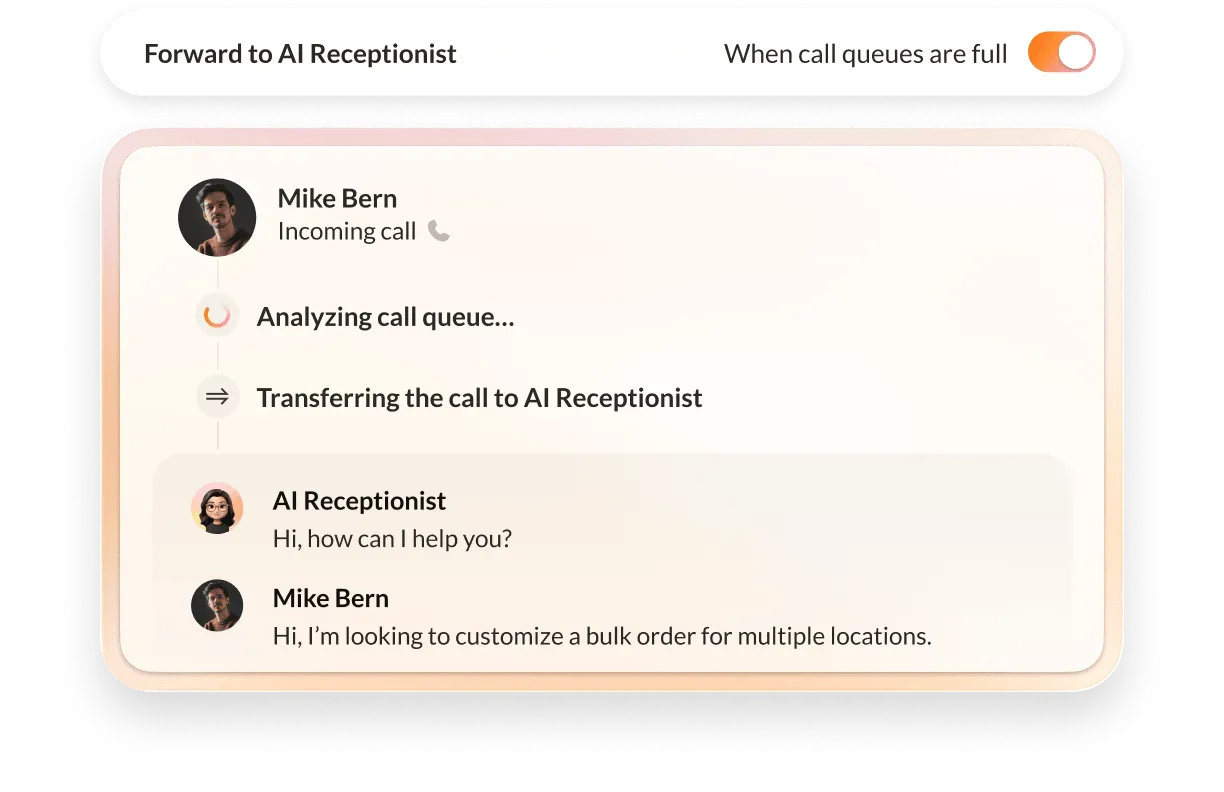
- AI Receptionist automatically answers and routes incoming calls, handles common questions, captures caller intent, schedules appointments, and seamlessly hands off conversations to live agents when needed.
- AI Conversation Expert analyzes customer conversations before, during, and after interactions to surface actionable insights. It automatically captures sentiment, intent, and key moments while providing in-the-moment guidance to agents and post-interaction summaries for managers.
- AI Virtual Assistant simplifies workflows and maximizes productivity with automated processes, real-time insights, and meeting transcriptions.
2. Genesys Cloud CX
Genesys Cloud CX is an enterprise-grade omnichannel platform with broad channel coverage and strong workforce engagement capabilities. It's a common fit for large-scale operations with complex routing requirements.
Key features:
- Wide omnichannel coverage across voice, email, chat, social, and messaging apps
- Advanced workforce management including forecasting, scheduling, and real-time adherence monitoring
- Broad open API ecosystem for enterprise tech stack integration
- Built-in journey analytics for tracking customer experience across interaction types
Keep in mind, Genesys Cloud CX’s implementation complexity for large enterprises may extend deployment timelines, and the licensing structure can lead to a higher total cost of ownership with increased feature usage and seat counts.
3. NICE CXone
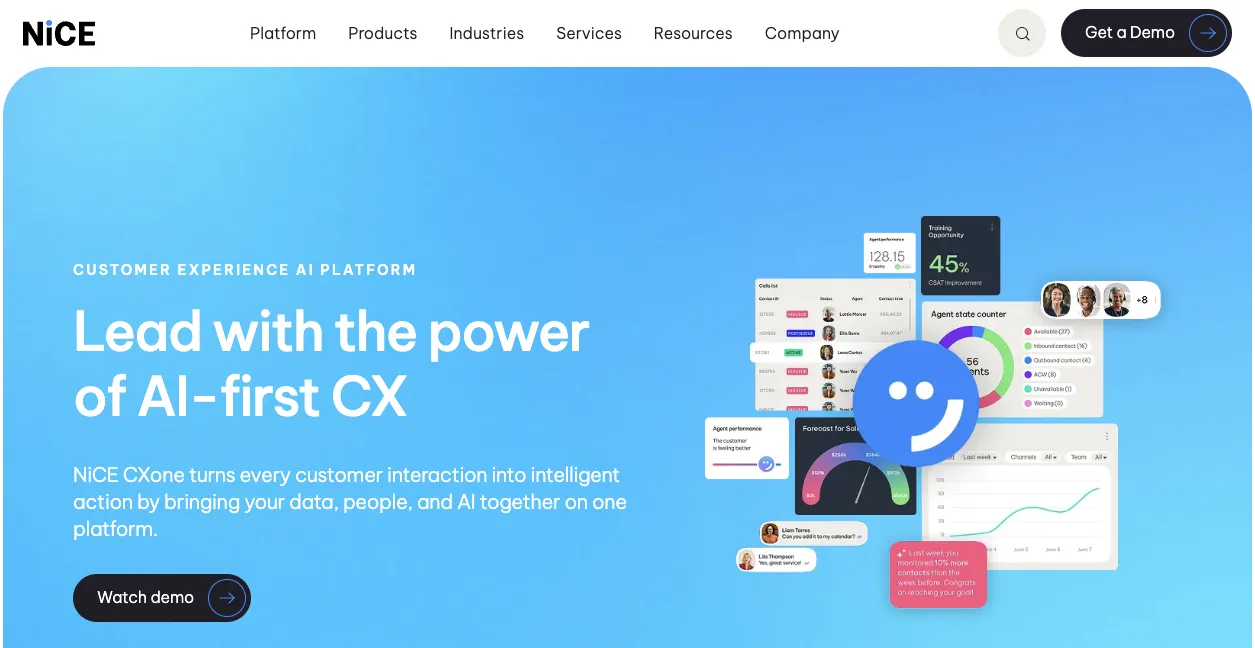
NICE CXone combines omnichannel routing with deep workforce engagement management and analytics. It has particular depth in compliance and quality management for regulated industries.
Key features:
- End-to-end workforce engagement management including forecasting, scheduling, and structured coaching workflows
- AI-powered analytics with sentiment analysis and interaction categorization at scale
- Strong recording and compliance capabilities for financial services and healthcare teams
- Unified reporting across all interaction types and channels
The platform's extensive breadth may create a steeper learning curve for administrators, so plan for ample training time and resources.
4. Talkdesk
Talkdesk is a cloud-native CCaaS platform with strong AI automation and pre-built vertical solutions for retail, financial services, and healthcare. It's well-suited for organizations that want fast deployment and customizable AI without requiring engineering resources.
Key features:
- AI Trainer lets contact center teams build and refine AI models without coding expertise
- Pre-built vertical packages for retail, financial services, and healthcare with relevant workflows included
- Strong self-service automation via intelligent virtual agents
- Fast implementation with an agent interface that requires minimal onboarding
Access to some enterprise-scale features requires higher-tier plan upgrades, and integration with certain legacy CRM systems may necessitate additional configuration.
5. Five9
Five9 is a cloud contact center platform with strong inbound and outbound capabilities. It's a common fit for sales-focused teams with high outbound call volume, known for its predictive dialer tooling and CRM integration depth.
Key features:
- Proven predictive dialer and outbound automation for high-volume sales teams
- Pre-built integrations with Salesforce, ServiceNow, and major CRM platforms
- Reliable omnichannel routing with skills-based and priority-based options
- Compliance tooling for the Telephone Consumer Protection Act (TCPA) and General Data Protection Regulation (GDPR) outbound calling requirements
The platform's interface is considered less modern than other cloud alternatives, and its AI capabilities may not be as robust as those in platforms built AI-first.
6. Dialpad
Dialpad is an AI-driven communications platform combining business phone and contact center in one solution. It's built for teams that want real-time AI assistance without complex enterprise rollouts.
Key features:
- Real-time AI transcription and agent coaching built into every call by default
- Fast, clean interface with a short onboarding curve
- Tight UCaaS and CCaaS integration for teams that want both on a single platform
- Pricing positioned for small business and mid-market teams
The platform's workforce management capabilities and omnichannel depth across social and messaging channels are less mature compared to dedicated enterprise-focused CCaaS solutions.
7. Nextiva
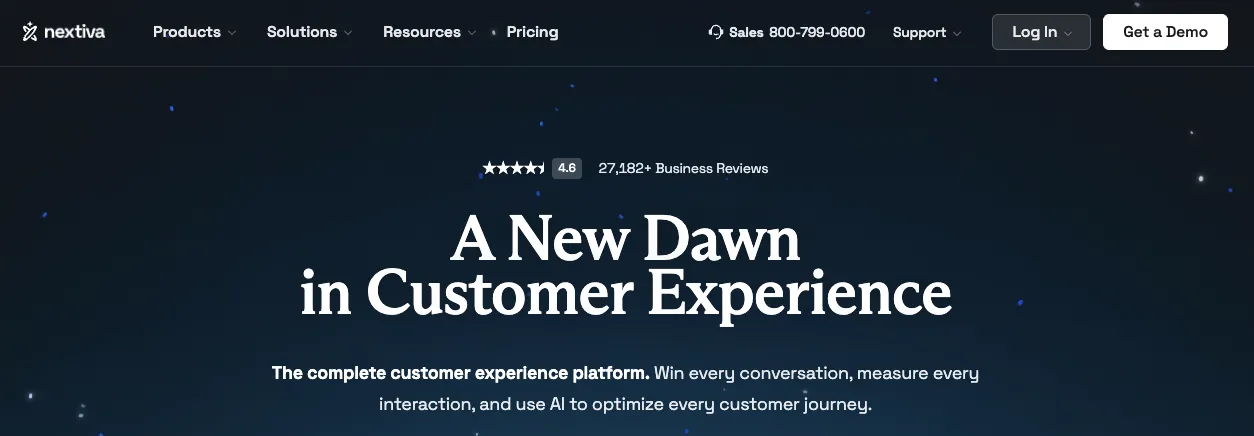
Nextiva combines UCaaS and CCaaS in a single platform, focused on simplifying the communications stack for mid-market organizations. It's a strong option for teams that want a business phone and contact center from one vendor.
Key features:
- Tight integration between UCaaS and contact center features in a single admin console
- Strong uptime track record and voice call quality
- Customer journey tracking across voice and digital interactions
- Accessible pricing structure for mid-market teams
The contact center feature depth is less extensive than dedicated CCaaS platforms, and advanced omnichannel routing for complex enterprise use cases may require supplemental tools.
8. Webex Contact Center
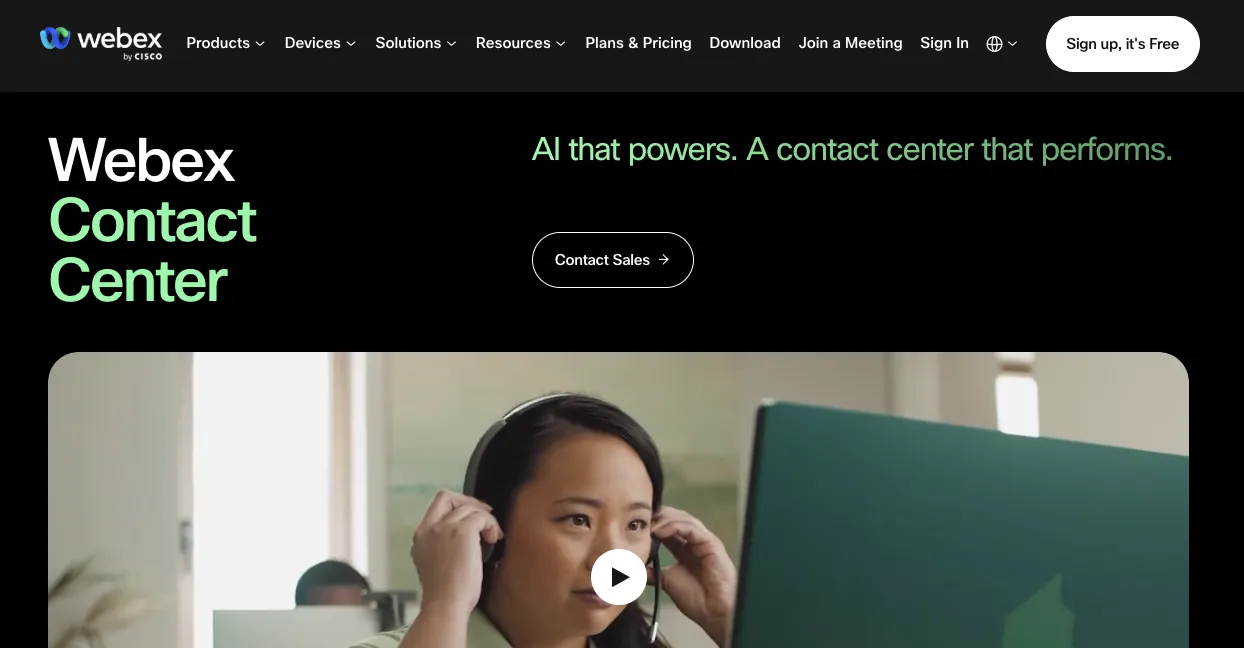
Webex Contact Center is Cisco's cloud CCaaS platform, combining enterprise-grade security with AI-assisted agent tools. It's a natural fit for organizations already running on Cisco infrastructure or with strict compliance documentation requirements.
Key features:
- Enterprise-grade security and compliance backed by Cisco's infrastructure and certifications
- Native integration with Webex collaboration tools for unified internal and external communications
- AI-powered agent assistance and automated call transcription
- Multi-region deployment options for global operations
Teams not already utilizing the Cisco ecosystem may face a more complex integration setup, and the platform's breadth can result in longer initial configuration timelines.
9. Twilio Flex
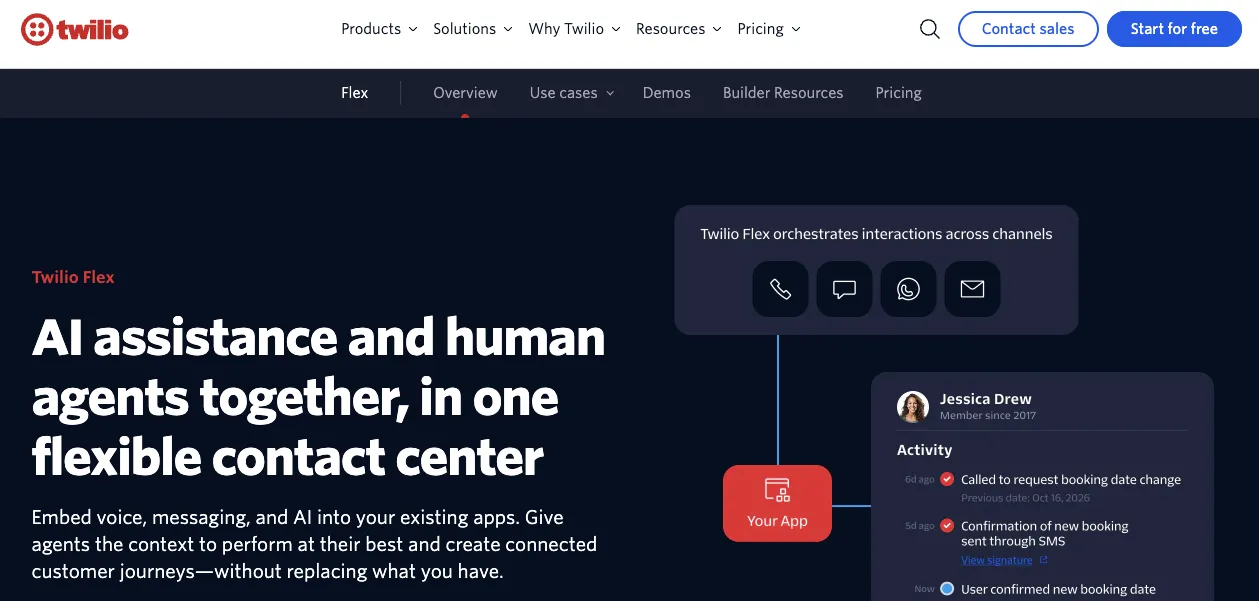
Twilio Flex is a programmable contact center platform that gives development teams full control over the agent interface, routing logic, and channel integrations. It's built for organizations with custom requirements that off-the-shelf platforms can't address.
Key features:
- Complete customization of the agent workspace, routing logic, and UI components
- Broad API library for connecting to any CRM, ticketing, or data system
- Pay-per-use pricing that scales with actual usage
- Active developer community with extensive documentation and pre-built components
Realizing the platform's full value requires dedicated engineering resources, which can make ongoing platform management challenging for non-technical teams, and custom builds often carry maintenance overhead as the underlying platform updates.
10. 8x8
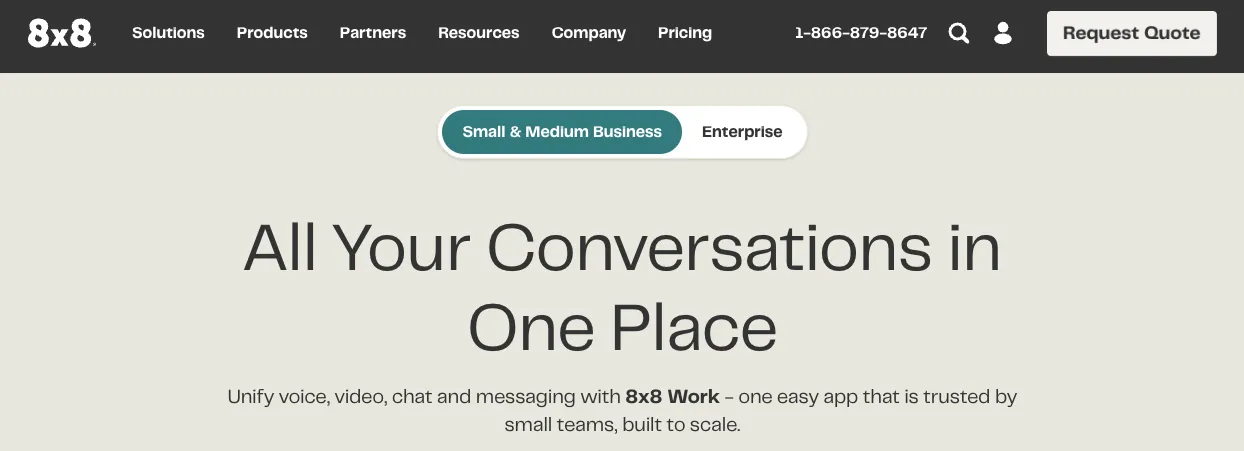
8x8 is a cloud communications platform that integrates UCaaS, CCaaS, and analytics in one solution. It's positioned for mid-market organizations looking to consolidate voice, messaging, video, and contact center under one vendor.
Key features:
- True UCaaS and CCaaS integration with unified administration and billing
- Global Public Switched Telephone Network (PSTN) coverage for organizations with international teams or customer bases
- Real-time and speech analytics across all interaction types
- Built-in video and team messaging alongside contact center capabilities
The contact center's AI capabilities are less mature than dedicated CCaaS-first platforms, and some users note that the feature depth can feel shallower compared to best-of-breed CCaaS alternatives in specific areas.
What is the business impact of modern call center software?
The business case for modern call center software comes down to four measurable areas: first-call resolution, average handle time, agent retention, and compliance. Each one has quantifiable benchmarks, and each one is where platform choice directly moves the number.
First-call resolution (FCR)
The metric most directly tied to customer satisfaction, SQM Group’s industry benchmarks put 70-79% FCR in the "good" range and 80%+ in world-class territory.1
Every percentage point matters: an FCR improvement of five points typically translates to a meaningful reduction in repeat contacts, which cuts handle volume without adding staff. The platforms driving those gains share one characteristic: real-time agent guidance that helps agents resolve more on the first attempt.
Average handle time (AHT)
AI automation creates the most immediate, measurable impact on average handle time (AHT).
Automated post-call summaries alone reduce after-call work time. When agents aren't manually writing notes and updating records after every conversation, AHT drops and capacity increases. AI self-service deflects routine inquiries, keeping AHT lower across the full queue.
Agent retention
Retention is a cost that rarely shows up clearly on a spreadsheet, but contact center leaders feel it acutely.
Industry data consistently puts annual contact center agent turnover between 40% and 45%, and shows that replacing an agent costs up to $46,000 when you factor in recruiting, onboarding, and lost productivity.2
Platforms that reduce daily friction (unified dashboards, real-time AI assist, clear performance coaching) typically show improvement in agent satisfaction scores and retention rates.
Compliance and risk management
These are non-negotiables for regulated industries. AI Quality Management tools that score 100% of interactions give compliance teams the coverage they need without adding headcount to the QA function. Automated flagging of policy violations catches issues before they become incidents.
How RingCentral powers your cloud contact center and call center operations
Running a cloud contact center means coordinating voice, digital channels, agent performance, and compliance in one architecture, without adding vendor sprawl. RingCentral's platform connects UCaaS and CCaaS to meet that need, giving contact center teams unified tooling across every customer channel.
RingEX handles high-quality internal and external voice interactions with the essential contact center capabilities teams need: intelligent call routing, call queues, call recording, live monitoring, and comprehensive historical reporting, all within a single, cloud-based app.
For omnichannel customer engagement at scale, RingCX brings voice, SMS, chat, email, and social channels together in one agent workspace with intelligent routing, real-time analytics, and built-in workforce and quality management. AI runs natively across every interaction.
RingCentral builds AI capabilities directly into the platform:
- AI Receptionist automatically answers and routes incoming calls, handles common questions, captures caller intent, schedules appointments, and transfers conversations to live agents when needed.
- AVA Agent Assist surfaces relevant knowledge and next-best-action suggestions to agents during live interactions, reducing search time and improving first-call resolution.
- AI Quality Management scores 100% of interactions automatically, with no manual sampling required and no coverage gaps for QA teams.
Choosing the right cloud contact center and call center software
Choosing cloud contact center and call center software is a long-term commitment to how your business responds to customers and keeps pace with their expectations. The platform you select should help you meet today's SLAs and compliance obligations while remaining flexible enough to evolve as customer expectations, regulations, and your own operating model change.
RingCentral combines enterprise-grade reliability with voice-first AI built into the platform. By bringing RingEX and RingCX together with a growing set of AI capabilities, you can modernize customer engagement without sacrificing stability or managing disconnected tools.
If you're ready to see how this could work in your environment, bring your requirements, use cases, and constraints to a conversation with us. We'll help you build a clear business case that connects your contact center needs to your broader business goals.
Sources
1. SQM Group. "First Call Resolution (FCR): A Comprehensive Guide." SQM Group, https://www.sqmgroup.com/resources/library/blog/fcr-metric-operating-philosophy.
2. Insignia Resources. "Call Center Turnover Rates: 2026 Industry Average." Insignia Resources, April 22, 2026, https://www.insigniaresource.com/research/call-center-turnover-rates/.